The years kept moving.
They always do.
The people who once seemed enormous become photographs.
The houses change hands.
The furniture disappears.
The voices you remember become harder to hear.
But certain lessons become clearer.
Our family story had started with a wedding.
At least, that was where I thought it had started.
It hadn't.
It had started with two researchers trying to understand disease.
It had started with a woman being told she carried a risk she did not fully understand.
It had started with a child losing a parent.
It had started with my mother losing my father.
It had started with fear.
By the time Claire and I met, we were simply the next generation standing in its path.
That realization changed how I remembered everything.
My mother had not invented her fear.
She had inherited it.
Claire's mother had not invented her uncertainty.
She had lived inside it.
My father had not solved it.
He had spent his career trying to explain it.
And we had not escaped it.
We had learned to live with it differently.
One afternoon, I visited the old research foundation alone.
The building looked different.
The original sign was gone.
The lobby had been renovated.
But the hallway still smelled faintly of paper and old carpet.
I stood outside the room where my father used to work.
The door was closed.
A younger researcher walked past me.
“Can I help you?”
“I used to know someone who worked here.”
“Who?”
“My father.”
I gave his name.
The researcher checked the system.
“He's in the historical archive.”
I smiled.
“Of course he is.”
The researcher showed me the collection.
My father's work had become part of a broader medical history.
There were later studies.
New findings.
Corrections.
Developments.
His work had not become a monument.
It had become part of a conversation.
That pleased me more than I expected.
Science was supposed to continue.
No one person's work was supposed to be the final word.
I sat in the archive and read several summaries.
Some of my father's conclusions had been supported.
Others had been refined.
Some had become outdated.
None of that diminished him.
It made his work human.
When I returned home, Claire asked how it went.
“He was right about some things.”
She smiled.
“And wrong about some?”
“Yes.”
“Good.”
I laughed.
“Good?”
“It means the research continued.”
She was right.
We had spent years learning that being wrong did not make someone worthless.
My father could be wrong.
My mother could be wrong.
I could be wrong.
Claire could be wrong.
Our child could be wrong.
What mattered was whether we were willing to learn.
That became one of the quiet foundations of our family.
Nobody was required to be right all the time.
Everyone was required to be honest when they were wrong.
It sounded simple.
It was not.
A few months later, our child called.
“I need advice.”
“What happened?”
“Nothing terrible.”
That was the first relief.
Then came the question.
“Someone in my life is worried about a health issue, but they don't want to tell anyone.”
I became very still.
I knew the shape of that story.
“What do they want you to do?”
“They want me to keep it secret.”
“What do you think?”
“I don't know.”
“Then don't decide yet.”
There was silence.
“What should I do?”
“Listen. Encourage them to talk to the right person. Don't make promises you can't keep. And don't turn someone else's private information into something everyone gets to know.”
“Okay.”
I thought about my mother.
How strange that the lesson had returned through another generation.
Not as a family tragedy.
As a question.
That was how I wanted the past to work.
Not repeating itself.
Teaching us.
Our child called again the next day.
“I talked to them.”
“How did it go?”
“They agreed to get help.”
I exhaled.
“Good.”
“But I was scared.”
“That's okay.”
“I almost tried to control the situation.”
I smiled.
“That sounds familiar.”
“Dad.”
“I know.”
We laughed.
Then our child said, “I understand Grandma a little more now.”
“So do I.”
“But I still think she should have told you.”
“She should have.”
That answer remained unchanged.
Understanding did not require rewriting the past.
Years later, when our child had children of their own, the family archive became a place where the younger generation asked questions.
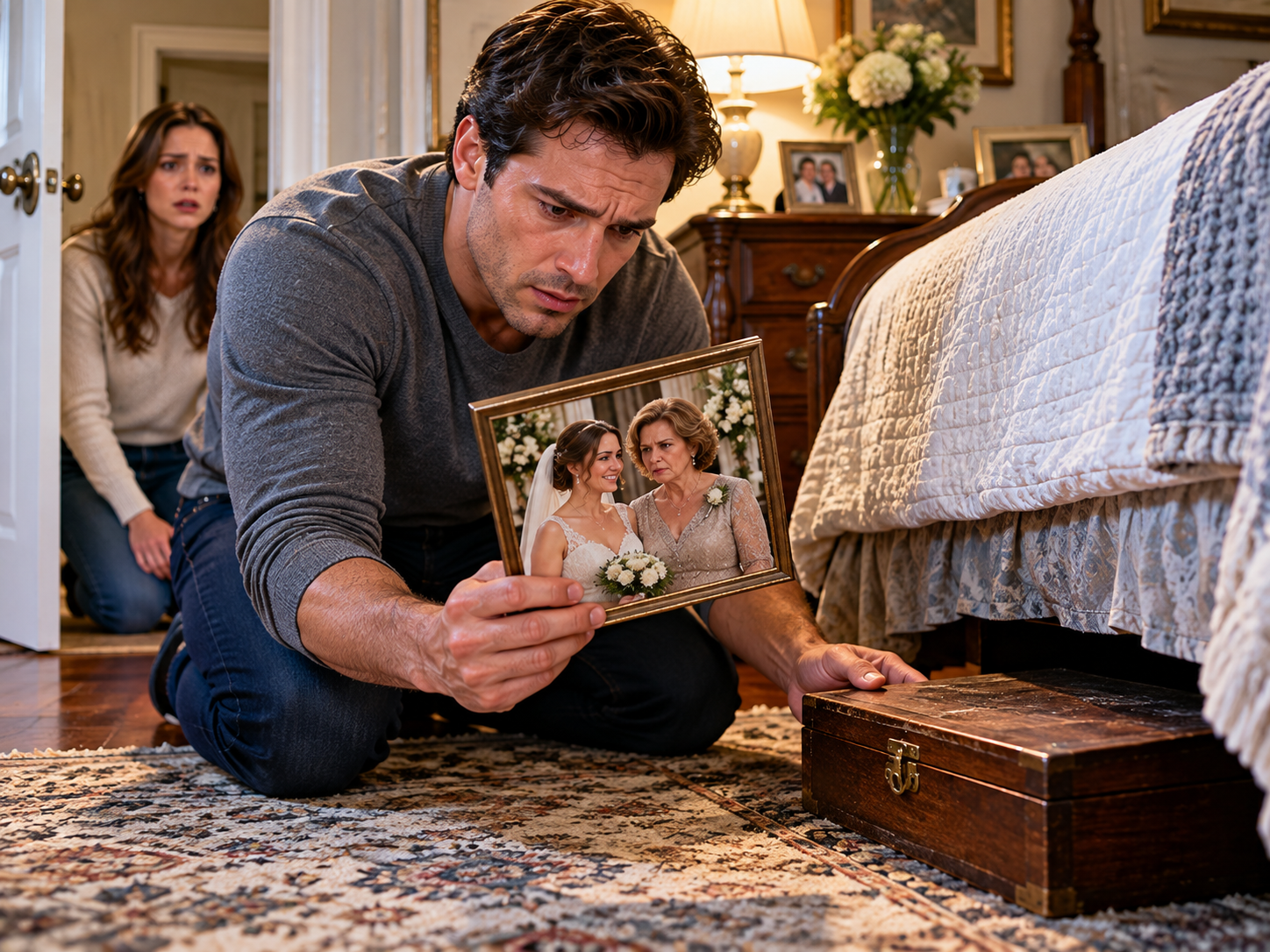
The wedding photograph remained.
The second photograph remained.
The wooden box remained with our child.
My father's manuscript remained protected.
Claire's mother's letter remained carefully stored.
My mother's final letter remained.
But the children did not treat these things as sacred.
They treated them as history.
They asked questions.
They laughed at old hairstyles.
They pointed at my father's clothes.
They made fun of my wedding suit.
They asked why Grandma looked so serious.
And we told them.
Not every detail.
Not private medical information.
Not things that belonged to people who were gone and could no longer consent.
But enough.
Enough to understand.
One day, one of the younger children asked, “Was Grandma bad?”
I smiled.
“No.”
“Was she good?”
I thought about it.
“Yes.”
“Then why did she make mistakes?”
“Because good people make mistakes.”
“Why?”
“Because people are complicated.”
The child considered this.
“Am I complicated?”
“Very.”
Everyone laughed.
That was how the family story survived.
Not as a warning.
As a conversation.
The original title of the story had once sounded simple in my mind.
My mother never liked my wife.
But after all these years, I understood how incomplete that sentence was.
She had disliked something she believed Claire represented.
She had feared a future she could not control.
She had confused risk with certainty.
She had tried to protect me.
She had hurt Claire.
She had loved us.
All of those things were true.
The sentence had never been false.
It had simply never been enough.
One evening, Claire and I sat on the porch.
We were older.
Our hair had changed.
The house was quieter.
The younger generation had gone home.
Claire looked at me.
“Do you ever wish we had never found the box?”
I thought about it.
“No.”
“Not even once?”
“No.”
“Why?”
“Because without it, I might have spent my life believing the wrong story.”
She nodded.
“And with it?”
“I learned a better one.”
Claire smiled.
“What story?”
I looked at her.
“That fear can disguise itself as love.”
She waited.
“And love can survive being misunderstood.”
She nodded.
“And truth can arrive late without becoming useless.”
Her eyes softened.
“And?”
I smiled.
“And sometimes the person you think is standing against your marriage is actually standing behind it badly.”
Claire laughed.
“That sounds exactly like your mother.”
“It does.”
We sat together until the sun disappeared.
No secrets.
No boxes.
No hidden reports.
Just two people who had spent a lifetime learning what their parents had struggled to teach them.
The story had not ended because everything had been solved.
It had ended because we no longer needed every answer to live honestly.
That was the difference.
My mother had needed certainty.
We had learned to live with truth.
And truth was sometimes incomplete.
Sometimes painful.
Sometimes inconvenient.
Sometimes beautiful.
But it was ours.
Click here to continue reading: PART 20: The Secret Under the Bed Was Never About Who My Mother Wanted Me to Love; It Was About Whether Fear Would Control Us After She Was Gone
My Mother Warned Me Before the Wedding, Yet Two Years Later Her Empty House Held a Secret She Had Never Trusted Me Enough to Reveal
Part 19 of 20