
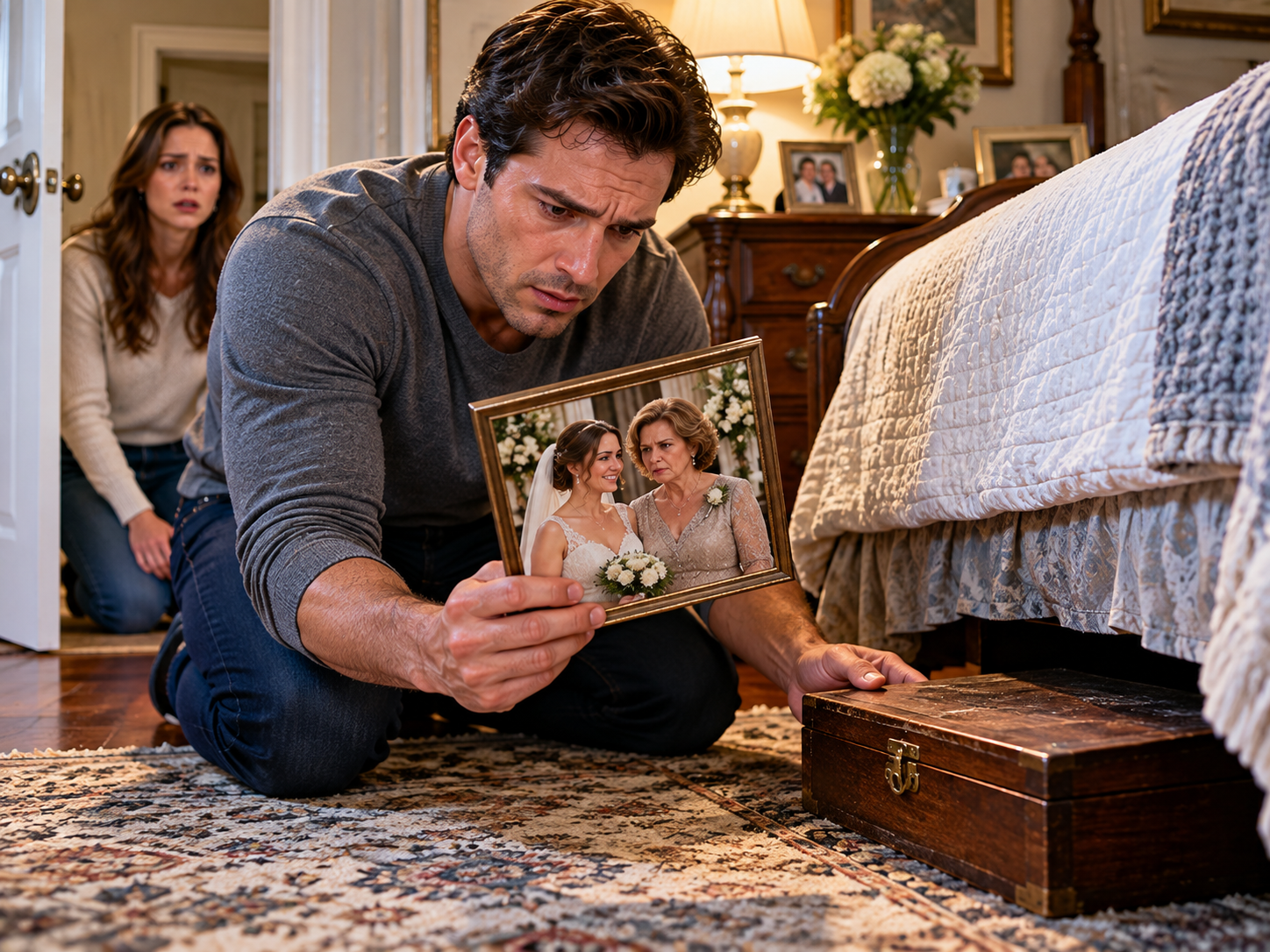
The house was quiet after everyone had gone to sleep.
I was standing in the archive room, looking at the two photographs on the wall.
My mother beside Claire’s mother.
My mother beside Claire.
Two moments separated by years.
Two women connected by a story none of us had understood when it mattered most.
I had thought finding the second photograph would close the final door.
Instead, it opened another.
Our child was older now.
Old enough to understand the difference between family history and family mythology.
Old enough to ask questions that could not be answered with a simple sentence.
And one evening, while we were putting away dishes after dinner, that question finally came.
“What are we supposed to pass on?”
I looked at Claire.
She knew immediately what our child meant.
Not money.
Not furniture.
Not photographs.
The question was about everything else.
The fear.
The medical history.
The letters.
The lessons.
The mistakes.
I dried my hands and sat down.
“What do you think we should pass on?”
Our child shrugged.
“I don't know. That's why I'm asking.”
Claire pulled out a chair.
“Then maybe we start with what we don't want to pass on.”
Our child smiled.
“Grandma’s secrets?”
I laughed.
“Yes.”
“But Grandma wasn't bad.”
“No,” I said. “She wasn't.”
“Then why don't we want to pass on her secrets?”
“Because secrets can become heavy when people are forced to carry them alone.”
Our child thought about that.
“What about fear?”
I nodded.
“Especially fear.”
We had spent years learning how easily fear traveled through families.
Sometimes it traveled through words.
Sometimes through silence.
Sometimes through behavior.
Sometimes through a parent looking at a child with such concern that the child began believing there must be something wrong with them.
My mother had not intended to give me fear.
She had intended to give me protection.
But intention and consequence were not the same thing.
That was one of the hardest lessons I had learned.
Our child leaned back.
“So what do we pass on?”
“Truth,” Claire said.
I smiled.
“Truth, when we know it.”
“And uncertainty when we don't,” Claire added.
Our child nodded.
“That sounds less exciting.”
“It can be,” I said.
They laughed.
Then they became serious again.
“Do you think Grandma would understand?”
I looked toward the hallway.
“I think she would understand more now than she did then.”
“That's not what I asked.”
I smiled.
“No. I don't think she would understand everything.”
That answer seemed to satisfy them.
The next morning, I opened the family archive.
I had not planned to change anything.
But after that conversation, I felt the need to add a new section.
Not another collection of documents.
A record of principles.
I called it *What We Learned.*
The first sentence was simple.
Medical information should be shared with the person whose life it concerns.*
The second followed.
Risk should never be described as certainty.*
The third was harder.
Love does not give us permission to control another person's choices.*
Claire read the page over my shoulder.
“You're making rules again.”
“Family guidelines.”
“That's just a nicer name for rules.”
I laughed.
She pointed to the fourth sentence.
“What about that one?”
I had written:
If we are afraid, we should say we are afraid instead of pretending fear is a fact.*
Claire nodded.
“Keep it.”
Our child read the page later.
“Are these Grandma's rules?”
“No.”
“Dad's?”
“Not exactly.”
“Mom's?”
Claire shook her head.
“They're ours.”
Our child thought about it.
“Can I add one?”
“Of course.”
They took the pen.
Under our four sentences, they wrote:
Ask before assuming.*
I stared at it.
Claire smiled.
“That might be the most important one.”
I nodded.
It was.
My entire relationship with my mother could almost be described as a chain of assumptions.
She assumed I would not understand.
I assumed she hated Claire.
Claire assumed she would never accept her.
My father assumed better explanations would eventually change medical practice.
Claire's mother assumed her daughter would be safer if she understood less.
Everyone had reasons.
Everyone had fears.
Everyone made assumptions.
And those assumptions became walls.
Our child had reduced the entire lesson to three words.
Ask before assuming.
We kept them.
Years later, that page would become more important than most of the documents in the archive.
Not because it contained scientific information.
Because it contained the reason the scientific information had mattered in the first place.
People needed to know how to live with it.
One afternoon, Claire asked me to help her scan the old letters.
We worked side by side.
The scanner hummed.
Pages moved beneath the glass.
My mother's handwriting appeared on the screen.
Claire's mother's handwriting appeared beside it.
My father's notes appeared next.
For a while, we said nothing.
Then Claire asked, “Do you think they would recognize this family?”
I looked around.
The shelves.
The photographs.
The children's drawings.
The medical files.
The wooden box.
The old research papers.
“I think they'd recognize parts of it.”
“And the rest?”
“We're the rest.”
She smiled.
That sentence stayed with me.
We were not merely preserving their story.
We were continuing it.
But continuing did not mean repeating.
That was the difference.
My parents had lived with a generation that often treated medical information as something discussed in private.
We had learned to discuss it openly.
They had feared uncertainty.
We had learned to name it.
They had tried to protect children from difficult truths.
We had learned that children deserve age-appropriate honesty.
They had carried fear silently.
We had learned to speak.
That was how families changed.
Not through dramatic declarations.
Through small choices repeated over years.
One evening, our child brought home a school assignment about family traditions.
“Do we have any?”
“Of course,” Claire said.
“Like what?”
I started counting.
“Sunday breakfast.”
“Your mother's terrible habit of keeping old receipts,” Claire added.
I looked at her.
“That was not a tradition.”
“It absolutely was.”
Our child laughed.
“What else?”
“Keeping photographs.”
“Talking about medical history.”
“Making sure everyone knows where important documents are.”
“That one sounds boring.”
“It saves time when you're older.”
Our child rolled their eyes.
Then they asked, “What about Grandma?”
I looked at the wedding photograph.
“She is part of the tradition too.”
“What tradition?”
“Trying to do better than the generation before us.”
That answer surprised even me.
Claire smiled.
Our child wrote it down.
I watched the pen move across the page.
For years, I had thought legacy meant preserving what came before.
Now I understood that legacy could also mean refusing to repeat it.
The next month, we visited the research foundation again.
Martin had retired fully by then.
But he had agreed to meet us for lunch.
He was older and slower, but his memory remained sharp.
When we showed him the second photograph, he stared at it for a long time.
“I remember this day,” he said.
“You do?”
“Yes.”
“What happened?”
He smiled.
“Nothing dramatic.”
That answer made me laugh.
“Nothing?”
“Your father was arguing with someone about a report. Your mother brought food. Claire's mother complained that your father was impossible.”
Claire laughed.
“That sounds familiar.”
Martin pointed at the photograph.
“They all looked happy.”
I looked at the picture.
“They were.”
“Then remember that too,” he said.
It was good advice.
We had spent years examining the painful parts of the story.
The warnings.
The secrecy.
The fear.
But there had also been ordinary happiness.
My father laughing.
Claire's mother smiling.
My mother bringing food.
People working.
People living.
Not every moment had been a clue.
Some moments had simply been life.
On the drive home, Claire said, “I think we were obsessed with finding meaning.”
“Maybe.”
“Sometimes a photograph is just a photograph.”
I smiled.
“Look who's teaching me now.”
She laughed.
“Someone has to.”
That night, I placed the second photograph beside the first.
For the first time, I did not see a beginning and an ending.
I saw a continuation.
My mother had met Claire's mother.
Then Claire became part of our family.
Then our child was born.
Then another generation began asking questions.
The story kept moving.
The photographs changed.
The people changed.
The lesson remained.
Do not let fear decide what truth belongs to someone else.
I turned off the light.
The archive room went dark.
But I knew the photographs were still there.
Not hidden.
Not forgotten.
Waiting for whoever came next.
Click here to continue reading: PART 18: The Day Our Child Became an Adult, I Gave Them the Wooden Box and Realized Protection Meant Letting Go
My Mother Warned Me Before the Wedding, Yet Two Years Later Her Empty House Held a Secret She Had Never Trusted Me Enough to Reveal
Part 17 of 20

