The house where my mother had lived was eventually sold.
For a long time, I thought I would never be ready to let it go.
Every room carried a memory.
The hallway where I had waited for her to finish getting ready.
The kitchen where she had complained that I never called enough.
The living room where she had sat quietly during the weeks after my wedding.
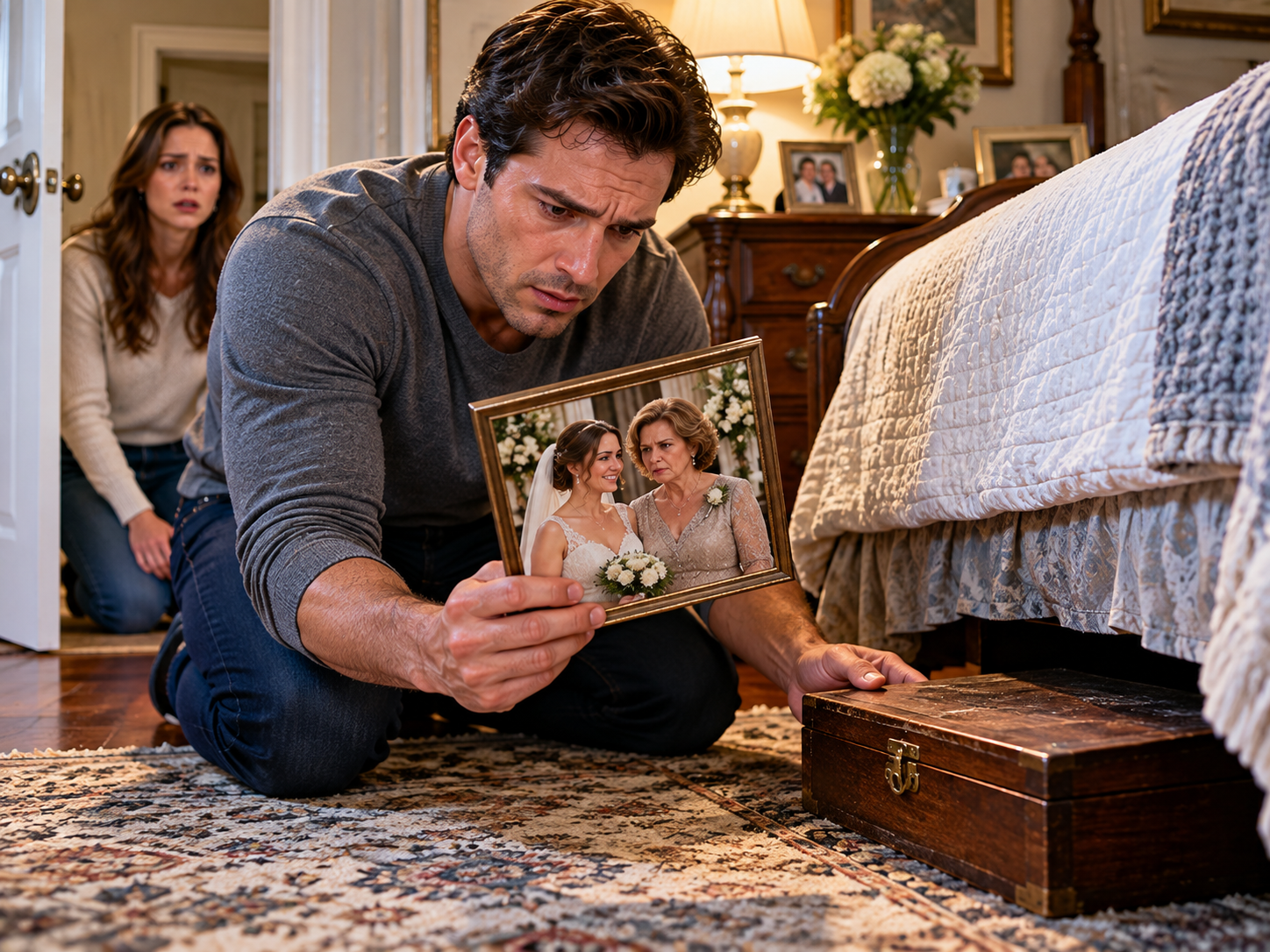
The bedroom where the wooden box had waited beneath her bed.
But a house is not a person.
I learned that slowly.
The memories came with us.
We kept some furniture.
We gave away some.
We donated many of her things.
The rest became part of other people's lives.
That felt right.
My mother had spent too much of her life believing that keeping something meant protecting it.
I was learning that sometimes letting something go was another form of love.
Before the house was sold, I went into her bedroom one last time.
The room was almost empty.
Sunlight fell across the floorboards.
There was no bed anymore.
No wooden box.
No hidden compartment.
No mystery.
Just dust where furniture had stood.
I knelt beside the place where the bed had been.
I could still remember the day I had discovered the box.
My heart had pounded.
My hands had shaken.
I had thought I was about to uncover proof that my mother had done something unforgivable.
Instead, I uncovered a story about fear.
I sat on the floor.
For years, I had imagined what would have happened if my mother had simply told me everything.
Maybe the wedding would have been different.
Maybe Claire would not have spent so long wondering whether she belonged.
Maybe I would have understood the medical history earlier.
Maybe my mother would have lived with less anxiety.
Maybe none of that would have changed her fate.
There were too many maybes.
I finally stopped asking them.
The past did not become kinder when I rearranged it.
It became clearer.
My mother had made mistakes.
My father had left unfinished work.
Claire’s mother had carried fears she never wanted her daughter to inherit.
Claire had endured a rejection she did not deserve.
I had spent years angry at someone who was already gone.
And eventually, we had all reached the same lesson from different directions.
Information belongs to the people whose lives it affects.
Fear does not become wisdom simply because it comes from love.
And love does not become less real because the person expressing it makes mistakes.
I stood and looked around the empty room.
“Goodbye, Mom.”
The words felt smaller than I expected.
But they were enough.
When I returned home, Claire was waiting on the porch.
She could tell immediately.
“You went back.”
“Yes.”
“How was it?”
“Empty.”
She nodded.
“Sometimes that's what closure feels like.”
I sat beside her.
Our child was playing in the yard.
The sound of laughter carried through the afternoon.
I watched for a while.
Then I said, “Do you ever think about what would have happened if we hadn't found the box?”
Claire thought about it.
“Yes.”
“What do you think?”
“I think we would have kept some wrong ideas.”
“About your mother?”
“About your mother. About mine. About ourselves.”
She looked toward the yard.
“We might have spent our whole lives believing the story we created when we were younger.”
“What story?”
“That your mother hated me.”
I nodded.
“And I would have believed my mother left me nothing.”
Claire smiled faintly.
“Neither story was true.”
“No.”
“And both were understandable.”
“Yes.”
She leaned against me.
That was the strange thing about the past.
Sometimes the version you believed had enough truth inside it to survive for years.
My mother really had disliked Claire at first.
Claire really had lost her mother young.
My father really had studied the same medical history.
The genetic marker really did connect our families.
The fear really had been serious.
But none of those facts, alone, told the whole story.
Truth was not always a single sentence.
Sometimes it was a room full of pieces.
You had to learn which pieces were facts, which were memories, which were fears, and which were conclusions people had drawn when they were too frightened to wait for more information.
That was what my mother had failed to do.
She had taken a possibility and treated it like a certainty.
She had taken fear and mistaken it for knowledge.
I understood her now.
But understanding was not the same as agreeing.
That distinction mattered.
Years later, when people asked me what I learned from my mother’s secret, I never told them it was simply that she loved us.
That answer was too easy.
I told them that love could coexist with fear.
That good intentions could still cause harm.
That medical information required context.
That families should not make decisions about someone's health behind their back.
And that sometimes the most loving thing a person can do is admit, “I don't know.”
Claire agreed with all of it.
Then she usually added one more thing.
“Ask the person.”
That had become our family rule.
If the information belonged to someone, tell them.
If you're worried, talk to them.
If you don't understand, ask.
If you made a mistake, admit it.
If you're afraid, don't disguise fear as certainty.
Our child grew up hearing those rules so often that they became ordinary.
That was exactly what we wanted.
Not a dramatic family lesson.
Just ordinary honesty.
One evening, years after my mother's death, our child asked me about the wooden box again.
“Do you still have it?”
“Yes.”
“Can I see it?”
“Of course.”
I brought it out.
The wood had darkened with age.
Our child ran a finger over the lid.
“Was this where everything started?”
I thought about it.
“No.”
Our child looked confused.
“Then where?”
“The story started long before this box.”
I explained that it started with grandparents who were frightened, with researchers trying to understand disease, with families making decisions from incomplete information, and with people who loved one another but did not always know how to communicate.
“The box didn't create the story,” I said.
“It just helped us understand it.”
Our child opened the lid.
Inside were copies of the important documents, the old photograph, and my mother's final letter.
Nothing looked dangerous anymore.
Nothing looked like a secret.
It looked like history.
Our child read the first few lines of the letter.
Then looked up.
“Did Grandma know she was wrong?”
“I don't know.”
“Did she know before she died?”
“I think she was beginning to.”
“Because she gave you the box?”
“Yes.”
Our child thought about that.
“Maybe that was her way of saying sorry.”
I looked at the letter.
“Maybe.”
I did not claim certainty where none existed.
That was another lesson.
We closed the box.
Outside, Claire called us for dinner.
Our child ran ahead.
I stayed behind for a moment.
The wooden box rested in my hands.
Once, I had thought it contained the answer to why my mother hated my wife.
It did not.
It contained something much harder.
The evidence that my mother had loved us while being afraid.
The evidence that she had made mistakes while trying to protect us.
The evidence that fear can make intelligent people secretive.
The evidence that families can inherit not only genes, but also stories, assumptions, silences, and unfinished conversations.
And perhaps most importantly, it contained the chance to decide what we would pass on.
We chose not to pass on the fear.
We passed on the truth.
I put the box back on the shelf.
Then I walked toward the kitchen.
Claire was setting plates on the table.
Our child was arguing about vegetables.
Nothing dramatic was happening.
Nobody was crying.
Nobody was discovering another secret.
For once, there was no mystery waiting beneath a bed.
There was only dinner.
There was only family.
There was only the ordinary life my mother had been so afraid I would lose.
I looked at Claire.
She caught my eye and smiled.
I smiled back.
Years earlier, my mother had stood at our wedding and told me Claire was not the one for me.
I had answered that one day she would love her too.
My mother had nodded through her tears.
I used to think I had been wrong about that promise.
I wasn't.
My mother never learned to love Claire in the simple way I had imagined.
She learned something more difficult.
She learned, too late, that Claire was not someone she needed to protect me from.
She was someone she could trust.
And by the time I understood that, my mother was gone.
So I could not change the wedding.
I could not give her another chance to explain.
I could not make her tell the truth sooner.
But I could decide what happened next.
I could refuse to let her fear become our inheritance.
I could love Claire without asking her to forgive what she could not forget.
I could remember my mother without pretending she had never hurt us.
I could teach our children that risk is information, not destiny.
And I could keep the family photograph on the wall.
Not because the day had been perfect.
It wasn't.
Not because everyone understood each other.
They didn't.
But because the photograph captured something I had spent years learning:
Sometimes people stand beside the people they love while carrying fears they cannot explain.
Sometimes a hand reaches out even when words fail.
Sometimes the truth takes years to arrive.
And sometimes, when it finally does, the secret you thought would destroy your family becomes the reason your family learns never to hide from one another again.
Click here to continue reading: PART 13: The Older Our Child Became, the More I Realized That Protecting Someone and Controlling Their Life Were Never the Same Thing
My Mother Warned Me Before the Wedding, Yet Two Years Later Her Empty House Held a Secret She Had Never Trusted Me Enough to Reveal
Part 12 of 20