Near the end of the summer, Annabelle asked Nigel whether she could speak to Dustin. Her request came after a quiet dinner, when they had been discussing the coming school year and the family gathering. Nigel did not answer immediately. He wanted to understand what she hoped to say and whether she expected Dustin to reassure her. Annabelle admitted that she wanted to apologize for the comments she had made about Vivian, but she was afraid Dustin would reject the apology or repeat it to his mother in a way that made her look worse. Nigel told her that if the apology was mainly an attempt to protect her image, it would be better not to make it yet.
Annabelle bristled at first. She said she was trying to do the right thing, and Nigel’s caution made it sound as if she could never do anything correctly. He told her he was not asking for a perfect apology. He was asking her to focus on Dustin rather than on how he might judge her. She would need to name what she had done, acknowledge why it had been wrong, and accept that he might not respond warmly. She could not ask him to forgive her, promise to like her, or keep the conversation secret. Annabelle looked down at her hands. After a long pause, she said she understood, though she was still nervous.
Nigel asked Dustin first whether he would be comfortable having a brief conversation with Annabelle. He did not tell him that she wanted to apologize until he had explained that Dustin could decline. The boy considered it, then asked what the conversation would be about. Nigel said Annabelle wanted to talk about the remarks she had made about Vivian and the way they had affected him. Dustin's face became guarded. “Do I have to say anything?” he asked. “No,” Nigel replied. “You can listen, you can answer if you want, or you can tell us you don’t want to continue. I’ll respect whatever you decide.” Dustin thought for another moment before agreeing to hear her.
They met in the living room on a quiet Sunday afternoon. Nigel stayed nearby but did not sit between them, and Vivian was not present because Dustin had chosen not to involve her in the conversation. Annabelle sat with her hands folded together, visibly anxious. She began by saying she wanted to apologize for making jokes about Vivian’s appearance and for speaking about Dustin’s mother in a disrespectful way when he could hear her. She said she had treated those remarks as harmless because she thought they were funny, and she had not considered what it would mean for him to hear them from someone who was spending time with his father.
She paused, then continued. “I also made it harder for you when I expected you to act as if nothing had happened. You were a child, and you shouldn’t have had to worry about whether I was upset or whether your dad would be angry.” Her voice faltered, but she did not ask Nigel to finish the sentence for her. She told Dustin that the remarks had been wrong, even if she had meant them as jokes, and that she was sorry she had made him feel he needed to stay quiet. She did not explain how embarrassed she had felt when the recording was played at the fair. She did not complain about the way the situation had unfolded. For once, the apology remained focused on the person who had been hurt.
Dustin sat quietly, looking at a small mark on the coffee table. Annabelle seemed tempted to fill the silence, but Nigel’s steady presence reminded her to let him decide what came next. After a while, Dustin asked, “Why did you think it was funny?” The question was direct, and Annabelle’s face reddened. She admitted that she had sometimes used jokes to feel confident around other people and to make herself seem clever. She had also been jealous of the place Vivian still held in Nigel’s life as Dustin’s mother. She said neither reason excused what she had done. “I should have dealt with those feelings without making you hear unkind things about her,” she added.
Dustin considered that answer. “I didn’t like it because she’s my mom,” he said. “And when Dad laughed, I thought maybe he agreed with you.” Nigel felt the words deeply, but he did not interrupt. Annabelle looked at Dustin and nodded. “I understand why you thought that. I’m sorry.” She did not tell him that his father loved him or insist that he had misunderstood. Those assurances were Nigel’s responsibility, and the moment belonged to Dustin. The boy looked toward his father briefly, then returned his attention to Annabelle.
“I don’t know if I want to be friends,” Dustin said. His voice was quiet, but it did not shake. Annabelle swallowed. For a moment, Nigel worried she would respond defensively, perhaps reminding Dustin that she had apologized. Instead, she nodded. “You don’t have to decide that now,” she said. “You don’t owe me friendship because I said I was sorry. I’ll try to show you that I can behave differently.” Dustin seemed relieved that he had not been asked to make her feel better. He said he was willing to keep being polite when they were together, but he wanted adults to stop making jokes about his mother. Annabelle agreed.
After the conversation ended, Dustin went outside to play. Nigel remained in the living room with Annabelle. She looked exhausted, as though the effort of speaking honestly had cost her more than she expected. Nigel told her that he appreciated her willingness to take responsibility, but he reminded her that the apology was only a beginning. She agreed. She admitted she had wanted Dustin to accept her immediately because the uncertainty had been uncomfortable, but she now understood that asking him for reassurance would have made the apology about her again. Nigel told her he was glad she had recognized that before saying it to him, not because he wanted to praise her but because it showed she was beginning to think differently.
When Vivian picked Dustin up later, he told her that Annabelle had apologized. Vivian did not ask for a transcript. She asked whether he had felt comfortable during the conversation and whether he had been able to say what he wanted. Dustin said yes, although he was not sure what he thought about it yet. Vivian told him that was fine. “You can accept an apology without feeling close to someone,” she said. “And you can wait to see whether their actions match their words.” Dustin nodded, then told her that Annabelle had promised not to make jokes about her anymore. Vivian answered that she hoped Annabelle would keep that promise, but Dustin did not have to be the person who checked.
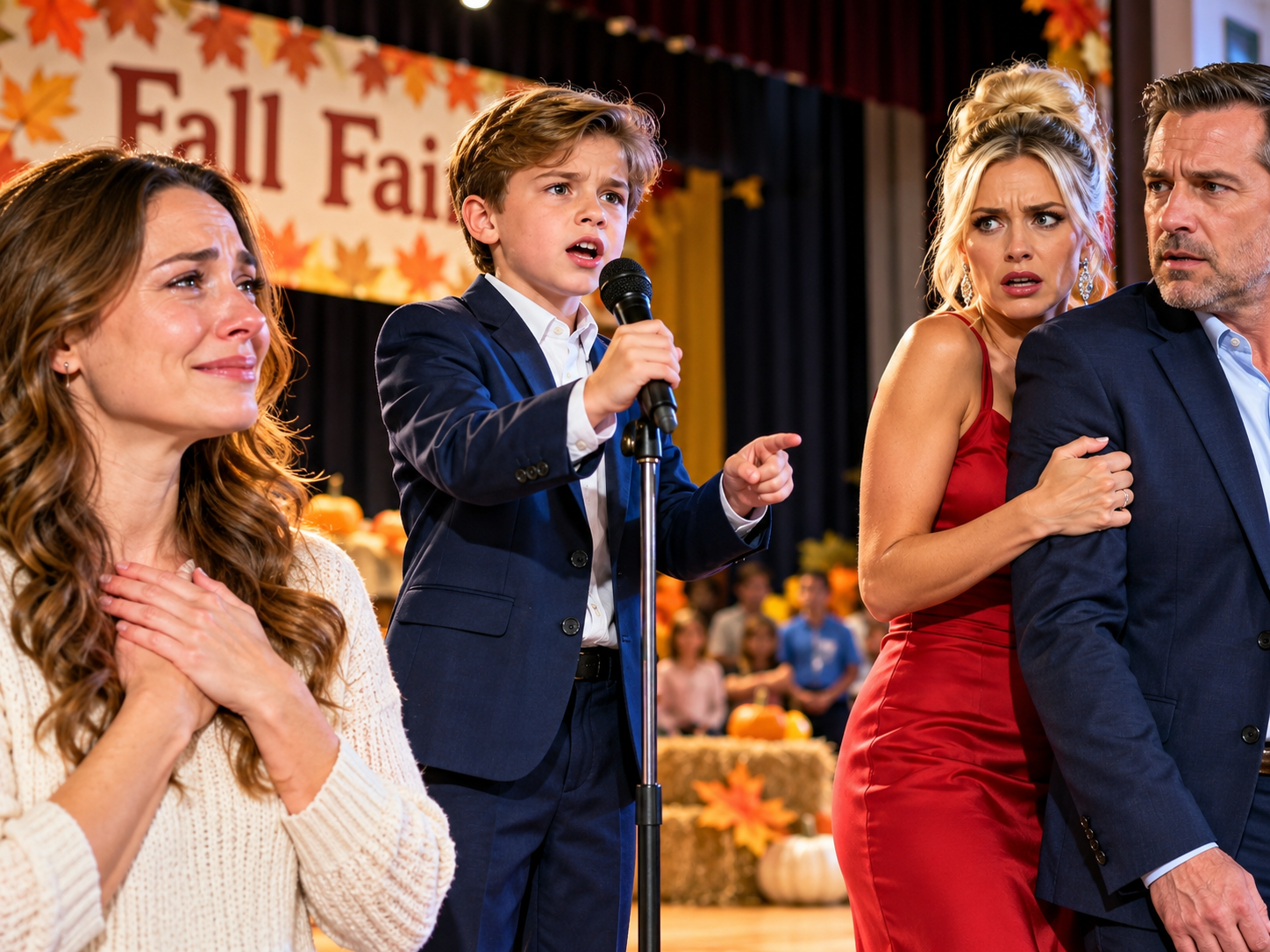
That night, Vivian thought about how differently the apology had unfolded from the fall fair. There had been no microphone, no audience, and no demand that someone be exposed before the adults would acknowledge the harm. Dustin had been given a choice about whether to listen. He had been allowed to ask a difficult question and express a boundary without being told he was unkind. Whether Annabelle’s behavior would truly change remained uncertain, but the conversation had given Dustin an experience he needed: an adult admitting wrongdoing without asking the child to make the adult feel forgiven.
Over the following weeks, Annabelle was more careful around Dustin. She did not become an endlessly patient person, and there were still awkward silences when the adults gathered. But she stopped making comments about Vivian’s clothes, appearance, or personal life. When a relative began to gossip about Vivian during another visit, Annabelle changed the subject rather than joining in. Nigel noticed, but he did not immediately tell Dustin about it or use the moment to demand trust. He understood that Dustin would notice changes in his own time. Respect was not a performance that needed to be announced. It was a choice that could be repeated quietly.
Dustin, for his part, did not suddenly seek Annabelle’s company. He remained courteous, sometimes talking to her about school or asking whether she had seen a particular film, and sometimes spending an entire visit focused on his father. Annabelle learned to accept that difference without interpreting every quiet moment as rejection. Nigel continued to make room for time alone with his son and time with Annabelle, while refusing to treat either relationship as a reason to neglect the other. Their arrangement was not effortless, but it was becoming more honest. And honesty, unlike forced harmony, gave everyone a chance to respond to what was actually happening.
Click here to continue reading: PART 16: What Dustin Carried Forward
My Ten-Year-Old Son Had Been Keeping a Secret About His Father’s Girlfriend, and I Finally Understood His Silence
Part 15 of 20