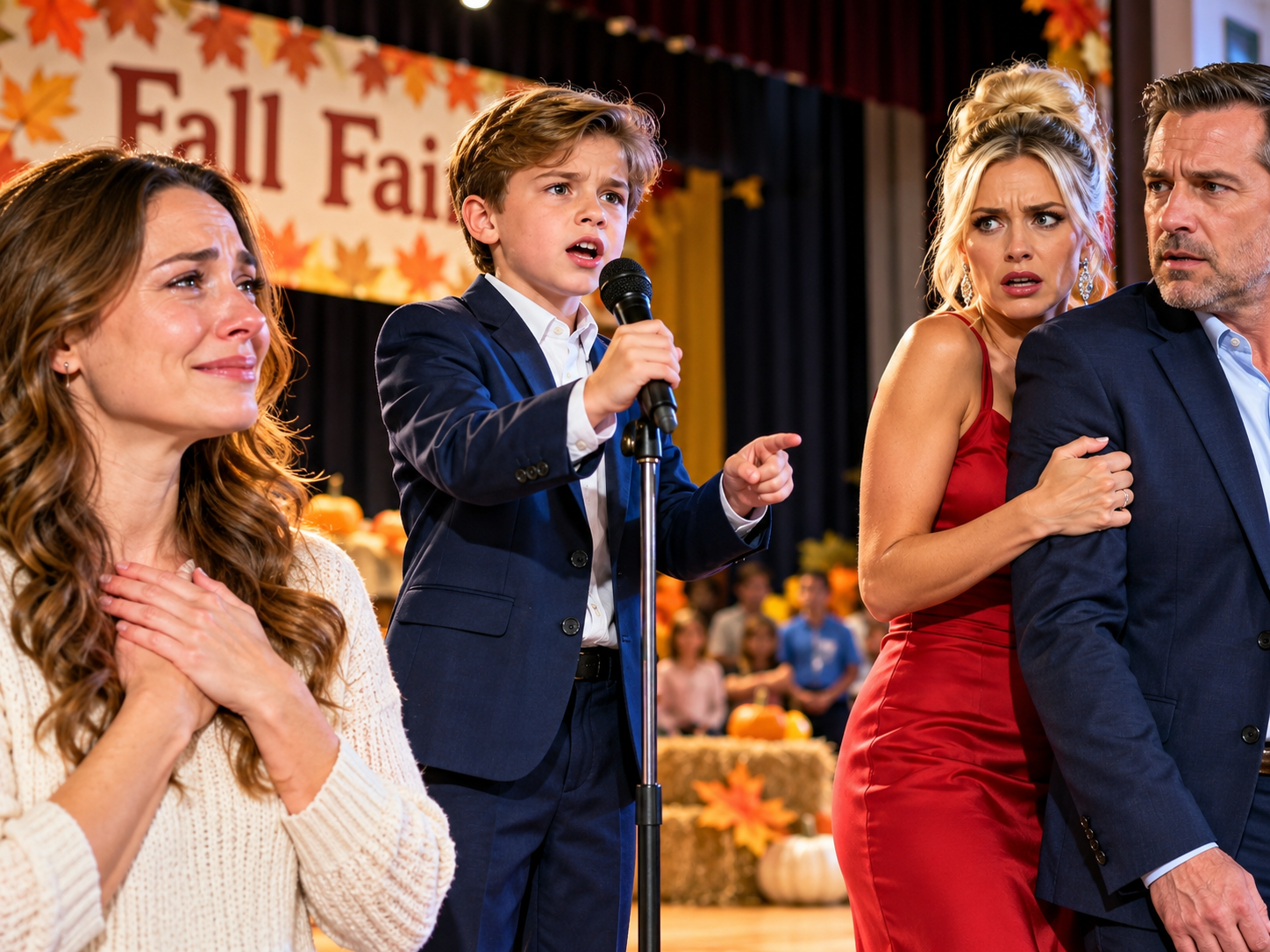
On Monday morning, I found three messages from Nigel waiting on my phone. The first asked whether Dustin had mentioned the fair to me again. The second complained that several parents had approached him about the recording. The third said we needed to speak because the situation was beginning to affect his reputation at school.
I read the messages while standing beside the kitchen counter, waiting for the kettle to boil. Dustin was upstairs getting ready for class, humming to himself as he searched for a missing sock. His ordinary morning sounds made Nigel's concern seem particularly misplaced. Our son had spent weeks worrying about whether his father would become angry with him. Now, after the recording had been played, Nigel's first priority appeared to be what other adults thought of him.
I replied that I was willing to discuss anything affecting Dustin, but I would not participate in an effort to make the fair disappear from people's memories. The recording had exposed conversations that had already happened. We could address the way it had been presented at school, but we could not pretend the underlying behavior had been harmless.
Nigel called almost immediately. His voice was controlled, but I could hear the strain beneath it.
“You don't understand what people are saying,” he began. “Some parents think I'm a terrible father.”
“I'm sorry you're having a difficult time with that,” I said. “But have you thought about what Dustin was dealing with before the fair?”
He sighed sharply. “I already apologized to him.”
“Yes. That was a start.”
“What more do you want from me?”
I looked through the kitchen window toward the garden. I could see the pumpkin costume folded over the back of a chair where Dustin had left it the night before. One of its cardboard eyes had bent inward, giving it an even more ridiculous expression.
“I want you to stop treating his feelings as a public relations problem,” I said. “He needs to know you understand why he was hurt, not just that you're upset people heard the recording.”
Nigel went quiet. I could almost hear him searching for a response that would return the conversation to safer ground. Finally, he said he would think about it and ended the call.
I did not feel triumphant. I felt tired. It was difficult to watch someone I had once trusted focus so intensely on the consequences of his behavior while struggling to acknowledge the behavior itself. Still, I reminded myself that I could not force Nigel to understand everything immediately. I could set boundaries and remain consistent about what Dustin needed.
That afternoon, Mrs. Carter sent a brief message asking whether Dustin was settling back into his routine. I thanked her for checking in and explained that he seemed more relaxed, although he occasionally worried about how other students might react. She said she would continue to give him space and would let me know if anything concerning arose.
When Dustin came home, he dropped his backpack near the stairs and headed straight for the refrigerator.
“I'm starving,” he announced.
“That's encouraging. I was beginning to think you had survived on cupcakes alone.”
He grinned. “I could probably do that.”
While he ate, he told me about a science activity in which his group had tried to build a paper bridge strong enough to hold a stack of books. Their first attempt had collapsed, and one boy had insisted that the problem was the glue. Dustin thought the paper folds were the real issue.
“What did you do?” I asked.
“We tried it again with different folds.”
“And?”
“It worked better.”
I smiled. “So the glue wasn't the whole problem.”
“Nope.”
He continued eating, unaware of how closely his answer resembled the conversation I had been trying to have with his father. It was tempting to draw a lesson from every ordinary thing Dustin said, but I resisted. He deserved to talk about school without having every comment turned into a discussion about the fall fair.
Later that week, Nigel asked to collect Dustin for an extra evening together. I told him that was fine, provided he confirmed the time and brought Dustin home as agreed. We had been following a regular schedule, and I did not want our son's relationship with his father to become a bargaining tool. Nigel confirmed the arrangement and arrived promptly.
Before Dustin left, he asked whether I thought his father would be angry if he mentioned the recording again.
“You don't have to bring it up unless you want to,” I told him. “And you don't have to hide your feelings if you do.”
He studied me. “What if Dad says I'm being dramatic?”
“Then you can tell him how you feel, and he can decide whether he is ready to listen. But you don't have to convince him that your feelings are real.”
Dustin nodded and went to get his jacket.
When he returned that evening, he seemed thoughtful but not distressed. He told me that he and Nigel had eaten burgers and played a racing game. They had not discussed the fair much, although Nigel had asked whether Dustin was still upset.
“What did you say?” I asked.
“I said I didn't like it when he laughed at Annabelle's jokes.”
“And what did he say?”
“He said he understood.”
Dustin hesitated, then added, “I think he was trying to understand.”
I appreciated the distinction. Children often notice effort long before adults recognize how important it is. Nigel might not yet have grasped the full extent of the harm, but Dustin had noticed that his father was trying to listen rather than dismiss him outright.
A few days later, Nigel requested a meeting without Dustin present. He suggested a café near the school, and I agreed because I wanted to discuss how we would handle future concerns. I arrived with no intention of arguing about the past for its own sake. I wanted us to establish clear expectations so Dustin would not again feel responsible for managing our reactions.
Nigel was already seated when I arrived. He had ordered coffee but had barely touched it. He looked older than he had at the fair, not because anything about his appearance had changed, but because his usual confidence seemed less secure.
“I've been thinking about what you said,” he began. “I did make this about how people see me.”
I waited.
“I was embarrassed,” he continued. “When Dustin got on that stage, I felt as though he had exposed me in front of everyone. I didn't want to think about why he had done it. I wanted him to stop.”
“That is what he heard you say,” I replied. “He already believed that telling the truth would make you angry.”
Nigel rubbed his forehead. “I know.”
He explained that Annabelle had told him the comments were harmless teasing. He had accepted that explanation partly because he agreed with some of the criticisms and partly because challenging her would have required him to admit that he was participating in something unkind. He had convinced himself that Dustin was too young to understand the difference between private adult humor and serious hostility.
I asked him whether he had considered how it felt for Dustin to hear his father laughing at his mother.
“No,” he admitted. “Not properly.”
The honesty was uncomfortable, but I preferred it to another defensive explanation. I told him that Dustin did not need us to agree about every aspect of our former marriage. He needed to know that neither parent would use him as an audience for insults or expect him to pretend they were funny.
Nigel nodded. “I should have stopped it.”
“Yes.”
He looked down at his coffee. “I thought you would never know.”
The sentence hung between us.
I had suspected that he was more comfortable with the comments than he wanted to admit, but hearing him acknowledge the assumption made the problem clearer. He had not merely failed to notice the effect on Dustin. He had behaved as though the behavior was acceptable because he expected it to remain private.
“You should not need to worry about whether I hear something,” I said. “The important question is whether you would say it in front of your son.”
Nigel did not answer immediately. Then he admitted that he had never considered the possibility that Dustin might remember those conversations long after the adults had forgotten them.
We agreed on a few practical boundaries. Conversations about either parent would remain respectful in Dustin's presence. If a concern arose about his care or schedule, we would discuss it directly rather than making comments through him. Nigel would speak to Annabelle about the effect of her remarks, and I would not ask Dustin to report on their conversations or prove that the behavior had stopped.
Before we left, Nigel apologized for laughing at the fair. His apology was quieter than his earlier explanations and more specific than the message he had sent after the recording. I accepted that he was making an effort, but I did not tell him everything was resolved.
When I returned home, Dustin was building a paper airplane at the kitchen table. He looked up as I entered and asked whether I had seen the latest design he had made.
“It flies farther than the others,” he said proudly.
I watched him launch it across the room. The airplane glided over the table, struck a cushion, and landed on the sofa.
“Excellent,” I said. “A controlled landing.”
He laughed, and I laughed with him.
For that evening, the house belonged to ordinary things again. Homework needed checking. Dinner needed preparing. A paper airplane needed a better design. I was grateful for those small demands because they reminded me that our lives were larger than the conflict that had briefly taken over the school fair.
But I also understood that the next step would not be determined by what Nigel said to me in a café. It would be determined by what he did when Annabelle made another cutting remark, when a conversation became uncomfortable, or when protecting Dustin required him to challenge someone he wanted to please.
I could not make those choices for him.
I could only watch, listen, and keep the door open for my son to tell the truth.
Click here to continue reading: PART 6: Annabelle Insisted the Recording Had Been Taken Out of Context, Until Nigel Asked Her a Question She Could Not Easily Avoid
My Ten-Year-Old Son Had Been Keeping a Secret About His Father’s Girlfriend, and I Finally Understood His Silence
Part 5 of 20