Mia woke before the alarm on the morning of her discharge, listening to the steady hum of the ventilation system and the soft shuffle of shoes in the hallway. For a moment, she forgot where she was. Then the pull of her incision reminded her, and the memories returned in fragments: the porch light, the ice, the terrible impact, and the snow beneath her turning red.
She pressed one palm against her abdomen and breathed slowly until the room settled around her. The pain medication had taken the sharpest edge off the ache, but she still moved carefully. The nurse had explained what to watch for at home and when to call for help. Claire had written the instructions down in large, practical handwriting, then stuck a copy in her bag and another on the refrigerator at her house.
Mia had never been so grateful for lists.
At nine, a nurse reviewed the discharge instructions one final time. Mia was to avoid lifting anything heavier than recommended, take her medication as directed, keep her incision clean and dry, and attend her follow-up appointments. If she developed concerning symptoms, she was to contact her medical team promptly. The NICU staff would continue updating her about her daughter, and Claire had offered to drive her to the hospital as often as needed.
“Leaving without her is going to be hard,” the nurse said gently.
Mia looked down at the small bag of baby clothes Claire had packed, most of which would remain unused for now. “I don’t know how to walk out of here without feeling like I’m leaving her behind.”
“You’re not abandoning her,” the nurse said. “You’re recovering so you can keep being present for her. You can come back. We’ll help you stay connected to her care.”
Mia nodded, although the distinction did not make the ache disappear. She had imagined carrying her daughter through a hospital doorway, protecting her head with one hand and supporting her tiny body with the other. Instead, she would carry a folder of medical instructions and a phone charger, leaving her baby surrounded by equipment and people she was learning to trust.
Before discharge, Mia visited the NICU one more time. Her daughter was sleeping, her face turned slightly toward the edge of the incubator. The nurse explained that the baby was still being monitored closely but had shown some encouraging signs. There was no firm date for when she would be ready to leave.
Mia rested her fingertips against the incubator and whispered the promise she had made the day before. She would return. She would learn everything she needed to learn. She would not let fear persuade her that she was powerless.
When she came back to her room, Claire was waiting beside the wheelchair with Mia’s coat folded over her arm.
“I checked the parking area,” Claire said. “We can use the side entrance. It’ll be easier than crossing the main lobby.”
Mia understood why she had checked. Evan knew she was leaving that day. She did not want a confrontation in front of the hospital doors, and Claire had no intention of letting one happen by accident.
They took the side corridor toward the exit. Claire pushed the wheelchair around a corner, and Mia saw Evan standing near the vending machines.
He looked as though he had slept badly. His shirt was creased, and the familiar watch on his wrist sat slightly crooked. In his hand was a brown envelope. For a second, Mia’s body reacted before her mind did. Her heart beat hard against her ribs, and she gripped the arms of the wheelchair.
Evan stepped toward her.
“Mia. We need to talk.”
Claire stopped the wheelchair. “Not here.”
“I’m her husband,” Evan said, glancing at Claire as if that should settle the matter. “I’m allowed to speak to her.”
“You’re allowed to speak respectfully,” Claire replied. “That’s not the same thing as getting whatever conversation you want.”
Mia took a careful breath. “What do you need, Evan?”
His eyes moved to the envelope. “I brought the paperwork about the account. And there are things we need to agree on before this gets more complicated.”
“Have you asked how your daughter is doing today?”
The question seemed to catch him off guard. His mouth opened, then closed. “Of course I care about her.”
“You haven’t asked me that once since you arrived.”
“I know she’s in the NICU. I’ve been told she’s stable.”
“Then you know more than I do some mornings.”
Evan’s expression tightened. “I’m trying to deal with everything at once. You think this has been easy for me?”
Mia stared at him. She had spent so many years trying to understand what he meant when he said things like that. Perhaps he meant that he was frightened. Perhaps he meant that he was embarrassed. Perhaps he genuinely believed that his distress should be given the same weight as the injuries she had suffered.
None of those possibilities changed the fact that he had left her on the ground.
“I’m not discussing the account in a hospital hallway,” she said. “I’ll have a lawyer review the records.”
He lowered the envelope. “You’re making this sound like some kind of legal battle.”
“You brought papers to my discharge.”
“I thought we could settle things calmly.”
“Then you can wait until I have advice.”
His gaze shifted toward the wheelchair, then back to her face. “You’re really going to let Claire get between us?”
“No,” Mia said. “I’m deciding who is allowed to be beside me while I recover.”
For a moment, Evan seemed unable to answer. He had always been comfortable when a disagreement could be redirected toward someone else. His mother had been too harsh. Rachel had misunderstood. Mia was emotional. Claire was interfering. There was always another person to blame, another reason the central question did not need to be answered.
He tried again. “I came here because I don’t want this to destroy our family.”
Mia’s throat tightened. She wanted to believe that sentence. She wanted to hear that he had come because he had replayed the moment on the porch and could no longer live with what he had done. She wanted him to say that he should have called for help, that he should never have left, that no crib and no amount of money could matter more than the life of his wife and unborn child.
Instead, he held the envelope a little higher.
“What is in it?” she asked.
“An agreement. Just something to keep the family from fighting over money while you’re recovering.”
“Who prepared it?”
“A person I spoke to.”
“Are they a lawyer?”
He hesitated. “They know about these things.”
“That isn’t an answer.”
His patience began to fray. “Mia, you’re making a simple thing impossible.”
“No. I’m making sure I understand what I’m being asked to sign.”
She did not reach for the envelope. The papers remained between them, held in Evan’s hand like a test she was supposed to pass by proving she still trusted him.
Claire leaned forward slightly. “Send it through the appropriate channel. She’s leaving now.”
Evan looked at his wife one last time. “If you walk out like this, don’t expect me to keep waiting forever.”
The threat was quiet enough that a stranger passing by might not have heard it. Mia heard it clearly.
She had once been terrified of his disappointment. She had measured the atmosphere of their home by his moods, adjusted her questions to his patience, and learned to postpone difficult conversations until he seemed receptive. Now she looked at the man who had left her bleeding and found that his threat had lost much of its power.
“I’m not asking you to wait,” she said. “I’m asking you to take responsibility.”
She turned her face toward Claire. Her sister pushed the wheelchair forward, and Evan did not follow them through the exit.
The drive to Claire’s house took twenty minutes. Mia watched the city pass through the window, her hands folded over the blanket across her lap. Familiar storefronts and traffic lights looked strangely distant, as though she were seeing them from another life. She had left the hospital without her daughter, but she had not left alone.
Claire’s house was small and warm, with a narrow front garden and a kitchen that always smelled faintly of coffee. She had prepared the downstairs guest room so Mia would not have to climb stairs. A glass of water stood beside the bed, and a basket held clean towels, medication reminders, and the hospital’s printed instructions.
Mia looked at the arrangement and began to cry.
Claire set the bag down. “What is it?”
“I thought coming here would make me feel relieved.”
“You can be relieved and heartbroken at the same time.”
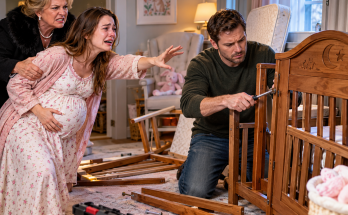
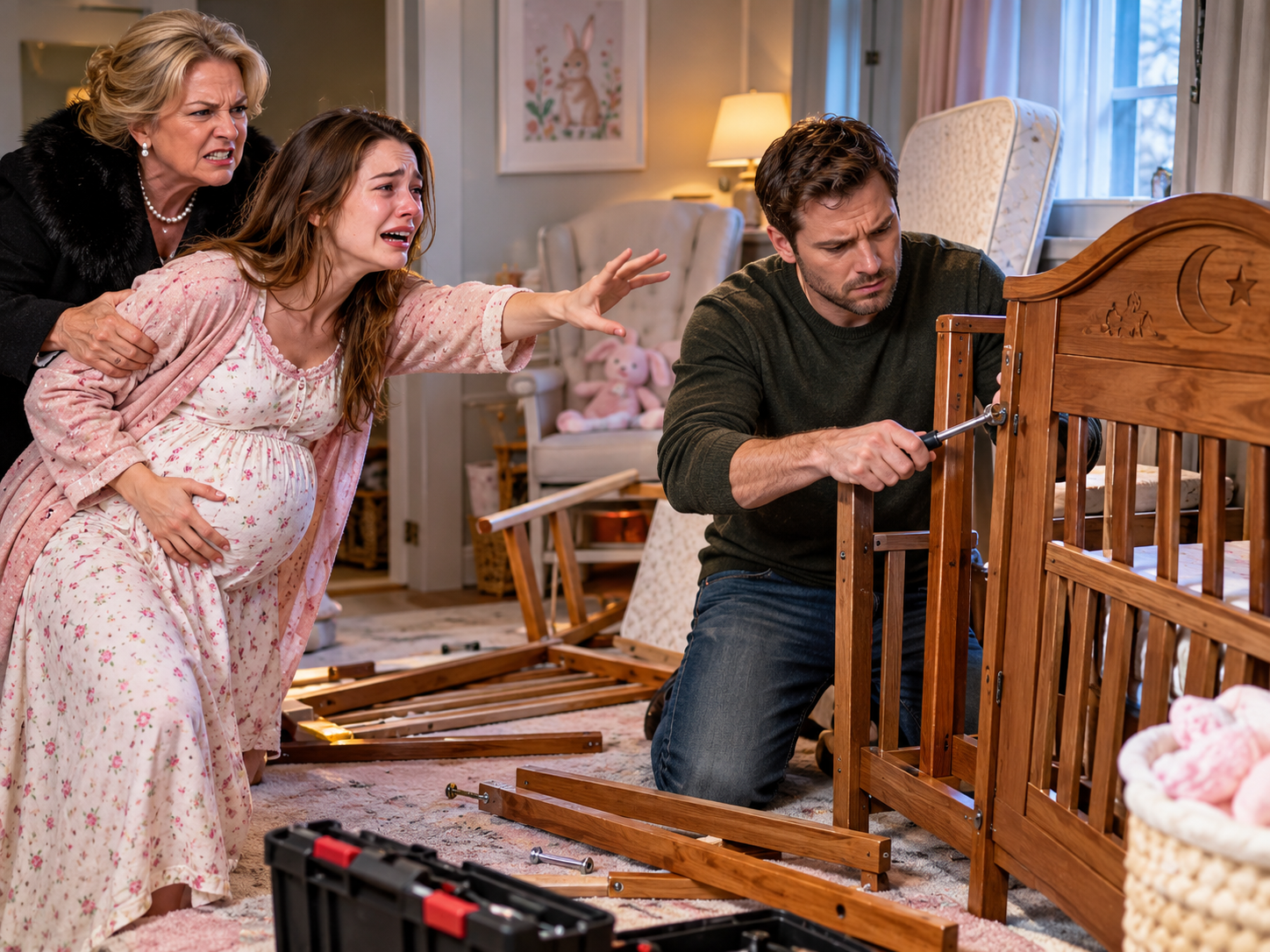
“I keep seeing the crib in my head. My father measuring the rails. He made me help sand the corners because he said a child would find every rough place we missed.” Mia wiped her cheek. “I thought if I kept the crib safe, I was keeping a piece of him safe.”
Claire sat on the edge of the chair. “The crib matters. What he made for her matters. But you don’t have to put yourself in danger to prove how much it matters.”
Mia looked toward the window. The late morning light fell across the blanket folded at the foot of the bed. Patricia had taken that, too. It had been her mother’s, worn thin in places, soft from years of washing. Neither the crib nor the blanket was simply an object. Both carried the touch of people Mia had lost and the promises she had made to the child she was waiting for.
“I want them back,” she said.
“Then we’ll work on getting them back safely.”
“And the money.”
“And the money.”
Claire did not promise that the outcome would be easy. She did not say Evan would return everything, or that a lawyer could solve the marriage in a single meeting. She promised only that Mia would not have to face the next step alone.
After lunch, Mia called the legal aid service Denise had recommended. She explained that she needed advice about joint savings, property, and communications with her husband after an incident that had left her hospitalized. The person who answered arranged an initial consultation and told her what records to bring. Mia wrote down the appointment, then placed the discharge instructions beside the legal notes so she would not confuse one set of responsibilities with the other.
By late afternoon, Rachel had sent the remaining messages she could find. She also forwarded a photograph of the crib pieces stacked in her garage. The carved crescent moon was visible on one side of the headboard, wrapped in a moving blanket that did not cover the inscription underneath.
Mia enlarged the photograph. She could see a small scratch near the lower rail, the one her father had repaired by hand after Mia had accidentally knocked a tool against it during the final week of sanding.
She knew that scratch. She knew the slight unevenness of the crescent moon because her father had refused to erase it, insisting that handmade things should show the person who made them.
For several seconds, she could not breathe properly.
Rachel’s next message appeared beneath the photograph. Evan told me he would come back for the remaining pieces. I didn’t know you had asked for them back. I haven’t let him take anything else.
Mia did not answer immediately. She saved the photograph and wrote down when Rachel had sent it. She wanted the crib returned, but she would not risk a confrontation to retrieve it. She would ask her lawyer about a safe, documented arrangement, one that did not require her to stand on another doorstep and beg to be heard.
That evening, the NICU nurse called with an update. Mia’s daughter had made it through the day without a major setback. She was still fragile and would need continued monitoring, but the team was pleased with certain signs of progress. Mia sat very still while she listened, one hand resting on the table and the other gripping the phone.
When the call ended, she remained there long after the screen went dark.
Claire placed a mug of warm tea beside her. “Good news?”
“Careful good news,” Mia said.
“That counts.”
Mia looked again at the photograph of the crib. She could not yet tell whether the pieces would be returned intact or whether she would ever use them for her daughter. She could not tell whether Evan would cooperate with the legal process or try to turn every request into a new argument.
But she could decide what she would no longer do. She would not sign papers she did not understand. She would not meet Evan alone because he insisted that marriage entitled him to private access. She would not pretend that money disappearing from their shared account was a minor misunderstanding. And she would not let the desire to recover her father’s work pull her back into a situation where her safety depended on other people’s moods.
For now, the next visit to the NICU was on the calendar. The legal consultation was scheduled. The evidence was saved. Claire’s guest room door stood open, and the house around her was quiet.
Mia set the phone beside her bed and lay back slowly, following the nurse’s instructions about protecting her incision. The future was still uncertain, but it was no longer entirely in Evan’s hands.
Click here to continue reading: PART 11: Rachel’s Evidence Revealed How Evan Had Used Their Savings, but the Most Painful Discovery Was What He Had Told His Own Family
Three Days Before My Daughter Was Born, I Discovered My Husband Had Decided Her Most Precious Possession Belonged to His Sister
Part 10 of 12