The message from Evan stayed on Mia’s phone overnight, its neat little demand glowing whenever the screen woke beneath her hand. We need to sit down and settle this privately. He had managed to make even that sound like an instruction, as though she were a difficult employee who had embarrassed him by discussing a workplace problem with the wrong people.
Mia read it again just before dawn, then locked the screen without answering. Beyond the hospital window, the sky had begun to lighten over the parking garage. The room smelled of disinfectant, warm blankets, and the weak coffee Claire had brought her the evening before. Somewhere down the hall, a cart rattled over a seam in the floor. Mia placed her phone facedown and listened to the small, ordinary sounds of a building beginning another day.
Her incision pulled when she shifted. The pain was no longer the blinding force that had followed her fall, but it still reminded her of what her body had endured. Every movement required thought. Sitting up, reaching for water, even laughing at one of Claire’s dry remarks could send a sharp ache through her abdomen. She had imagined the final days of pregnancy differently. She had imagined measuring the distance between contractions, arranging tiny clothes, and waiting for Evan to pace nervously beside her.
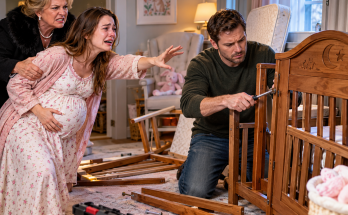
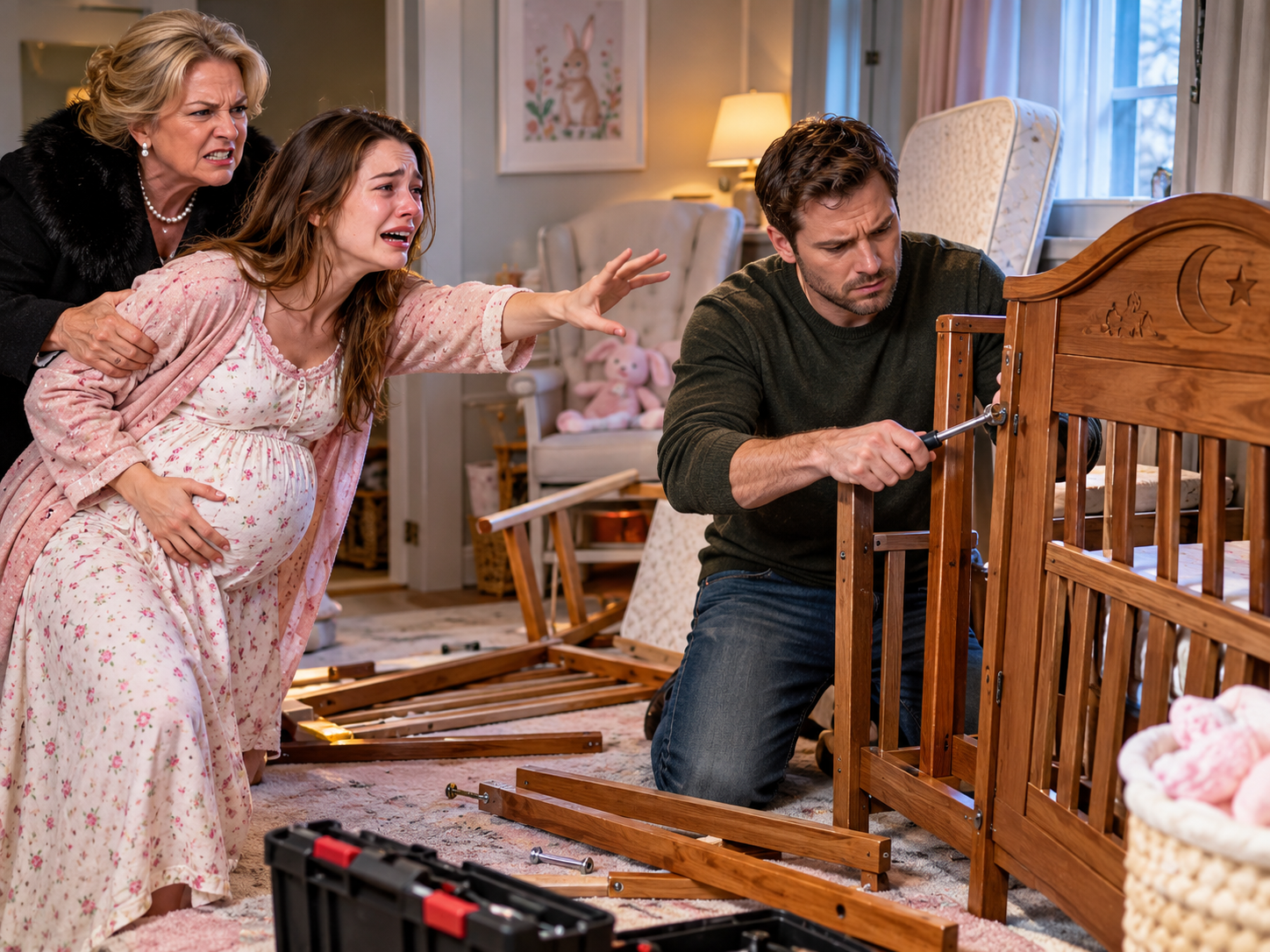
Instead, her daughter was in the NICU, and the crib her father had built lay in pieces somewhere under another family’s roof.
Claire arrived at seven with a paper bag of toast, a container of yogurt, and a clean sweater. She took one look at Mia’s expression and set everything down without asking whether she had slept.
“He messaged again?” Claire asked.
“No. The same message is still there.”
“Then it can stay there.”
Mia almost smiled. “You make everything sound easy.”
“I make some things sound simple because they should be.” Claire pulled the visitor’s chair closer to the bed. “You don’t owe him an immediate response just because he wants one.”
“He’ll say I’m making things worse by refusing to talk.”
“He can say whatever he wants. That doesn’t make it true.”
Mia looked at the phone. The old instinct to explain herself rose automatically. She wanted to tell Evan that she had not been gossiping about him, that she had only answered Rachel’s questions, that the money had not been a private matter once it began disappearing from their shared account. She wanted to defend every decision she had made since waking in the hospital.
Then she remembered the porch. She remembered trying to breathe while blood spread across the snow, and the sound of Evan’s vehicle pulling away.
She had spent years believing that if she could explain herself clearly enough, he would understand her. That morning, she began to suspect that he had understood more than he wanted to admit.
“I’m not going back to the house,” she said.
Claire did not react as if the decision surprised her. “Good. You can stay with me until you’re ready to decide what comes next.”
“I don’t know how long that will be.”
“You don’t have to know today.”
The certainty in her sister’s voice loosened something in Mia’s chest. She had been treating every choice as though it had to settle the entire future: whether she would divorce Evan, whether she would recover the crib, whether her daughter would need more time in intensive care, whether she would ever be able to look at the house without remembering the fall. Claire was offering her something smaller and more manageable. One day. One safe place. One decision at a time.
A nurse came in to check Mia’s incision and review her medications. When Mia asked about discharge, the nurse explained that she was recovering well enough for the team to begin planning, provided she could move safely, manage her pain, and arrange help at home. The baby’s condition was a separate matter. Mia could leave the hospital before her daughter did, a possibility that had seemed impossible when the emergency team first rushed her into surgery.
“Does that mean I can see her whenever I come back?” Mia asked.
“We’ll work with you on visits,” the nurse said. “The NICU team will explain the arrangements before you leave. You’re her mother, and we want you involved in her care.”
Mia nodded, but her eyes had already filled. She turned toward the window until she could speak without her voice breaking.
At nine, the hospital social worker, Denise, arrived with a folder and a quiet manner that never made Mia feel as though she were being examined. They went through the discharge plan, including Claire’s address, transportation to follow-up appointments, and what Mia should do if Evan or Patricia appeared unexpectedly. Denise also asked whether Mia wanted help documenting the messages she had received since the incident.
“I’ve kept everything,” Mia said. “The texts, the account statements, the photographs. I haven’t deleted anything.”
“That’s helpful,” Denise replied. “Keep the original messages when you can. Don’t edit the screenshots or write notes on the original files. If you need to organize them, make copies and keep a separate list of dates. And if you feel threatened, contact the appropriate authorities rather than trying to handle it alone.”
Mia looked at the folder. She had never imagined needing a file about her own marriage. Yet the paperwork offered a kind of steadiness. The events had been chaotic, but their dates could be recorded. Messages could be preserved. A witness could describe what she had seen. The fall did not become less terrible because it could be documented, but it no longer had to exist only in Mia’s frightened memory.
Denise asked if Mia wanted to make a formal statement to the authorities who were following up on the incident. Mia said she did. She also wanted independent legal advice before responding to Evan’s request for a private meeting or signing anything he brought her.
“That is a sensible boundary,” Denise said. “You can cooperate with an investigation and still get legal advice about your finances, your home, and your marriage. Those are related issues, but they aren’t all the same question.”
After Denise left, Claire helped Mia sort the papers she had brought from home. The bank statements were creased where Mia had folded them in a hurry. The unfamiliar account numbers still looked unreal, like details belonging to somebody else’s life. She had marked the transfers that she recognized and circled the ones she could not explain. Several payments appeared to relate to nursery purchases and moving expenses. The most recent transfer had been made after Mia was already in the hospital.
She stared at that date for a long time.
“Maybe there’s an explanation,” Claire said carefully. “We don’t have to decide what every transaction means before someone qualified looks at it.”
“I know.”
“Knowing and feeling are different.”
Mia let out a slow breath. “I keep thinking that if I find one innocent explanation, then perhaps the rest of it can still make sense.”
Claire rested a hand on the edge of the bed. “You can wait for the evidence without pretending the evidence you already have doesn’t exist.”
That was the distinction Mia had been struggling to make. She did not need to declare Evan guilty of every suspicion in her mind. She did not need to decide whether Patricia had planned to hurt her. She could simply refuse to ignore the facts: the crib had been taken without her consent, the money had moved without a clear accounting, and when she fell bleeding on the concrete, Evan had left.
By late morning, the NICU nurse called to say Mia could visit her daughter again. Claire helped her into the wheelchair, making sure the blanket covered Mia’s legs and the phone was within reach. The corridor seemed longer than it had the day before. Every doorway brought a different sound: a monitor chirping, a telephone ringing, a doctor speaking in a low voice. When they reached the NICU entrance, Mia washed her hands carefully and followed the nurse to the incubator.
Her daughter looked impossibly small beneath the lights. The support around her seemed too large for her delicate body. A thin cap covered her head, and a monitor traced the rhythm of her heart. Mia had begun to recognize the pattern of the equipment, though she still watched every number as if it might tell her something the staff had not yet said.
“She had a steadier night,” the nurse explained. “We’re still watching her closely, but she has had some encouraging periods.”
Mia pressed her lips together. She did not want to turn cautious progress into a promise. She had learned how quickly hope could be frightened by a sudden alarm.
“Can I touch her?”
“Of course. Let me help you position your hand.”
The nurse guided Mia’s fingers to the baby’s back. Her daughter’s skin was warm beneath the soft fabric, and the movement against Mia’s palm was so slight that at first she wondered if she had imagined it. Then the baby shifted again.
Mia bent forward as far as her incision allowed. “I’m here,” she whispered. “I’m not going anywhere.”
The words were meant for her daughter, but they settled something inside Mia, too. She could not control the machines, the doctors’ decisions, or the time her baby would need. She could not undo the night of the fall. But she could keep showing up. She could learn every instruction, ask every question, and protect the small person who had entered the world in circumstances neither of them had chosen.
When Mia returned to her room, her phone showed a new message from Rachel.
I’ve been thinking about what you said. I found the transfer messages Evan sent me. I’m going to forward them. I should have asked you before I accepted anything. I’m sorry.
Mia read it twice. She did not feel relief. The apology was a beginning, not a repair, and Rachel’s willingness to help did not erase the fact that she had accepted the crib.
Still, Mia replied with a single sentence: Please send the original messages and any records you have, and don’t delete anything.
Rachel responded almost immediately. I will.
A few minutes later, files began arriving. There were screenshots of Evan’s messages about nursery expenses, a list of purchases, and a photograph of a transfer confirmation. One message caught Mia’s attention because of its casual tone.
Don’t worry about the cost. I’ve already moved what we need. Mia won’t mind once she sees how much the twins need.
Mia read the line until the words blurred. It was not a confession to anything beyond what it said. It did not establish where every dollar had gone or whether Evan had moved the money for reasons he had not disclosed. But it did show that he had represented Mia’s consent to Rachel without asking for it.
Another message, sent the evening before the fall, mentioned the crib. Mom says we should take it tomorrow. It’ll be easier if we do it before Mia gets emotional about it again.
Mia’s stomach tightened. She placed the phone on the blanket and stared at the wall. The sentence did not prove that anyone had planned the fall. She would not let herself leap from a cruel plan to a conclusion the evidence could not support. But it showed that they had expected her to object and had decided to proceed anyway.
Claire read the messages over Mia’s shoulder. Her jaw tightened, but she kept her voice low.
“That’s why you save the originals,” she said. “And that’s why a lawyer should see them.”
Mia forwarded the files to a separate secure folder and wrote down the date and time she received them. Then she added a note to her evidence list, keeping the language factual. She did not write that Evan had deliberately caused the fall. She wrote that Rachel had provided messages indicating Evan knew Mia had not agreed to the crib being taken.
For the first time since the accident, Mia felt that she was doing something other than reacting to what had happened. She was making a record. She was choosing what would happen next.
That evening, Denise returned to confirm the discharge arrangements. Mia would stay with Claire, who had agreed to help with meals, transportation, and the practical restrictions that followed surgery. Mia would return to the hospital for her daughter’s care and her own follow-up appointments. She would not go to the marital home alone to collect belongings. If she needed additional property, she could seek advice about the safest and most appropriate way to retrieve it.
As Claire packed the few things Mia would need, another message arrived from Evan.
I heard you’re leaving tomorrow. We need to discuss the house and the account before you start making decisions that affect both of us.
Mia’s fingers hovered above the screen. There was no question about the baby. No acknowledgment of the surgery or the days she had spent watching their daughter struggle. He had gone straight to the house and the money, as if those were the emergencies that mattered.
She showed Claire the message, then placed the phone in her bag.
“I’m not meeting him alone,” Mia said. “And I’m not discussing any of this until I’ve spoken to a lawyer.”
Claire zipped the bag shut. “Then that’s the plan.”
Mia looked once more toward the NICU corridor before the nurse wheeled her back to her room. Tomorrow she would leave the hospital without her daughter, and the thought hurt more than she could explain. But she would not be returning to the house where she had been pushed aside, injured, and abandoned. She would be going somewhere safe, with her records intact and her next steps chosen by her.
For the first time, the decision was not about convincing Evan to understand what he had done. It was about making sure he could no longer decide, without her, what happened to her life.
Click here to continue reading: PART 10: When Mia Finally Left the Hospital, Evan Arrived With Papers in His Hand and a Version of Their Marriage She No Longer Recognized
Three Days Before My Daughter Was Born, I Discovered My Husband Had Decided Her Most Precious Possession Belonged to His Sister
Part 9 of 12