The call came just after breakfast, while Mia was checking the hospital’s latest message about her daughter. Patricia’s name appeared on the screen, and Mia felt the old tension gather in her shoulders before she had even answered. She could almost hear the sharp breath Patricia took before criticizing someone, the little pause she used to make an insult sound like a reasonable observation.
Mia considered letting the call go to voicemail. Instead, she answered and put the phone on speaker so Claire could remain beside her.
“Well,” Patricia said, without greeting her, “I hear you’ve been stirring up trouble.”
Mia set the hospital message facedown. “What trouble?”
“Don’t play games with me. Rachel says you’ve been asking questions about the money and sending people copies of private family messages.”
“I asked Rachel to preserve the messages she already had. I also asked the bank for records of transfers from my joint account.”
“Your joint account,” Patricia repeated with a scornful laugh. “As though Evan has no right to use his own money.”
“I haven’t said he has no rights. I’ve asked for an explanation of transactions I don’t recognize.”
“You know perfectly well he was helping his sister. She has twins coming. She needs support.”
“Then he can explain the transfers.”
Patricia made an impatient sound. “You have always been too sensitive about things. That crib was taking up space, and Rachel needed it. You should be grateful your husband’s family has made room for you at all.”
Claire’s hand tightened around her mug. Mia gave her a small shake of the head, silently asking her not to interrupt.
“The crib belonged to my daughter,” Mia said. “My father built it for her. I never gave permission for anyone to take it.”
“Oh, here we go again. Your father, your feelings, your precious little keepsakes. You’re about to have a child. You need to grow up.”
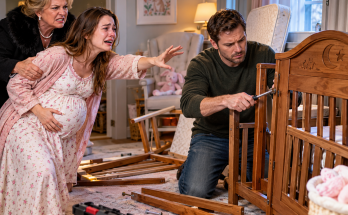
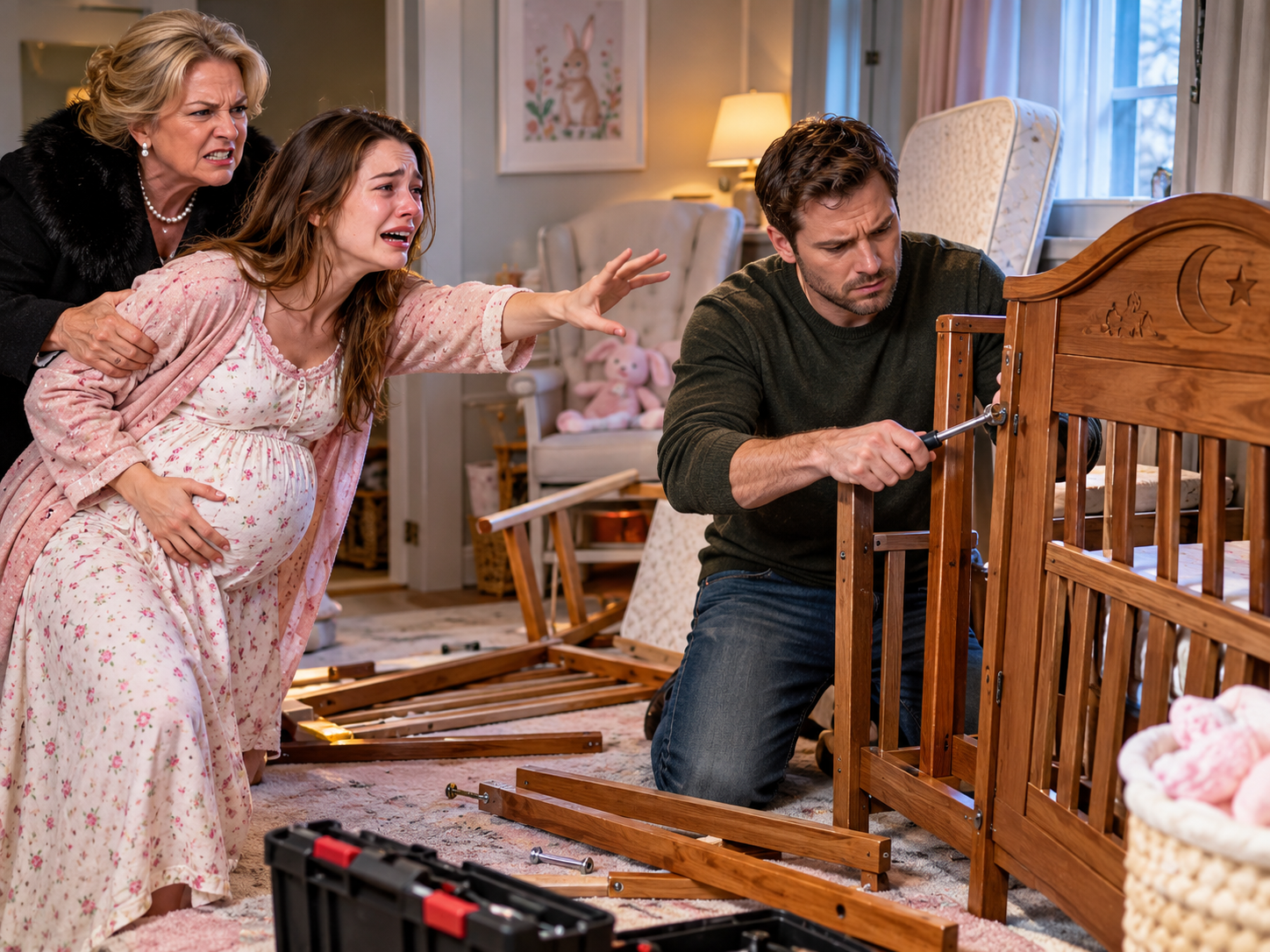
Mia felt the words land, but they did not move her the way they once had. Patricia had used the same accusation on the porch, standing between Mia and the crib, as if Mia’s grief were a character flaw that needed correcting. She had said it when Mia begged them to stop, and again when Mia tried to regain her footing on the icy steps.
The memory came with the cold, the impact, and the terrible inability to draw a full breath.
Mia sat straighter. “I’m not discussing this with you.”
“Don’t you dare hang up on me.”
“I’m ending the call.”
“Evan is going to be furious when he finds out what you’re doing to him.”
“He can speak to my lawyer about the account and the property.”
For a moment, Patricia said nothing. Then her voice dropped, becoming quieter and more dangerous.
“You have no idea what you’re risking. If you keep dragging outsiders into this, don’t expect this family to welcome you back.”
Mia looked at Claire, who had stopped breathing for a second. The threat was familiar, but the meaning had changed. Patricia was still speaking as though family acceptance were a prize Mia had to earn by remaining silent.
“I’m not asking to be welcomed back,” Mia said. “I’m asking you to stop contacting me about these matters. Any necessary communication can go through the appropriate channel.”
She ended the call.
Her hands shook afterward. She had expected that part. Courage, she was discovering, did not always feel like strength. Sometimes it felt like sitting at a kitchen table with a trembling hand, knowing she had done something she would once have apologized for.
Claire took the phone and placed it beside the notebook.
“You did well,” she said.
“I feel sick.”
“That doesn’t mean you made the wrong decision.”
Mia pressed her fingers against the edge of the table. “She talks as though I’m the one who took something from them.”
“She needs you to believe that. Otherwise, she has to face what happened.”
Mia did not answer. She had no way of knowing what Patricia believed privately. She could only judge the words she had heard and the actions she remembered. She wrote down the time of the call, the main statements, and the fact that Patricia had warned her not to involve outsiders. She did not embellish the account or try to decide what the threat meant beyond its actual words.
Then she sent a brief message to Ms. Bennett, asking whether she should respond if Patricia contacted her again. The lawyer’s reply came later that morning: preserve the communication, avoid arguments, and direct property or financial matters through the agreed process. If Mia felt in immediate danger, she should contact the appropriate authorities.
Mia saved the reply beside the rest of the records.
At noon, the NICU called. Her daughter had tolerated a period of care with fewer supports than before, although the staff emphasized that she remained under close observation. The nurse explained the change in ordinary language, careful not to promise that progress would continue at the same pace.
Mia listened with one hand over her mouth. She asked what she should learn before the baby eventually came home, and the nurse explained that the team would guide her through feeding, monitoring, and any other care the child required when the time came. Nothing had been decided about discharge yet.
When the call ended, Claire hugged her carefully, avoiding the healing incision.
“She’s fighting,” Claire whispered.
“She’s so small.”
“And she has people looking after her.”
Mia rested her forehead against Claire’s shoulder. She had spent days imagining how close she had come to losing her daughter. She still woke at night with the memory of the fall pressing into her chest. Yet the hospital’s cautious updates gave her something to hold on to that did not depend on Evan’s remorse or Patricia’s approval.
Later that afternoon, Rachel sent a message asking whether Mia had spoken with their mother.
She called me too, Rachel wrote. She said you’re trying to take everything away from Evan. I told her you never agreed to give us the crib. She said I shouldn’t get involved.
Mia stared at the message. Rachel’s decision to contradict Patricia was small, but it was different from what she had done before. She had once accepted Evan’s version of events without asking Mia directly. Now, at least, she was willing to say aloud that the crib had never been given willingly.
Mia replied: Please don’t argue with her on my behalf. Keep the records and let the legal process handle the rest.
Rachel answered with a simple acknowledgment.
An hour later, she sent another photograph. The crib pieces were still stacked in her garage, secured along one wall. The moving blanket had slipped from the headboard, exposing the inscription beneath the top rail. Rachel had placed a folded sheet of paper beside the pieces. In her message, she explained that she had written down the condition of each part and would not let anyone remove them without documenting what was taken.
I want you to have it back, she wrote. I know that doesn’t fix anything.
Mia enlarged the image. She could see the little crescent moon, the familiar scratch, and the inscription her father had carved with his own hands: For my little girl. May she always have a place where she is safe.
The sentence seemed to fill the room.
She remembered her father standing in the garage, sleeves rolled to his elbows, explaining why he was sanding the corners again even though they already felt smooth. He had said that babies found every edge adults overlooked. Mia had teased him about being too particular, and he had pretended to be offended before handing her the sandpaper.
The memory was so clear that for a moment she could almost smell the sawdust.
She wanted the crib back with an urgency that surprised her. Not because it would solve the financial questions, not because it would prove she had been right, and not because she needed to win a contest with Patricia. She wanted her daughter to have the thing her grandfather had made for her. She wanted to touch the smooth rails and show the child, years from now, where her great-grandfather had carved the tiny moon.
But the photograph also reminded her that the crib could not be allowed to become another reason to put herself in danger.
She forwarded it to Ms. Bennett with a short request for advice about arranging a documented return. The lawyer replied that the appropriate procedure would depend on the ownership facts and the circumstances of the dispute. Mia should not go to Rachel’s home alone or attempt to retrieve the pieces without an agreed arrangement. They could discuss a written request and a neutral way to handle the exchange.
Mia read the reply twice, then put the phone down.
For the first time, the possibility of getting the crib back felt real enough to plan for. It was not guaranteed, but it was no longer merely a wish she repeated when she could not sleep.
That evening, Evan sent an email. The subject line read: We need to settle this before it gets worse.
Mia opened it, with Claire sitting beside her.
He wrote that the family was under enormous strain. He said Patricia was upset, Rachel was being pulled into a private dispute, and the financial questions could be resolved if Mia would stop treating normal family help as misconduct. He insisted he had never intended for the incident on the porch to become so serious. He said he had panicked and made a mistake by leaving, but he had also been overwhelmed by Mia’s reaction and the pressure of the situation.
Near the end, he wrote that he wanted her to sign a statement confirming that the crib had been taken during a family misunderstanding and that the transfer of money had been made for shared family purposes. He claimed the statement would prevent unnecessary conflict while they focused on their daughter.
Mia read the email in silence.
“He’s trying to make you sign his version of events,” Claire said.
“He’s calling it a misunderstanding.”
“He knows you didn’t agree to give away the crib.”
Mia scrolled to the bottom. Evan had added that he was willing to discuss reconciliation once the family stopped being subjected to accusations. There was no direct apology for leaving her on the concrete. No recognition that she had needed emergency surgery. No mention of the nights their daughter had spent in the NICU.
Mia felt the old urge to answer rise inside her. She wanted to write every detail he had left out. She wanted to remind him that she had screamed for help while he drove away, that she had not been asking for an argument when she begged him to stop dismantling the crib, and that the snow had turned red before a stranger stopped to help her.
She wanted him to admit that he knew she had not agreed.
Instead, she forwarded the email to Ms. Bennett without responding. She saved the original, recorded the date, and added it to the evidence file. The lawyer could advise her on whether a reply was necessary and how to handle the proposed statement.
Claire watched her close the laptop.
“You didn’t answer him.”
“I don’t know how to make him understand.”
“Maybe understanding isn’t the thing you need from him right now.”
Mia looked toward the dark window. Outside, the streetlights had come on, reflecting in the glass. She could see her own face faintly over the quiet street: pale from the hospital, tired, still carrying the evidence of a frightening week.
“What if he never admits what he did?” she asked.
“Then your choices still belong to you.”
The answer was simple, but it did not pretend the loss would be easy. Mia might never hear the apology she needed. Evan might continue to insist that he had been misunderstood. Patricia might tell relatives that Mia had broken the family apart by involving outsiders. Even Rachel’s help might prove temporary.
Mia could not make any of them tell the truth. She could only refuse to sign a false account of what she remembered.
Before bed, she called the NICU to ask whether she could visit early the next morning. The nurse confirmed the visiting arrangements and reminded her to rest, too. Mia promised she would. After the call, she laid out her clothes and set the alarm, then placed her notebook beside the phone.
On the final page, she wrote down the decisions she had made that day: she would not meet Evan or Patricia alone; she would not sign any statement without independent advice; she would continue documenting the financial transactions; and she would pursue the return of the crib through a safe, appropriate process.
Then she added one more sentence.
My daughter’s safety will not be negotiated in exchange for keeping this family comfortable.
Mia read the line once, closed the notebook, and switched off the lamp.
The next morning, she would return to the hospital. Her daughter was still fragile, and there was no guarantee of how quickly she would recover. The money had not been fully traced, the crib had not been returned, and the marriage remained unresolved. But the direction of Mia’s life had changed.
She was no longer waiting for Evan to explain the situation in a way she could accept. She was no longer asking Patricia to recognize the value of what had been taken. She was building a record, following advice, and protecting the small life that had survived a beginning no child should have had to endure.
And somewhere in Rachel’s garage, the dismantled crib remained intact enough to be recognized—not yet home, but no longer beyond Mia’s reach.
The End
Read more original stories on Feel Every Story.
Three Days Before My Daughter Was Born, I Discovered My Husband Had Decided Her Most Precious Possession Belonged to His Sister
Part 12 of 12