
The new school year began with the usual mixture of excitement and worry. Dustin had grown a little taller over the summer, and his school uniform sleeves seemed shorter than Vivian remembered. He was nervous about a new teacher and a more demanding timetable, though he tried to hide it beneath his enthusiasm for the classroom science corner. Vivian helped him organize his books, and Nigel took him shopping for a new backpack. They coordinated the schedule without arguing over who should buy what or which parent deserved credit. When Dustin discovered that he had left his pencil case at his father’s apartment, Nigel drove it over before school the next morning. It was a small rescue, handled without blame or a reminder that Dustin should have been more careful.
On the first Friday of the term, Dustin came home talking about a class discussion on family traditions. The teacher had asked the students to share an activity they enjoyed doing with their families. Some had talked about holidays, others about cooking or weekend trips. Dustin had mentioned making projects with Vivian and visiting the nature reserve with Nigel. He said he had not known whether to include both, because he worried his classmates might ask why his parents did not live together. Vivian asked whether anyone had asked. He shook his head. “They just wanted to know what bird I saw.” She smiled. “Sometimes people are interested in the thing you’re telling them, not the part you’re worried they’ll notice.”
Dustin thought about that while unpacking his books. Then he said he wanted to make a new project at home, perhaps a model showing different kinds of weather. Vivian suggested they collect materials over the weekend, and Dustin said he wanted to ask his father to help build the frame. He made the request himself that evening. Nigel agreed and asked whether Dustin had a particular design in mind. Their conversation moved naturally into measurements, cardboard thickness, and how to keep the model upright. No one mentioned the old pumpkin costume, but the same quiet pattern was there: Dustin asked, Nigel listened, and the two of them began making a plan.
Annabelle came over while they were drawing the first design. She glanced at the paper and asked whether the model would include a storm. Dustin explained that he wanted to show how wind and rain affected buildings, using small paper houses and a fan. Annabelle asked whether he wanted help finding some lightweight materials. Dustin considered the offer and said he could use thin cardboard. She wrote the idea down on a scrap of paper and left it beside him. It was a simple exchange, and he did not seem uncomfortable. Later, when she asked whether he wanted to come along to a shop with her and Nigel, he said he would rather finish the drawing first. She accepted his answer without making him explain himself.
That evening, Nigel noticed how much easier it had become for Dustin to say what he wanted. He also noticed that the change did not mean his son agreed with him more often. Dustin challenged his suggestions about the model, rejected one of his ideas, and insisted that the paper houses should have removable roofs. Nigel found himself enjoying the debate. He had once mistaken compliance for closeness, as though a happy father-son relationship required Dustin to be agreeable. Now he understood that a child who felt safe could disagree and still remain connected. Their relationship was stronger when Dustin did not have to pretend his father was always right.
The model took several afternoons to complete. Vivian helped Dustin label the different weather conditions, and Nigel built a frame sturdy enough to support the cardboard houses. Dustin chose the colors and decided where each house should stand. Annabelle contributed some transparent plastic for the rain effect, which Dustin used after testing it on a spare piece of cardboard. When the project was finished, he stood back and studied it with a satisfied expression. “It actually works,” he said. Nigel put an arm around his shoulders. “Because you kept testing it until it did.” Dustin smiled, pleased by the praise, then immediately pointed out that one of the houses leaned to the left.
At the school exhibition, the model drew a small crowd. Dustin explained how the fan represented strong wind and how the plastic strips showed the direction of rain. He demonstrated what happened when a house had a weak base, then compared it with the more stable design. When a teacher asked what he had learned from building it, Dustin answered that a strong-looking structure could still fail if the support underneath was poor. Vivian heard the answer and thought of all the work their family had done beneath the surface, work no audience could see. She did not need to turn the moment into a metaphor for Dustin. He was describing his project, and his accomplishment belonged to him.
Nigel congratulated his son afterward, and Annabelle told him the demonstration had been clear. Dustin thanked them both. He then ran to meet a friend, leaving the adults to collect the materials. Vivian and Nigel stood on opposite sides of the table, folding the display cloth. Nigel told her he appreciated how well they had coordinated the project. She replied that Dustin had done most of the important thinking himself. Nigel agreed. They did not discuss the fall fair or list the mistakes they had learned from. They had reached a point where they could acknowledge good work without turning it into a ceremony of regret.
As they walked toward the school entrance, Nigel told Vivian that he had recently thought about how worried he had been when the recording was played at the fall fair. At first, he had focused on how everyone would see him, what the relatives might hear, and whether Annabelle would be angry. He had been embarrassed by the public nature of the moment, but it had taken longer for him to understand that Dustin had already been living with the embarrassment of hearing his mother mocked and seeing his father join in. “I wish I’d listened sooner,” he said. Vivian did not tell him that everything was forgiven. She simply answered that what mattered now was that he had finally begun to listen, and that he kept doing so after the immediate shock had passed.
Nigel nodded. He knew there was no sentence he could say that would return Dustin to the years before the divorce or erase the occasions when he had made his son feel responsible for keeping the peace. He could not ask Vivian to certify that he had become a good father, and he could not demand that Dustin remember the past differently. What he could do was keep his word, correct himself when he failed, and avoid making his son responsible for protecting his reputation. He had learned that accountability was not a single apology offered at the right moment. It was the willingness to behave differently long after the moment had stopped attracting attention.
At home, Dustin placed his exhibition certificate on the desk beside his bird notebook. He had added a new page to the notebook, listing the species he hoped to identify during another trip to the nature reserve. Vivian asked whether he wanted to go with Nigel again when the weather improved. “Yes,” he said. Then he added, “Maybe we can all do something together someday. But not all the time.” Vivian smiled at the honesty of the answer. She told him that he did not have to plan the whole family’s future, and that adults could work out the details. Dustin nodded and returned to drawing a small bird beside the newest entry.
The suggestion stayed with Vivian, not because it promised that everyone would eventually become close, but because it came without fear. Dustin could imagine a shared activity without feeling obligated to make it happen. He could also want separate time with each parent and say so plainly. There would still be difficult conversations ahead, especially as he grew older and his needs changed. Nigel and Vivian would sometimes disagree about schedules, expectations, and decisions. Annabelle might still struggle with the limits of her place in Dustin’s life. But those difficulties no longer had to be hidden behind jokes or passed down to a child who had no power to solve them.
A few weeks later, Dustin found the old pumpkin costume again while searching for a box of markers. He pulled it out, put it on over his clothes, and shuffled into the kitchen with his arms held out like a giant orange vegetable. Vivian laughed so suddenly that she had to lean against the counter. Dustin bowed dramatically, nearly losing his balance. “Welcome to the world’s most expensive pumpkin,” he announced. “It cost at least three rolls of tape.” Vivian laughed harder, and he joined her. The sound was warm and unguarded, without the brittle edge that had once followed a hurtful joke.
Nigel arrived later to take Dustin to his weekend visit. When he saw the costume, he asked whether it still fit. Dustin turned sideways to demonstrate that it barely did. Nigel laughed at the ridiculous shape, not at anyone’s body or appearance, and Dustin laughed with him. For a second, Vivian remembered the fall fair—the crowded tables, the public joke, the disappearance of Dustin’s smile. The memory still hurt, but it no longer swallowed the present. Nigel looked at Vivian and then at his son, aware of the history in the room. He did not try to explain the difference between that day and this one. He simply asked Dustin whether he was ready to go.
Dustin took off the costume and folded it carefully. He placed it in the storage box rather than throwing it away. Then he picked up his backpack and headed for the door. Before leaving, he turned back to Vivian and told her he would see her on Sunday evening. She reminded him to take his bird notebook, and he hurried back to get it. Nigel waited patiently while Dustin checked his things, then held the door open for him. There was no tension in the exchange, no hidden message, and no demand that anyone recognize the moment as evidence of change. It was just a father giving his son time to remember what he needed.
When the door closed, Vivian stood in the kitchen for a while, looking at the box beneath the table. The costume had begun as a silly project made with tape, felt, and too much enthusiasm. It had become tangled with a painful memory, then gradually returned to being what it had been before: a thing she and her son had made together. The same was true of their family in a broader sense. What had happened could not be undone, but it did not have to dictate every moment that followed. Their story was not repaired by pretending nothing had broken. It was repaired, slowly, by learning what needed to be protected.
The fall fair had revealed the cost of allowing cruelty to pass as humor and silence to pass as peace. But it had also become the beginning of a different way forward. Vivian learned to give Dustin room to speak without asking him to report on the adults around him. Nigel learned that loving his son required more than affection and good intentions; it required courage when another adult was displeased with him. Annabelle had begun learning that an apology could not purchase immediate trust, and that respect was shown most clearly when no one was watching. None of them had become perfect. They had simply become more accountable for the choices they made.
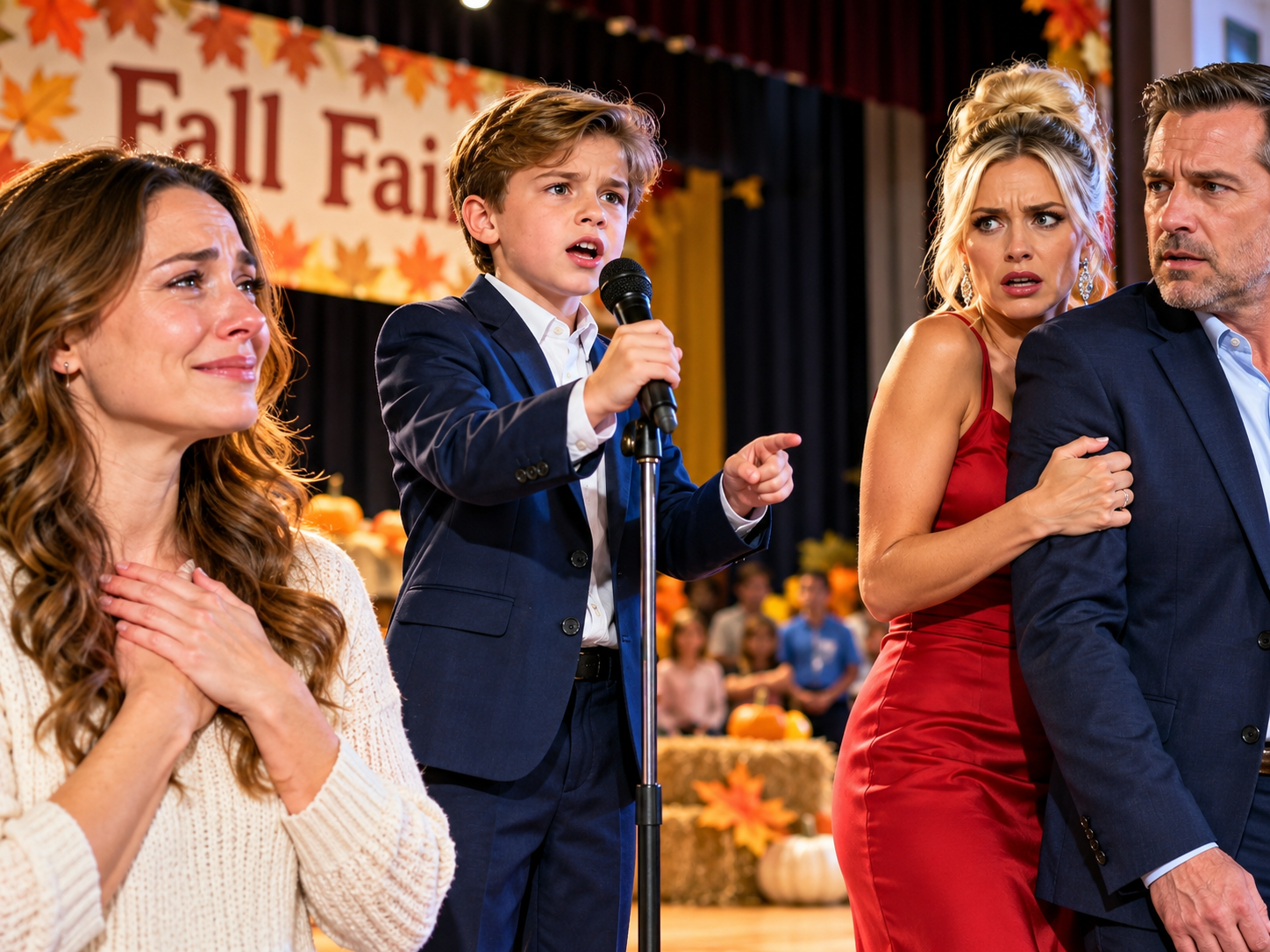
And Dustin, who had once stood on a school stage with a microphone in his hand because he could no longer bear to stay silent, was learning something that mattered far beyond that afternoon. He did not have to choose between loving his parents and telling the truth. He did not have to make himself smaller to keep adults comfortable. He could be thoughtful without being responsible for everyone, kind without accepting disrespect, and hopeful without pretending that change happened overnight. His voice belonged to him, whether he used it in front of a crowd or in a quiet conversation at home.
That was what Vivian carried forward from the fall fair—not the recording, the whispers, or the stunned expressions of the adults who had finally been forced to listen. She carried the image of her son laughing freely in a ridiculous pumpkin costume, knowing that his happiness did not depend on keeping a secret or protecting someone’s pride. She carried the knowledge that the adults around him still had work to do, and that doing it well meant allowing him to grow beyond the worst moment they had shared. The past remained part of their story, but it was no longer the only part.
Click here to continue reading: PART 17: The Day Dustin Chose His Own Words
My Ten-Year-Old Son Had Been Keeping a Secret About His Father’s Girlfriend, and I Finally Understood His Silence
Part 16 of 20

One Comment on “PART 16 – What Dustin Carried Forward”