Annabelle contacted Nigel twice during the week after his meeting with me. He did not tell me the details immediately, and I did not ask him to share private conversations that did not affect Dustin. I learned only that she was upset about the recording and believed the public reaction had been unfair. She wanted Nigel to defend her, and she expected him to make it clear that their relationship would not be changed by something a child had played at a school fair.
For a while, Nigel tried to keep the situation separate from his parenting responsibilities. He told himself that Annabelle's remarks were an issue between adults and that he could continue seeing her while making sure Dustin was not exposed to further comments. The distinction sounded reasonable until he considered what had actually happened. The remarks had been made in front of Dustin, and his laughter had helped create the very discomfort he now claimed he wanted to prevent.
He met Annabelle at her apartment on Thursday evening. She had prepared dinner, but neither of them seemed interested in eating. The conversation began with the school fair and quickly turned to the recording.
“You should have stopped the presentation,” she said. “You stood there while everyone listened to me.”
Nigel placed his keys on the table. “I tried to stop it.”
“Not quickly enough.”
“He was onstage, and the principal was there. I couldn't just grab the microphone.”
Annabelle folded her arms. “You could have told everyone it was private and inappropriate.”
“It was private,” Nigel replied. “But the comments were real.”
She stared at him. “You agreed with me at the time.”
He did not deny it.
Annabelle sat down, visibly frustrated. “I was joking. I didn't know he was taking it so seriously.”
“He told us he was.”
“He's ten, Nigel. Children misunderstand things. He might have heard one conversation and decided it meant something else.”
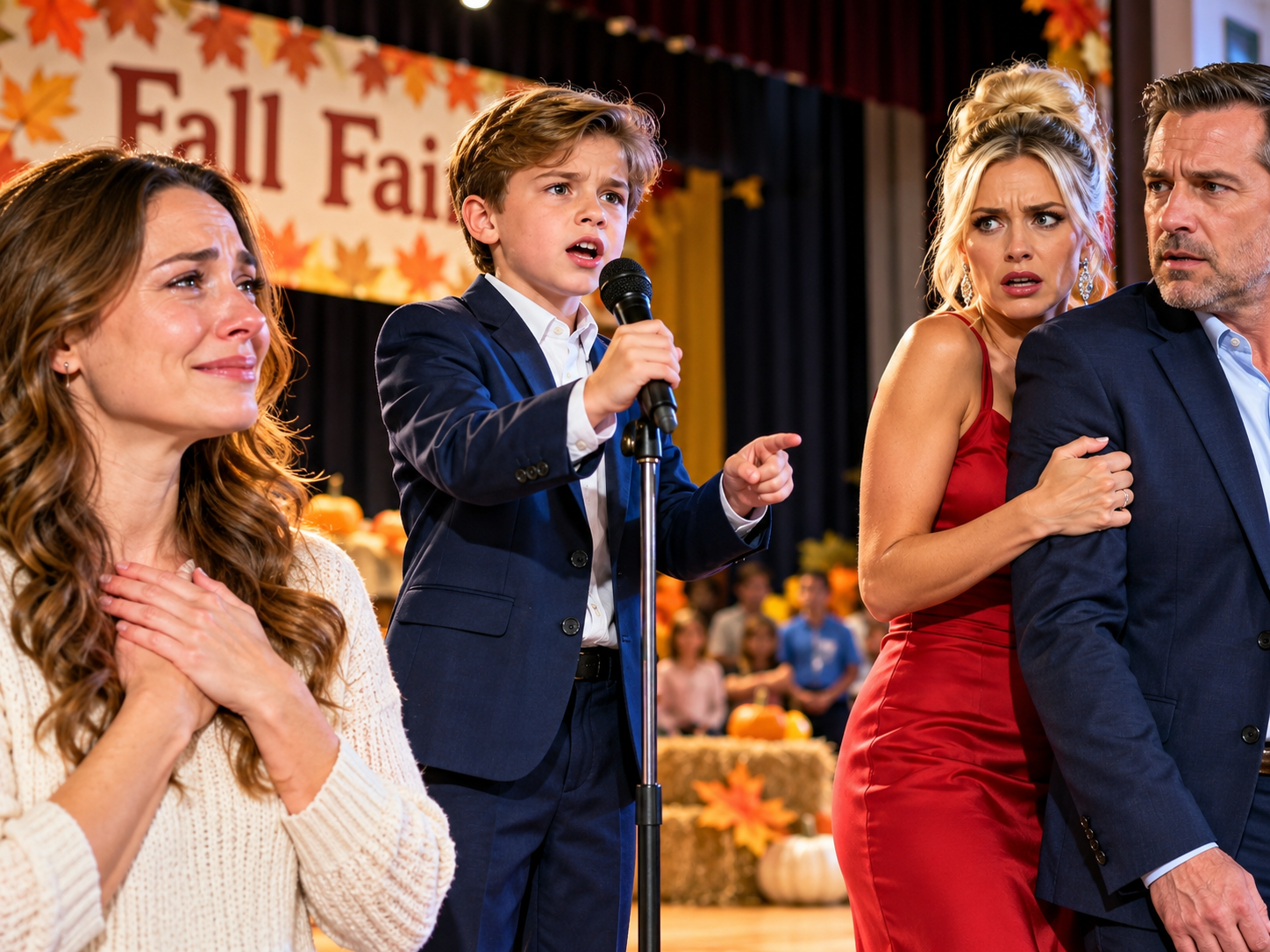
Nigel remembered Dustin standing on the stage, looking directly at him. He remembered the way the boy's voice had trembled when he explained that he had felt uncomfortable for weeks. Most of all, he remembered his own reaction: the immediate urge to stop the recording, not because he knew it was false, but because he was afraid of what people would think when they heard it.
“What part did he misunderstand?” Nigel asked.
Annabelle's expression shifted. “What do you mean?”
“You said Vivian dresses badly. You questioned how I stayed married to her. You made comments about her appearance. Which part of that did he misunderstand?”
She looked away. “I didn't say all those things in the way he presented them.”
“Then how did you say them?”
Annabelle picked up her glass, took a sip, and set it down with more force than necessary. “You're making this sound like some terrible character flaw. People talk about their exes. It's normal.”
“Not when my son is listening.”
“He shouldn't have been listening to private conversations.”
Nigel felt a familiar defensive impulse rise. It would have been easy to agree with her, to say that Dustin should not have recorded anything, to focus on the manner in which the conversation had become public. Those concerns were real, but they did not answer the question he had asked.
“He wasn't sitting behind a locked door trying to spy on us,” Nigel said. “He was in the same house. Sometimes you made the comments when he was right there.”
Annabelle's face flushed. “I never said them to hurt him.”
“That's not what I'm asking.”
The distinction seemed to irritate her more than a direct accusation would have. She wanted to be judged by her intention, while he was finally trying to consider the effect. He had spent weeks assuming that because she called the remarks jokes, they could not be serious. Now he was beginning to see how convenient that assumption had been.
Annabelle leaned forward. “So what happens now? Are you going to let your ex-wife dictate our relationship? Because I won't be in a relationship where every word I say is examined.”
“Nobody is asking you to let Vivian dictate anything,” Nigel replied. “I'm asking you not to make our son uncomfortable by insulting his mother.”
“And if I think Vivian is difficult?”
“You can think whatever you want. You don't need to discuss it with Dustin.”
Annabelle gave a short laugh, but there was no warmth in it. “You've changed your tune.”
“I should have said this earlier.”
The admission surprised them both. Nigel had spent much of the previous week explaining why the fair had been an unfortunate way for the truth to emerge. He had not yet fully accepted that the public embarrassment was a consequence of his choices rather than an injustice inflicted on him. Speaking plainly to Annabelle was the first time he had placed the boundary ahead of his desire to avoid conflict.
She looked at him for a long moment, then asked whether he still loved her. The question seemed to arrive from a different conversation, but Nigel understood what lay beneath it. She wanted reassurance that his willingness to challenge her did not mean he was preparing to abandon their relationship.
He did care about her. He had enjoyed their time together, and he had been drawn to her confidence and humor. But he could not ignore the fact that some of those same qualities had become ways to dismiss other people's discomfort. He told her that he cared about her, but he needed to know whether she understood why the comments had hurt Dustin.
Annabelle's response was cautious. She said she was sorry the boy had been upset, but she did not believe she should have to apologize for every joke she made. Nigel replied that she did not need to apologize for every thought she had. She did need to recognize that repeatedly criticizing a child's mother in front of him was different from privately disliking someone.
They ended the conversation without resolving everything. Annabelle asked for time to think, and Nigel left feeling unsettled rather than relieved. He had wanted a simple explanation that would allow him to return to his previous life with only a few adjustments. Instead, he was beginning to recognize that the problem had grown because he had repeatedly chosen the least uncomfortable response.
The next weekend, Dustin came to his house as scheduled. Nigel had been nervous about the visit, but he decided not to make it into a special event designed to prove that he was a good father. They ordered pizza, played a board game, and watched a football match. For the first hour, they barely mentioned the fair.
Eventually, while they were putting the game away, Nigel asked how Dustin was feeling about everything.
Dustin shrugged. “I'm okay.”
Nigel recognized the familiar answer. It was the same one Dustin had given his mother when he did not feel safe enough to explain what was wrong.
“You don't have to say you're okay just because you think I want to hear it,” Nigel said.
Dustin looked at him carefully. “Are you going to get mad if I tell you?”
“No.”
“You might.”
Nigel felt the truth of that. He could not promise that he would never feel defensive, but he could choose what to do with the feeling. “I might feel upset,” he admitted. “But I won't blame you for telling me how you feel.”
Dustin sat down on the sofa. “I didn't want you to laugh at Mom. It made me feel like you didn't like her anymore, and then I wondered if you would stop liking me if I didn't laugh too.”
Nigel's face tightened. He had not imagined that his behavior could lead his son to question whether affection depended on agreeing with him. He sat beside Dustin, leaving enough space that the boy did not feel crowded.
“I should never have made you feel that way,” he said. “You don't have to agree with me about everything to be loved by me.”
Dustin studied the carpet. “Then why did you laugh?”
Nigel could have blamed Annabelle's humor, the awkwardness of the moment, or the fact that he had been trying to impress his girlfriend. He had used all those explanations before. None answered the question in a way his son deserved.
“Because I wasn't thinking about how it would affect you,” he said. “And because it was easier for me to laugh than to tell Annabelle she was being unkind. That was my mistake.”
Dustin did not respond immediately. He leaned against the sofa cushion, considering the answer. Nigel resisted the urge to ask whether they were all right now. He understood that his apology could not demand reassurance from the person he had hurt.
After a while, Dustin asked whether he would still be allowed to spend time with Annabelle.
Nigel answered honestly. He said he was still working out what their relationship would look like, but Dustin would not be expected to spend time with anyone who made him feel uncomfortable without being able to talk about it. He also explained that adults sometimes needed time to work through disagreements, and that Dustin was not responsible for deciding whether they stayed together.
That seemed to relieve him. He asked whether they could go to the park the following weekend, and Nigel agreed.
When Dustin returned home, he told me that his father had listened to him. He did not say that everything was fixed. He said the conversation had been awkward, and that he still wanted to see whether Nigel would behave differently next time.
I told him that was reasonable. Trust did not have to return all at once, and he did not need to decide how he felt about his father based on one conversation.
Several days later, Nigel called me. He said he had spoken to Annabelle and had made his position clear. He did not tell me that she had become a different person overnight, and I did not ask him to make promises about the future. I simply said that Dustin needed to experience the difference, not just hear about it.
“I know,” Nigel replied.
For once, he did not follow the admission with an explanation of why the situation had been difficult for him. He asked whether Dustin had been sleeping well and whether he had mentioned any problems at school. We discussed the ordinary details of our son's week, then ended the call.
I could not know whether Nigel's change would last. But I could see that he was beginning to understand something he had missed before: protecting his relationship with his son required more than arranging outings and buying gifts. It required Dustin to feel safe enough to tell him the truth.
Click here to continue reading: PART 7: When Dustin Asked Whether He Could Trust His Father Again, I Realized the Hardest Part of Repairing Their Relationship Had Only Begun
My Ten-Year-Old Son Had Been Keeping a Secret About His Father’s Girlfriend, and I Finally Understood His Silence
Part 6 of 20