By the time spring approached, the pumpkin costume from the fall fair had been folded away in a storage box beneath Dustin’s bed. The orange fabric had lost some of its brightness, and one of the felt leaves had come loose from the shoulder. For weeks, Dustin had refused to let Vivian throw it out, though he rarely mentioned it. One Saturday morning, while searching for an old set of building blocks, he dragged the box into the middle of his room and lifted the costume by its padded sides. He examined the crooked smile they had sewn onto the pumpkin face. “It looks even worse now,” he said, grinning. Vivian leaned against the doorframe. “It looked pretty terrible then, too.” He burst out laughing, and the sound carried into the hallway.
They spread the costume across the floor and searched for the small sewing kit Vivian kept in a drawer. Dustin insisted that he could repair the loose leaf himself. His first attempt made the thread knot around his fingers, and he groaned in frustration. Vivian showed him how to loosen the knot without pulling it tighter, then let him try again. This time, the needle passed through the fabric cleanly. He held the leaf in place and worked slowly, his tongue caught between his teeth in concentration. When he finished, the stitching was uneven but secure. He sat back to inspect it. “It’s not perfect,” he said. Vivian smiled. “It doesn’t need to be perfect to work.”
The words seemed to please him. He turned the costume over and noticed the small patch they had added after the original seam tore. “Remember when we tried to make the pumpkin taller?” he asked. Vivian remembered the cardboard pieces collapsing, the tape sticking to their sleeves, and Dustin laughing so hard he had fallen backward onto the carpet. “I remember you telling me it needed a bigger bottom,” she said. He covered his face with both hands, embarrassed by his own old joke, then laughed again. For the first time, the costume seemed to belong entirely to that memory rather than to the painful moment that had followed at the fair.
A few days later, Dustin asked whether he could bring the repaired costume to school for a classroom activity about memorable family projects. Vivian helped him prepare a short explanation of how they had made it, including the mistakes and the repairs. He decided to mention that the costume had taught him how to sew a loose piece back on, though he did not want to explain the fall fair itself. Vivian respected that choice. She told him he could share as much or as little as he wanted. The story was his, and he did not owe anyone a dramatic confession just because adults had once made his feelings part of a public moment.
When Nigel heard about the classroom activity, he asked Dustin if he could see the costume again. Dustin brought it to his father’s apartment the following weekend. Nigel examined the repaired leaf and praised the stitching without pretending it looked professional. “You did that yourself?” he asked. Dustin nodded. “Mom showed me how to untangle the thread.” Nigel smiled. “Then you both did good work.” He did not compare the experience with the fair or ask Dustin to reassure him that everything was forgiven. He simply listened while his son explained how they had made the pumpkin face and why the cardboard frame had never stayed straight.
Annabelle was there when Dustin brought out the costume, and for a moment the room became still. Vivian was not present, and no one had mentioned the fair, but the memory sat between them. Annabelle looked at the uneven felt leaves and then at Dustin. “You made this with your mom?” she asked. “Yes,” he said. She touched one of the seams carefully. “It looks like you had fun making it.” Dustin studied her expression, perhaps waiting for a joke that did not come. When none followed, he nodded. “We did.” Annabelle did not ask him to say more or try to make the exchange into proof that he liked her. She moved aside to let him show Nigel the repair.
Later, Nigel told Vivian about the visit. He said Annabelle had been quiet at first, and that he had felt himself preparing for an awkward conversation that never happened. He admitted he had wanted to point out how far things had come, but he had decided not to turn Dustin’s costume into a symbol everyone had to discuss. Vivian appreciated that. Some moments became more meaningful when adults resisted the urge to explain them. She told Nigel she was glad the visit had gone smoothly, then asked whether he had confirmed the dates for the next school break. They returned to the practical details of co-parenting, which was another kind of progress: they could talk about Dustin’s life without every conversation circling back to the past.
The next school event was a small spring exhibition, less crowded than the fall fair and without a stage large enough to make every family moment feel public. Dustin displayed a new project about weather patterns, complete with hand-drawn clouds, arrows, and a tiny paper house designed to show how wind affected different structures. Vivian arrived early to help him set out the labels. Nigel came a little later, carrying two drinks and asking whether Dustin had remembered the notes he wanted beside the model. Annabelle attended too, but she stayed near the back while the children presented their work. When Dustin began explaining the project, all three adults listened.
Dustin spoke about the difference between a structure that looked strong and one that could withstand pressure. He demonstrated how a paper wall bent when the fan was turned toward it, then showed how adding support changed the result. His explanation was clear, and he answered a teacher’s question without looking to any adult for permission. Vivian felt pride rise in her chest, but she kept her attention on her son rather than on the people standing beside her. Nigel applauded when Dustin finished. Annabelle did too. There was no theatrical reconciliation, no public declaration, and no attempt to rewrite the fall fair as a good thing. There was simply a boy sharing something he had learned while the adults in his life gave him room to speak.
After the exhibition, Dustin ran ahead to show a classmate another part of his project. Vivian and Nigel remained near the display, gathering the materials he had left behind. Nigel folded the paper notes and placed them in the box. “He seems more comfortable speaking up,” he said. Vivian nodded. “He does.” Nigel looked toward the children. “I used to think keeping things peaceful meant not making a fuss. I’m realizing I was often asking him to be quiet so I wouldn’t have to deal with the fuss myself.” He spoke without asking Vivian to absolve him. She appreciated that he could finally name the difference between peace and silence.
“I think he’s learning that adults can disagree and still take care of him,” Vivian said. Nigel nodded slowly. They did not attempt to settle every question about Annabelle or the future of their co-parenting. They had already learned that one conversation could not repair years of habits, and that their son should not have to carry the responsibility of making the adults feel successful. Instead, they discussed the upcoming school calendar, agreed on a pickup time, and checked that each had the correct dates. The exchange was unremarkable, which made it feel like a real improvement rather than a performance.
That evening, Dustin placed the pumpkin costume back in its box. He had considered bringing it home to keep on a shelf, but decided he did not need to see it every day. Before closing the lid, he ran a finger over the repaired leaf. “Maybe I’ll make something better next year,” he said. Vivian sat beside him. “I hope you do.” He looked at her. “And maybe Dad can help, too.” She smiled, careful not to attach more meaning to the suggestion than he intended. “If that’s what you want, you can ask him.” Dustin nodded, then closed the box and pushed it beneath the bed.
Later, after he was asleep, Vivian stood for a moment in the doorway of his room. She thought of the boy who had once gone quiet after weekends away, who had measured his words around adults’ moods and worried that honesty might cost him his father’s affection. She also thought of the boy who had stepped onto a stage at the fall fair because he could no longer carry the hurt alone. It had taken courage for him to speak, but it should never have been his responsibility to make the adults listen. The work belonged to them: to Vivian, to Nigel, and to every grown-up who entered Dustin’s life and wanted to be trusted by him.
She no longer measured progress by whether Annabelle attended an event without making a cruel remark, or whether Nigel apologized in exactly the right words. Those things mattered, but they were not the whole story. She measured it in Dustin’s willingness to ask for time with his father, in the way he could disagree without immediately looking frightened, and in the laughter that returned when a crooked paper tree collapsed or a sewing needle tangled the thread. She measured it in the ordinary freedom of a child who no longer felt responsible for keeping everyone else comfortable.
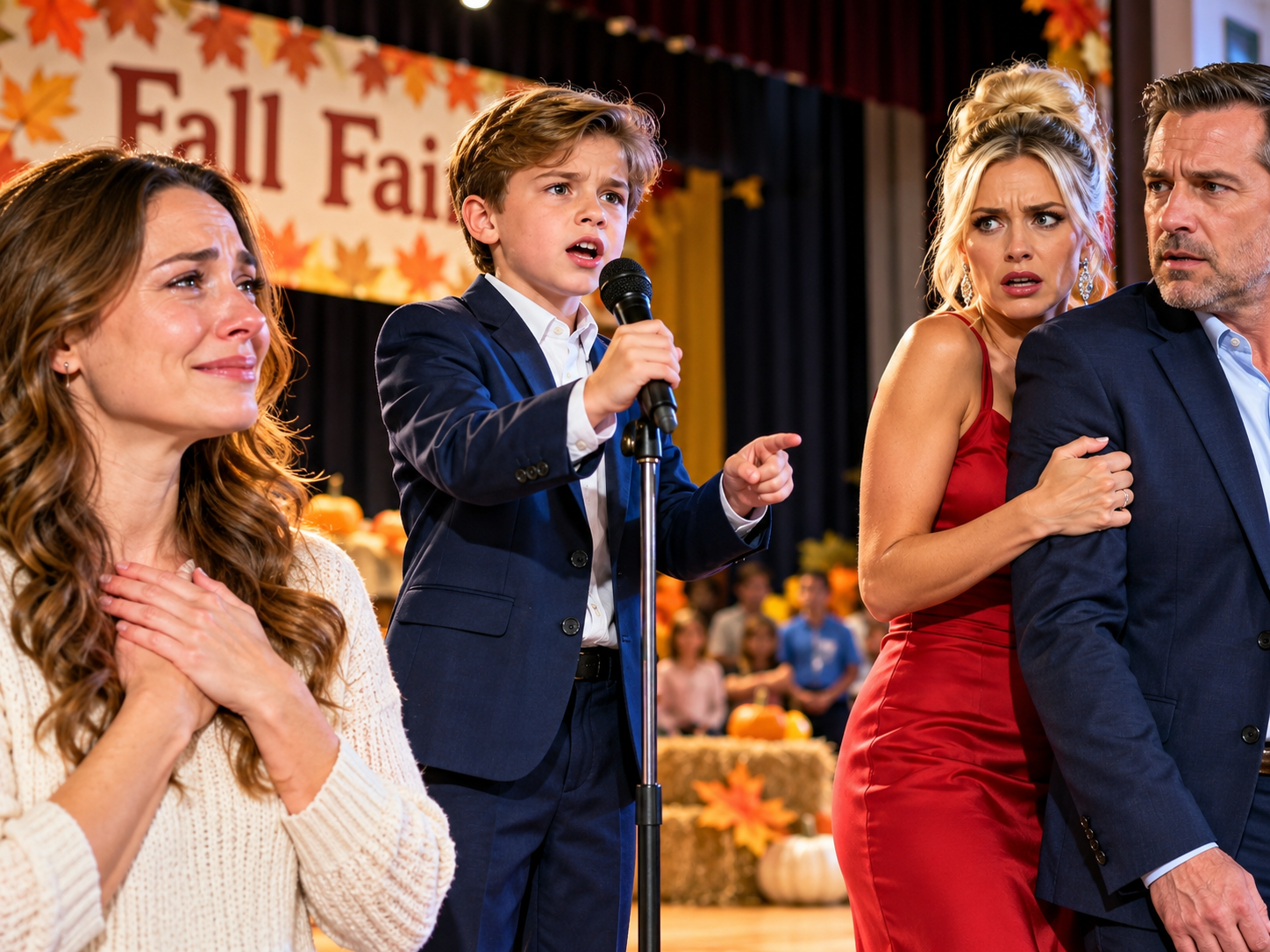
The fall fair would remain part of their family history. It would not disappear, and Vivian would never pretend that Dustin’s pain had been necessary to teach the adults a lesson. But it no longer defined every encounter between them. The microphone, the recording, and Annabelle’s whispered demand had exposed a truth the family could no longer ignore: a child notices not only what adults say, but what they laugh at, excuse, and allow. What happened afterward mattered just as much. Nigel had to learn to act differently, Annabelle had to decide whether she could respect boundaries, and Vivian had to give her son room to rebuild relationships at his own pace.
Most importantly, Dustin had begun to understand that he could love his father without agreeing with everything his father did. He could be kind to Annabelle without accepting hurtful comments. He could tell his mother he was happy after a visit without worrying that she would feel left behind. None of these lessons arrived all at once, and none guaranteed that the adults would never make another mistake. They gave him something more useful than a promise of perfection: the knowledge that his voice belonged to him, and that he was allowed to use it.
When Vivian switched off the hallway light, she heard a small movement from Dustin’s room. He had turned over in his sleep, shifting the blankets around his shoulders. The house settled into quiet, the ordinary kind that did not depend on anyone swallowing a feeling or pretending a hurtful joke was harmless. Vivian paused, listening for a moment, then continued toward her own room. Their family was still imperfect, still learning, still made of separate homes and complicated relationships. But the silence no longer felt like a warning. It felt like rest.
Click here to continue reading: PART 13: The Question Dustin Finally Asked
My Ten-Year-Old Son Had Been Keeping a Secret About His Father’s Girlfriend, and I Finally Understood His Silence
Part 12 of 20