I could not tell how long I lay on the concrete.
Time had broken into fragments: the sting of snow against my face, the distant hum of a passing car, the pain that tightened across my abdomen and then loosened just enough for me to believe I might survive it.
I tried to reach for my phone.
It had slipped from my pocket when I fell and landed several feet away, near the bottom step. I could see its dark screen, but my fingers would not cooperate when I tried to crawl toward it.
My breath came in short, uneven pulls.
The blood beneath me had spread farther than I wanted to look. I kept my eyes on the porch railing instead, fixing on the chipped patch of white paint where I had once hung a wreath for Christmas. It was a ridiculous thing to notice, but I needed something familiar while my body seemed to be turning into a place I could no longer trust.
The baby.
I placed both hands against my stomach.
"Please," I whispered. "Please move."
Nothing happened.
I had felt her move during breakfast. She had pressed a tiny foot against my ribs while I sat at the kitchen table, and I had smiled despite the argument I was already having with Evan in my head. I had imagined telling her about it when she was older, how she had been impatient to meet the world.
Now I could not remember the last definite movement.
I tried to call out again, but the sound came out weak.
A car slowed on the road.
For a moment, I thought it was Evan returning. I turned my head toward the driveway, and the movement made the edges of my vision darken.
A woman stepped out of a silver sedan.
She wore a long green coat and carried a paper cup, which she dropped as soon as she saw me. It rolled across the driveway, spilling coffee onto the snow.
"Oh, my God."
She hurried toward me, then stopped just short of touching my body.
"Can you hear me?"
I tried to nod.
"My name is Linda. I'm calling 911, all right? Don't try to get up."
Her hands shook as she pulled out her phone. She knelt beside me, careful to keep her knees away from the blood, and spoke rapidly to the dispatcher.
"She's pregnant. Very pregnant. She's fallen, and there's blood everywhere. I don't know how long she's been here."
Linda glanced toward the road.
"Was someone with you?"
I tried to answer.
"My husband."
"Where is he?"
I looked toward the place where the truck had disappeared.
"Gone."
She went silent for half a second.
Then she turned back to the dispatcher and gave the address again, more clearly this time.
I clutched her sleeve when another wave of pain passed through me.
"My baby."
"I know. The ambulance is coming."
"Please tell them. Tell them she's almost due."
"I will."
She kept talking to the dispatcher while holding my hand. I could feel her thumb moving across my knuckles, a small, steady motion that helped me remain aware of the world around me.
I had spent the morning begging my husband to care whether our daughter had a safe place to sleep.
Now a stranger was kneeling in the snow, trying to keep me alive.
The ambulance arrived with its siren wailing. Two paramedics hurried toward us carrying equipment, and one immediately knelt beside my head.
"Ma'am, can you tell me your name?"
"Mia."
"Mia, I'm Daniel. We're going to help you. Don't try to move."
He checked my breathing, asked whether I had lost consciousness, and pressed a gloved hand against my wrist. His colleague examined the blood beneath me, then spoke into a radio.
"Late-term pregnancy. Significant abdominal trauma. Possible placental abruption. We need obstetrics ready on arrival."
The words meant little to me. I understood only that they were moving quickly and that neither of them looked comfortable with what they were seeing.
"Is my baby alive?" I asked.
Daniel looked directly at me.
"We're going to get you to the hospital as fast as we can. Keep talking to me, Mia."
It was not an answer.
They secured me to a stretcher and lifted me carefully. Even with their movements controlled, the change in position sent pain through my abdomen. I cried out and grabbed the side of the stretcher.
Daniel leaned closer.
"Look at me. Slow breaths. That's it."
The ambulance doors closed, cutting off the winter air.
As we sped toward the hospital, a paramedic inserted an intravenous line while another checked my blood pressure. Someone asked about my due date, my medical history, and whether I had felt the baby move since the fall.
I could barely answer.
Then the monitor began sounding an alarm.
The paramedic nearest my head glanced at the screen. His expression tightened.
"Let's get an update from the hospital."
I gripped the blanket covering my chest.
"What is it?"
He adjusted the equipment without looking away from it.
"We're making sure the team is ready for you."
I had heard that kind of careful answer before, usually from people trying to keep me from worrying. It had never made me feel better.
"Please," I said. "Tell me if she's in trouble."
He finally met my eyes.
"Your condition is serious. The doctors will assess both of you as soon as we arrive."
I turned my face toward the ambulance window.
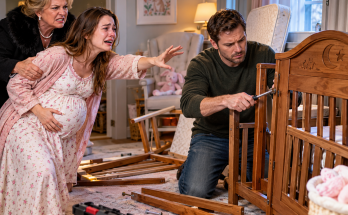
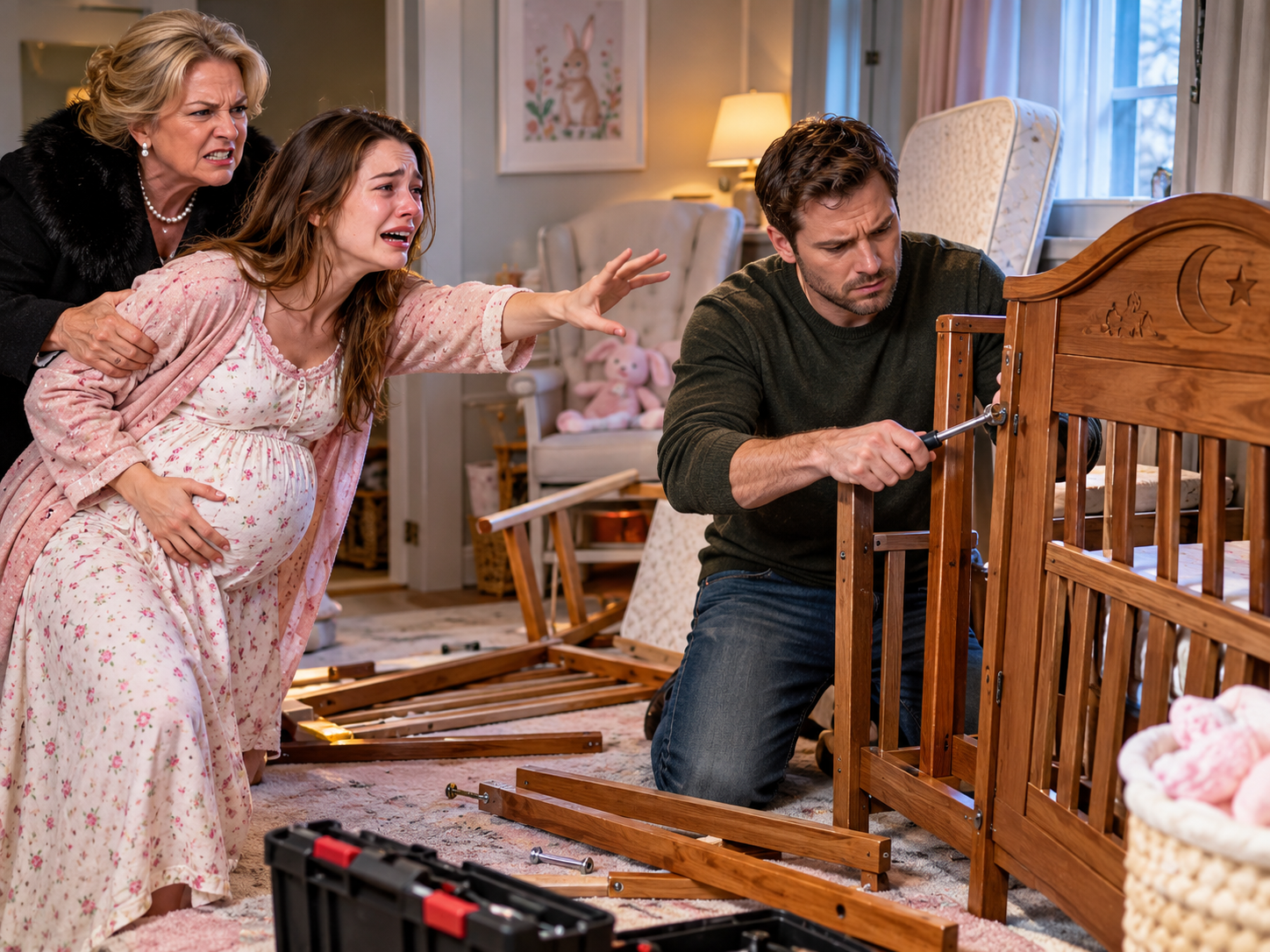
Snow streaked across the glass. Houses and bare trees flashed past, blurred by the speed of the vehicle. Somewhere beyond that road, my father was buried beneath the same winter sky. I thought of the crib he had built, the tiny moon carved into the wood, and the words he had written where only someone looking closely would find them.
May she always have a place where she is safe.
I had thought safety meant preparing enough blankets, installing the car seat, and making sure the nursery was ready before the baby came.
I had not understood how quickly those preparations could become meaningless.
When we reached the hospital, a team was waiting. The paramedics transferred me to a hospital bed, and the corridor became a blur of white coats, bright lights, and urgent instructions.
A nurse asked whether Evan was coming.
I tried to shake my head.
"He left."
She paused, just long enough for me to notice.
"All right, honey. We'll take care of you."
They wheeled me into an examination room. Someone cut away the lower part of my robe. A doctor pressed the ultrasound probe against my abdomen while another nurse attached monitors and asked me to confirm my name and date of birth.
I stared at the ceiling.
"Can you see her?" I asked.
The doctor did not answer immediately.
He adjusted the probe, moved it slightly, and looked at the monitor. A nurse stood beside him, watching his face.
"Doctor?"
He spoke to the nurse in a low voice.
"Get the obstetric team. Now."
My heart began to pound.
"What does that mean?"
He turned toward me.
"Mia, the impact may have caused the placenta to separate from the uterine wall. We need to deliver your baby urgently."
I did not understand every word, but I understood urgently.
"Is she alive?"
He looked back at the monitor.
"We're trying to assess her heartbeat. We cannot afford to wait."
I began to cry.
"Please save her."
The nurse took my hand.
"We're doing everything we can."
The next few minutes passed in a confusion of movement. Someone explained that I needed an emergency cesarean section. Another person asked whether I had any allergies. A nurse contacted the operating room while the doctor continued examining me.
I asked about Evan.
No one knew where he was.
I asked them to call him.
The nurse beside me said she would try, but there was no time to wait for anyone's permission or arrival. My daughter's life depended on the people standing around my bed, and every second mattered.
As they wheeled me toward the operating room, I remembered the truck leaving the driveway.
I remembered Evan's face.
I had begged him to come back, and he had chosen to drive away.
The memory settled inside me with a terrible finality. Whatever happened in the next few minutes, I would never again be able to tell myself that he had simply failed to understand how much I was hurting.
He had seen me on the ground.
He had heard me scream.
He had left.
The operating room doors opened, and the lights above me seemed brighter than anything I had ever seen. A nurse placed an oxygen mask over my face while the anesthesiologist spoke calmly beside my head.
"You're in good hands, Mia. We're going to take care of you."
I tried to hold on to those words.
Then the room became a series of voices, movements, and unfamiliar sensations. I heard the surgeon asking for instruments. I heard someone report my blood pressure. I heard the anesthesiologist tell me to keep breathing slowly.
I could not see my daughter.
I could not hear her.
I wanted to ask whether she was still there, whether she could feel my hand resting against my stomach, whether she knew that I had been trying to protect her.
But the medication was taking effect, and my thoughts began slipping away from me.
The last thing I remember before the darkness was whispering my father's name.
When I woke, my throat was dry, my abdomen hurt, and a nurse was adjusting the blanket over my legs.
I tried to sit up.
"Easy," she said, placing a hand against my shoulder. "You've had surgery."
"My baby."
The nurse looked at me.
For a moment, I thought she might smile. I thought she might tell me that my daughter was resting nearby, wrapped in a pink blanket, waiting for me to open my eyes.
Instead, she called the doctor.
He came in a few minutes later, his expression gentle but serious.
"Mia, your daughter was delivered by emergency cesarean section. The separation of the placenta had reduced the oxygen reaching her. Our neonatal team worked on her immediately."
I could hear my pulse in my ears.
"Where is she?"
"She's in the neonatal intensive care unit. She's alive, but she's very sick. She's receiving breathing support, and the next twenty-four to forty-eight hours will be important."
My body seemed to loosen all at once.
Alive.
The word was not a promise, but it was something I could hold.
"Can I see her?"
"As soon as your condition allows us to move you safely. The neonatal team will explain everything when you're ready."
I covered my mouth with my hand and cried without making a sound.
My daughter was alive.
She had arrived in a world where her father had driven away while her mother lay bleeding in the snow. She had been born into an emergency that neither of us had chosen, and I could do nothing except lie in a hospital bed and hope she would survive it.
Then I remembered that I had not yet told anyone the full truth.
"Doctor?"
He moved closer.
"I need you to understand something. I fell because my husband's mother pushed me. My husband saw me on the ground, and he left."
The doctor's expression changed.
"Did someone witness what happened?"
"A woman found me. Linda. She called the ambulance."
"Do you feel safe returning home?"
I looked at him.
For the first time since the fall, I allowed myself to consider the question without making excuses for Evan.
I did not know whether Patricia would admit what she had done. I did not know what Evan would tell his family or what he would say when he discovered the seriousness of our daughter's condition.
But I knew I could not return to a home where my husband had watched me beg for help and decided that leaving was easier.
"No," I said. "Not with them."
The doctor nodded and told the nurse to contact the hospital's social worker. He did not pressure me to explain further. He simply made sure someone would speak with me about safety, documentation, and the options available while I recovered.
Later that afternoon, Linda came to see me.
She stood near the doorway, holding a small paper bag containing my phone and the belongings the paramedics had collected. Her coat was folded over one arm, and she looked as though she had not stopped thinking about the driveway since she left it.
"I hope it's all right that I came," she said.
I reached for her hand.
"You saved my life."
She shook her head. "I found you. The paramedics and doctors did the rest."
"If you hadn't stopped…"
I could not finish.
Linda pulled a chair closer to the bed.
"You don't have to explain anything right now."
I looked down at my phone. The screen had cracked, but it still worked when I pressed the power button.
There were several missed calls from an unfamiliar number and a message from Evan.
What happened? Mom says you fell. Why didn't you call me?
I stared at the words.
He had not called the ambulance. He had not returned to the house. He had not asked the hospital whether our daughter was alive.
He had asked why I had not called him.
A second message appeared.
I just heard the baby was delivered early. Tell me what's going on.
I felt a strange calm settle over me.
For months, I had believed that the right words might reach him. I had thought there was a version of the truth he could hear without becoming defensive, a way to explain my pain that would finally make him understand.
Now I knew the problem was not my explanation.
He had been given every opportunity to act with compassion. He had chosen not to.
I handed the phone to Linda and asked her to put it in the bedside drawer.
Then I asked for a nurse to take me to the neonatal intensive care unit as soon as it was medically safe.
I needed to see my daughter.
I needed to look at the child my father had never met and tell her, even if she was too small to understand, that I was still here.
The next morning, a nurse helped me into a wheelchair. Every movement hurt, and the incision across my abdomen made it difficult to sit upright. But when the neonatal unit doors opened, I forgot the pain for a moment.
My daughter lay inside an incubator beneath a cluster of medical equipment. Her skin was delicate and pale, her fingers no larger than the tip of my thumb. A small tube supported her breathing, and wires connected her to monitors that measured the fragile work her body was trying to do.
A nurse stood beside me.
"She's fighting hard," she said. "We're watching her closely."
I leaned forward as far as I could.
"Hello, sweetheart."
My voice broke.
"I know this wasn't how we planned to meet."
I reached through the opening in the incubator and touched her hand with one finger. Her skin was warm. After a moment, her tiny fingers curled against mine.
I began to cry.
For the first time since the fall, the tears did not feel like helplessness. They came because she was there, because she had survived the night, because I had something to fight for beyond the hope that Evan might someday become a different man.
I stayed beside her until the nurse reminded me that I needed rest.
Before I left, I asked whether I could bring a photograph of my father.
"Of course," she said. "We can help you find a safe place for it."
I returned to my room and opened the photograph album on my phone. There was one picture I loved most: my father sitting beside the unfinished crib, holding a tiny pair of pink socks in his broad hands. He was smiling at something outside the frame, and the illness that would take him was already visible in the hollows beneath his eyes.
I sent the photograph to the nurse and asked her to print it.
Then I contacted my sister and asked her to bring my identification, a change of clothes, and the folder containing my financial documents.
I did not tell her everything over the phone. I was too tired, and I wanted to speak to someone who could sit beside me while I explained what had happened.
But I gave her one instruction.
"Please don't let Evan or Patricia into my room without asking me first."
She did not question me.
"All right," she said. "I'm coming."
That afternoon, the social worker helped me arrange a formal report about the fall. Linda agreed to provide a statement describing what she had found and what I had told her at the scene. The hospital documented my injuries and the circumstances I had reported. I saved the messages from Evan and Rachel, along with the photographs I had taken of the dismantled crib and the inscription beneath its headboard.
I did not know what a legal investigation would uncover, and I did not pretend to understand every decision I would have to make. I only knew that the truth needed to exist somewhere beyond my memory.
When the nurse returned with my father's photograph, I asked her to place it near the incubator where my daughter could eventually see it.
Then I turned my attention to the other unfinished matter in my life.
The money.
I asked my sister to bring my laptop. When it arrived, I logged into our joint account and downloaded the statements from the previous several months. I found the transfers Evan had dismissed as ordinary banking activity, then followed the dates and amounts through the records.
The money had not gone into a savings account in our names.
Several transfers had gone to an account I did not recognize. Others had been used to pay expenses connected to Rachel's household. There were purchases for nursery furniture, a deposit to a moving company, and payments that had no obvious connection to our own expenses.
I sat staring at the screen, my hands resting on either side of the laptop.
The money I had believed we were saving for our daughter's arrival had helped prepare Rachel's home for her twins.
I could not yet determine whether every transfer had been made without my knowledge or what legal consequences might follow. But the records were clear enough to show that Evan had been making financial decisions he had never honestly explained.
I saved copies and sent them to a secure email account he could not access.
Then I closed the laptop.
My daughter was still in intensive care. I had a long recovery ahead of me, and I would need help navigating the practical and legal questions waiting beyond the hospital walls. I did not have the strength to resolve everything in one afternoon.
But I had stopped pretending that the problems would disappear if I remained quiet.
Three days after the fall, my daughter was still receiving intensive care. Her condition remained fragile, but the doctors told me there were encouraging signs. I learned to recognize the small changes in her breathing and the different tones of the monitors. I learned how to touch her through the incubator without disturbing the equipment, and I learned that loving her meant living with uncertainty one hour at a time.
Evan came to the hospital once.
He arrived with Patricia, who remained near the elevator while he approached my room. My sister was sitting beside my bed when he entered, and she stood immediately.
"Leave," she told him.
Evan ignored her and looked at me.
"Mia, we need to talk."
I did not invite him closer.
"About what?"
His eyes moved toward the door, where Patricia was waiting.
"About what happened. Mom says you slipped."
"I fell after she pushed me."
"She says she was trying to get past you."
"And you saw me on the ground."
His mouth tightened.
"I panicked."
"You started the truck."
"I didn't know how badly you were hurt."
"I was screaming for you to call an ambulance."
He looked down at the floor.
For a moment, I could see the man I had married, the one who had once held my hand in a hospital waiting room when we thought I might miscarry. I remembered how frightened he had looked then, how he had promised that whatever happened, we would face it together.
I had spent a long time holding on to that memory.
But it did not change what he had done.
"You left me bleeding in the snow," I said. "You left while our daughter was still inside me, and you didn't call for help."
His eyes filled with tears, but I could not tell whether he was grieving for us or for the consequences he was beginning to face.
"I made a mistake."
I looked at him.
"A mistake is forgetting an appointment. A mistake is buying the wrong thing. You saw me injured and drove away."
He swallowed.
"What do you want me to do?"
The question would once have broken my heart. I would have told him to apologize, to promise he would change, to show me that the marriage could still be saved.
Instead, I said, "I want you to leave."
"Mia—"
"Not today. Not until I am ready to speak with you. And not near our daughter without the medical team's permission."
His face hardened.
"You can't keep my child from me."
"I'm not making decisions about the future in this room. I'm protecting my recovery and her care right now."
He opened his mouth, then closed it.
I watched him struggle to find a response that would return the conversation to familiar ground, where I would become the unreasonable wife and he would become the man forced to defend himself.
I did not give him that opening.
My sister walked him to the door.
Patricia was waiting outside, and I heard her say something sharp as they left. Evan answered in a low voice. Their footsteps faded down the corridor.
I leaned back against the pillows and closed my eyes.
It hurt to lose the future I had imagined. It hurt to accept that the man who had promised to protect our family had become someone I could not safely trust. It hurt to think about the crib, the winter morning, and the child who had nearly died before she had a chance to open her eyes.
But beneath the grief was a certainty I had not felt in years.
I would not return to that house and pretend the fall had been an unfortunate accident. I would not allow Patricia to rewrite what she had done, and I would not let Evan's shame become another burden I was expected to carry for him.
My father had built a crib for his granddaughter because he wanted her to have a place where she was safe.
I could not give her the beginning he had imagined.
I could give her the truth, a mother who listened when something was wrong, and a home where love would never be used as an excuse to take away her dignity.
That evening, I returned to the neonatal unit.
My daughter lay beneath the soft glow of the incubator lights, her tiny hand resting beside the photograph of the grandfather she would never meet. I touched her fingers and watched them curl around mine.
"Your grandpa made you something beautiful," I whispered. "I'm sorry you didn't get to sleep in it yet."
She did not answer, of course. She was still fighting to grow stronger, and I had no way of knowing what the coming days would bring.
I rested my forehead against the edge of the incubator.
"But I'm here, sweetheart. I'm not going anywhere."
For the first time since the truck disappeared down the road, I believed the words without needing anyone else to promise me they were true.
Click here to continue reading: PART 5: My Daughter Was Fighting for Her Life While My Husband Tried to Rewrite the Morning He Left Me Bleeding in the Snow
Three Days Before My Daughter Was Born, I Discovered My Husband Had Decided Her Most Precious Possession Belonged to His Sister
Part 4 of 12