The first thing I saw was my father's hands.
Not his face, not the photographs I kept beside the rocking chair, but his hands as I remembered them: broad palms, square fingertips, and a thin white scar across the knuckle of his right thumb. In my memory, he was standing in his garage, brushing sawdust from the sleeves of his old flannel shirt while he inspected the walnut crib he had spent six weeks building for my daughter.
Then I heard the metallic scrape of a wrench against wood, and the memory disappeared.
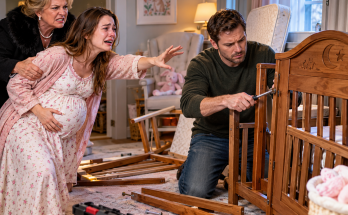
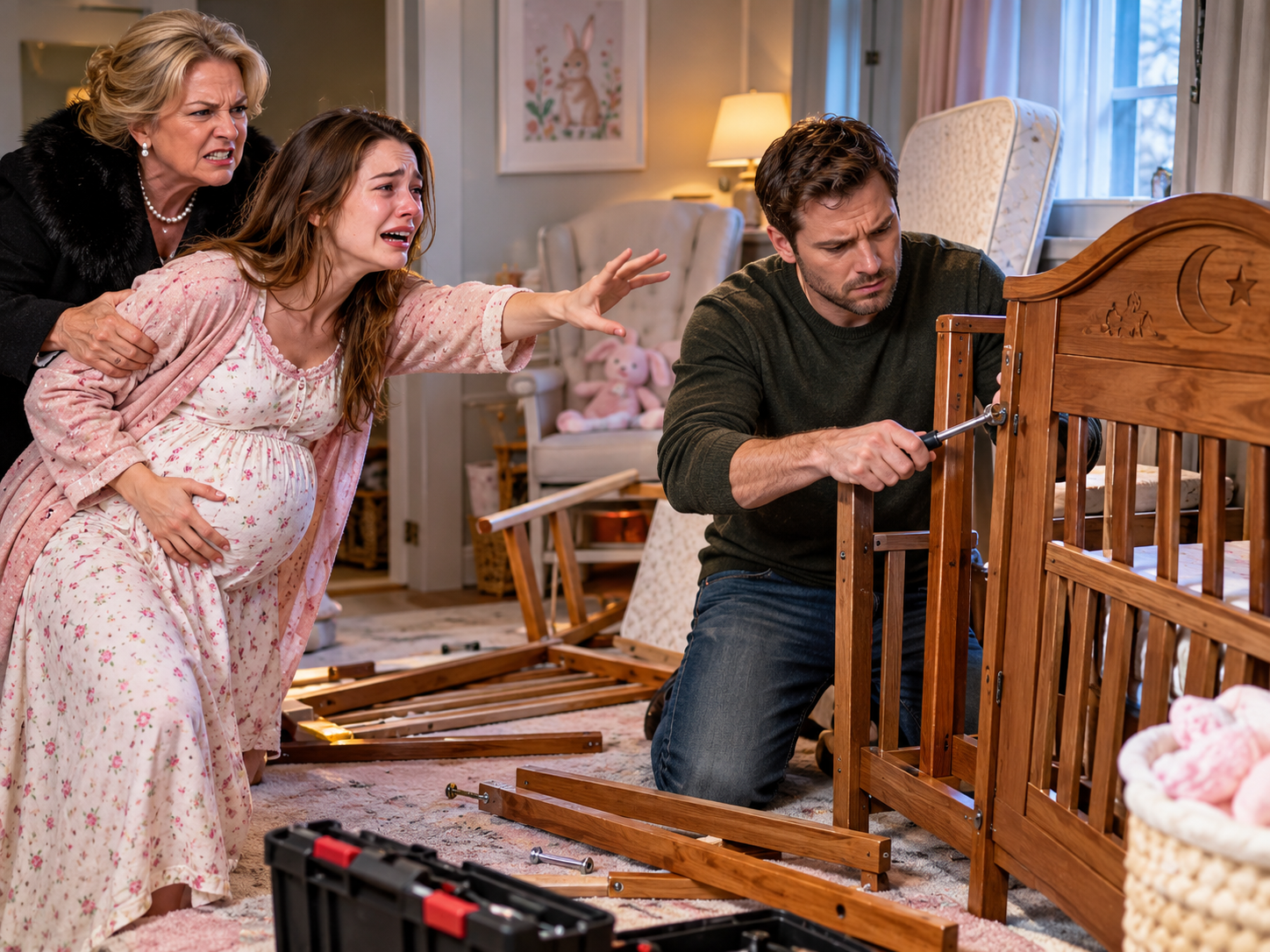
Evan was kneeling beside the crib with one of its side rails already removed. A collection of screws lay in a small plastic container near his knee. He had folded a moving blanket over the floor to protect the wood, which might have seemed considerate if he had not been taking apart the one thing in our house that I had begged him, repeatedly, to leave alone.
For a few seconds, I stood in the doorway without speaking.
The nursery had taken months to prepare. Pale cream walls, white curtains, a secondhand dresser I had sanded and painted myself, and tiny dresses arranged by size in the closet. The air smelled of freshly washed cotton and the lavender detergent my father used to buy my mother. Sunlight usually fell across the rug in the afternoons, making the whole room feel warmer than the rest of the house.
That morning, winter light barely reached the windows.
"What are you doing?"
Evan glanced over his shoulder. He looked irritated, not surprised.
"Getting this ready to move."
He turned back to the crib and loosened another bolt.
I looked at the empty space where the side rail should have been. "Move where?"
"My sister's."
The answer was so casual that it took a moment to understand it.
I walked farther into the room, one hand pressed against the underside of my stomach. Our daughter had been moving less dramatically that morning, shifting occasionally beneath my ribs, and every small movement reminded me how close we were to meeting her. My due date was three days away. The hospital bag sat beside our bedroom door. Her car seat had been installed in the back of Evan's truck two weeks earlier, after I had reminded him three times.
"You cannot be serious."
He sighed, set the wrench down, and looked at me as though I had asked him to explain something painfully obvious.
"Rachel needs a crib. She's having twins, Mia. Two babies. She doesn't have everything ready, and this one's just sitting here."
I stared at him.
"Just sitting here?"
"It's not like we're using it yet."
"Our daughter will be here in three days."
"Could be a week. Could be two. The doctors are always estimating."
He spoke with the confidence of someone who had never spent a sleepless night worrying about whether his child would arrive safely. I had spent the last month counting kicks, tracking contractions that turned out to be false alarms, and reading the hospital's instructions until I knew the emergency number by heart.
Evan had complained when I asked him to attend the final prenatal appointment. He had said his schedule was too busy, then spent the afternoon helping Rachel choose curtains for the spare bedroom in her house.
Now he was dismantling our daughter's crib.
"My father made that," I said.
Something changed in his expression, but only briefly. His eyes flicked toward the engraved wooden plaque mounted above the crib, where my father's name and the year he finished it were carved in small, careful letters.
Then Evan shrugged.
"I know."
"No, I don't think you do."
He rose and picked up the detached rail. He was tall enough that the wood looked almost weightless in his hands, and he carried it toward the nursery door without glancing at me.
My father had begun building the crib after I told him I was pregnant. At the time, he had already been sick for months, although he insisted on calling his illness a stubborn problem that would eventually go away. He never explained much about the treatments. He simply kept working, taking breaks when the pain became too much and returning to the garage whenever he felt strong enough.
I remembered finding him one afternoon asleep in his chair beside the workbench, his glasses crooked on his nose and a pencil still tucked behind one ear. The crib's headboard lay unfinished across two sawhorses. He woke when I touched his shoulder, then immediately asked whether I had felt the baby move.
He never got to meet her.
He died before the final coat of finish had dried.
The crib was not expensive in the way a piece of furniture from a luxury store was expensive. It was valuable because every joint had been fitted by hand, every corner smoothed until it was safe for a newborn, and every measurement checked twice. My father had chosen the walnut himself. He had even tested the finish to make sure it would be safe for a baby who might eventually chew on the rails.
I had watched him work on it from a stool in the garage, listening to him describe the things he wanted to teach his granddaughter when she was old enough to understand.
Now Evan was carrying the first piece out of the room.
"Put it down."
He stopped in the doorway.
"What?"
"Put the rail down."
His mouth tightened. "Mia, don't start."
"I'm not starting anything. You're taking apart my daughter's crib without asking me."
"Our daughter's crib," he corrected, though his tone suggested the distinction annoyed him. "And we're lending it to Rachel. It's not like we're giving it away forever."
"Then why are you dismantling it?"
"Because it won't fit in the truck otherwise."
I looked past him at the remaining pieces. "You could have asked me."
"I knew you'd make a big deal out of it."
There was the truth, delivered without shame.
He had already made the decision. He had simply avoided telling me because he knew I would object, and now he expected the sight of the dismantled furniture to force me into accepting what he had done.
A chill passed through me that had nothing to do with the weather.
"When did you decide this?"
"Yesterday."
"And you didn't think to mention it?"
"Rachel called Mom. Mom said we should help. That's what families do."
I almost laughed at that. My own father had helped me whenever he could, but he had never treated generosity as a weapon or demanded that I surrender something precious to prove my love. He had never told me that being family meant having no right to refuse.
Before I could answer, Patricia appeared in the doorway.
My mother-in-law wore a cream coat with fur around the collar and leather gloves that looked too delicate for the cold. She had been staying with us for several days, supposedly to help prepare for the birth. In practice, she had spent most of her time criticizing the food I ate, the clothes I wore, and the way I arranged the nursery.
She glanced at the disassembled crib and smiled faintly.
"Good. You're nearly finished."
I turned toward her. "You knew about this?"
"Of course."
"And neither of you thought I should have a say?"
Patricia removed one glove, finger by finger. "Mia, don't make this unpleasant. Rachel is expecting twins. She needs the help more than you do."
I stared at her, waiting for some acknowledgment that what she was asking was unreasonable. Instead, she walked into the room and began inspecting the furniture as though she were deciding which pieces were worth taking.
"The mattress should go, too," she said. "And those sheets. They'll need everything."
"No."
She paused.
"Excuse me?"
"The crib is not going anywhere. Neither are the sheets."
Patricia looked at Evan. "See? This is exactly what I told you."
He rubbed his forehead.
"Can we please not do this right now?"
I wanted to ask him when would be a convenient time for him to respect me. Before the baby was born? After? Once every item my father had touched had been carried out of our house?
Instead, I walked toward the crib and placed my hand on the smooth headboard.
My father had carved a tiny crescent moon into one corner. It was almost invisible unless the light struck it at the right angle. He had done it because I once told him I liked looking at the moon through my childhood bedroom window.
That small detail made my throat tighten.
"Please," I said, looking at Evan. "You know what this means to me."
For the first time that morning, he seemed uncomfortable. His gaze shifted toward the window, then to the wrench on the floor.
I thought he might relent.
Then Patricia said, "Your father is gone, sweetheart. Keeping his furniture won't bring him back."
The words landed so quietly that for a moment I could not respond.
Evan looked at his mother but said nothing.
Patricia continued, "A baby needs a safe place to sleep. That's all. Rachel has two coming. You have one. There's no reason to be selfish about it."
I turned toward her.
"My daughter is not even born yet, and you're already deciding she should have less because Rachel wants more."
"That's a ridiculous way to put it."
"Is it?"
Patricia's face hardened. She had never liked being questioned, especially by me. In her mind, marrying Evan had placed me inside her family without giving me the same standing as the people who had been there before me.
I had spent years trying to earn that standing. I had hosted holidays, remembered birthdays, sent flowers when Patricia was ill, and swallowed remarks that would have ended other relationships. I had convinced myself that if I remained patient, she would eventually see me as someone worth respecting.
Instead, she had learned that patience made it easier to take things from me.
Evan lifted the headboard from the crib.
"Enough," he said. "We're leaving in twenty minutes."
I stepped in front of him.
"No, you're not."
His eyebrows rose.
"Move, Mia."
I looked at the wood in his hands, then at the man carrying it.
For years, I had believed the worst thing Evan could do was fail to stand up for me when his mother was cruel. I had mistaken his silence for weakness, his excuses for fear, and his occasional apologies for evidence that he still cared enough to change.
Standing there in the nursery, I finally understood something I had spent too long avoiding.
He was not confused about whose side he was on.
He had already chosen.
And he was waiting for me to step aside.
Click here to continue reading: PART 2: My Husband Called Me Unreasonable, His Mother Claimed the Nursery, and I Realized They Had Mistaken My Grief for Permission
Three Days Before My Daughter Was Born, I Discovered My Husband Had Decided Her Most Precious Possession Belonged to His Sister
Part 1 of 12