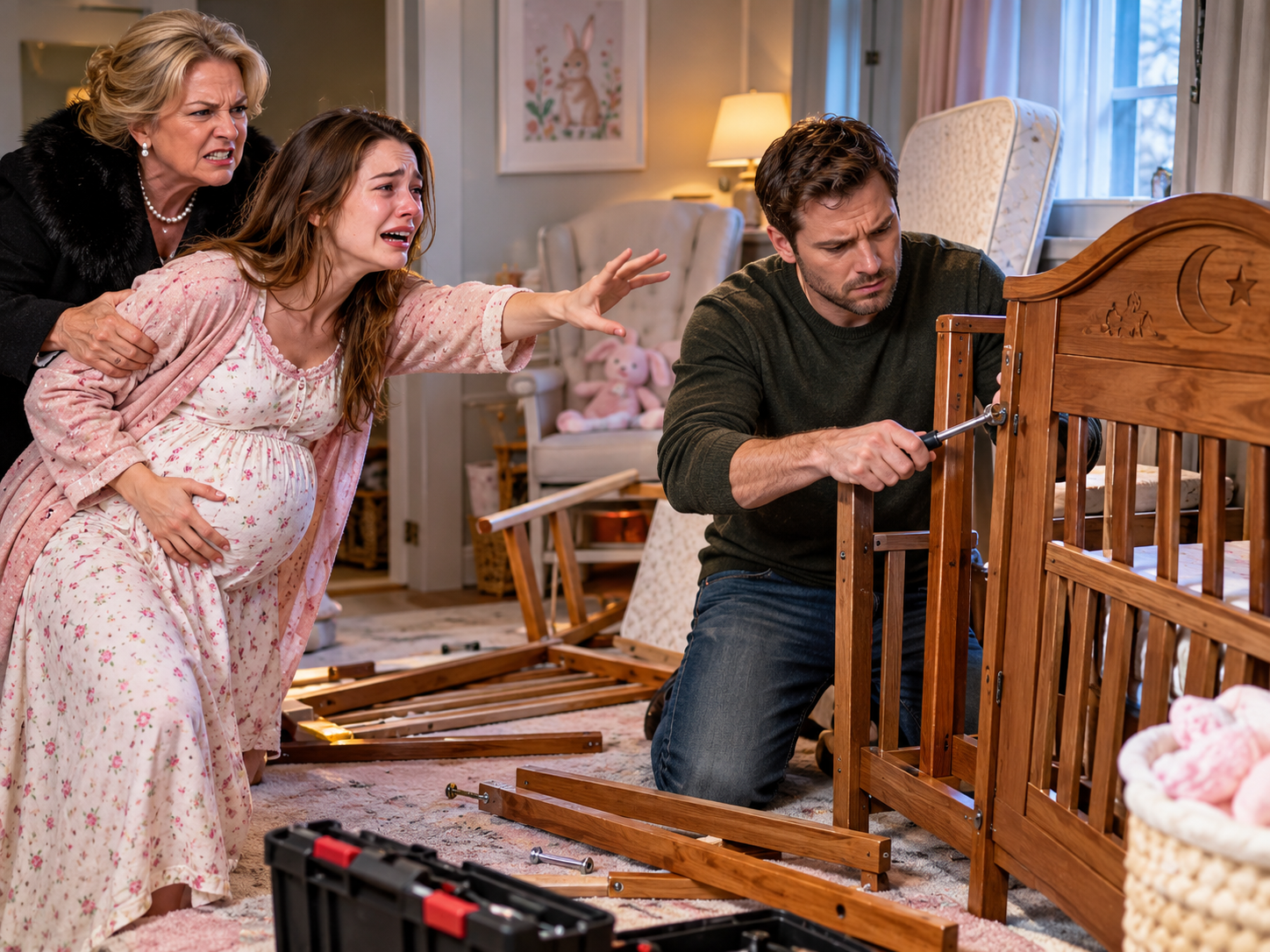
Mia’s legal consultation took place two days after she left the hospital. Claire drove her there, parked close to the entrance, and waited while Mia walked slowly from the car with one hand pressed against her abdomen. The lawyer, Ms. Bennett, had agreed to meet her in a quiet office on the ground floor. Mia brought a folder containing the bank statements, the messages Rachel had forwarded, the photograph of the dismantled crib, and the hospital documents she had been advised to preserve.
She had organized everything by date. It was the only way she could keep the events from crowding into one unbearable memory.
Ms. Bennett listened without interrupting while Mia explained what had happened at the house, what she knew about the missing money, and why Evan’s request for a private meeting made her uneasy. When Mia finished, the lawyer asked several questions about the joint account, the ownership of the crib, and whether Mia had access to copies of the relevant records.
“I have statements going back several months,” Mia said. “I can see transfers leaving the account, but I don’t have records from the account receiving them. Evan said he was moving money into an account with a better interest rate. He never showed me the account.”
“Do you know whether that receiving account was in his name, your name, or both?”
“No.”
“Then we should not assume its ownership yet. We can document what the statements show and identify what information is missing. The fact that an account is unfamiliar to you is important, but it does not tell us everything about who controls it or where every dollar went.”
Mia nodded. She appreciated the precision. Everyone in her family seemed eager to decide what the evidence meant before examining it. Ms. Bennett was willing to leave a question unanswered until there was enough information to answer it.
They reviewed the messages from Rachel. The one about Mia eventually seeing how much the twins needed was clear evidence that Evan had represented her consent to his sister. The note about taking the crib before Mia became emotional again showed that he expected resistance and intended to proceed anyway. The financial messages supported further questions about the transfers, but the lawyer warned Mia not to make accusations that went beyond what the records established.
“What about the transfer made after I was in the hospital?” Mia asked. “That one feels impossible to explain.”
“It may be significant,” Ms. Bennett said. “Keep the statement showing the date and amount, and ask the bank about the transaction through its formal process. Don’t try to access an account that isn’t yours, and don’t delete or alter any records. We can discuss the appropriate legal steps after we understand the account structure.”
Mia had expected the lawyer to tell her what to do. Instead, Ms. Bennett separated the problem into parts. There was the account, which needed documentation. There was the crib and the blanket, which required a safe approach to property recovery. There was the incident itself, which had its own factual and legal questions. And there was the marriage, which Mia did not have to resolve before taking steps to protect herself.
“You are not required to sign an agreement just because your husband brings it to you,” Ms. Bennett said. “If he sends you anything, you can forward it for review. You should avoid private confrontations while you’re concerned about your safety. Keep communications factual, and if there is an immediate threat, contact the appropriate authorities.”
“What if he says I’m refusing to cooperate?”
“You can cooperate through a safer process. Refusing an unplanned meeting is not the same as refusing to address the issues.”
The distinction stayed with Mia as she left the office. For weeks, she had been measuring herself against Evan’s descriptions of her: emotional, selfish, difficult. Ms. Bennett had not asked whether Mia was a good wife or whether Evan was a bad husband. She had asked what happened, what evidence existed, and what Mia needed to remain safe.
In the car, Claire glanced over. “How did it go?”
“I have more steps to take than I thought.”
“That sounds like a lawyer’s way of saying you have a plan.”
“It’s a plan with a lot of paperwork.”
Claire smiled. “Paperwork is better than another argument on the porch.”
Mia laughed, then winced when the movement pulled at her incision. Claire immediately reached to steady her, but Mia waved her off. “I’m all right. Just remind me not to laugh until I’m healed.”
“I’ll put it on the refrigerator.”
Back at Claire’s house, Mia found three new messages from Rachel. The first contained additional screenshots. The second included a list of purchases Evan had told her to make for the twins’ nursery. The third was longer.
I need to tell you something I should have told you earlier. Evan said you were upset about the crib, but that you had agreed to let us use it because you wanted to help with the twins. He said you were only changing your mind because your father’s things made you emotional. I believed him because I wanted to believe him. I didn’t ask you directly. I should have.
Mia read the message twice. She had known Rachel had accepted Evan’s explanation, but the details hurt in a new way. Evan had not merely assumed Mia would eventually agree. He had turned her grief into evidence that she could not be trusted to make a decision.
She pictured Rachel standing in a nursery, arranging blankets and folding tiny clothes while believing that the crib had been given willingly. It did not excuse Rachel’s failure to ask, but it helped Mia understand how Evan’s version of events had spread. He had offered each person a story that made his actions convenient. Rachel was helping her sister prepare for twins. Patricia was keeping peace in the family. Evan was moving money responsibly. Mia was the only obstacle.
Mia typed a reply, then erased it. She wanted to tell Rachel that she had no right to decide what grief made Mia capable of. She wanted to ask how Rachel could have looked at the carved crescent moon and not wondered whether Mia had truly agreed to give away the last gift her father had made for his granddaughter.
Instead, she wrote: Thank you for sending the records. I need you to understand that I never agreed to give away the crib. I’m not ready to discuss forgiveness, but please keep the original messages and don’t allow anyone to remove the remaining pieces.
Rachel replied: I understand. I won’t.
Mia did not know whether Rachel fully understood. She had said she was sorry, and she was now helping preserve the evidence. Those actions mattered. They did not erase the decision she had made when she accepted the crib without asking Mia herself.
That afternoon, Rachel sent one more file. It was a screenshot of a conversation between her and Evan, dated the day before the fall. Rachel had asked whether Mia was really comfortable with the arrangement. Evan had answered, She’ll get over it. Mom will handle her if she starts making a scene.
Mia felt the room go quiet around her.
The words were not proof that Evan had planned for her to fall. She reminded herself of that immediately. They did not establish what Patricia intended, and they did not explain every moment that had followed on the porch. But they revealed the attitude Evan had carried into the confrontation. He had expected his mother to control Mia’s reaction. He had treated Mia’s objection as a scene to be managed, not a boundary to be respected.
Mia forwarded the screenshot to the folder she had prepared for her lawyer. Then she sat at the kitchen table with both hands flat against the wood, trying to understand how a person could share a home, a bed, and plans for a child with someone who spoke about her that way.
Claire found her there. She read the screenshot, her face hardening as she reached the final line.
“I want to call him,” Claire said.
“No.”
“I want to ask him what kind of person writes that.”
“He’ll say it was a joke, or that I’m taking it out of context.”
“Then he can explain it to your lawyer.”
Mia looked at her sister. “I keep thinking about how many times I accepted a small explanation because I wanted the marriage to work. If he forgot something, I told myself he was busy. If he dismissed me, I thought he was stressed. If Patricia said something cruel, I tried to keep the peace because I didn’t want to make him choose between us.”
“You were trying to make a life with him,” Claire said. “That doesn’t make you responsible for the way he treated you.”
Mia looked away. The hardest part was not only that Evan had hurt her. It was the realization that she had spent years trying to make his behavior understandable, sometimes at the expense of trusting her own judgment.
The next morning, she called the bank. After verifying her identity, she asked what information could be provided about the unfamiliar transfers from the joint account. The representative explained which transaction records were available and what additional steps might be needed to identify the receiving account. Because the account was shared, certain actions could require further verification or legal guidance. Mia did not try to freeze everything or move the remaining balance without advice. She requested the available records and wrote down the reference number for the inquiry.
The amount transferred was not small. It included several payments spread across weeks, with one larger transfer that aligned with the date Evan had told her he was setting aside money for the baby. Mia compared the entries with the expenses Rachel had documented. Some purchases matched nursery items. Others did not. The records suggested a connection between the shared savings and Rachel’s preparations, but they did not yet explain the full route of the money.
She added the bank’s information to her file and sent Ms. Bennett a concise note asking what to request next. She was learning that patience was not the same as surrender. It was possible to take the matter seriously without inventing answers.
Later that day, the authorities following up on the incident contacted Mia to arrange a statement. She agreed and asked whether she could provide the messages and photographs she had preserved. The person she spoke with told her how to submit them and advised her not to confront Evan or Patricia about the evidence. Mia wrote down the instructions, then sat quietly after the call.
The formal process frightened her. Once she gave a statement, the incident would no longer be something she could keep within the private boundaries of her marriage. Other people might ask questions. Evan might become angry. Patricia might tell relatives that Mia was exaggerating. But keeping quiet had not protected her on the porch, and it would not restore the truth now.
That evening, Rachel called instead of messaging. Mia almost let the call go unanswered, but finally accepted it.
“I don’t expect you to forgive me,” Rachel said immediately. Her voice sounded tired. “I just need you to know I didn’t understand how far Evan had gone with the money. He told me it was his decision to help me. He said you were fine with it.”
“You didn’t ask me.”
“I know.”
“You knew Dad made that crib. You knew what it meant to me.”
“I did.” Rachel’s voice broke. “I told myself you’d rather have your niece and nephews comfortable than keep a crib sitting in your house. I told myself that because it made what I was doing easier.”
Mia closed her eyes. Rachel’s admission was more honest than the excuses she had heard from Evan, but honesty did not undo the harm.
“Did you ever wonder why he needed to take it while I wasn’t home?”
Rachel was silent for a moment. “I thought you would argue with him.”
“That’s not the same as wondering whether he had the right.”
“No,” Rachel whispered. “It isn’t.”
Mia wanted to end the call. She wanted to tell Rachel that she had lost the right to speak as a sister when she helped take the crib. But she also understood that the truth mattered more than making Rachel feel the full weight of her anger in one conversation.
“I need you to keep helping with the records,” Mia said. “And I need you not to share anything about my medical care or where I’m staying with Evan or your mother.”
“I won’t.”
“If that changes, tell me.”
“I promise.”
When the call ended, Mia placed the phone on the table and looked at the photograph of her father’s crib. The crescent moon was still there, its uneven edge catching the light. The inscription beneath the headboard remained intact. Someone had taken the crib apart, but they had not erased the words her father had carved into it.
She could not know whether she would ever place her daughter inside that crib. She could not know whether Rachel would become someone she could trust again. But she knew what the new evidence had changed: she no longer had to rely only on her memory of the porch or her feeling that something had been wrong with the money. There were messages, dates, statements, and a witness to the aftermath. There were people outside Evan’s family who could examine them without asking Mia to protect his reputation.
Before bed, she wrote one sentence in her notebook: I do not have to prove what he intended before I can respond to what he did.
Then she closed the notebook, set her alarm for the next hospital visit, and rested her hand over the place where her daughter had once moved beneath her ribs.
Click here to continue reading: PART 12: When Patricia Demanded the Crib Back for Herself, Mia Discovered That the Family’s Fight Was No Longer About Furniture or Money
Three Days Before My Daughter Was Born, I Discovered My Husband Had Decided Her Most Precious Possession Belonged to His Sister
Part 11 of 12