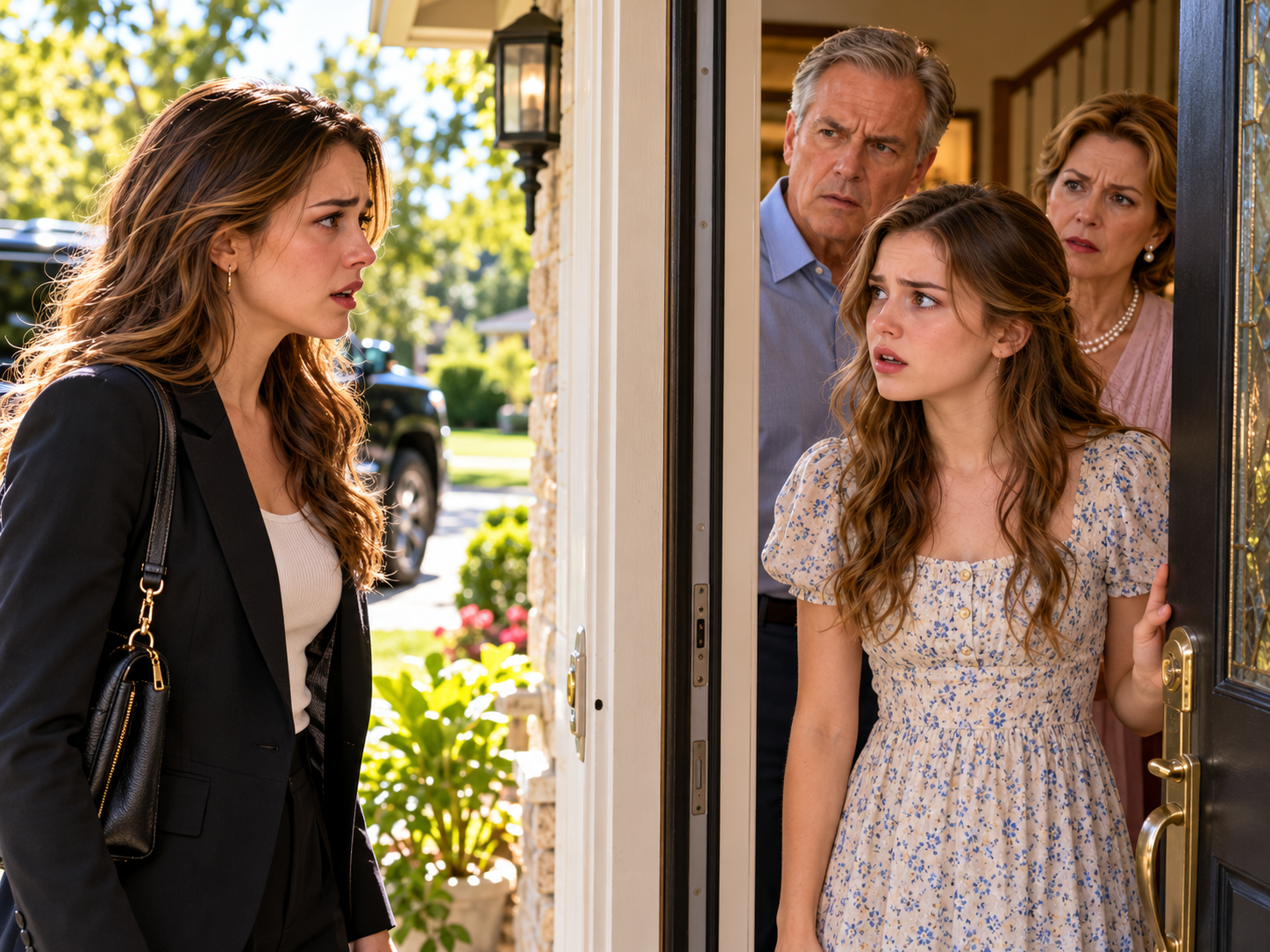
Lily returned to Alabama on Sunday evening, carrying a small sketchbook and a bag of clothes she had bought with her own money. I drove her to the airport, and we hugged beside the security entrance before she joined the line.
“Text me when you land,” I said.
“I will.”
“And if you need anything—”
“I know.” She smiled. “You'll answer.”
I laughed softly.
“Yes, I will.”
She walked away, then turned and lifted her hand before disappearing into the crowd.
I watched until I could no longer see her.
For the next several days, we spoke regularly. She sent me photographs of the sketchbook she had started filling with ideas for handmade clothing. I sent her a few articles about small-business development, making it clear that they were resources rather than instructions.
She was beginning to build a life that belonged to her.
I wanted to support that without turning her choices into a continuation of my own story.
Then my mother called.
I almost let the phone ring out.
Her name appeared on the screen, and I sat staring at it until the final ring. I had not spoken to her since returning to Denver, and I wasn't certain what she wanted. An apology? Reassurance that Lily still loved her? Another explanation for why she had done what she had done?
I answered.
“Hello.”
“Anna?”
Her voice was thin and uncertain.
“Yes.”
“I know you may not want to speak to me.”
I said nothing.
She took a shaky breath.
“I wanted to ask whether Lily arrived home safely.”
“She did.”
“Good.”
A long silence followed.
“I've been thinking about what you said,” she continued. “About being afraid of what people would think.”
I leaned back in my chair.
“What about it?”
“I think you were right.”
I had heard my mother admit that she was frightened. I had heard her acknowledge that she and my father had lied. But this was different. She seemed to be trying to look directly at a part of herself she had spent years avoiding.
“I spent so much time worrying about our reputation,” she said. “I convinced myself that if we kept the family together, everything would eventually be all right.”
“You kept the appearance of a family together.”
She began to cry.
“Yes.”
I waited.
“When you got pregnant, I was terrified. People at church had already started asking questions. I imagined the things they would say about me, about your father, about how we'd raised you. I was ashamed, and instead of helping you, I made you carry all of it.”
I remembered the kitchen floor, the pregnancy test, and the way she had looked at me as if I had become someone she could no longer recognize.
“You made me responsible for your shame,” I said.
“Yes.”
“Then you made Lily responsible for keeping your secret.”
“Yes.”
She didn't try to defend herself.
For a moment, I felt a flicker of the relief I had once imagined would come from hearing her admit the truth. But it was quickly followed by grief. Her acknowledgment could not give me back the nights I had spent alone, or the birthdays Lily and I had missed, or the years when we had each believed the other was beyond reach.
“Why did you keep the box?” I asked.
She was quiet.
“Because I couldn't bear to throw away the things that belonged to you. I told myself that keeping them meant I hadn't forgotten you.”
“But you refused to let me come home.”
“Yes.”
“Did you ever consider sending the box to me?”
“I thought about it.”
“When?”
“Several times. I even wrote your address on a piece of paper once. But your father said sending it would encourage you to come back.”
I closed my eyes.
“You always let him decide.”
“I know.”
Her voice broke on the last word.
“I was afraid of losing Lily. I was afraid of losing your father. I was afraid of admitting that what we had done was wrong. Every time I had a chance to make a different choice, I found another reason to wait.”
I stared at the desk in front of me.
That was the most honest thing she had said yet.
Not that she had made one mistake. Not that she had been young or confused or overwhelmed. She had been given chances to tell the truth, and each time she had chosen the path that required the least courage from her.
“I'm not asking you to forgive me,” she said. “I know I don't deserve that.”
I appreciated that she had finally understood the difference between an apology and a demand.
“What are you asking for?” I said.
“To tell you that I'm sorry. Not because Lily found out. Not because you came back. I'm sorry because I hurt you, and because I let her grow up believing she wasn't wanted.”
I looked out the office window at the traffic moving through the intersection.
“I believe you mean that now.”
“Thank you.”
“But I don't know what our relationship will look like.”
“I understand.”
“And I won't promise to return to the way things were. There was no healthy relationship to return to.”
She made a small sound, perhaps a sob, perhaps an acknowledgment.
“I understand that, too.”
We ended the call without making plans.
For the rest of the day, I found myself thinking about the woman my mother had been before everything happened. I remembered her helping me with school projects, bringing me soup when I was sick, and teaching me how to sew a button back onto a shirt.
Those memories were real.
So was the night she threw my backpack into the storm.
I no longer needed to choose one version of her and deny the other. People could love and harm the same person. They could feel remorse and still have to live with the consequences of their decisions.
A week later, Lily called and asked whether I would be willing to visit Alabama again.
“I want to have dinner with Grandma and Grandpa,” she said. “I don't want to pretend everything is fixed. But I want to talk to them without you there.”
“Of course.”
“Would you be upset if I asked them to come to the café instead of going to their house?”
“No. You should choose the place where you feel comfortable.”
She was quiet for a moment.
“Grandma told me she called you.”
“She did.”
“What did she say?”
I explained the conversation without adding anything I thought might influence Lily's decision.
After I finished, Lily said, “I think I want to hear her apologize to me.”
“You deserve that.”
“And I want to ask Grandpa whether he's willing to tell the rest of the family what happened. I don't want to keep carrying a lie I didn't create.”
I understood why that mattered. My parents had spent years controlling the story told to their neighbors, relatives, and church community. Lily had inherited a reputation built around an invented history. She had the right to decide whether she wanted that history corrected.
“That's your decision,” I said. “I'll support you.”
She took a breath.
“Thank you for not telling me what to do.”
“I spent too many years having decisions made for me. I don't want to repeat that with you.”
The dinner took place the following Saturday at a small restaurant near the town square. Lily asked me to come to Alabama, but she wanted to meet her grandparents alone first. I agreed to wait at a nearby coffee shop until she contacted me.
I spent nearly two hours staring at a cup of tea, checking my phone and trying not to imagine every possible outcome.
Finally, Lily called.
“Can you come now?”
I walked to the restaurant and found her sitting at a table with my parents. Her eyes were red, but her posture was straight. My father looked exhausted. My mother had placed a folded napkin in her lap and was twisting its corners between her fingers.
Lily gestured toward the empty chair beside her.
“I asked them to tell me the truth about what they said to the family.”
My father looked at me.
“We've agreed to correct what we told people.”
I sat down.
“What does that mean?”
He swallowed.
“We told relatives that Anna had chosen to leave and didn't want contact. We'll tell them that wasn't true. We'll tell them we kept the baby and failed to tell Anna where she was.”
“And Sarah?” Lily asked.
My mother lowered her head.
“We'll tell them Sarah was a name we invented.”
Lily nodded, but she didn't look relieved.
“Why didn't you tell me the truth when I was old enough to understand?”
My mother answered this time.
“Because every year that passed made it harder. When you were little, we told ourselves you wouldn't understand. When you were older, we were afraid you'd hate us. Eventually, we were afraid that if you learned the truth, you'd leave us.”
“You were right to be afraid of losing me,” Lily said. “But you were wrong to think lying would prevent it.”
My father closed his eyes.
“Yes.”
Lily looked at both of them.
“I love you. I don't know what that means now, but I do. You raised me, and there are good things in my life that came from you. I'm not going to pretend those things didn't happen.”
My mother reached for her hand.
Lily allowed the contact, but she didn't lean toward her.
“However,” she continued, “I won't let you tell me what to feel anymore. I won't accept another lie because you say it's for my own good. If I ask a question, I expect an honest answer.”
My father nodded.
“I understand.”
“And I won't be responsible for keeping your secrets.”
My mother began crying.
“I understand,” she whispered.
Lily took a breath.
“I don't know whether I'll forgive you. I don't know how often I'll want to visit. But I want to make those decisions myself.”
My father looked at her, and for once he did not try to persuade her to choose differently.
“All right,” he said.
The meal continued awkwardly. They talked about the weather, the restaurant, and the repairs needed on the house. My mother asked Lily about Denver, and Lily told her about the mountains and the office tour. No one pretended that the conversation had erased the past.
When dinner ended, my mother stood and looked at me.
“Anna, I know you may never forgive me.”
“I don't know what the future holds,” I said.
She nodded.
“I'll have to accept that.”
My father stood beside her.
“I will tell the family the truth,” he said. “Even if they judge us.”
“That's your responsibility,” I replied. “Not something you need praise for.”
He accepted the answer without protest.
Lily walked outside with me. The evening air was cool, and the town square was nearly empty.
“How do you feel?” I asked.
“Sad,” she said. “But not confused in the same way.”
I waited.
“I used to think that if I understood why they lied, I'd know what to do. Now I think I can understand them and still decide that what they did was wrong.”
I nodded.
“That sounds right to me.”
She looked at me.
“Grandma asked whether I'd stop visiting if she told everyone the truth.”
“What did you say?”
“I told her I couldn't promise anything. I don't want to punish her. But I don't want to be manipulated by her fear, either.”
I felt proud of her, though I didn't say it immediately. She had learned to make room for complicated feelings without surrendering her judgment.
After a moment, I asked, “Would you like to come with me to the airport tomorrow? I'm flying back to Denver.”
She smiled faintly.
“Not this time. I think I want to stay here for a while and work things out.”
“All right.”
“But I'll visit you again.”
“I'll look forward to it.”
She hugged me, and this time I held her without wondering whether she would pull away.
As we separated, she said, “I'm glad we found each other.”
“So am I.”
I returned to the inn alone that evening, carrying no promise of forgiveness and no guarantee that my family would ever become whole in the way I had once imagined.
But I no longer needed those guarantees.
My mother had finally admitted what she had feared. My father had agreed to correct the lies. Lily had begun making her own decisions, and I had learned that loving my daughter meant allowing her the freedom to choose her own pace.
The past remained painful.
It no longer had to dictate every choice we made.
Click here to continue reading: PART 12: The Last Thing My Father Gave Me Was the Truth, and It Forced Me to Decide What I Wanted to Carry Into the Future
Twenty Years After Being Thrown Into the Storm, I Returned to the House That Had Erased Me From Its Memory
Part 11 of 13