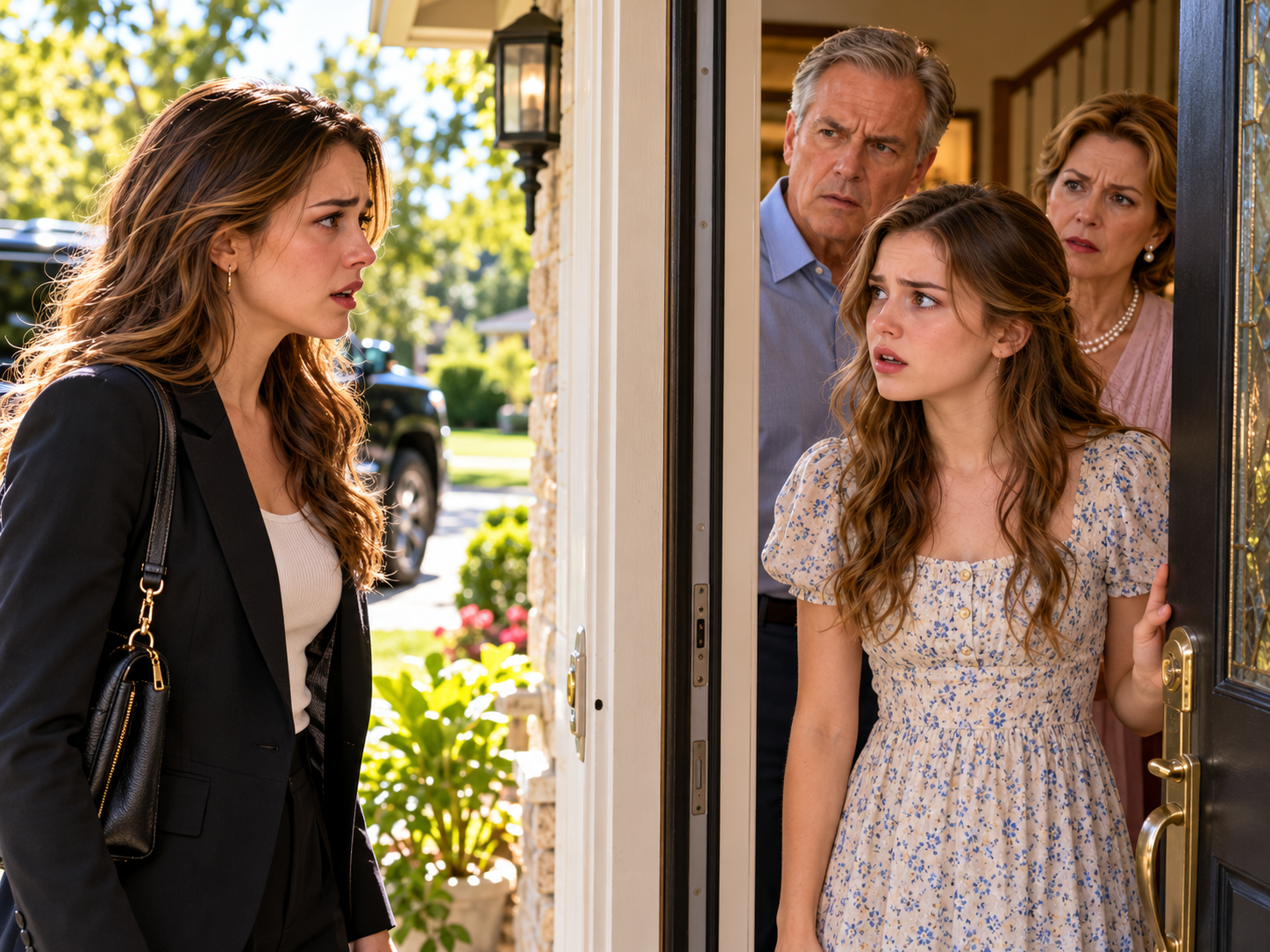
I kept looking at the photograph, waiting for some detail to rearrange itself into an explanation that made sense. The young woman in the hospital gown had my narrow shoulders, my dark hair, and the small scar above her eyebrow. Her left hand rested on the edge of the bassinet. Her expression was exhausted, frightened, and fiercely protective.
I remembered that hospital room.
I remembered the fluorescent lights, the cold metal bedrail, and the nurse who had placed a tiny bundle in my arms before asking me whether I had chosen a name. I remembered being sixteen and so terrified that I could hardly speak. I remembered promising my baby that I would find a way to give her a better life, even though I had no idea where I would sleep that night.
But I remembered leaving the hospital with my daughter.
Or at least, I had always believed I had.
My hands began to shake.
“Where was this taken?” I asked.
Neither parent answered.
Lily pulled out the chair beside me. She looked at the photograph, then at my face, and her confusion seemed to deepen with every passing second.
“That's the part I don't understand,” she said. “You look exactly like her. And the date on the back is the year I was born.”
I swallowed.
“How old were you when you first heard about Sarah?”
“About five, I think. Grandma said my mother had been sick for a long time. Grandpa said she died before I could remember her.”
“Did they ever tell you where she was buried?”
Lily's eyes moved toward my mother.
“No. Whenever I asked, Grandma said remembering the dead wouldn't bring them back.”
My mother sat down heavily.
“Please,” she whispered. “Stop asking questions.”
I looked at her. “You don't get to ask for silence now.”
She began twisting the dish towel between her fingers. It was such a familiar gesture that, for an instant, I was back in our old kitchen, watching her prepare to tell me what I had done wrong.
Only this time, I wasn't sixteen.
“Tell me what happened after I left the hospital,” I said.
My father moved toward the table. “Anna, you need to understand that we were trying to protect you.”
“From what?”
“From the consequences of your choices.”
I stared at him.
“You mean from being pregnant?”
“You were a child.”
“Yes,” I said. “I was.”
The admission seemed to unsettle him more than any accusation could have. He looked down at the photograph, and the silence that followed was different from the others. It was no longer the silence of a man determined to control a conversation. It was the silence of someone deciding whether he could still lie convincingly.
My mother finally spoke.
“You were in no condition to raise a baby.”
“I was in no condition to be thrown out of my home, either. That didn't stop you.”
Her face crumpled slightly, but she quickly straightened it.
“You don't know what those years were like for us.”
“No,” I said. “I don't. You made certain I wouldn't.”
Lily stood and walked around the table. She took the photograph from my hands, holding it close to her face.
“Grandma, is this my mother?”
My mother shut her eyes.
“Lily—”
“Is this my mother?”
The question came out louder. Her fingers had begun to tremble around the edges of the photograph.
My father reached for it.
Lily pulled it away.
“Don't touch it.”
“Give that to me.”
“No.”
For a moment, they stared at each other across the table. I could see the same conflict playing out that I had witnessed as a child: my father issuing an order, someone resisting, and the whole house holding its breath to see who would surrender.
Lily didn't surrender.
“You told me Sarah was my mother,” she said. “You told me she died. You told me I was lucky to have you because nobody else wanted me.”
My stomach tightened.
My father looked toward me.
I understood then that whatever had happened, Lily had spent years living under the weight of a story designed to keep her from asking questions.
“Did you ever meet someone named Sarah?” I asked her.
“No.”
“Did you ever see a death certificate?”
She shook her head.
“An obituary? A grave?”
Another shake.
I turned to my mother. “Was Sarah even real?”
Her mouth opened, but my father spoke first.
“Sarah was a name we used to protect the family.”
Lily stared at him.
“What does that mean?”
He rubbed his forehead. “We thought it would be easier if you grew up without the complications of your biological mother.”
“My biological mother?”
His eyes darted toward me.
Lily followed his gaze.
For a few seconds, the room seemed to hold its breath.
Then she looked at me, and I watched the truth begin to take shape in her mind.
“No,” she whispered.
I couldn't bring myself to speak.
She stepped backward, bumping into the counter.
“No. You're not saying—”
“Lily,” my mother began.
“Am I your daughter?” Lily asked me.
The question was so direct, so painfully young, that I felt something inside me break open.
“I don't know,” I whispered. “Not yet. But I think we need to find out.”
My father pushed his chair away from the table.
“This conversation is over.”
“No,” Lily said. “It isn't.”
He looked at her with the same hard expression he had once turned on me.
“You have a home. You have people who have cared for you your entire life. Whatever happened before that is none of your concern.”
“It's my life!”
The words echoed through the kitchen.
My mother began crying quietly. She covered her face with both hands, but she didn't move toward Lily or offer to explain anything. Her tears seemed less like grief than fear of what would happen if the truth became impossible to contain.
Lily turned to me.
“Please tell me what you remember.”
I took a breath.
“I was sixteen when I became pregnant. My parents threw me out of this house. I stayed with a friend for a while, then moved between places until I could afford a room in Birmingham. I gave birth in a hospital there.”
“What happened to the baby?”
I stared at the photograph.
“I thought I took her with me.”
The sentence sounded wrong as soon as I said it.
I remembered leaving the hospital. I remembered a nurse placing a bundle in my arms. I remembered walking through the automatic doors into a bright morning, my body aching, my head spinning from exhaustion.
But when I tried to picture the journey afterward, the memories became uncertain. I had been so frightened, so sick with worry about how I would feed a newborn, that entire hours seemed to have dissolved into one long stretch of panic.
“I was alone,” I said. “I had no money. I had nowhere permanent to live.”
My mother lowered her hands.
“You were exhausted,” she said. “You were confused.”
I turned toward her.
“What did you do?”
She shook her head.
“Elaine. What did you do?”
My father stepped between us.
“Your mother and I made a decision. We believed it was the right one.”
“What decision?”
He took a long breath, then sat down.
“We brought the baby home.”
The room seemed to tilt.
I gripped the edge of the table.
“You brought my baby home?”
“We gave her a stable life.”
“You took my child?”
“You weren't ready to raise her!”
The sudden force of his voice startled even him. He looked at Lily, who had gone perfectly still, then lowered his voice.
“You were sixteen, Anna. You had no husband, no proper income, no future. We knew you would struggle. We knew the child would struggle with you.”
“So you stole her?”
“We gave her a chance.”
I stared at him, unable to recognize the man sitting before me. He had taken the worst moment of my life and turned it into an opportunity to decide that I no longer deserved a place in my own child's future.
“You let me believe I had lost everything,” I said.
My mother was crying openly now.
“We thought you'd eventually understand.”
“Understand what? That you could take my baby because I was poor? That you could erase me from her life because I embarrassed you?”
“We didn't erase you,” she whispered.
I looked at the photograph again.
“What did you call her?”
My father didn't answer.
Lily did.
“Lily.”
She said her name as though she were testing whether it still belonged to her.
My mother nodded faintly.
“We named her Lily.”
“And what happened to the name on the photograph?” I asked.
My father glanced at the words written on the back.
“Baby Anna was what the hospital called her in the first paperwork. We changed it when we brought her home.”
I felt sick.
The child I had carried for nine months, the child whose heartbeat I had once heard through a machine in a cramped examination room, had been given another name by the people who had thrown me away.
They had not merely taken her from me.
They had changed the first thing I had given her.
Lily backed away from the table, shaking her head.
“You told me I was your granddaughter.”
“You are,” my mother said.
“You told me my mother was Sarah.”
“We were trying to spare you pain.”
“Then why does Anna have a photograph of herself holding me?”
My mother had no answer.
Lily looked at me again. There were tears in her eyes now, but she seemed almost afraid to let them fall.
“Did you want me?”
The question took the breath from my lungs.
I rose so quickly that my chair scraped backward across the floor.
“Yes.”
She flinched at the urgency in my voice.
“I wanted you more than anything,” I continued. “I was sixteen, and I was frightened, and I didn't know how I was going to manage. But I wanted you. I never stopped wanting you.”
“Then why didn't you come back?”
I opened my mouth.
Because I had believed the door was closed forever. Because I had been ashamed of needing help. Because I had spent years thinking my parents would never let me near the child they had decided I didn't deserve to raise.
But those answers belonged to the girl I had been, and Lily deserved more than a frightened girl's explanations.
“I didn't know what they had done,” I said. “I thought my life was something I had to rebuild on my own. I never knew they had kept you here.”
Lily stared at my face as if she were searching for proof that I meant it.
My father stood abruptly.
“You've heard enough. Lily, go upstairs and pack your things if you want to punish us. But don't expect to walk out of this house and come crawling back when the world turns against you.”
She looked at him in disbelief.
“You're threatening me?”
“I'm telling you how life works.”
“No,” she said. “You're telling me how you work.”
She placed the photograph carefully on the table and walked toward the front door.
I followed her.
“Lily, wait.”
She stopped without turning around.
“Don't call me that like you know me.”
The words hurt, but I knew I had no right to demand anything from her.
“All right,” I said softly.
She faced me then.
“What was I like when I was born?”
I searched my memory for something I could give her that belonged to neither my parents nor their lies.
“You were tiny,” I said. “Your fingers curled around mine, and I remember thinking that you trusted me even though I had no idea what I was doing. You had a little dark hair on your head. You made a noise like a kitten when you cried.”
A tear slid down her cheek.
“Did I look like you?”
I nodded.
“Even then.”
For the first time, she looked directly at me without suspicion. The resemblance between us no longer felt like an impossible coincidence. It was a connection neither of us had chosen, but one that had survived twenty years of silence.
Then she asked the question I had been dreading.
“Are you going to leave again?”
I looked past her at the driveway, at the place where my backpack had landed in the rain, and at the house that had once seemed powerful enough to decide whether I deserved to exist.
“No,” I said. “Not until you know the truth.”
Lily nodded once, then turned toward the front door.
Behind us, my father began speaking in a low, urgent voice to my mother. I couldn't make out every word, but I heard enough to understand that they were already thinking about how to contain what had happened.
Lily opened the door.
Before she stepped outside, she looked back at them.
“You said she abandoned me,” she whispered. “You said she never wanted me.”
Neither parent answered.
And in that silence, I saw the last piece of their carefully constructed family story begin to fall apart.
Click here to continue reading: PART 4: I Returned to Demand an Explanation, but the Truth Forced Three Generations to Decide What Family Really Meant
Twenty Years After Being Thrown Into the Storm, I Returned to the House That Had Erased Me From Its Memory
Part 3 of 20