
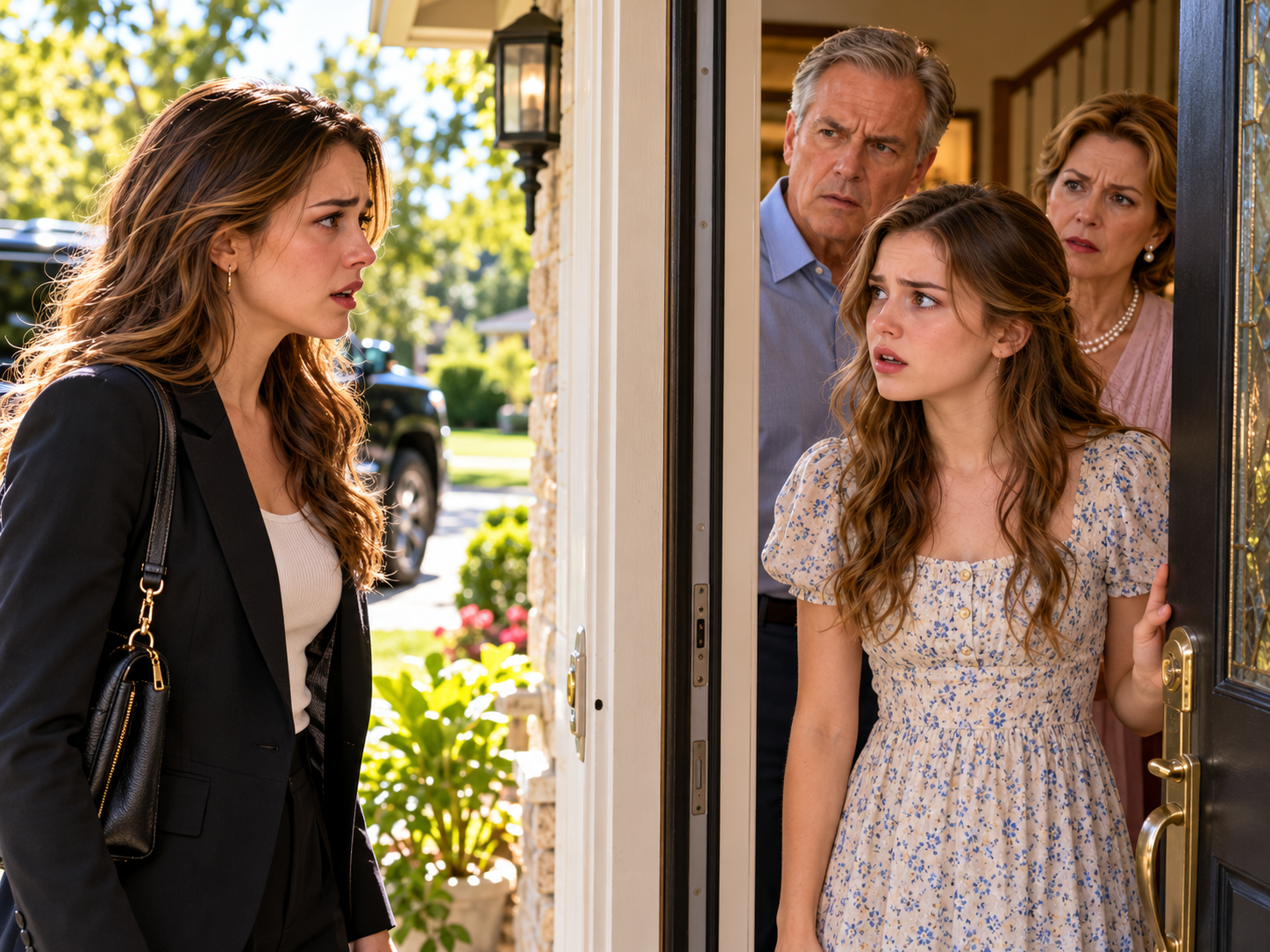
Lily didn't go far. She stopped at the bottom of the porch steps, folded her arms across her chest, and stared at the overgrown lawn. The afternoon sun had slipped behind a bank of clouds, leaving the yard in a dull, yellowish light. A car passed on the county road, its tires whispering over the pavement.
I stood a few feet behind her, unsure whether to approach.
I had imagined holding my daughter again countless times during the years when I couldn't afford to replace a broken refrigerator or pay a medical bill without calculating which other expense would have to wait. In those private moments, I had pictured a little girl with my eyes, a teenager with my stubbornness, a young woman who might someday find me and ask why I hadn't been there.
I had never imagined that she would stand in front of me as a stranger, believing I had abandoned her.
“Lily,” I said, keeping my voice low, “you don't have to decide anything today.”
She stared at the fence.
“You got twenty years to figure out what you wanted. I just found out my whole life was a lie.”
“I know.”
“No, you don't.”
She turned toward me, and I saw how hard she was fighting to keep her face composed.
“You got to leave. You got to become somebody else. You got to build a business and have a life. I stayed here. Every time I asked about my mother, they made me feel selfish. Every time I wanted to know where I came from, they told me I should be grateful.”
I had no defense against that.
“I can't give you those years back,” I said. “I won't pretend I can.”
She wiped her cheek with the heel of her hand.
“Did you ever think about me?”
The question was almost too quiet to hear.
“Every day.”
“Even when you were happy?”
I swallowed.
“Especially then. When something good happened, I'd sometimes wonder whether you were happy, too. I'd wonder what you might have liked, what kind of music you listened to, whether you would have enjoyed the things I was building.”
She looked at me for a long time.
“Did you ever have another child?”
“No.”
“Why not?”
I considered giving her the simplest answer, but she had already spent too much of her life being denied the truth.
“Because I couldn't bear the thought of having another child and knowing I might lose that one, too. And because I spent a long time convincing myself I wasn't the kind of person who could be a mother.”
Her expression softened, but only slightly.
“Do you have a family now?”
“I have people I love. I have friends who became family. I built a company with women who know what it means to have nowhere to turn. But I never had another child.”
She lowered her eyes.
“I don't know what I'm supposed to call you.”
“You don't have to call me anything you're not ready to call me.”
That answer seemed to surprise her.
She had probably expected me to claim the title immediately, to demand that she recognize me because biology gave me a right that twenty years of absence had made complicated. But I couldn't bear the thought of repeating my parents' mistake by deciding what she should feel.
“I want the truth,” she said.
“Then we'll get it.”
We returned to the kitchen together.
My father was seated at the table. My mother stood beside the counter, her face blotchy from crying. The photograph lay between them, and neither had attempted to move it.
“I want every document you have,” I said. “The hospital records. The adoption or guardianship papers. The original birth certificate. Anything that explains how my daughter ended up in this house.”
My father gave a short, bitter laugh.
“You think this is a business negotiation?”
“No. If it were, I'd have brought my lawyers and let them do the talking.”
That silenced him.
My mother pulled out a chair.
“Anna, we need you to understand something. We didn't do this because we hated you.”
I looked at her.
“You told me I was dead to you.”
“I was angry.”
“You threw my belongings into a storm.”
“I was frightened.”
“You watched me leave.”
She pressed her hands against her mouth.
I let the silence remain until she lowered them.
“You were frightened of the neighbors,” I continued. “You were frightened of what the church would say. You were frightened that people would discover your daughter was pregnant. You were so afraid of being judged that you decided I was worth sacrificing.”
My mother began to cry again.
My father stared at the table.
For once, I wasn't going to rescue either of them from the consequences of their choices by pretending that their pain was equal to mine.
“Tell us what happened,” Lily said.
My father looked at her, and something in his expression shifted. He had spent years assuming that obedience would protect his authority. Now he was looking at a young woman who knew enough to question him and had nothing left to gain by pretending his answers were acceptable.
He drew a long breath.
“After you left, Anna, your mother and I were ashamed of what had happened. We told people you had gone away. We said you were living somewhere else and didn't want contact.”
“You lied to everyone.”
“We thought we were protecting the family.”
“From me.”
He didn't dispute it.
My mother sat down opposite us.
“When we learned where you had given birth, we contacted the hospital,” she said. “You were exhausted, and you were barely managing. We believed we could give the baby a better home.”
“Who told you where I was?”
She hesitated.
“Someone from town knew you had been admitted. Your father made a few calls.”
I felt the old coldness settle in my chest. Even when I had believed myself alone, my parents had been able to find me. They had known where I was, yet they had not come to offer me a home or help me care for my child.
They had come to take control.
“What happened at the hospital?” I asked.
My mother glanced at my father.
He answered this time.
“We told the hospital staff that we were your parents and that we wanted to help. You were in no condition to make a decision about your future. We said we'd take the baby temporarily while you recovered.”
“Temporarily,” I repeated.
He nodded, avoiding my eyes.
“And when I asked for her?”
My mother began twisting her wedding ring.
“You were discharged. We told you the baby needed medical observation and that we would bring her to you when things were settled.”
I stared at her.
“I remember asking you where she was.”
“We told you to go home and rest.”
“I didn't have a home.”
Her eyes filled again.
“You were staying with your friend.”
“For a few days. You knew that. You knew I had nowhere to go.”
My father rubbed his palms against his trousers.
“We believed that if we kept her here, you would eventually get yourself established. We thought we'd be able to make arrangements when you were older.”
“Arrangements for what?”
He didn't answer.
The truth was becoming clear, and each new piece made the previous one more cruel.
They had not simply made one terrible decision in a moment of panic. They had kept making decisions, day after day, year after year, until the lie became the structure of their lives.
They had taken my daughter under the pretense of helping me. Then they had used my poverty, my age, and my absence as justification for keeping her.
“And the name Sarah?” I asked.
My mother looked at Lily.
“We invented it. We told her that her mother had been called Sarah and that she had died. We thought it would be easier than explaining everything.”
“Easier for whom?” Lily demanded.
My mother began to answer, then stopped.
“For us,” she whispered.
The admission left the room strangely quiet.
Lily stood beside me, gripping the back of her chair.
“You let me believe my mother was dead when she was alive the entire time?”
“Yes,” my mother said.
“And you let her believe I was gone?”
My father lifted his head.
“We never told Anna that you had died.”
“No,” I said. “You did something worse. You gave me no reason to believe you would ever let me see her.”
He looked at me, and for a moment I thought he might argue. Instead, his shoulders sank.
I had spent years imagining an explanation that might make the abandonment understandable. Perhaps they had been too young, too poor, too frightened, too overwhelmed by the opinions of others. But they had been adults with a house, steady work, and a community willing to help them. I had been a child who needed her parents.
They had possessed the power to help me.
They had used it to separate me from my daughter.
“What happens now?” Lily asked.
My father looked up.
“We're still your grandparents. Nothing changes that.”
“Everything changes that.”
“Lily—”
“You made me feel guilty for wanting to know my own mother. You made me think she didn't want me. You told me I was lucky to have you when you were the ones who lied to me.”
She looked toward my mother.
“Did you ever love me?”
My mother covered her face.
“Yes,” she whispered. “We loved you.”
“Then why did you do it?”
“Because we thought we knew what was best.”
Lily shook her head.
“You thought you knew what was best for yourselves.”
My father pushed his chair back.
“I won't sit here and be called a monster in my own house.”
“No one has to call you anything,” I replied. “Your decisions speak for themselves.”
He looked at me with an expression I remembered from my childhood, the one that had always meant the discussion was finished because he had decided it was finished.
But no one stood up.
No one apologized to make him comfortable.
At last, he walked out of the kitchen.
My mother remained seated, staring at the photograph.
“I never thought you would come back,” she said.
“I know.”
“I thought you had forgotten us.”
I almost laughed again, but this time the sound never reached my throat.
“You thought I had forgotten the people who threw me out with nowhere to go? You thought I had forgotten the child you took from me?”
She shook her head, crying harder.
“I don't know how to make this right.”
“You can't make it right,” I said. “You can only stop making it worse.”
Lily took the photograph from the table and slipped it into her pocket.
“I need some time,” she said.
I nodded.
“Take as much as you need.”
She looked at me.
“Would you stay in town tonight?”
The question was tentative, almost reluctant. She wasn't asking me to become her mother in a single afternoon. She was asking whether I would still be there when she was ready to talk again.
“Yes,” I said. “I'll stay.”
“Can I have your number?”
I took a business card from my handbag and wrote my personal number on the back. I handed it to her, resisting the urge to hug her when she reached for it.
She studied the card.
“Do you live in Denver?”
“I do.”
“Is that where your company is?”
“Yes.”
She looked at me with an expression I couldn't quite read.
“Grandma said you left town and never amounted to anything.”
I felt an ache in my chest, but I didn't let it turn into anger.
“I built a life there,” I said. “But it took a long time.”
“Would you tell me about it sometime?”
“Anything you want to know.”
She slipped the card into her pocket beside the photograph.
Then she walked upstairs.
I stayed in the kitchen with my mother until the light outside began to fade. She apologized more than once, but each apology seemed to collapse beneath the weight of the next question. She wanted forgiveness to be a moment, a sentence, something I could give her so she could finally stop feeling afraid.
I couldn't give her that.
Not yet.
Before I left, I asked for copies of every document they had. My father eventually brought a folder from his study. Inside were hospital papers, forms bearing signatures I didn't recognize, and the original certificate that recorded my daughter's birth.
The documents confirmed the dates. They confirmed that my parents had taken custody of the baby shortly after her birth. They also showed that the story I had been told about a temporary arrangement had never been resolved in the way I had hoped.
I photographed every page and made arrangements to have the records reviewed by an attorney. If Lily wanted a DNA test, I would arrange one. If she wanted legal help understanding what had happened, I would pay for it. But I wouldn't force her to do anything simply because I was finally able to offer it.
Before I reached the door, my father appeared in the hallway.
“Anna.”
I turned.
He seemed to have aged several years since that afternoon. His hands hung at his sides, and he looked at the floor before meeting my eyes.
“I was wrong,” he said.
The words were awkward, almost unfamiliar in his mouth.
I waited.
“I should never have thrown you out.”
“No,” I said. “You shouldn't have.”
He swallowed.
“I thought I was protecting this family.”
“You were protecting your reputation.”
He didn't argue.
“I can't undo it.”
“No.”
“Will you ever forgive me?”
I looked at the man who had once stood in front of me and declared that I was dead to him. I thought of the years I had spent wondering whether I had deserved what happened, whether I should have tried harder to make him understand, whether my life would have been different if I had been a better daughter.
I had finally learned that a child's worth was not measured by a parent's willingness to love her.
“I don't know,” I told him. “And I'm not going to promise you something just to make you feel better.”
He nodded slowly.
For the first time, he didn't try to force the conversation to end on his terms.
I left the house and walked down the cracked concrete path. The sky had darkened, and a warm wind moved through the weeds along the fence. I paused beside my car, looking back at the porch where my mother had once ordered me to leave.
I had come to Alabama wanting to look my parents in the eye.
I had done that.
But I had discovered something far more important than an explanation for their cruelty. I had found my daughter, and she had finally learned that the mother she believed was dead had never stopped existing.
My phone vibrated as I sat behind the wheel.
A message from Lily.
I'm not ready to call you Mom yet. I need time. But I want to meet you tomorrow. Just you and me.
I read it twice, then typed my reply.
Of course. I'll be there.
A moment later, another message appeared.
Can you tell me what I was like as a baby? Everything you remember, even the little things.
My eyes filled with tears.
I began typing about the tiny fingers that had curled around mine, the soft dark hair, the little cry that had sounded like a kitten. I told her how I had held her and promised that I would find a way to give her a good life.
Then I stopped, because there was one thing I wanted her to understand more than anything else.
I wanted you from the very beginning. I never chose to leave you.
I pressed send.
For a long time, I sat in the driveway without starting the engine. The house behind me was still shabby, the fence still rusted, and the people inside it were still responsible for what they had done. Nothing about my success could change those facts. Nothing about their apologies could return the years they had stolen from us.
But when my phone vibrated again, I looked down and saw a final message.
I believe you. I'll see you tomorrow.
I let the tears come then.
Not because everything was forgiven. Not because the past had suddenly become bearable. And not because I had found a way to turn twenty years of separation into something good.
I cried because my daughter had given me one small thing my parents had spent twenty years denying me: the chance to begin again, this time with the truth between us.
I started the car and pulled away from the house.
I didn't look back.
For the first time in my life, I wasn't leaving because someone had decided I didn't belong.
I was leaving because I finally had somewhere else to go—and because tomorrow, if Lily still wanted me there, I would return on my own terms.
Click here to continue reading: PART 5: My Daughter Agreed to Meet Me Again, but the First Question She Asked Forced Me to Revisit the Worst Day of My Life
Twenty Years After Being Thrown Into the Storm, I Returned to the House That Had Erased Me From Its Memory
Part 4 of 20

