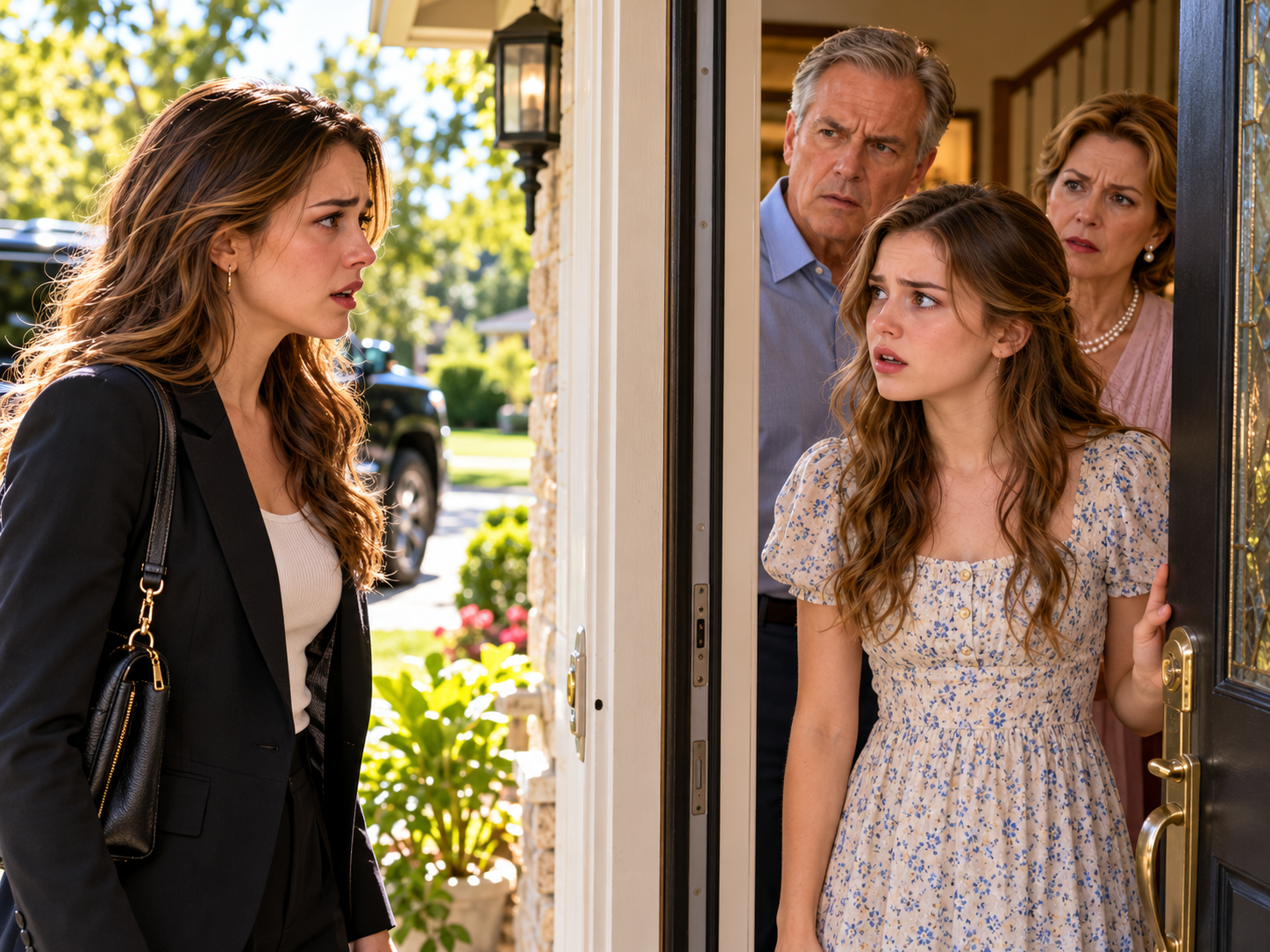
Lily arrived in Denver on a clear Monday afternoon, carrying one suitcase and a small backpack. I waited near the arrivals exit, watching people emerge through the sliding doors with flowers, rolling luggage, and tired children. When I finally saw her, she was standing beside a pillar, looking at her phone as if she needed to check that she had reached the right place.
I raised my hand.
She smiled when she spotted me.
The expression was tentative, but it was real.
I walked over and took her suitcase. She let me, then looked around the terminal.
“It's bigger than I expected.”
“The airport?”
“Everything. The mountains. The sky. Even the parking lot.”
I laughed softly.
“Wait until you see the traffic.”
She followed me to the car, asking questions about the city before we had even left the airport grounds. She wanted to know how long I had lived in Denver, whether winter was difficult, and whether the mountains looked as close from my house as they did from the road.
I answered as we drove.
I didn't tell her how many times I had imagined bringing my daughter here. I didn't want to turn her visit into a fulfillment of my private dreams. This was her trip, and she deserved to experience it without feeling responsible for the happiness it brought me.
My house stood in a quiet neighborhood a short drive from downtown. It was comfortable rather than enormous, with large windows, a small garden, and a kitchen that opened onto the living room. I had bought it years after the company became profitable, when I finally felt secure enough to stop moving from one rented place to another.
Lily stepped inside and looked around.
“This is really your house?”
“It is.”
She ran her fingers along the back of the sofa, then glanced at the framed photographs on the mantel. There were pictures of me with employees, friends, and women who had helped build the business. A photograph of my first boutique sat beside one from the company's tenth anniversary.
She studied them quietly.
“You did all this?”
“Not alone. I had help from good people, and I made plenty of mistakes.”
She pointed to a picture of me standing outside a small storefront with a handmade sign.
“You look so young.”
“I was younger.”
“You look scared.”
I examined the photograph.
“I was.”
She turned toward me.
“Were you ever happy back then?”
“Yes,” I said. “Not every day. But there were good moments. There were customers who came back because they liked what I made. There were women who sold their first products through the website and cried when they received their first real orders. There were days when I realized the company was doing something useful.”
She nodded, taking that in.
“Can I see your office?”
“Tomorrow. Today, you can settle in.”
I showed her the guest room, where fresh sheets covered the bed and a small vase of flowers stood on the dresser. I had tried to make the room welcoming without filling it with things I thought she might like. I didn't know her tastes well enough yet to make those choices for her.
She set her suitcase beside the closet.
“You didn't have to do all this.”
“I wanted you to be comfortable.”
She looked at the bed, then at me.
“Thank you.”
We ordered dinner from a nearby restaurant and ate at the kitchen table. At first, our conversation stayed on safe ground. She told me about the flight, the woman who had fallen asleep against her shoulder, and the child who had spent half the journey asking when the plane would land.
Then she looked at the framed photograph of my first shop.
“Can I ask you something about your company?”
“Of course.”
“Did you build it because you wanted to prove your parents wrong?”
I set down my fork.
“Partly, at first. I wanted to prove that they hadn't destroyed me. I wanted to show them that I could survive without them.”
“And later?”
“Later, I realized that proving something to them wasn't enough to sustain a business. I had employees who depended on me. Customers who trusted us. Women who needed a place to sell what they made. The company became bigger than my anger.”
She looked thoughtful.
“Did becoming successful make you feel better about losing me?”
“No.”
The answer came quickly, and she looked up.
“Not at all?”
“It gave me purpose. It gave me security. It gave me the ability to help other people. But success couldn't replace you. It couldn't tell me what your first words were, or what you liked to eat when you were little, or whether you were afraid of thunderstorms.”
She looked down at her plate.
“I am afraid of thunderstorms.”
I went still.
“You are?”
“Not as much as when I was little. But I don't like them.”
I had no memory of knowing that. I had missed every small discovery that a parent normally collected without realizing how precious it was.
“I'm sorry,” I said.
She shook her head.
“You didn't know.”
After dinner, we sat in the living room and talked about her childhood. She told me about school, the friends who had come and gone, and the way her grandparents had encouraged her to choose a practical career. She had considered nursing for a while, then teaching, but neither had felt right.
“I like making things,” she said. “Drawing, sewing, fixing old furniture. Grandma thinks it's a hobby.”
“What do you think?”
“I think I'd like to do something creative. I just don't know what.”
I told her about the women who sold clothing, jewelry, and home goods through my company's platform. I explained that she could explore those possibilities without joining the business or making a commitment.
She seemed relieved.
“I don't want a job just because you're my mother.”
“You shouldn't have one for that reason.”
She smiled.
The following morning, I took her to the corporate office. I introduced her to the people who worked closest to me and showed her the small room where our product team photographed handmade goods. She asked questions about materials, pricing, shipping, and how sellers reached customers.
One of the designers brought out a sample jacket made by a woman who had started sewing after losing her job. Lily examined the stitching and turned the garment inside out to inspect the seams.
“You can tell someone cared about this,” she said.
The designer smiled.
“That's exactly what we hope people notice.”
I watched Lily ask another question, then another. Her curiosity was not forced. She seemed genuinely interested in the process of turning an idea into something tangible.
For a moment, I saw a glimpse of a future in which we might share something beyond the circumstances of her birth.
But I kept the thought to myself.
She had come to visit, not to become part of my company.
That evening, we walked through a nearby park. The air had cooled, and the mountains were visible in the distance. Lily carried a paper cup of hot chocolate, warming her hands around it.
“Can I ask you something difficult?” she said.
“Of course.”
“When you were building your company, did you ever imagine finding me?”
“Every year.”
“What did you imagine would happen?”
I considered the question.
“When I was younger, I imagined that you would find me and that I'd somehow be able to explain everything in a way that made you understand. I imagined you'd forgive me immediately. Later, I stopped imagining specific conversations. I just hoped you were safe.”
She looked toward the mountains.
“Did you ever think I might hate you?”
“Yes.”
“Were you afraid of that?”
“Very.”
“Then why come back?”
I stopped walking.
“Because I realized that fear had already taken enough from me. I couldn't keep letting it decide what I was willing to face.”
She studied my expression.
“I think I understand that.”
We continued along the path.
After a while, she said, “I want to tell you something, but I don't want you to misunderstand.”
“Go ahead.”
“I don't feel like I've suddenly found a mother. I feel like I've found a person who should have been part of my life, and I don't know how to fit you into it.”
I nodded slowly.
“That's fair.”
“I like you. I think I trust you. But sometimes I feel guilty when I enjoy being here, because it feels like I'm betraying Grandma and Grandpa.”
“You're not responsible for protecting their feelings from the consequences of their choices.”
“I know. But knowing something and feeling it are different.”
“They are.”
She stopped beside a bench.
“Would you be upset if I went home and kept seeing them?”
“No.”
“Even after everything?”
“Yes. They're still people you love. I won't ask you to erase that.”
She sat down, and I joined her.
“I think I need to build a relationship with you without making it a competition.”
“I agree.”
She looked at me with a small, grateful smile.
“I'm glad.”
We stayed in the park until the light began to fade. On the walk home, she told me about a sketchbook she had left in Alabama and asked whether I thought she should bring it to Denver next time.
“Absolutely,” I said.
“It's messy.”
“Most interesting things are.”
She laughed.
The next few days were filled with small discoveries. I learned that she liked her coffee sweet, that she preferred walking to driving when the weather was good, and that she always read the final page of a book before deciding whether to finish it.
She learned that I kept emergency snacks in the car, that I disliked voicemail, and that I sometimes worked late because I found it easier to concentrate after everyone had gone home.
We disagreed about music. We laughed over a cooking disaster when I tried to make a family recipe and realized I had misremembered the measurements. We visited a bookstore where she spent nearly an hour examining art books.
None of these moments repaired the years we had lost.
They gave us something new to build.
On her final evening in Denver, we sat at the kitchen table with a stack of photographs. I showed her pictures of the first apartment I had rented, the warehouse where I had packed boxes, and the storefront that had nearly bankrupted me during its first winter.
She studied a photograph of me standing beside a display of handmade jewelry.
“You look exhausted.”
“I was.”
“Were you ever tempted to go back to Alabama?”
“Sometimes. But I was afraid of what I would find, and I didn't know whether your grandparents would let me see you.”
She traced the edge of the photograph.
“I wish you'd known.”
“So do I.”
She placed the picture back on the table.
“I don't want to spend the rest of my life being angry about what happened.”
“You don't have to.”
“But I don't want to pretend it was all right, either.”
“You shouldn't.”
She looked at me.
“I think I want to keep coming here. Maybe not every month, but when I can.”
I felt warmth spread through my chest.
“You're welcome whenever you want to visit.”
“And maybe I'd like to learn more about the business. Not because I need a job. Just because I'm interested.”
“I'd be happy to show you more.”
She nodded.
Then she stood and walked to the window.
“Anna?”
“Yes?”
“I'm glad you came back to Alabama.”
I looked at her reflection in the glass.
“So am I.”
She turned toward me, and for a moment the resemblance between us was almost startling. The same eyes, the same mouth, the same crease in the forehead when she was trying to decide what to say.
But she was not a younger version of me.
She was Lily, with her own memories, her own fears, and her own future.
I had finally begun to understand that my job was not to reclaim the daughter I had imagined for twenty years.
It was to get to know the woman standing in front of me.
Click here to continue reading: PART 11: My Mother Finally Admitted What She Had Feared Most, and I Had to Decide Whether Her Remorse Deserved a Place in My Future
Twenty Years After Being Thrown Into the Storm, I Returned to the House That Had Erased Me From Its Memory
Part 10 of 20