For several weeks after we uncovered my father's research, Claire and I tried to return to ordinary life.
We went to work.
We cooked dinner.
We answered messages.
We laughed when something genuinely funny happened.
But underneath all of it was the knowledge that our families had been connected long before we ever met.
That knowledge changed the way I looked at Claire.
Not because I suddenly saw her as innocent.
She had never been the enemy I once imagined.
She had been carrying pieces of a history neither of us understood.
The same was true of my mother.
Her behavior had hurt Claire.
It had embarrassed me.
It had nearly damaged our marriage before it had properly begun.
But her fear had not come from hatred.
It had come from watching people she loved become frightened by an uncertain medical future.
One Sunday morning, Claire and I sat at the kitchen table with my father's research papers spread between us.
There were pages of handwritten calculations, patient observations, correspondence with doctors, and notes about the genetic marker that had frightened both our families.
Some pages were difficult to understand.
Others were surprisingly clear.
My father had written repeatedly that a genetic risk should never be confused with a guaranteed outcome.
He had underlined that point so many times that the ink had nearly torn through the paper.
Claire ran her finger along one paragraph.
"He was trying to prove something."
"Yes."
"Not just for patients."
I looked at her.
"What do you mean?"
"He was trying to prove that my mother hadn't been given a hopeless future."
I hadn't considered that.
My father had spent years researching the condition because he had watched Claire's mother live under the shadow of a prediction that might never have been accurate.
His work had become personal.
Then his own death had left my mother with the fear he had been trying to dismantle.
That was the cruel irony.
The man who wanted people to stop fearing uncertainty had left behind a wife who could not tolerate it.
Claire found another folder.
The label read: "Long-Term Follow-Up."
Inside were names.
Some were familiar.
Some were not.
Then she found her mother's name.
Her fingers stopped.
"Look."
The file contained years of medical observations.
Claire's mother had been monitored from her early adulthood.
Her condition had been considered high risk.
But my father's notes showed that he had questioned the original interpretation.
He believed some of her symptoms could have been unrelated.
He had wanted additional testing.
That testing had never been completed.
Claire sat back.
"She might have lived differently if she had known."
I nodded.
"Maybe."
The word felt inadequate.
There was no way to know.
That was the problem with history.
It gave you facts about what happened.
It rarely gave you certainty about what might have happened instead.
Claire looked at me.
"Do you think your mother blamed herself?"
"For your mother's death?"
"Yes."
"I think she blamed herself for a lot of things."
We sat quietly.
Then I noticed a note attached to the file.
It was from my father.
He had written that my mother had become increasingly anxious after Claire's mother died.
He worried that she would transfer that fear onto me.
He was right.
But there was another sentence.
He wrote that he wanted to establish a support program for families dealing with inherited disease.
The program never happened.
Funding disappeared.
The research center changed direction.
And my father died before he could finish it.
I looked at Claire.
"Maybe that's what we should do."
She raised an eyebrow.
"Do what?"
"Finish it."
She smiled faintly.
"You want to continue your father's work?"
"I don't know if I can."
"You don't have to do it alone."
That sentence stayed with me.
Within months, we contacted several doctors who had known my father.
We asked whether the old research could be preserved.
Some responded enthusiastically.
Others warned us not to romanticize incomplete research.
They were right.
My father's work was important to our family.
That didn't make every conclusion correct.
We wanted the records preserved, not turned into a legend.
So we created a small archive.
We donated copies of the research documents to a medical institution.
We kept personal correspondence privately.
We separated documented findings from my father's personal beliefs.
For the first time, I understood why my mother had been so careful with the papers.
She had known they mattered.
She simply hadn't known how to let them matter without reopening old wounds.
Claire began researching her mother's medical history.
She contacted relatives.
She searched through old records.
She found letters her mother had written during the years when her health was declining.
One letter contained a sentence that made Claire cry.
"I don't want my daughter to grow up believing that illness is the same thing as destiny."
Claire read it several times.
Then she folded the letter.
"She knew."
"What?"
"She knew there was uncertainty."
I nodded.
"Maybe she was afraid anyway."
Claire looked at me.
"Everyone was."
That became the phrase we returned to.
Everyone was afraid.
My mother.
My father.
Claire's mother.
Claire.
Me.
Fear had moved through our families like an inheritance.
Not through blood.
Through behavior.
One person became frightened and kept silent.
Another person saw the silence and became frightened.
Another tried to protect someone.
Another hid information.
Eventually, no one knew which secret had started the chain.
We wanted to stop it.
So Claire and I made one rule.
No medical decisions about either of us would ever be made without both people knowing.
It sounded simple.
It was.
But simple rules are sometimes the hardest ones to follow when fear is involved.
We began attending appointments together.
We asked questions.
We requested explanations.
We refused to treat uncertainty as catastrophe.
The doctors told me I needed regular monitoring.
They told Claire the same.
Neither of us was promised a perfectly healthy future.
Neither of us was told to live as though death were waiting around every corner.
For the first time, that felt reasonable.
Months later, we returned to my mother's house.
The house had been sold, but the new owners had allowed us to retrieve a few remaining boxes.
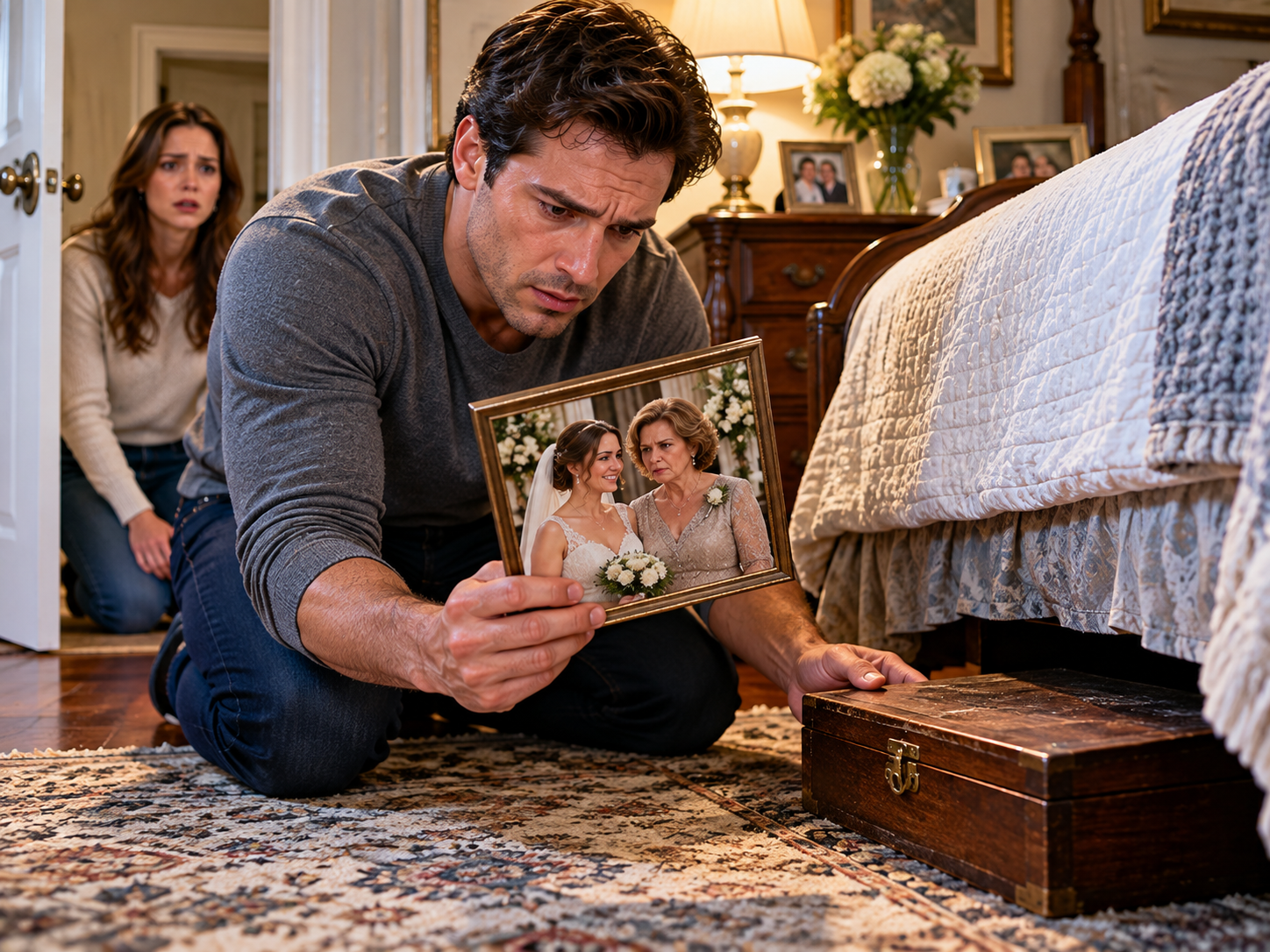
Claire walked through the old bedroom.
She stopped beside the empty space where the bed had stood.
"That's where she kept the box."
"Yes."
"Do you miss her?"
I looked at the room.
"Every day."
Claire nodded.
"I do too."
I turned toward her.
"You barely knew her."
"I knew enough."
That surprised me.
"What did you know?"
"That she loved you."
I smiled.
"She did."
"And I think she loved me too."
I nodded.
"She did."
Claire looked around.
"She just didn't know how to say it."
That was true.
My mother had spent her life expressing love through action.
She cooked.
She organized.
She worried.
She paid bills.
She kept records.
She made plans.
She rarely said the thing she felt.
Perhaps that was why the final letter mattered so much.
She had finally written what she couldn't say.
We left the house that afternoon carrying only a few boxes.
Among them was the photograph from our wedding.
I had kept it.
Claire asked why.
"Because it tells the truth."
"What truth?"
"She was scared."
Claire looked at the photograph.
"She was also trying to smile."
I laughed.
"She was terrible at pretending."
Claire smiled.
"Maybe that's why I liked her."
I looked at my wife.
"Did you?"
"Eventually."
We both laughed.
For the first time, we could laugh about my mother's dislike without feeling wounded by it.
That felt like another kind of healing.
Then, months later, something unexpected arrived.
A letter from the medical institution where we had deposited my father's papers.
They had discovered an unfinished manuscript.
It was titled:
"Risk Without Destiny."
The manuscript contained my father's explanation of the problem he had spent years studying.
It also contained a dedication.
The dedication was to two women.
His wife.
And Claire's mother.
He had written that he hoped one day their daughters would grow up without being frightened by the uncertainty that had shaped their mothers' lives.
I read the final page twice.
Claire was beside me.
Neither of us spoke.
My father had never known we would marry.
He had never known the two families would become connected again.
He had simply hoped the next generation would live differently.
And somehow, despite everything, that was what had happened.
Claire folded the manuscript carefully.
"What should we do with this?"
I looked at her.
"Finish it."
She smiled.
"Together?"
"Together."
We began.
Not as doctors.
Not as researchers.
Not as people pretending to know more than we did.
As two people who had lived inside the consequences of fear.
We added a personal introduction explaining why the manuscript mattered.
We made it clear which conclusions belonged to my father and which had later been challenged or developed.
We included the history of both families.
We removed anything that would expose private medical information unnecessarily.
And at the end, we added a single sentence.
"Risk is information, not destiny."
It became the line I wished my mother had heard years earlier.
But perhaps she had needed to discover it in her own way.
The manuscript was eventually preserved.
The story of our families was preserved with it.
Not as a tragedy.
Not as a romance.
Not as a mystery.
As a record of what fear can do when people stop speaking honestly.
And of what can happen when they finally begin.
Click here to continue reading: PART 6: Finishing My Father’s Work Brought Claire and Me Closer, Until an Old Letter Forced Us to Reconsider the Last Thing My Mother Had Hidden
My Mother Warned Me Before the Wedding, Yet Two Years Later Her Empty House Held a Secret She Had Never Trusted Me Enough to Reveal
Part 5 of 20