The promise came during a storm.
Rain had been falling since late afternoon, hard enough to blur the lights outside the windows.
Our child was asleep upstairs.
Claire and I were in the living room, surrounded by books and the faint smell of wet earth coming through the open window.
She had been quiet for nearly an hour.
“What are you thinking about?” I asked.
She looked at the rain.
“My mother.”
I waited.
“She was told something about her health, and it changed the way she saw her entire future.”
“Yes.”
“She didn't know how much of it was certain.”
“No.”
“And then your mother became afraid because of it.”
“Yes.”
Claire folded her arms.
“What if we do the same thing?”
I knew what she meant.
Not with our child.
Not deliberately.
But fear had a way of disguising itself as responsibility.
“We won't,” I said.
She looked at me.
“That isn't a promise you can make casually.”
“I know.”
“I mean it, Daniel.”
“So do I.”
She took a breath.
“What if our child gets scared one day?”
“We listen.”
“What if they refuse an appointment?”
“We talk.”
“What if the doctors tell us something frightening?”
“We learn what it actually means before reacting.”
“What if we don't understand?”
“We ask.”
“What if we're terrified?”
I looked at her.
“We tell them we're terrified.”
She was quiet.
“Not hide it?”
“Not turn it into their burden.”
Claire nodded.
That was the promise.
Not that we would never be afraid.
We would.
Not that we would always know what to do.
We wouldn't.
The promise was that fear would not become an excuse to take someone else's choices away.
The rain continued.
Claire rested her head against my shoulder.
“I wish our parents had known that.”
“So do I.”
But wishing could become another way of living in the past.
We had learned to stop there.
The next morning, our child found us in the kitchen.
“Why were you talking about Grandma last night?”
I looked at Claire.
“You were awake?”
“No. I heard you before I fell asleep.”
Children hear more than adults think.
Claire smiled.
“We were talking about family.”
“About Grandma?”
“Yes.”
Our child pulled out a chair.
“What about her?”
I considered whether to explain everything.
Then I remembered the rule.
Tell the truth appropriate to the person asking.
Not everything.
Not nothing.
Enough.
“We were talking about how Grandma was sometimes afraid and how fear made her keep things secret.”
“Like the box?”
“Yes.”
“Was she bad?”
The question was direct.
Claire sat beside them.
“No,” she said. “She made mistakes.”
“What's the difference?”
I answered.
“A bad action doesn't automatically make someone a bad person.”
Our child looked thoughtful.
“Can good people do bad things?”
“Yes.”
“Can bad people do good things?”
I paused.
“Yes.”
“That’s confusing.”
“It is.”
Our child frowned.
“I thought people were good or bad.”
“So did I when I was younger.”
“What changed?”
I looked at Claire.
“Life.”
That answer seemed to satisfy them.
Then came another question.
“Did Grandma say sorry?”
“Yes.”
“How?”
I brought out the letter.
“She wrote this.”
Our child read the portions we had decided were appropriate.
The room became quiet.
“She was sorry,” our child said.
“Yes.”
“Did Mom forgive her?”
Claire smiled.
“I forgave what I could.”
“What couldn't you forgive?”
Claire thought carefully.
“Some things don't need to be forgiven in order for you to understand them.”
Our child looked puzzled.
I understood why.
Adults often used forgiveness as if it were a switch.
On.
Off.
Done.
But real families were messier.
Claire had forgiven my mother without pretending the hurt never happened.
That was more honest.
A few weeks later, Claire and I attended another medical appointment.
This time, our child was old enough to participate more directly.
The doctor explained the family history in careful language.
There was no prophecy.
No dramatic warning.
Just information.
Our child listened.
Then asked questions.
Some were simple.
Some were surprisingly precise.
At one point, the doctor said, “The most important thing is that we keep monitoring appropriately.”
Our child looked at me.
“Monitoring means checking, right?”
“Yes.”
“Not waiting for something bad?”
“Correct.”
I felt something inside me loosen.
That distinction had taken me years to understand.
Monitoring was not expecting disaster.
It was making room for knowledge.
After the appointment, we stopped for lunch.
Our child ordered something unhealthy.
Claire objected.
I supported the child.
Claire accused me of undermining parental authority.
I denied it.
We argued about vegetables.
Then we laughed.
The medical appointment disappeared into the ordinary rhythm of the day.
That was exactly what we wanted.
Health should matter.
It should not become the only story.
Years later, I would remember that lunch more vividly than the appointment itself.
Because the appointment gave us information.
The lunch gave us life.
That evening, I opened my father's manuscript again.
Risk Without Destiny.*
The title seemed almost too simple.
But simplicity had become difficult for our family.
I read the old pages carefully.
My father wrote about uncertainty.
About incomplete evidence.
About the danger of treating probabilities as guarantees.
But there was something else in his notes that I had overlooked before.
He repeatedly returned to communication.
He believed medical knowledge only helped people when they understood how to use it.
I closed the manuscript.
My father had been trying to solve a scientific problem.
My mother had been trying to solve an emotional one.
Neither had solved it completely.
That was not failure.
That was being human.
The following month, our family hosted a small dinner.
We invited relatives who had known my parents.
There were old stories.
Some funny.
Some embarrassing.
One relative remembered my mother arguing about the proper way to fold tablecloths.
Another remembered my father forgetting where he parked his car at the research foundation.
Everyone laughed.
Someone asked about the archive.
I explained what we had preserved.
A relative said, “Your mother would be proud.”
I smiled.
“Maybe.”
Claire looked at me.
I added, “I think she would also complain about how we organized it.”
Everyone laughed.
That felt right.
My mother had become a person again.
Not a villain.
Not a saint.
Not a warning.
A person.
A woman who had loved deeply and feared deeply.
A woman who had made mistakes.
A woman who had left behind evidence of both.
After dinner, one of the older relatives pulled me aside.
“She always worried about you,” he said.
“I know.”
“She thought you were too willing to trust people.”
I smiled.
“That sounds like her.”
“She wasn't always easy.”
“No.”
He looked toward Claire.
“But she respected your wife.”
I glanced at Claire.
“Eventually.”
He nodded.
“I think she respected her sooner than you knew.”
That stayed with me.
Perhaps my mother’s love had changed before her behavior did.
Perhaps that was why her hand had been on Claire’s back at the wedding.
Perhaps she had been fighting herself even then.
I would never know for certain.
And I had finally learned that not knowing did not have to be painful.
Some questions could remain open.
They could sit quietly beside the answers.
That was another form of peace.
One night, I found Claire in the archive room.
She was looking through the photographs.
“Anything interesting?”
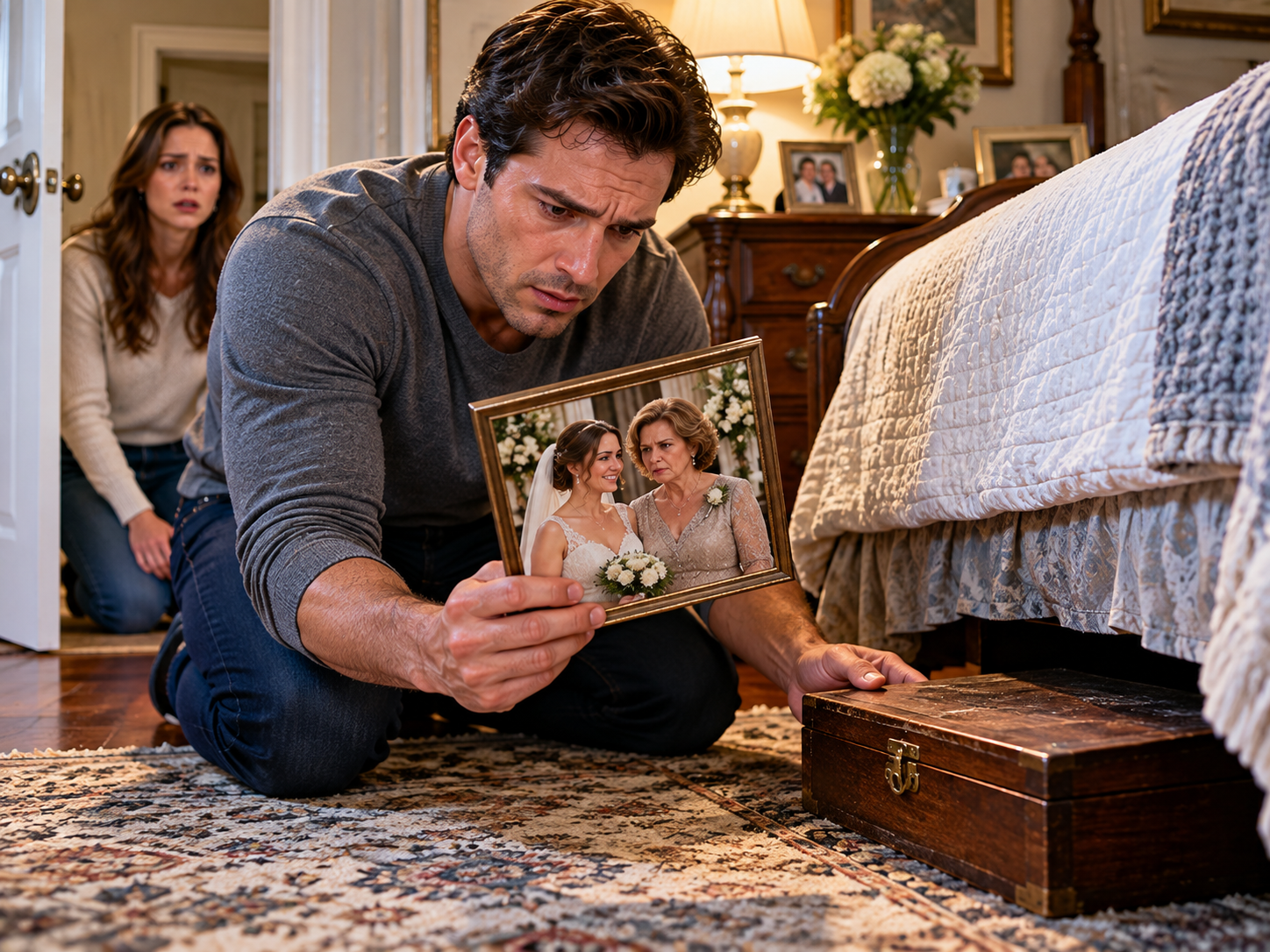
She held up the wedding picture.
“Still this one.”
“You're obsessed.”
“Maybe.”
She smiled.
“Look at her hand.”
“I know.”
“No.”
She pointed.
“Look at her fingers.”
I stepped closer.
My mother's hand was not simply resting on Claire's back.
Her fingers were slightly curled, as if she had begun to pull away and then decided not to.
A tiny gesture.
A hesitation.
A choice.
I stared at it.
“You're right.”
Claire smiled.
“She was trying.”
“Yes.”
Neither of us needed to say more.
We put the photograph back.
Not in the archive.
On the wall.
Where it belonged.
Click here to continue reading: PART 15: When Our Child Asked Whether Grandma Had Been Right About the Wedding, I Finally Understood What Her Warning Had Really Been Trying to Say
My Mother Warned Me Before the Wedding, Yet Two Years Later Her Empty House Held a Secret She Had Never Trusted Me Enough to Reveal
Part 14 of 20