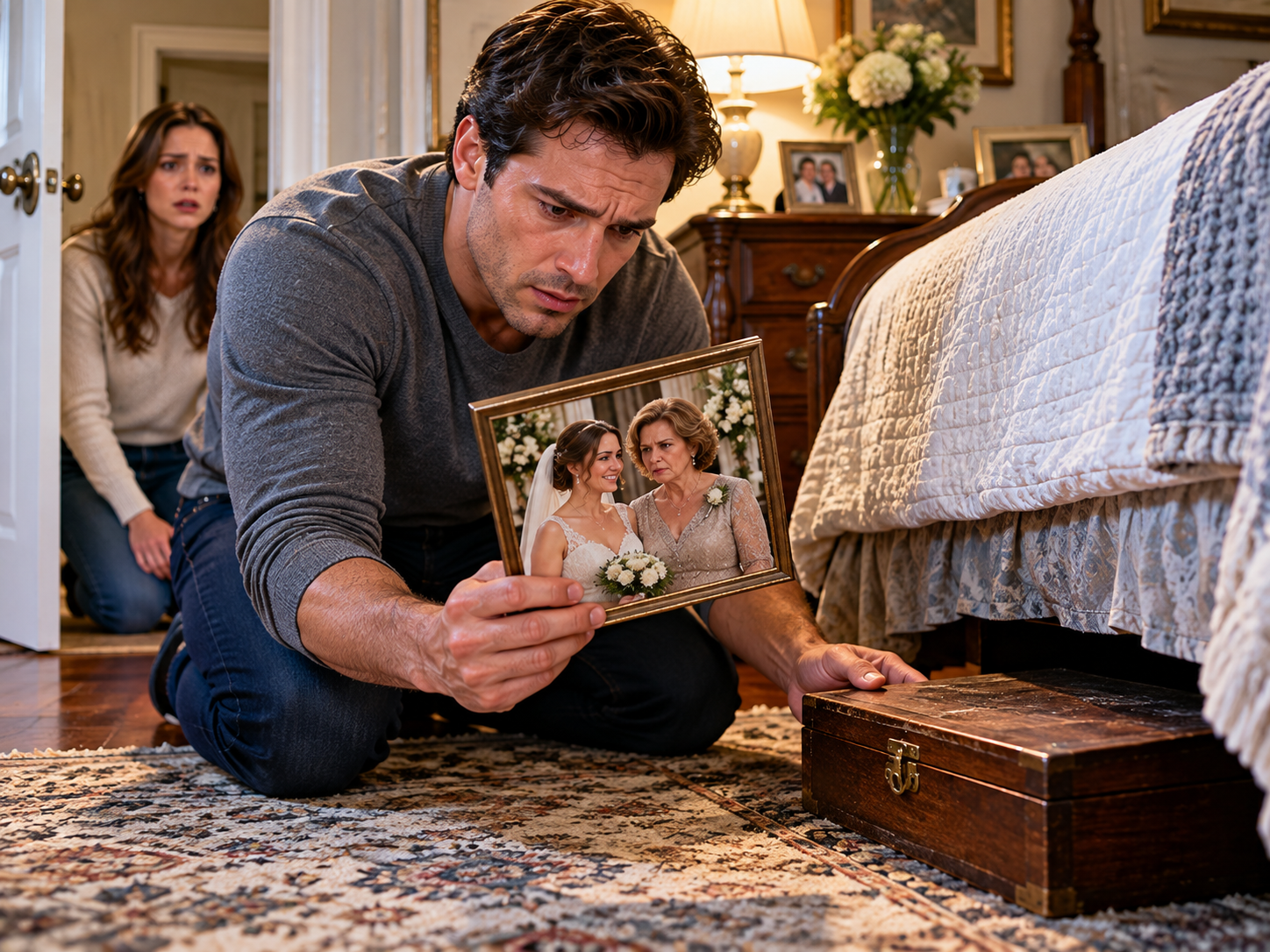
Years later, our child found the wedding photograph.
It was tucked inside a family album.
There was my mother.
There was Claire.
There was me.
The photograph looked ordinary.
But our child had grown up hearing enough of the family history to know that the image contained a story.
"Why did Grandma look unhappy?"
I smiled.
"She was worried."
"About Mom?"
"Yes."
"Why?"
I looked at Claire.
She was sitting across the room.
She nodded.
It was time.
Our child was old enough.
So we told the story.
Not every medical detail.
Not every private conversation.
But the truth.
We explained that my mother had initially disliked Claire because she believed Claire was connected to a dangerous medical history.
We explained that she had been wrong about what that meant.
We explained that Claire's mother had suffered because of an incomplete understanding of the same genetic condition.
We explained that my father had spent years researching it.
We explained that fear had caused people to keep secrets.
Our child listened carefully.
Then came the inevitable question.
"Did Grandma hate Mom?"
Claire answered.
"No."
Our child looked surprised.
"But Dad said she didn't like you."
"I didn't think she liked me."
"Then why didn't she?"
I looked at Claire.
She smiled.
"Because she was scared."
Our child thought about that.
"Scared of Mom?"
"No."
Claire shook her head.
"Scared of losing your father."
The answer seemed to satisfy them for a moment.
Then another question came.
"Did Grandma know she was wrong?"
"Eventually."
"When?"
"Before she died."
"Did she tell you?"
I answered.
"She wrote it down."
We showed the letter.
Our child read the first few lines.
Then stopped.
"She said she was sorry."
"Yes."
"Did you forgive her?"
Claire looked at me.
I answered.
"Yes."
"But she hurt Mom."
"She did."
"Then why forgive her?"
I smiled.
"Because forgiveness doesn't mean what she did was okay."
Our child frowned.
"Then what does it mean?"
"It means I decided I didn't want anger to control the rest of my life."
That became a conversation that lasted nearly an hour.
We talked about mistakes.
We talked about fear.
We talked about health.
We talked about how people sometimes make decisions because they believe they are helping.
And how good intentions don't always produce good results.
Our child asked whether my father had made mistakes.
"Yes."
"Did he love Grandma?"
"Very much."
"Did he love you?"
"Very much."
"Then why didn't he tell you?"
"Because he thought he was protecting me."
"Was he wrong?"
"Yes."
The child considered that.
"Can someone love you and still make a bad decision?"
"Absolutely."
That was one of the most important things I wanted them to understand.
Love does not make people infallible.
Parents can be wrong.
Partners can be wrong.
Children can be wrong.
And forgiveness does not require pretending otherwise.
As the years passed, our family became increasingly open about medical history.
We kept records.
We attended regular appointments.
We discussed risks without turning them into predictions.
When someone became worried, we talked.
No one secretly contacted a doctor.
No one quietly changed another person's treatment.
No one hid test results.
The rule was simple.
If the information belongs to you, you deserve to know it.
That rule had been learned through pain.
But it didn't have to be painful forever.
Claire remained healthy for many years.
So did I.
The genetic marker never became the sentence my mother had feared.
It remained what it had always been.
A piece of information.
Something worth respecting.
Something worth monitoring.
Not a prophecy.
Sometimes I wondered what my mother would have thought.
Would she have been relieved?
Would she have regretted everything?
Would she have finally laughed at how frightened she had been?
I liked to imagine she would.
The manuscript my father left behind eventually became part of a larger medical history collection.
His work was cited in later research.
Not because he had solved everything.
He hadn't.
But because he had asked an important question.
How much harm can fear cause when uncertainty is treated as certainty?
That question stayed relevant.
It also became personal.
One afternoon, Claire and I attended a small gathering where researchers discussed the historical papers.
A doctor asked us why we had chosen to preserve such personal material.
Claire answered.
"Because medical history isn't only about discoveries."
She paused.
"It's also about what happens to families when people don't understand the information."
I added:
"And what happens when fear fills the gaps."
The doctor nodded.
That was exactly why we had kept the records.
Not to glorify our family.
To remember what happened.
Afterward, Claire and I walked outside.
The air was cool.
She took my hand.
"Do you ever wish we'd never found the box?"
I thought about it.
"No."
"Not even once?"
"Sometimes I wish my mother had told me everything sooner."
"That's different."
"Yes."
I looked at her.
"If we hadn't found the box, I would have spent the rest of my life believing she hated you."
Claire smiled.
"And now?"
"Now I know she was afraid."
"Does that make you love her more?"
I considered the question.
"It makes me understand her more."
Claire nodded.
"That's probably better."
I agreed.
Understanding is not always comfortable.
Sometimes it makes people harder to judge because you can finally see all the things that were happening at once.
My mother had been afraid.
She had also been controlling.
She had loved me.
She had also violated my trust.
She had protected me.
She had also withheld information I deserved.
All of those statements were true.
The same was true of my father.
The same was true of Claire's mother.
The same was true of Claire.
The same was true of me.
We were not simple people.
None of us were.
That realization made the old story less satisfying.
There was no perfect villain.
There was no perfect victim.
There was only a family making choices under pressure.
Some choices were good.
Some were terrible.
And all of them had consequences.
One evening, our child asked me something I hadn't expected.
"If Grandma were alive, would you want her to meet me?"
I smiled.
"Yes."
"Why?"
"Because I think she would have loved you."
"Even though she didn't like Mom?"
"She learned to love your mother."
"When?"
"Before she died."
Our child smiled.
"Then maybe she would have liked me too."
"She would have spoiled you."
Claire laughed.
"Definitely."
The thought made me smile.
My mother had been strict.
But with grandchildren, perhaps she would have softened.
I would never know.
That was one of the losses no amount of truth could repair.
But truth could at least prevent me from filling the gap with bitterness.
I could imagine her differently now.
Not as the woman who rejected my wife.
As the woman who was frightened and wrong.
That was a more honest memory.
And somehow, a kinder one.
The wedding photograph remained on our wall.
Not hidden.
Not displayed like a shrine.
Just part of the family photographs.
Visitors sometimes asked who everyone was.
We answered.
No secrets.
No embarrassment.
Just names.
My mother.
My father.
Claire.
Me.
And eventually, our children.
The photograph that once represented conflict became a record of where the family had begun.
Not where it ended.
Because the family continued.
And so did we.
Click here to continue reading: PART 8: The Last Secret Beneath My Mother’s Bed Finally Found Its Place in Our Family History, and I Learned What Her Final Warning Had Really Meant
My Mother Warned Me Before the Wedding, Yet Two Years Later Her Empty House Held a Secret She Had Never Trusted Me Enough to Reveal
Part 7 of 20