The question came years later, when our child was nearly grown.
We were cleaning the house before a family celebration.
The archive had expanded into two shelves.
The wedding photograph remained on the wall.
Our child stood beneath it, holding an old frame.
“Dad?”
“Yes?”
“Can I ask you something serious?”
I put down the box I was carrying.
“Of course.”
“Was Grandma right?”
I knew immediately what they meant.
“About Mom?”
“Yes.”
I looked at Claire.
She was across the room, arranging photographs.
She heard the question.
But she did not answer for me.
That mattered.
This was my story to explain.
“No,” I said.
Our child waited.
“Not because Grandma was foolish. Not because she didn't love me. She was wrong because she believed the risk she saw meant something it didn't.”
“So she was wrong about Mom?”
“Yes.”
“Did she know she was wrong?”
“I think she eventually understood.”
“But she still warned you.”
“Yes.”
“Why?”
I sat down.
Our child sat opposite me.
“Because she thought she was protecting me.”
“From Mom?”
“No.”
“Then from what?”
I looked toward Claire.
“From losing the life she thought I might have.”
Our child frowned.
“That doesn't make sense.”
“It didn't to me either.”
I explained.
My mother had known about the family medical history.
She had known about my father's research.
She had seen the genetic marker.
She had seen Claire's connection to the same history.
She had become frightened.
She imagined a future filled with hospitals, uncertainty, and loss.
Instead of telling me what she knew, she tried to control what I chose.
“That sounds unfair,” our child said.
“It was.”
“But she loved you.”
“Yes.”
“Then why did she do something unfair?”
“Because love doesn't automatically make people wise.”
Our child was quiet.
That sentence seemed to land.
“Were you angry with her?”
“For a long time.”
“Do you still hate what she did?”
“Yes.”
Claire looked over.
I corrected myself.
“I hate that she kept the truth from us.”
“That’s different.”
“Yes.”
Our child nodded.
“Can you love someone and still hate something they did?”
“Yes.”
“Like Grandma?”
“Exactly.”
The room became quiet.
Then our child looked at the wedding photograph.
“She looks like she doesn't want to be there.”
“She didn't want the wedding to happen.”
“Why did she come?”
I smiled.
“Because even when she disagreed with me, she still wanted to stand beside me.”
Our child looked at the picture again.
“And Mom?”
“Your mother wanted her there.”
“Was Mom scared?”
“Yes.”
“Why?”
“Because she thought Grandma hated her.”
Claire finally spoke.
“I was.”
Our child turned.
“You were?”
Claire smiled.
“Very.”
“But you stayed.”
“Yes.”
“Why?”
Claire looked at me.
“Because I loved your dad.”
Our child smiled.
“That was a good reason.”
“It was.”
The conversation changed something in me.
For years, I had thought of the wedding as the beginning of the conflict.
Now I saw it differently.
The conflict had started before Claire and I met.
It had begun with inherited fear.
With my father's research.
With Claire's mother's illness.
With my mother's grief after my father's death.
With years of uncertainty.
The wedding had simply become the place where all those things collided.
Claire had not caused the fear.
I had not caused it.
My mother had inherited it.
And eventually, we had inherited the consequences.
But inheritance did not mean inevitability.
That was the lesson.
The next day, our child asked to read my mother's final letter again.
We sat together.
This time, I let them read the whole thing.
They were old enough.
When they finished, they folded the paper carefully.
“She really was sorry.”
“Yes.”
“She wanted you to know the truth.”
“Yes.”
“Then why didn't she tell you before?”
“I don't know.”
Our child looked at me.
“Doesn't that bother you?”
“Sometimes.”
“Then why don't you stay angry?”
I thought about it.
“Because anger helped me find the truth. It didn't help me live with it.”
That was probably the simplest way I could explain it.
Anger had been useful once.
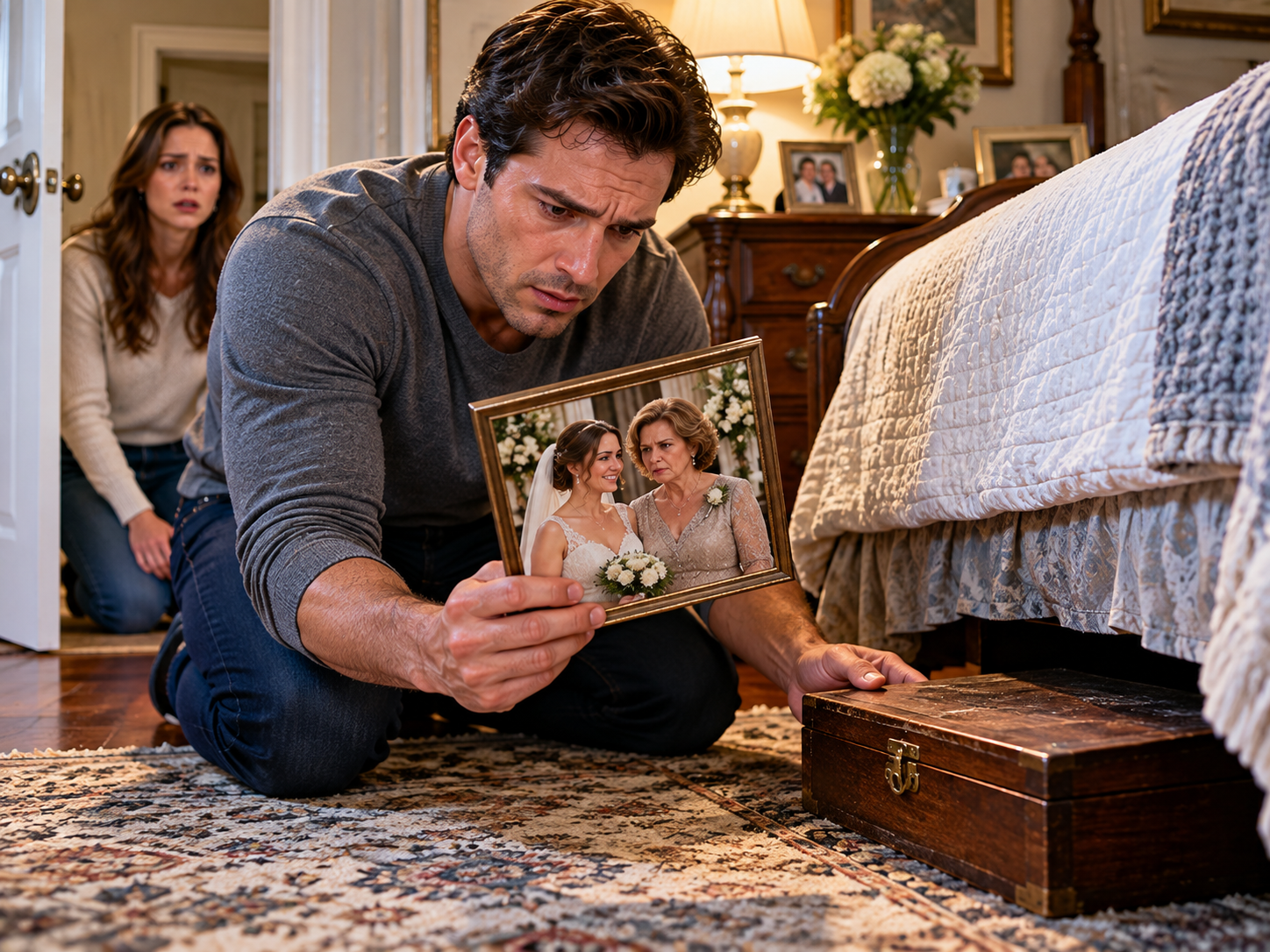
It had forced me to look beneath the bed.
It had forced me to open the box.
It had forced me to question the story I had believed.
But eventually, anger had become another box.
A container for everything I could not change.
I had to put it down.
Our child asked, “Do you think Grandma would have changed if she lived?”
“I don't know.”
“You always say that.”
“Because sometimes that's the honest answer.”
Our child smiled.
“Grandma would hate that.”
I laughed.
“She probably would.”
That afternoon, we continued cleaning.
We found old cards.
Photographs.
Receipts.
A faded ribbon from our wedding.
A note in my mother's handwriting that simply said:
Buy more rice.*
We laughed until our sides hurt.
The woman who had once seemed like the central mystery of my life was suddenly present in the most ordinary way.
Rice.
Photographs.
A crooked handwritten note.
A wedding picture.
A box.
That was how memory worked.
It turned extraordinary things ordinary again.
The family celebration arrived the following weekend.
Everyone gathered in the yard.
There was food everywhere.
Children ran between chairs.
Older relatives argued about music.
Someone played an old song my mother used to like.
Claire stood beside me.
Our child was talking with cousins.
For a moment, I looked around and realized something.
This was the future my mother had been afraid I would lose.
It had arrived anyway.
Not perfectly.
Not without uncertainty.
But it was here.
Alive.
Loud.
Messy.
Beautiful.
Claire leaned toward me.
“What are you thinking?”
“My mother would complain about the noise.”
“She absolutely would.”
“And then she'd stay until everyone left.”
Claire smiled.
“She would.”
We watched our child laugh.
Then Claire said something quietly.
“You know what I think?”
“What?”
“I think your mother finally got what she wanted.”
I looked at her.
“What do you mean?”
“She wanted you safe.”
I smiled.
“We're not safe from everything.”
“No.”
“But we're honest.”
“Yes.”
“And maybe that's what she was trying to reach.”
Claire took my hand.
The family celebration continued around us.
I looked toward the photograph hanging inside the house.
The wedding picture was visible through the open doors.
My mother was frozen in that image.
Still young enough to believe she could protect me from everything.
Still afraid.
Still standing beside Claire.
Still trying.
I used to think that photograph showed the beginning of my mother's rejection.
Now I saw something else.
It showed a woman standing beside the future she did not understand.
She had not accepted it yet.
But she had not walked away either.
That mattered.
That evening, after everyone left, I took the photograph down.
I cleaned the frame.
Then I put it back.
Claire watched me.
“You're still keeping it.”
“Always.”
“Why?”
“Because I don't want to remember only the version of her I was angry with.”
Claire nodded.
“That’s fair.”
I looked at the photograph.
“I want to remember all of her.”
“The difficult parts too?”
“Especially those.”
“Why?”
“Because if I only remember the good parts, I won't learn anything.”
Claire smiled.
“That sounds like something your father would say.”
“Maybe.”
We turned off the lights.
The house became quiet.
The photograph remained on the wall.
Not as an accusation.
Not as an apology.
Not as proof that everything had worked out perfectly.
It was simply a reminder.
Love could be complicated.
Fear could be powerful.
Truth could arrive late.
But none of those things had to decide what came next.
Click here to continue reading: PART 16: At Last, I Understood Why My Mother Kept My Wife’s Photograph Beneath Her Bed, and the Answer Was Nothing Like the One I Had Feared
My Mother Warned Me Before the Wedding, Yet Two Years Later Her Empty House Held a Secret She Had Never Trusted Me Enough to Reveal
Part 15 of 20