Years passed quietly.
That surprised me.
For a story that began with a wedding warning, a hidden box, a dead mother, and a secret medical history, the ending did not arrive with fireworks.
It arrived through ordinary mornings.
School bags by the door.
Coffee cooling beside unfinished paperwork.
Appointments written on calendars.
Birthday candles.
Arguments over homework.
Rainy afternoons.
The occasional forgotten grocery item that somehow became a family crisis.
Life became wonderfully boring.
And I learned to appreciate that.
The genetic marker remained part of our medical history.
It did not become the center of our lives.
We kept up with recommended monitoring. We asked questions. We followed medical advice when appropriate. We did not search for signs of disaster in every headache, every tired afternoon, every uncomfortable sensation.
That had been one of my mother’s biggest mistakes.
She had turned uncertainty into surveillance.
We chose something different.
Awareness without obsession.
One evening, our child came home from school carrying a project about family history.
“Dad, I need help.”
I looked at the poster board.
There were sections for grandparents, parents, traditions, and important family events.
“What do you need?”
“I need a picture of Grandma.”
I looked toward the hallway.
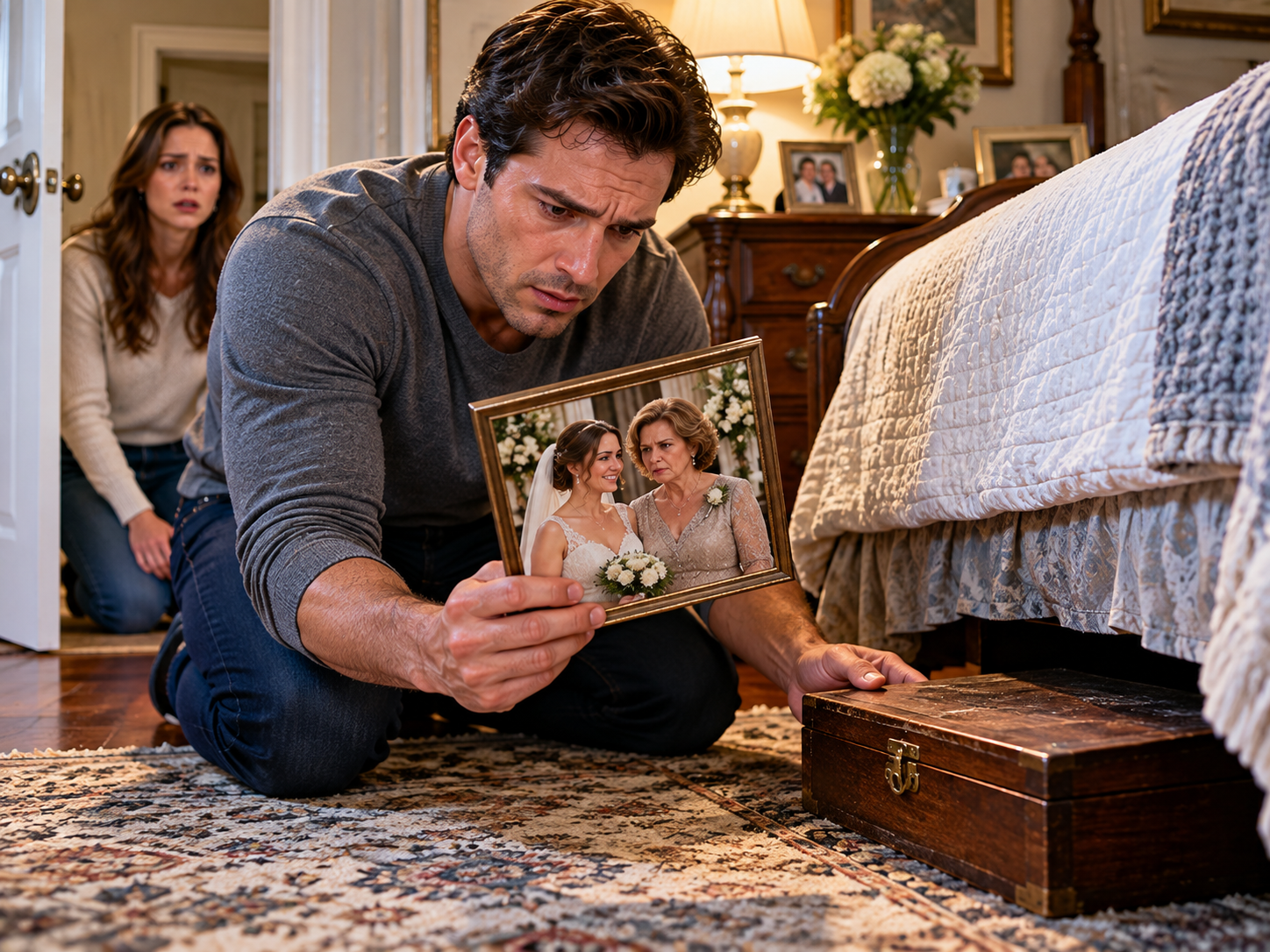
The wedding photograph was still there.
Our child had seen it hundreds of times.
But now the picture had become important.
“Which one?”
“The wedding one.”
I took it down.
Our child studied it carefully.
“Grandma looks sad.”
“She was.”
“Because she didn't like Mom?”
The old answer would have been easy.
The truthful answer required more care.
“She was afraid.”
“Of Mom?”
“No.”
“Then why was she crying?”
I sat beside our child.
“Because she believed something bad might happen to our family.”
“Did it?”
“No.”
“Why not?”
“Because what she feared was based on a risk she misunderstood.”
Our child looked at the photograph again.
“So Grandma was wrong.”
“Yes.”
The word was difficult to say.
Not because it was untrue.
Because I loved my mother.
But loving someone did not require protecting them from every consequence of their mistakes.
“She was wrong about what the medical information meant,” I said. “But she wasn't wrong to care about us.”
Our child nodded.
“Can both be true?”
“Yes.”
That might have been the most important lesson of all.
Two truths could exist beside each other.
My mother loved me.
My mother hurt Claire.
My father did valuable research.
His work was not perfect.
Claire’s mother was afraid.
She still tried to protect her daughter.
The medical marker mattered.
It did not decide our future.
None of these truths canceled the others.
Our child placed the photograph on the poster.
“What should I write?”
I thought for a moment.
“Write what you know.”
Our child frowned.
“That’s boring.”
I laughed.
“Then write something interesting that is also true.”
The final sentence became simple.
Grandma was scared at our wedding, but later we learned she loved our family very much.*
I read it twice.
“That’s good.”
Our child smiled.
“Can I add that Mom looked pretty?”
Claire called from the kitchen, “You may absolutely add that.”
We laughed.
The poster went on the refrigerator.
The photograph remained there for several weeks.
Eventually, I noticed something I had never seen before.
In the picture, my mother stood beside Claire.
Her face looked tense.
Her mouth was pressed into a thin line.
But her hand was resting lightly against Claire’s back.
I had noticed that gesture years earlier.
Now I understood it differently.
My mother had been struggling.
She had not known how to accept what she could not control.
But even then, she had reached toward Claire.
It was a small gesture.
Almost invisible.
Yet it had been there the whole time.
That night, Claire and I talked about it.
“I keep thinking about that hand,” I said.
She smiled.
“I noticed it years ago.”
“You did?”
“Of course.”
“Why didn't you tell me?”
“Because you were busy being angry.”
I stared at her.
“That sounds like me.”
“It was.”
I laughed.
Then Claire became serious.
“I think she wanted to be close to me.”
“I think so too.”
“She just didn't know how.”
We sat quietly.
There was no need to defend my mother anymore.
There was no need to condemn her either.
She had become what she really was.
A woman who had loved badly in one area because she was frightened.
That was not a perfect ending.
It was a human one.
A month later, I received a message from Martin.
He had found another small box while the foundation was clearing an old storage room.
Inside were copies of administrative documents related to my father’s research.
Nothing dramatic.
No secret diagnosis.
No hidden confession.
Just records.
Meeting minutes.
Funding correspondence.
Old notes.
And one photograph of my father standing beside a group of researchers.
I stared at it for a long time.
My father looked younger than I remembered.
I had spent so many years thinking of him as the man who had left behind research papers and unanswered questions.
In the photograph, he was simply smiling.
Alive.
Tired.
Probably worried about some unfinished experiment.
Probably arguing with someone about terminology.
Probably believing that one more study might make the truth clearer.
I showed the photograph to Claire.
She smiled.
“He looks happy.”
“He probably was.”
“What will you do with it?”
“Keep it.”
“Of course.”
We added it to the archive.
Then I wrote one sentence underneath.
Research is made by people, and people are always unfinished.*
It was not something my father had written.
It was something I had learned from him.
Our archive had grown by then.
We had stopped calling it “the box.”
It was simply our family records.
That change mattered.
The box had represented secrecy.
The archive represented memory.
The difference was not the objects.
It was what we chose to do with them.
We no longer hid the documents because we were afraid of what someone might discover.
We kept them because someday someone might need to understand.
That distinction followed us into parenting.
When our child asked difficult questions, we answered as honestly as we could.
When we did not know, we said we did not know.
When something was private, we explained why.
When medical information mattered, we did not whisper about it behind closed doors.
We did not make promises we could not keep.
And we never told our child that family history was destiny.
One Saturday afternoon, our child asked me whether Grandma would have liked the person they were becoming.
I stopped what I was doing.
“Why do you ask?”
“Because I don't know her.”
I sat down.
“You would have made her laugh.”
“How do you know?”
“Because you make me laugh.”
“That doesn't mean Grandma would.”
I smiled.
“Your Grandma was complicated.”
“So am I.”
“Definitely.”
Our child grinned.
Then I said, “I think she would have loved you.”
The answer came from somewhere deeper than evidence.
It was not a medical fact.
It was not documented history.
It was simply something I believed about my mother.
And for once, I was comfortable knowing the difference.
That night, I put the wedding photograph back on the wall.
I stood there for a while.
The photograph no longer made me angry.
It did not make me sad in the same way either.
It reminded me that people can stand inside the same moment and understand completely different things.
My mother had seen danger.
I had seen love.
Claire had seen rejection.
Years later, we could all see the same photograph and understand more than one truth.
I touched the frame.
“Mom,” I whispered, “we figured it out.”
There was no answer.
There did not need to be.
Click here to continue reading: PART 12: I Once Thought the Secret Beneath My Mother’s Bed Would Destroy Our Family, But It Became the Reason We Learned How to Tell the Truth
My Mother Warned Me Before the Wedding, Yet Two Years Later Her Empty House Held a Secret She Had Never Trusted Me Enough to Reveal
Part 11 of 20