The question came on an ordinary Tuesday morning.
Our child was sitting at the kitchen table, one shoe on and the other somewhere under the chair, staring at a school form with the kind of concentration usually reserved for difficult mathematics.
“Dad?”
“Hmm?”
“Do I have to tell the school about our family medical history?”
I stopped stirring my coffee.
Claire looked up from the counter.
Our child was old enough now to understand that the genetic marker was part of our family history, but still young enough to wonder where privacy ended and honesty began.
“That depends on what they’re asking,” I said.
“They want to know if anyone in the family has inherited conditions.”
Claire came over and sat beside them.
“We can help you decide what information is necessary,” she said. “But nobody should make that decision for you without explaining why.”
Our child looked between us.
“Grandma would have filled out the whole form.”
I laughed before I could stop myself.
Claire laughed too.
“She probably would have attached copies of every medical record we own.”
“That sounds like Grandma.”
The laughter faded naturally.
I looked at the form.
There was something strangely comforting about that moment.
Years earlier, my mother had believed that protecting me meant collecting information without telling me.
Now my child was asking us how to decide what belonged to them.
The difference was enormous.
“Your medical information belongs to you,” I said. “When you’re old enough to make those choices, we’ll help you understand them. We won’t secretly make decisions about your health.”
Our child nodded.
“Okay.”
Then they picked up the missing shoe from beneath the chair.
The conversation ended.
But it stayed with me all day.
At work, I found myself thinking about the wooden box again.
Not the fear.
Not the wedding.
The lesson.
My mother had spent years collecting information because she believed information gave her control over uncertainty.
But information without communication had not protected anyone.
It had only created a second problem.
The next weekend, I took the box down from the shelf.
Claire was sorting old photographs nearby.
“You're thinking about her again,” she said.
“I never stopped.”
She smiled.
“That wasn't what I meant.”
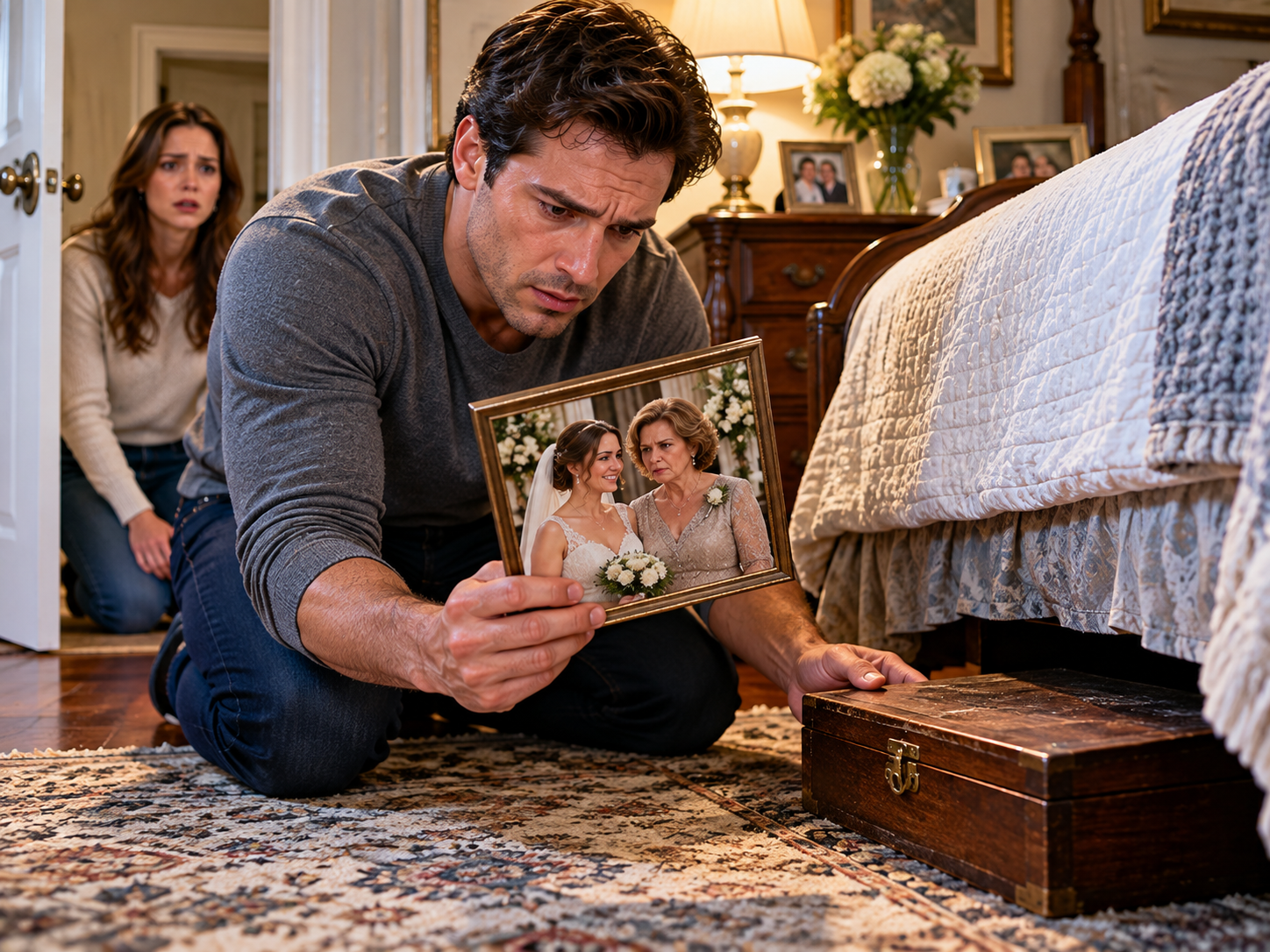
I opened the box.
The documents were exactly where I had left them.
My father’s manuscript.
The old reports.
My mother’s notes.
The letters.
The wedding photograph.
And beneath those, a folder I had almost forgotten.
It contained receipts.
Not medical reports.
Ordinary receipts.
Pharmacy purchases.
Transportation expenses.
Small payments made at clinics.
Things my mother had paid for over the years.
I had seen them before.
But I had never really considered what they meant.
My mother had not only been afraid.
She had been doing something with that fear.
She had been paying for appointments.
Paying for monitoring.
Paying for transportation when necessary.
She had even covered expenses Claire had never asked her to cover.
Claire noticed what I was holding.
“She paid for that?”
“Yes.”
Claire took the receipt.
Her expression changed.
“I knew she helped.”
“You knew?”
“Not all of it.”
She turned the paper over.
There was a handwritten note on the back.
Make sure they keep going.*
Claire stared at it.
“That's her handwriting.”
I nodded.
Neither of us spoke for a while.
Then Claire said, “She really was terrified.”
“Yes.”
“But she was also trying to do something useful.”
“Yes.”
She put the receipt down.
“I wish she had just told us.”
“I know.”
There it was again.
The simplest sentence.
The one that appeared in every version of the story.
She should have told us.
We should have asked.
Someone should have spoken sooner.
But the past had no rewind button.
All we could do was make sure the lesson survived.
A few months later, our child asked to visit my mother’s old house.
The house was no longer ours, but the new owners had agreed to let us collect one remaining box from the storage shed.
We went together.
The neighborhood looked smaller than I remembered.
The trees had grown.
The road had been repaved.
A shop on the corner had become a café.
Claire held our child's hand as we walked toward the house.
“This is where Grandma lived?”
“Yes.”
“Where you found the box?”
“Yes.”
Our child looked at me.
“Were you scared?”
“Very.”
“Why?”
“Because I thought I was about to learn something terrible.”
“Did you?”
“No.”
“What did you learn?”
I smiled.
“That sometimes the truth is sad without being terrible.”
Our child thought about that.
The new owner led us to the shed.
There was one old cardboard box with my mother's handwriting on the side.
We carried it outside.
Inside were photographs, Christmas decorations, an old blanket, and several kitchen utensils.
Nothing important.
Nothing secret.
Yet our child handled each object carefully.
“Did Grandma use this?”
“Yes.”
“This?”
“Yes.”
“This ugly bowl?”
I laughed.
“Especially that ugly bowl.”
Claire picked it up.
“She loved that bowl.”
“Why?”
“No idea.”
Our child held it up.
“It is pretty ugly.”
We all laughed.
That was the moment I realized something.
The house was no longer a place of mystery.
It was becoming a place of memory.
The difference mattered.
Before, every object in my mother's house seemed capable of hiding something.
Now an ugly bowl could simply be an ugly bowl.
A photograph could simply be a photograph.
A bedroom could simply be a bedroom.
Not every drawer needed to contain a revelation.
We loaded the box into the car.
On the drive home, our child asked, “Did Grandma know you found everything?”
“She knew I would.”
“How?”
“She left instructions.”
“Before she died?”
“Yes.”
“Then she wanted you to know.”
I looked at Claire.
“Yes,” I said. “Eventually.”
That word was important.
Eventually.
My mother had delayed the truth.
But she had not destroyed it.
She had left a path toward it.
That evening, we placed the old photographs into the family archive.
Our child selected several.
One showed my mother in the kitchen.
Another showed my father at the research foundation.
Another showed Claire's mother beside a group of researchers.
Our child studied the last one.
“That’s Grandma’s mom?”
Claire nodded.
“She looks happy.”
“She was.”
“Did she know Grandma?”
“No.”
Our child looked confused.
“How can they both be part of the same story?”
I smiled.
“Because families are bigger than the people who meet.”
That night, after everyone went to bed, Claire and I sat on the porch.
The city was quiet.
Not silent.
There were distant engines, voices from another house, a dog barking somewhere down the street.
Ordinary sounds.
“I used to hate that my mother died before I understood her,” I said.
Claire looked at me.
“Do you still?”
“No.”
“Why?”
“Because I realized understanding someone isn't the same as finishing their story for them.”
Claire nodded.
“You can only understand what they left behind.”
“And what they did.”
“And what they didn't do.”
I looked at her.
“That last part matters.”
“It does.”
My mother had not told us.
That absence had consequences.
But her silence was also part of the record.
We did not need to erase it to forgive her.
The next morning, I added a new page to the family archive.
I titled it simply:
What We Know. What We Believe. What We Don't Know.*
Under the first heading, I listed documented facts.
The genetic marker.
The research history.
The medical recommendations.
The letters.
The dates.
Under the second, I listed interpretations.
Why my mother may have delayed.
What my father may have hoped to accomplish.
What Claire’s mother may have feared.
Under the third, I wrote:
We do not know exactly what my mother thought during every year of her life.*
We do not know what she would have said if she had lived.*
We do not know whether earlier honesty would have changed every outcome.*
Then I stopped.
It was the most honest document I had ever written.
Claire read it.
“I like this.”
“Why?”
“Because you're finally leaving room for uncertainty.”
I smiled.
“My father would approve.”
“Your mother might not.”
We laughed.
Maybe that was the final balance.
My father had taught us not to mistake risk for destiny.
My mother had taught us, unintentionally, not to mistake fear for certainty.
Claire's mother had taught us that medical information could shape a person's life long before anyone understood it completely.
And our child was teaching us something new.
The future belonged to them.
Not to our fears.
Not to our family history.
Not even to our love.
Our job was to give them information, support, and honesty.
Then let them live.
That was harder than controlling them.
But it was also love.
Click here to continue reading: PART 14: Claire Asked Me to Promise That We Would Never Let Fear Make Decisions for Our Children the Way It Once Made Them for Us
My Mother Warned Me Before the Wedding, Yet Two Years Later Her Empty House Held a Secret She Had Never Trusted Me Enough to Reveal
Part 13 of 20