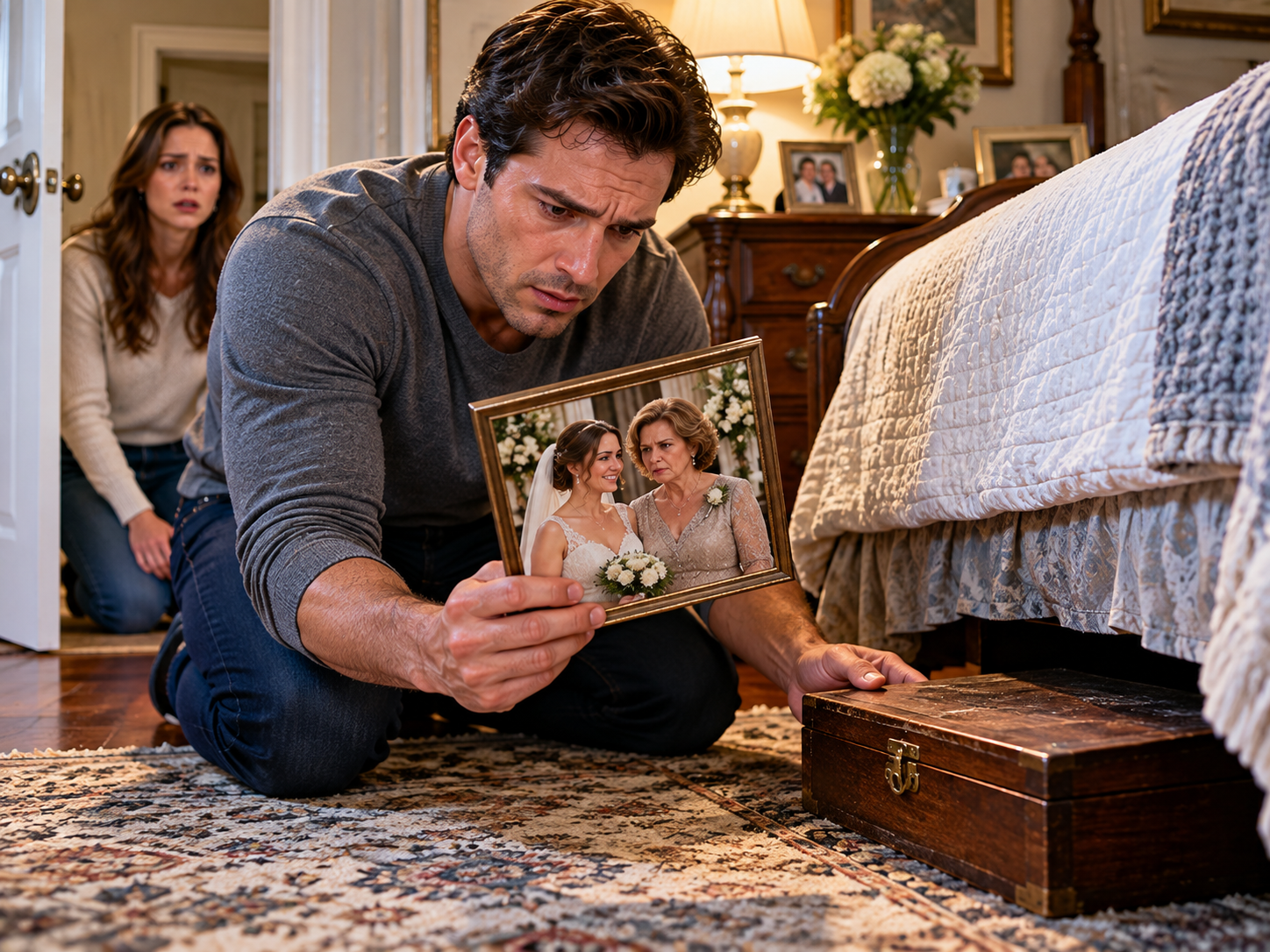
Many years after my mother's death, I returned to the bedroom where I had found the wooden box.
The house had changed owners again.
The new family had renovated almost everything.
The walls were painted a different color.
The floor had been replaced.
The old bed was gone.
Nothing looked familiar.
And yet I remembered exactly where I had knelt.
Exactly where the box had been.
Exactly how my hands had trembled when I opened it.
I stood in the empty room.
For years, I had thought of that moment as the beginning of a mystery.
Now I understood it differently.
It had been the beginning of an answer.
Not one answer.
Many.
My mother had not hated Claire.
She had feared the medical history connecting their families.
She had feared losing me.
She had feared repeating what had happened to Claire's mother.
She had believed secrecy could protect us.
She had been wrong.
But she had eventually tried to correct that mistake.
The wooden box had been her last attempt to put the truth somewhere I would eventually find it.
I wondered whether she had known exactly when I would open it.
Probably not.
My mother planned everything.
But even she couldn't plan death.
She could only leave something behind.
A trail.
A clue.
A choice.
I walked to the window.
The garden outside had changed too.
The tree was larger.
The flowers were different.
But sunlight still came through the glass in almost the same way.
I remembered Claire standing beside me there.
I remembered the day we found the final report.
I remembered her tears.
I remembered my mother's letter.
And I remembered the sentence that had once seemed so strange.
Don't let fear make your decisions for you.
At the time, I had thought she was talking about my marriage.
She wasn't.
She was talking about everything.
My health.
My family.
My wife.
My memories.
My future.
She wanted me to find the truth before deciding whom to trust.
She had spent years failing to follow her own advice.
But in the end, she gave it to me anyway.
I returned home that evening and opened the family archive.
The photograph from the wedding was there.
Beside it was my father's manuscript.
Claire's mother's letter.
My mother's final note.
The original medical report.
And a photograph of the four of us from a family gathering years after our wedding.
My mother was smiling.
Claire was beside her.
I was standing between them.
The photograph had been taken before my mother died.
I had forgotten that.
Claire hadn't.
She pointed it out to me once.
"Look at her."
"What?"
"She's holding my hand."
I had looked.
She was right.
My mother's hand was intertwined with Claire's.
At the time, I had barely noticed.
Now I saw it clearly.
She had already changed.
She simply hadn't known how to say so.
That photograph became the one I kept closest.
It showed something the earlier wedding photograph couldn't.
Not that my mother had suddenly become perfect.
That she had chosen to try.
That mattered.
Claire and I stayed married.
We had children.
We faced health questions without turning them into prophecies.
We disagreed.
We argued.
We apologized.
We grew older.
And whenever fear appeared, we tried to speak before it became a secret.
Sometimes we succeeded.
Sometimes we didn't.
We were human.
But the difference was that we knew what silence could cost.
Our children grew up knowing their grandparents through stories.
They knew my father as a researcher who believed uncertainty mattered.
They knew my mother as a woman who worried too much but loved deeply.
They knew Claire's mother as someone whose life had been shaped by medical uncertainty.
And they knew that none of those people were perfect.
That was important.
We didn't create family legends.
We created family history.
There is a difference.
A legend smooths out the difficult parts.
History leaves them visible.
When our children became adults, they asked more detailed questions.
Some were uncomfortable.
I answered.
Some questions had no answers.
I said so.
Some things I had forgotten.
I admitted that too.
I never pretended to remember conversations word for word.
I never invented explanations for what people might have felt.
I told them what I knew.
Then I told them what I believed.
And when I didn't know, I said:
"I don't know."
That became another family tradition.
We were allowed not to know.
Uncertainty no longer frightened us as much as it once had.
That was perhaps my mother's greatest unintended gift.
She taught us how destructive fear could become.
My father's work taught us how important uncertainty was.
Claire's mother's story taught us what happened when people were denied that uncertainty.
Claire taught me that love could survive uncomfortable truth.
And my own life taught me that protecting someone without their knowledge can become another form of control.
Together, those lessons became our inheritance.
Not fear.
Not secrecy.
Understanding.
Years later, Claire and I visited my mother's grave.
We stood together.
There were flowers beside the stone.
Claire touched the engraved name.
"I wish I had told her thank you."
I smiled.
"You did."
"When?"
"She knew."
Claire looked at me.
"How?"
"Because she kept your photograph."
Claire smiled.
Then she cried.
I put my arm around her.
We stood there quietly.
No speeches.
No dramatic declarations.
Just two people remembering a woman who had once been afraid of losing us.
On the way home, Claire asked:
"Do you think she would be surprised by us?"
"Probably."
"Why?"
"Because she spent so much time worrying about what could go wrong."
Claire smiled.
"And what happened?"
"We lived."
That was the simplest answer.
We lived.
Not perfectly.
Not without loss.
But fully.
The disease my mother feared never became the inevitable tragedy she had imagined.
The genetic marker remained part of our medical history.
We monitored it.
We respected it.
We didn't worship it.
Our lives were not defined by a possibility.
That was what my father had wanted.
That was what my mother had struggled to understand.
And eventually, that was what we learned.
One evening, I found myself looking at the original photograph again.
My mother stood beside Claire.
Her expression was serious.
Claire was smiling.
I was between them.
I remembered the wedding day.
My mother's warning.
My anger.
The years that followed.
Then I remembered the box.
The medical reports.
The letters.
The hidden key.
The research.
The truth.
I finally understood why the story had stayed with me for so long.
It wasn't because my mother had disliked my wife.
It was because I had believed that was the whole story.
It wasn't.
The real story was about people who were frightened by something they couldn't control.
People who made mistakes while trying to protect one another.
People who kept secrets because they thought knowledge would cause pain.
And people who eventually learned that the pain of truth is often easier to live with than the damage caused by silence.
I kept the wooden box.
Not because I needed the documents anymore.
Because it reminded me of the moment everything changed.
I had opened it expecting proof that my mother had been right about Claire.
Instead, I found proof that she had been wrong.
And I found something even more valuable.
Proof that love can be clumsy.
Fear can disguise itself as anger.
And a person can make a terrible mistake without becoming incapable of love.
My mother had never liked my wife.
At least, that was what I had believed.
The truth was more complicated.
She had been afraid of what Claire represented.
A medical history.
A family connection.
A reminder of my father's unfinished work.
A reminder of a woman who had died believing her future was already decided.
And most of all, a reminder that my mother could not control everything that happened to her son.
She tried anyway.
She failed.
Then she left me the truth.
That was her final gift.
Not an apology.
Not an explanation.
A chance.
A chance to look beneath the surface before judging the people I loved.
A chance to understand that family history doesn't have to become family destiny.
And a chance to choose differently.
I chose Claire.
Not because my mother had been wrong.
Not because Claire was perfect.
Because after everything we learned, I finally understood that my wife had never been the danger my mother feared.
Fear was.
And once fear stopped making our decisions, we were free to build a life that belonged to us.
The photograph remains in our home.
My mother's hand rests against Claire's back.
Claire is smiling.
I am standing between them.
My father is somewhere beyond the frame, part of the history that brought us there.
When I look at it now, I no longer see a mother who didn't approve of her son's marriage.
I see three people who were trying, imperfectly, to protect one another.
And I see the truth that took me years to understand.
Sometimes the secret beneath the bed isn't hiding a betrayal.
Sometimes it is hiding the reason someone was too afraid to tell you the truth.
And sometimes, when you finally find it, you discover that the person you thought was standing against your marriage had actually been standing behind it all along.
Not perfectly.
Not wisely.
But with love.
Click here to continue reading: PART 9: Years After the Box Was Opened, Daniel and Claire Learned That Telling Their Children the Truth Was Harder Than Hiding It
My Mother Warned Me Before the Wedding, Yet Two Years Later Her Empty House Held a Secret She Had Never Trusted Me Enough to Reveal
Part 8 of 20