
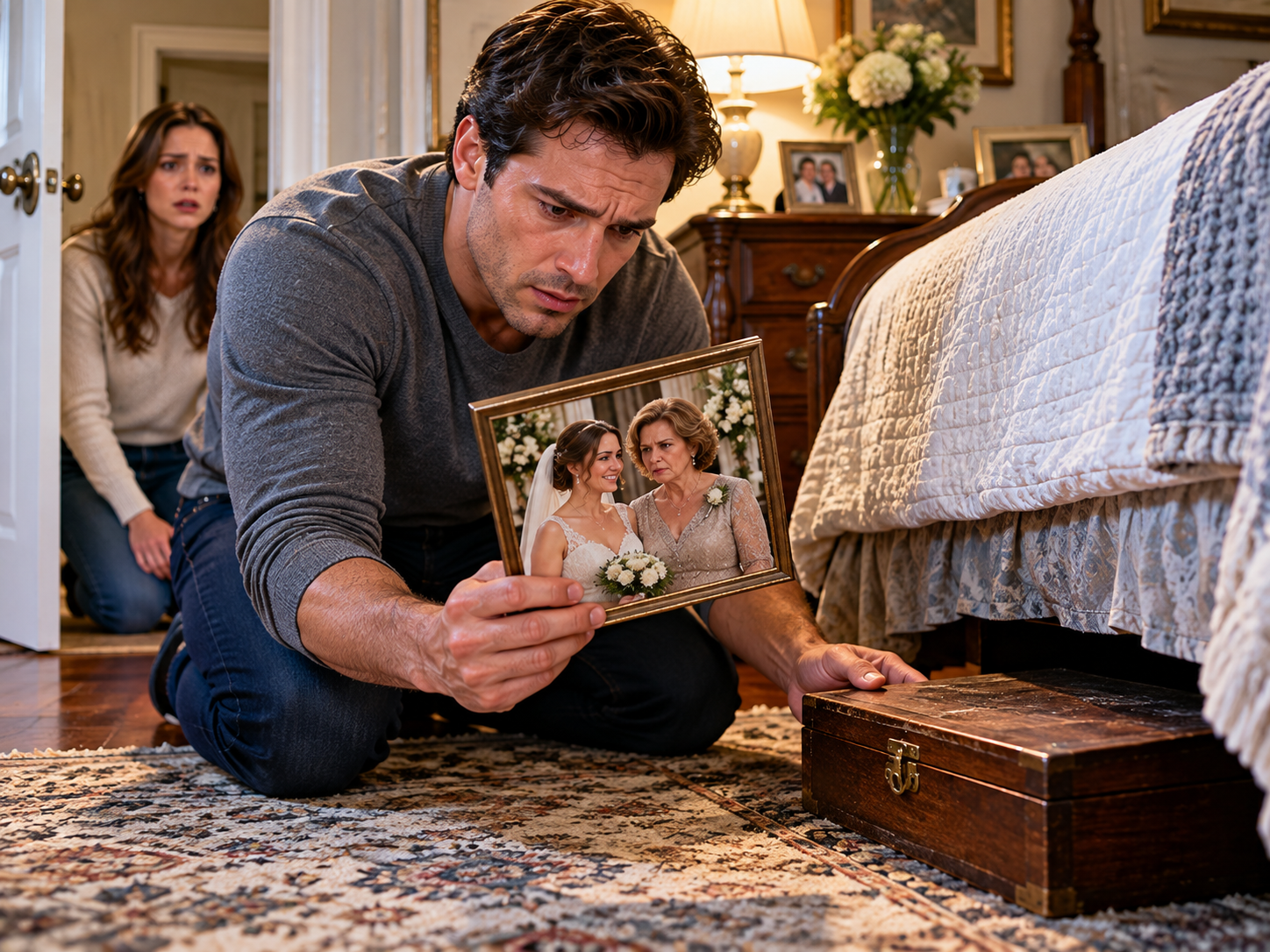
There was one final photograph.
I found it years after I thought the story was finished.
It happened almost by accident.
We were reorganizing the archive.
Claire was sorting medical documents.
Our child was scanning old photographs.
I was checking the wooden box one more time before moving it into long-term storage.
The false bottom had already been emptied years ago.
The key to Locker 314 was no longer needed.
Every important document had been copied and preserved.
There should have been nothing left.
But when I lifted the lining, I felt something underneath.
A thin envelope.
I froze.
“Claire.”
She looked over.
“What?”
“I found something.”
She came closer.
The envelope had no stamp.
No date.
Only two words written in my mother's handwriting.
For Claire.*
Claire stopped breathing for a second.
“You're sure?”
I nodded.
She reached for it.
Then stopped.
“What if I don't want to open it?”
I looked at her.
“Then we don't.”
She thought for several seconds.
Then she took the envelope.
“I want to.”
She opened it carefully.
Inside was a photograph.
Claire stared at it.
Then she covered her mouth.
It was her mother.
Young.
Smiling.
Standing beside my father at the research foundation.
But that was not what made Claire cry.
In the corner of the photograph stood my mother.
She was holding a small child.
Me.
I had never seen the photograph before.
Claire turned it over.
There was a note.
The day I first met her.*
Claire looked at me.
“Your mother kept this?”
“Yes.”
“Why?”
I turned the photograph over again.
On the back, beneath the first sentence, there was another line.
I didn't know then that her daughter would someday become my son's wife.*
I sat down.
For several minutes, neither of us spoke.
The photograph changed nothing.
And somehow, it changed everything.
My mother had known Claire's mother long before Claire and I met.
Not just through research files.
Not just through medical records.
Personally.
She had met her.
She had seen her smile.
She had seen her with me as a child.
She had known that family connection before I ever understood it.
Claire sat beside me.
“She knew me before she knew me.”
I smiled sadly.
“In a way.”
“Why didn't she ever tell me?”
“I don't know.”
Claire traced the edge of the photograph.
“She must have been carrying this for years.”
“Yes.”
There was something almost unbearably human about that.
My mother had kept a photograph beneath her bed not because it was evidence against Claire.
She had kept it because it connected two generations of women who had never understood how deeply their lives would intersect.
The secret beneath the bed had not been a weapon.
It had been a memory.
We found another note folded behind the photograph.
This one was shorter.
If Daniel ever finds this, tell him I knew Claire's family before he did. I was afraid that knowledge would make him see her differently.*
I read the sentence twice.
Then I understood.
My mother had not only feared losing me.
She had feared that once I learned the family history, I might begin seeing Claire as a medical risk rather than as my wife.
That fear had shaped everything.
The warning.
The secrecy.
The appointments.
The records.
The box.
She had been trying to control information because she was terrified information would control me.
The tragedy was that secrecy had done exactly what she feared.
It had made the information more frightening.
Claire leaned against me.
“I wish she had trusted you.”
“So do I.”
“She should have trusted me too.”
“Yes.”
She nodded.
That mattered.
Understanding my mother did not erase Claire's right to be hurt.
We sat together with the photograph between us.
Then Claire said something I will never forget.
“She loved my mother.”
I looked at her.
“I think she did.”
“Maybe that's why she couldn't look at me normally.”
“What do you mean?”
“Maybe every time she looked at me, she saw everything she had lost.”
That possibility had never occurred to me.
My father.
Claire's mother.
The research.
The years of uncertainty.
The child she had raised.
The daughter-in-law she feared losing.
All of it might have been in one person's face.
Claire wiped her eyes.
“She wasn't seeing me.”
“No.”
“She was seeing the whole story.”
“Yes.”
And suddenly the wedding photograph made even more sense.
My mother had looked at Claire and seen the past.
Claire had looked at my mother and seen rejection.
I had looked at both of them and seen an argument.
None of us had seen the whole picture.
Until now.
That evening, we showed the photograph to our child.
They stared at it.
“Is that Grandma?”
“Yes.”
“And that's Mom's mom?”
“Yes.”
“Together?”
“Years before we met.”
Our child smiled.
“They look like friends.”
I looked at Claire.
“They were.”
Our child looked confused.
“Then why did Grandma act like she didn't like Mom?”
Claire answered gently.
“Because sometimes people can care about someone and still become afraid of what that person represents.”
“That sounds complicated.”
“It was.”
Our child studied the photograph.
“Can we keep it?”
“Yes.”
“Where?”
I looked toward the archive.
Then toward the wall where the wedding photograph hung.
“Not hidden.”
Claire smiled.
“Definitely not hidden.”
We framed the photograph.
We placed it beside the wedding picture.
Two photographs.
Two moments.
Two versions of my mother.
In one, she was standing beside Claire at our wedding, afraid.
In the other, she was standing beside Claire's mother years earlier, smiling.
Together, they told a fuller story.
The story could no longer be reduced to hatred.
It was fear.
Memory.
Loss.
Love.
Mistakes.
And time.
That night, I wrote the final note for the archive.
I did not write it as a conclusion.
I wrote it as a reminder.
We found this photograph years after my mother's death. It does not prove what she felt at every moment. It does not erase the pain caused by her secrecy. It simply shows that the story began earlier than we knew.*
I added another sentence.
When people are frightened, they sometimes hide the information they think will hurt others. That does not make the hiding right. It only helps us understand why truth can arrive so late.*
Claire read it.
“Keep that.”
“I will.”
The archive was complete.
Not because every question had an answer.
It wasn't.
There were still things I would never know.
What exactly did my mother think on the morning of my wedding?
Did she regret her warning immediately?
Did she understand the medical reports before she died?
Did she know how deeply Claire had been hurt?
I could make educated guesses.
But guesses were not facts.
I had learned that lesson too well to forget it now.
So we left some questions unanswered.
And strangely, that felt peaceful.
Years earlier, uncertainty had frightened us.
Now we knew uncertainty was simply part of being alive.
Our child grew older.
The family continued.
Appointments came and went.
Birthdays arrived.
The wooden box became an artifact rather than a secret.
My father's manuscript was preserved with proper context.
Claire's mother's letter remained with Claire.
My mother's final letter remained in the archive.
The wedding photograph stayed on the wall.
And the new photograph hung beside it.
Sometimes visitors asked about them.
We told the story.
Not every private detail.
Not every medical fact.
Just enough.
A woman had been afraid.
A family had misunderstood one another.
A secret had been kept for the wrong reasons.
And eventually, the truth had been found.
One evening, I stood alone in the hallway.
The two photographs were illuminated by the soft light above them.
I looked at my mother.
Then at Claire's mother.
Then at Claire.
She was standing at the other end of the hallway, watching me.
“You finally understand her,” she said.
I considered that.
“No.”
Claire raised an eyebrow.
“I understand some of her.”
She smiled.
“That's probably better.”
I nodded.
Because complete understanding was another kind of illusion.
We never fully knew another person.
Not even someone we loved.
We knew what they told us.
What they did.
What they left behind.
What they regretted.
What they remembered.
And what we could reasonably infer.
Everything beyond that belonged to uncertainty.
I had once hated uncertainty.
Now I respected it.
My mother had spent years trying to defeat it.
My father had spent years studying it.
Claire's mother had lived beneath its shadow.
Claire and I had learned to live beside it.
That was the inheritance we chose.
Not fear.
Not secrecy.
Not certainty where none existed.
Truth.
Humility.
Conversation.
And love without control.
I looked one last time at the wedding photograph.
My mother was still crying.
Claire was still standing beside her.
My younger self was still smiling, convinced that one day my mother would love the woman I had chosen.
I had been right.
Just not in the way I imagined.
She had not become the mother-in-law I once hoped for.
She had become something more complicated.
A woman whose fear had hurt us.
A woman whose love had protected us imperfectly.
A woman whose secret eventually taught us how not to keep secrets from one another.
I reached up and straightened the frame.
Then I turned off the hallway light.
The photographs disappeared into darkness.
But they were no longer hidden.
They were simply resting there, waiting for morning.
And for the first time, that was enough.
Click here to continue reading: PART 17: After the Last Photograph Was Found, I Thought Our Family Story Was Finally Complete, Until Our Child Asked What We Would Pass On
My Mother Warned Me Before the Wedding, Yet Two Years Later Her Empty House Held a Secret She Had Never Trusted Me Enough to Reveal
Part 16 of 20

