Claire had avoided reading one particular letter for almost a year.
It was not because she was afraid of what it contained.
She was afraid of what it might make her feel.
The letter had been written by her mother to my father years before Claire and I ever met. We had discovered it among the papers in Locker 314, folded between research notes and old correspondence.
I had read it first because my father’s name was on the outside.
Then I gave it to Claire.
She put it in the archive.
For months, it remained there.
One Sunday morning, she finally took it out.
We were sitting on the porch. The air was warm, and somewhere down the street a motorbike passed with a rattling engine. Claire held the envelope in both hands.
“My mother knew your father well,” she said.
“Yes.”
“I knew they worked together.”
“You knew the basic story.”
She looked at the envelope.
“I never knew how much.”
I did not answer.
She opened it.
The paper inside was thin and slightly yellowed.
She read silently for several minutes.
Her expression changed gradually.
First curiosity.
Then confusion.
Then something I recognized because I had felt it myself.
Grief without surprise.
“What does it say?” I asked.
Claire kept reading.
“She was afraid.”
“Of the condition?”
Claire shook her head.
“Of what people would do with the information.”
She read another paragraph.
Then she stopped.
“What?”
She looked at me.
“She told your father not to let fear become our inheritance.”
I closed my eyes.
That sentence had already existed in my memory from the first time I had read the letter, but hearing Claire say it made it feel new.
“She knew?” I asked.
“She knew the marker might mean something. But she also knew nobody could tell her exactly what it meant.”
Claire folded the letter carefully.
“She was tired of being treated like a future patient instead of a person.”
I understood then why my father had kept the letter.
He had not kept it because it proved his theory.
He had kept it because it reminded him why the research mattered.
People were not numbers.
A genetic marker was not a personality.
A risk percentage was not a life story.
A prediction was not permission to decide someone’s future for them.
Claire looked toward the yard.
“My mother died before I could ask her any of this.”
“I know.”
“I used to think she left me nothing.”
She touched the letter.
“She left me this.”
I reached for her hand.
“She left you more than that.”
Claire looked at me.
“What?”
“You.”
She smiled sadly.
“You always say things like that when you don't know what else to say.”
“Because I’m good at romance.”
“You're terrible at romance.”
I laughed.
She did too.
Then the laughter faded, and she looked at the letter again.
“My mother must have been terrified.”
“She probably was.”
“And your mother knew.”
“Yes.”
Claire's eyes narrowed slightly.
“That explains why she looked at me the way she did.”
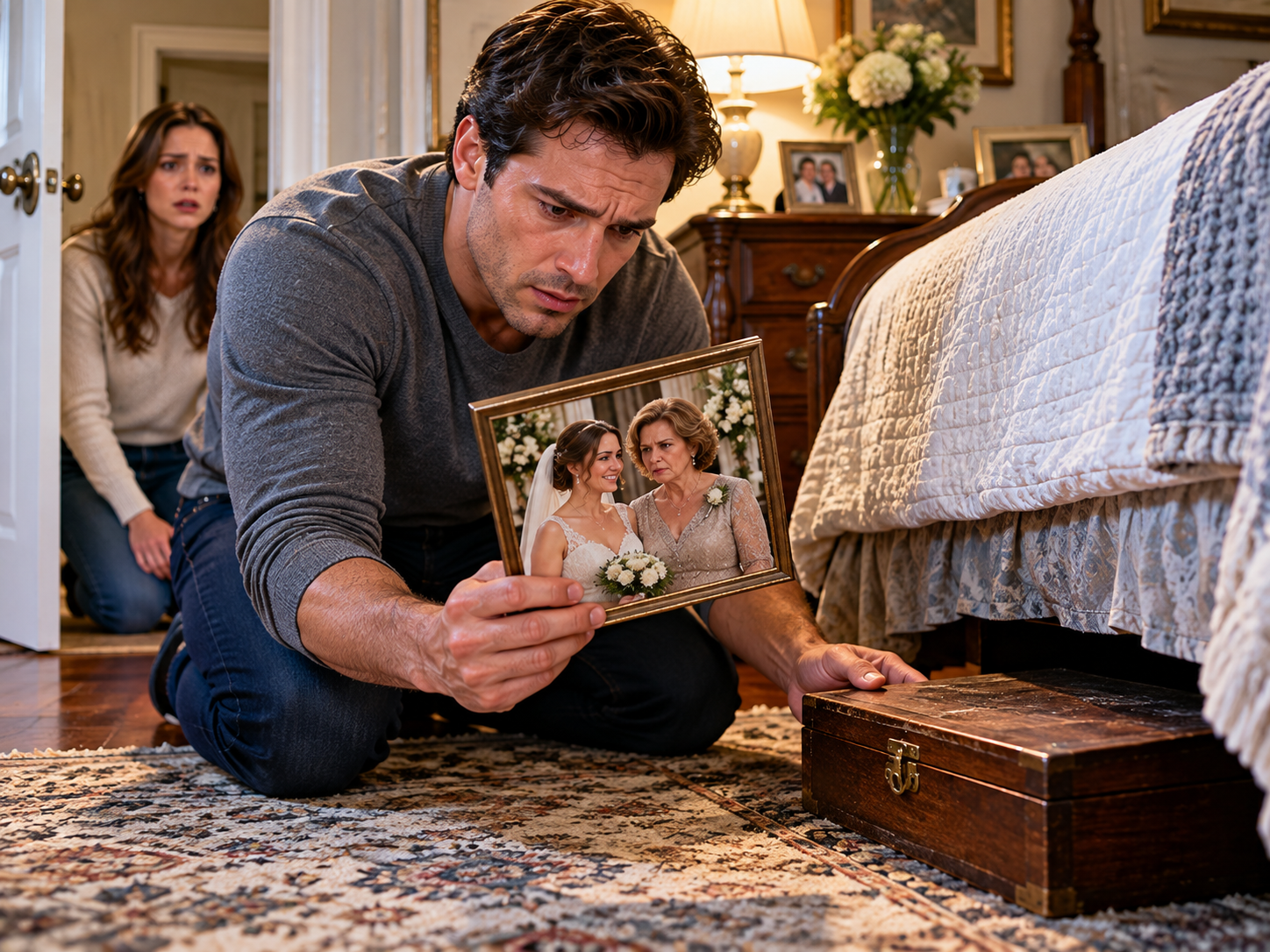
I remembered the wedding.
The white flowers.
The nervous speeches.
My mother standing near the doorway.
Claire in her dress.
And the moment my mother had whispered that Claire was not the one for me.
“I think she saw your mother’s face in yours,” I said.
Claire looked down.
“That must have been hard.”
“For her.”
“For me too.”
I nodded.
That was something I had learned later.
Understanding my mother did not erase what her behavior had done to Claire.
Claire had spent two years wondering whether she would ever be accepted by the woman who was supposed to become family.
She had smiled through dinners.
She had brought gifts.
She had tried conversations.
She had tolerated silence.
And all that time, my mother had been carrying a fear she refused to explain.
Understanding did not make the secrecy harmless.
It simply made the story honest.
That afternoon, Claire suggested we visit the old foundation.
The building had changed since the years when my father worked there. The sign had a different name, the lobby had been renovated, and the records department was smaller than I remembered from old photographs.
Martin was still there part-time.
He had aged, but his memory remained sharp.
When he saw Claire, he smiled.
“You finally read it.”
Claire looked surprised.
“You knew about the letter?”
Martin laughed softly.
“I knew your mother wrote it. I did not know what she said.”
He looked at me.
“Your father kept everything.”
“That seems to be a family tradition,” I said.
Martin led us into the records room.
There were fewer shelves now.
Most material had been digitized.
But one cabinet remained filled with old project files.
Martin pulled out a folder.
“This is not medical information,” he said. “It is administrative history. I thought you might want to see it.”
Inside were meeting notes from the early research years.
My father’s name appeared repeatedly.
So did Claire’s mother’s.
Claire leaned closer.
“They argued.”
Martin smiled.
“They disagreed.”
“About what?”
“About how results should be explained to patients.”
Claire looked at me.
My father had believed people deserved uncertainty stated clearly.
Her mother had believed uncertainty itself could become frightening when delivered without compassion.
They had agreed on the science more often than they disagreed.
They disagreed about language.
That seemed almost painfully ordinary.
But perhaps that was why the consequences had become so complicated.
A doctor could say, “You have an increased risk.”
A frightened person might hear, “You will become sick.”
A parent could hear, “Your child is in danger.”
A spouse could hear, “Your future together is uncertain.”
One sentence could become four different fears.
Martin closed the folder.
“Your father once told me that the hardest part of medicine wasn't discovering information.”
“What was it?”
“Making sure people understood what the information did not mean.”
Claire was quiet.
On the drive home, she said, “My mother was trying to protect me from fear.”
“My mother was trying to protect me from losing you.”
“And they both made things worse.”
“Sometimes.”
She looked out the window.
“I wish they had trusted us.”
I understood exactly what she meant.
Not trusted us to be medically knowledgeable.
Trusted us to live with uncertainty.
That evening, we added a copy of Claire’s mother’s letter to the family archive.
Not the original.
The original belonged with Claire.
She had decided that.
Beside the copy, she wrote a small note.
This document reflects the writer’s concerns at that time. It is not a medical conclusion.*
That sentence mattered.
We had learned to separate evidence from interpretation.
We had learned that letters could reveal feelings without proving facts.
We had learned that medical records could show findings without predicting an entire life.
We had learned that memories could be sincere and still incomplete.
Our child wandered into the room while we were finishing.
“What are you doing?”
“Saving family history,” Claire said.
“Why?”
“So nobody has to guess later.”
Our child looked at the shelves.
“Will you save my things too?”
“Only if you want us to.”
Our child thought for a moment.
“Save my drawing from yesterday.”
Claire smiled.
“That can be arranged.”
After our child left, I looked at Claire.
“A drawing beside genetic research.”
“Why not?”
She was right.
That was what family history really was.
Not just disease.
Not just death.
Not just secrets.
It was drawings on refrigerators, wedding photographs, terrible jokes, old letters, birthdays, arguments, recipes, mistakes, and people trying to understand one another.
My mother had wanted to protect the family by controlling what we knew.
Claire’s mother had wanted to protect her daughter by refusing to let fear define her.
My father had wanted to make knowledge more honest.
And somehow, years later, their unfinished work had become ours.
Not a medical project.
A family lesson.
We could not promise our children certainty.
We could promise them honesty.
That was the promise we intended to keep.
Click here to continue reading: PART 11: The Wedding Photograph Stayed on Our Wall, Not Because It Was Beautiful, But Because It Told the Truth About Love and Fear
My Mother Warned Me Before the Wedding, Yet Two Years Later Her Empty House Held a Secret She Had Never Trusted Me Enough to Reveal
Part 10 of 20