The first time our child asked about Grandma’s photograph, I thought the hardest part would be explaining why my mother had looked unhappy on our wedding day.
I was wrong.
The harder question came a few minutes later, when our child pointed at the photograph and asked, “If Grandma was scared, why didn’t she just tell you?”
Claire and I were sitting at the kitchen table after dinner. Outside, rain tapped steadily against the windows, and the house smelled faintly of rice, ginger, and the tea Claire had forgotten beside her elbow. The photograph lay between us, the same one I had carried through years of questions.
I looked at Claire before answering.
She gave me a small nod.
“She should have,” I said.
Our child frowned. “But she was Grandma.”
“I know.”
“Adults are supposed to tell the truth.”
Claire reached across the table and rested her hand over mine. “Adults are supposed to try,” she said gently. “Sometimes fear makes people hide things they believe they’re protecting you from.”
Our child studied the photograph again.
“Was Grandma afraid of Mom?”
The question landed differently this time.
“No,” I said. “Not really.”
Claire smiled faintly. “She was afraid of losing your dad.”
I looked at her.
She had always understood that distinction better than I did.
For years, I had carried the sentence my mother spoke at our wedding like a stone. *She’s not the one for you.* I remembered the tremble in her voice, the tears gathering in her eyes, and the way she had looked at Claire as though she were seeing something I could not see.
Back then, I thought my mother was rejecting the woman I loved.
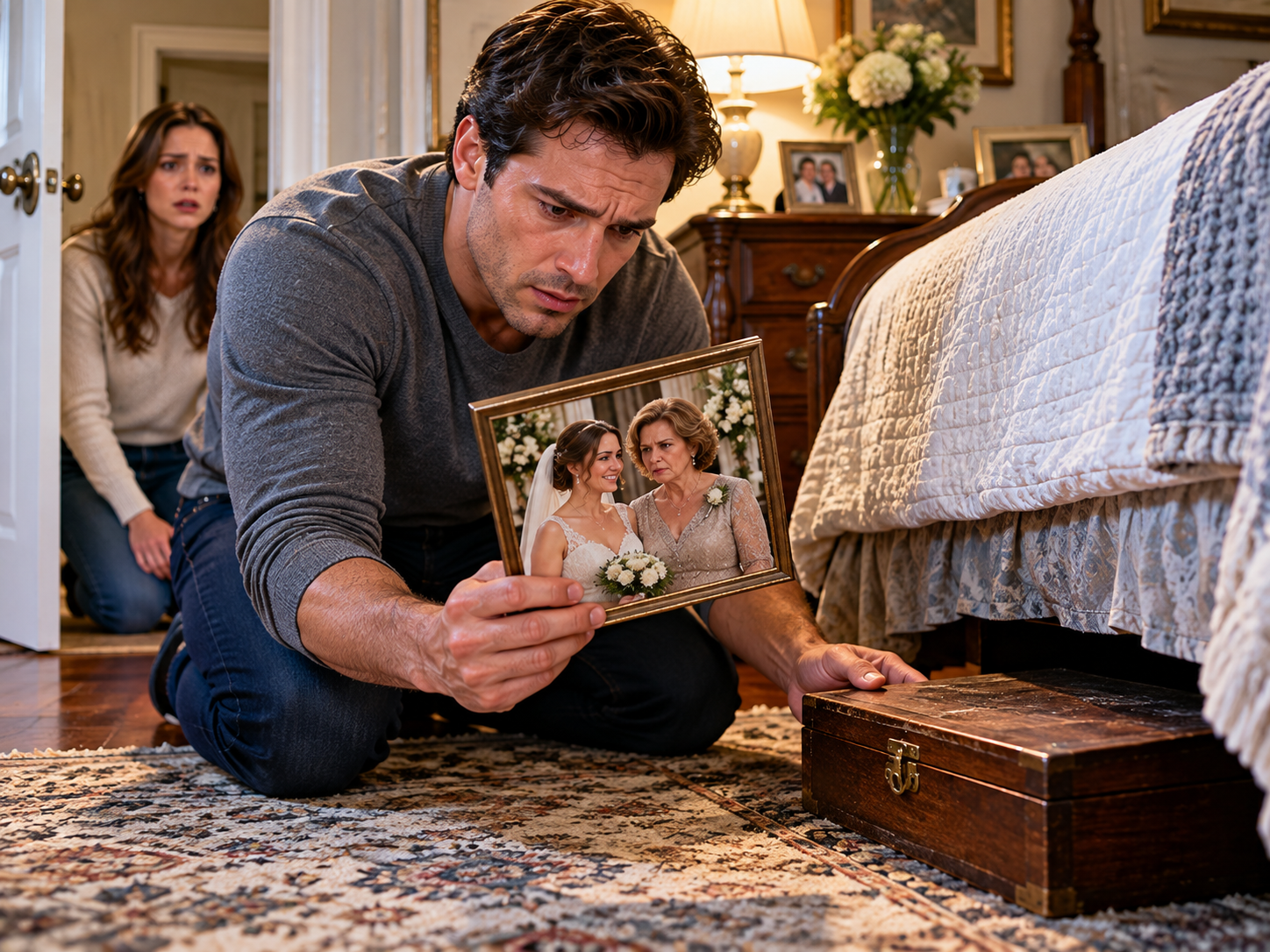
Later, after the box beneath her bed, the medical records, the letters, the research papers, and the old photographs, I learned that she had been looking at something much more complicated.
She had seen a family history she believed might destroy mine.
She had seen the genetic marker connecting Claire’s family to my father’s research. She had seen medical reports she did not fully understand. She had watched my father spend years warning people that inherited risk was not destiny, only to lose himself inside the same fear he had spent his career studying.
And my mother had inherited that fear after he died.
Our child touched the corner of the photograph.
“Did Grandma know Mom was good?”
Claire laughed softly.
“She knew I loved your dad,” she said.
I looked at her.
“She knew,” I repeated.
Claire nodded.
That was one of the things that had taken me years to understand. My mother had not secretly investigated Claire because she believed Claire was dangerous. She had investigated because she was terrified that the person I loved was connected to the very medical history she feared most.
And even while she was frightened, she had seen Claire’s character.
That contradiction had been difficult for me to accept.
People wanted simple reasons for complicated behavior. They wanted someone to be cruel because cruelty was easier to understand than fear. But my mother had not been simple. She had been loving, controlling, frightened, stubborn, generous, secretive, and deeply imperfect all at once.
Claire knew that better than anyone.
“She loved you,” Claire told our child. “She just didn’t always know how to show it in healthy ways.”
Our child looked toward me.
“Did she love you?”
I swallowed.
“Yes.”
The answer came easily now.
Two years after my mother died, I might have needed several minutes.
Now I did not.
“She loved me so much that sometimes she made choices for me because she was afraid I would make the wrong ones.”
Our child considered that.
“That sounds annoying.”
Claire laughed.
“It was,” I said.
We all laughed then, and somehow the laughter made the room feel lighter.
Later that night, after our child went upstairs, Claire and I stayed at the table. The photograph was still between us.
“You handled that well,” Claire said.
“I almost said too much.”
“You always think telling the whole story is the same as telling the truth.”
I smiled.
“Isn’t it?”
“No.”
She turned the photograph face down.
“Sometimes the truth is knowing what belongs to someone else.”
That mattered to us now.
When we first opened my mother’s box, I wanted every answer. I wanted every report, every date, every conversation, every reason. I wanted to know exactly what she had thought and when she had thought it.
But some of the records involved other patients.
Some involved confidential medical histories.
Some belonged to people who had never agreed to become part of our family story.
So Claire and I had preserved the documents carefully. We kept what belonged to our family. We separated confirmed medical facts from personal notes and fears. We did not turn private lives into entertainment simply because they helped explain ours.
My father’s unfinished manuscript, *Risk Without Destiny*, remained in a protective folder.
We had never treated it as a sacred answer.
Some of his ideas had been challenged by later research. Some had been developed further. Some remained historically useful because they showed how medical understanding had changed.
That was enough.
The point was never to prove my father had been right about everything.
The point was to understand what he had been trying to teach.
Risk is information.
It is not prophecy.
A week later, Claire and I took our child to the specialist appointment.
We had made those appointments ordinary.
That was deliberate.
There was no dramatic music in our heads. No sense that a doctor was about to pronounce a sentence over our lives. We brought our questions, listened to the answers, and wrote down what we needed to remember.
Our child was still too young to understand every detail, but old enough to understand that family medical history was something we talked about instead of hiding.
On the drive home, our child asked, “Does having the marker mean I’m sick?”
“No,” I said.
“Does it mean I will get sick?”
“No one can promise that,” Claire answered.
Our child looked between us.
“Then what does it mean?”
I thought about my father.
I thought about my mother.
I thought about the wooden box beneath the bed.
“It means doctors have information that can help you take care of yourself,” I said.
Our child nodded slowly.
“Like wearing a helmet?”
Claire smiled.
“Exactly.”
The comparison was imperfect, but it worked.
We were not living under a curse.
We were living with information.
That difference changed everything.
That evening, I went into the room where we kept the family archive.
The shelves were modest. There were no trophies, no framed certificates, nothing that made the collection look grand.
There were folders.
Letters.
Photographs.
Medical records.
My father’s manuscript.
My mother’s final letter.
And beneath everything, carefully wrapped in cloth, the wooden box.
I lifted the lid.
The old smell of paper and cedar returned immediately.
For a moment, I was back in my mother’s house, standing beside her bed with dust on my hands and a strange pressure in my chest.
I remembered the first time I had looked underneath that bed.
I had expected betrayal.
Instead, I found fear.
I had expected evidence that my mother hated my wife.
Instead, I found evidence that she had spent years trying, badly and secretly, to protect people she loved.
That did not make every choice she made right.
It simply made the truth larger.
I took out her final letter.
The paper had softened at the folds.
I read the opening again.
She had written that she wanted to protect me without frightening me. Instead, she had frightened everyone.
I used to read those words and feel angry.
Now I read them and felt something closer to sorrow.
Not because I wanted to excuse her.
Because I finally understood how much time fear had stolen from all of us.
Claire appeared in the doorway.
“You're reading it again.”
“Apparently.”
She leaned against the frame.
“What are you looking for?”
“I don’t know.”
She walked over and sat beside me.
“You’re still trying to find the sentence that would make everything make sense.”
I laughed quietly.
“Maybe.”
“There isn’t one.”
“I know.”
She rested her head against my shoulder.
For a while, neither of us spoke.
Then Claire said, “I’m glad we found it.”
“The box?”
“The truth.”
I looked at her.
“So am I.”
She squeezed my hand.
“But I’m also glad we didn’t find it until we were ready to understand it.”
That stayed with me.
Because the truth had not changed.
We had.
Click here to continue reading: PART 10: When Claire Finally Read Her Mother’s Old Letter, She Realized the Woman She Never Knew Had Been Afraid of the Same Things
My Mother Warned Me Before the Wedding, Yet Two Years Later Her Empty House Held a Secret She Had Never Trusted Me Enough to Reveal
Part 9 of 20