
The second Christmas without Grandpa arrived with a cold wind and a sky the color of pewter. I woke early, made coffee, and stood at the kitchen window while the first light spread across the garden. The apple tree was bare, the flower beds were covered with leaves, and the crooked birdhouse hung quietly from its branch. I could see the faint outline of the path I had cleared after the last rain.
For a moment, I thought about the previous Christmas, when I had been learning how to decorate the tree without him. Back then, every ornament had felt like a question. Should I use the old brass bell? Should I hang the glass bird even though it was missing a feather? Should I place Grandpa’s crooked wooden star at the top, where he had always insisted it belonged?
This year, I simply took the decorations out of their box.
The star still leaned slightly to one side. The glass bird’s faded eyes caught the light. The brass bell made a small, clear sound when I lifted it from the tissue paper. I placed each ornament on the tree as I remembered, then stepped back and adjusted the branches until the star sat securely at the top.
It was not a perfect tree. One side was fuller than the other, and a bare patch showed near the bottom. I liked it anyway.
I had invited Brianna for Christmas dinner, along with Elaine and a friend from work. I had not invited my parents to the gathering, though I had left open the possibility of seeing them separately. My mother had asked about the holiday a few weeks earlier, and I had told her that I planned to spend the day with Brianna and friends. She had said she understood and wished me a peaceful Christmas.
My father had sent a similar message. Neither of them argued or suggested that the invitation should have included them. I appreciated the restraint, though I knew it would take more than two polite messages to rebuild what they had broken.
On Christmas Eve, Brianna came over to help prepare the food. She brought the blue-covered notebook she had given me the previous year, explaining that she had found a recipe tucked inside and wanted to make sure we used it.
“You wrote this down?” I asked, opening the notebook.
“I did.”
The page contained a recipe for a simple apple cake. At the bottom, Brianna had added a note: Grandpa said the best part of cooking was having someone to share it with. I think he was right.
I looked up at her.
“I forgot I wrote that,” she said. “I was probably trying to sound profound.”
“It worked.”
“Don’t tell anyone. I have a reputation to maintain.”
We baked the cake that afternoon. Brianna measured the flour while I peeled the apples, and we argued about whether the cinnamon should be added to the batter or sprinkled over the top. We eventually did both, mostly because neither of us wanted to admit defeat.
When the cake came out of the oven, its center had risen unevenly, leaving one side higher than the other. Brianna stared at it.
“It’s crooked.”
“Like the birdhouse.”
“Like our family,” she said, then immediately looked uncomfortable.
For a moment, neither of us moved. The remark had escaped without warning, and I could tell she was afraid she had ruined the afternoon.
Then I laughed softly.
“Maybe,” I said. “But at least this cake can still be eaten.”
She let out a breath and began laughing, too. The tension passed, not because the comparison had been meaningless, but because we did not need to pretend that every mention of our family had to end in sadness.
We decorated the cake with a little powdered sugar and set it aside. Later, we brought the tree into the living room, adjusted the lights, and wrapped the remaining presents. I had bought Brianna a book about gardening, hoping she would not return it for something more fashionable. She had bought me a small wooden frame for the photograph of Grandpa beside the apple tree.
“I thought you might want to put it somewhere other than the study,” she explained.
I ran my fingers over the smooth edge of the frame.
“I do.”
We placed the photograph on the mantel, where it could be seen from the living room and the kitchen. It felt right there, not hidden away among the papers, but part of the life that continued around it.
On Christmas morning, I woke to the smell of coffee and the faint sound of wind against the windows. I opened the curtains and looked out at the garden. The ground was pale with frost, and the birdhouse had a thin white line along its roof. I made breakfast, listened to music, and allowed myself to enjoy the quiet.
For the first time, Christmas did not feel like a day I had to survive.
There was still sadness. I missed Grandpa’s voice, his terrible singing, and the way he would insist that everyone take another helping of food even when they were already full. I missed the sound of him moving around the kitchen, opening drawers and humming while he cooked. But the sadness no longer crowded out every other feeling.
I could miss him and still enjoy the morning.
Brianna arrived shortly before noon carrying a dish of roasted vegetables. Elaine came later with a bottle of sparkling cider, and my friend from work brought a tin of cookies. The house filled with conversation, the clatter of plates, and the occasional complaint about the weather. Nobody asked me to explain why my parents were not there. Nobody treated their absence as a problem I was expected to solve.
We ate at the dining table, passing dishes from hand to hand. The soup had turned out well, and the apple cake was only slightly crooked. Brianna declared that the uneven shape made it look homemade, which she said was a compliment.
After dinner, we exchanged gifts and sat around the living room. Someone asked about the photograph on the mantel, and I told the story of Grandpa holding the ladder while I insisted that I could climb the apple tree by myself. Brianna added her own version, claiming I had been so stubborn that Grandpa had eventually given me a lecture about gravity.
“That is not how it happened,” I protested.
“It is absolutely how it happened.”
“He told me to be careful.”
“He told you gravity didn’t care how confident you were.”
I stared at her. “That sounds like something he would say.”
“Because it is something he would say.”
We laughed, and the room seemed to grow warmer around us. The story belonged to all of us now, not because we remembered it in exactly the same way, but because we could share it without needing to agree on every detail.
Later, while the others played a board game, Brianna helped me clear the table. We carried plates into the kitchen and washed them in warm water. For a while, we worked in comfortable silence.
Then she said, “I’ve been thinking about Mom and Dad.”
I dried a plate and placed it on the rack. “What about them?”
“I don’t know whether I want to invite them to Christmas next year. Part of me thinks we should try to have everyone together. Another part of me thinks I only want that because I’m tired of feeling like the family is divided.”
I turned off the tap.
“You don’t have to decide now.”
“I know. I just don’t want to keep avoiding the question.”
“You can think about it without turning it into a responsibility to fix everyone.”
She nodded. “I’m learning.”
I understood the feeling. For years, I had believed that if I could find the right explanation, the right response, or the right boundary, I might finally bring my family into some kind of order. I had tried to understand why my parents left, why they returned when Grandpa died, and why they believed a moving truck would make them owners of a house where they had not raised me.
But there was no arrangement of words that could make their choices disappear.
What I could do was decide what happened in my own home.
“If you want to see them, you can,” I told Brianna. “If you don’t, you don’t have to. And if you change your mind later, that’s allowed, too.”
She smiled faintly. “You make it sound simple.”
“It isn’t simple. It’s just yours to decide.”
We finished the dishes and returned to the living room. As the evening went on, our guests began to leave. Elaine hugged me at the door, and my friend promised to bring the recipe for her grandmother’s cookies next time. Brianna stayed behind to help me put away the leftovers.
When the last container was sealed, she stood beside the kitchen table and looked around.
“This was a good Christmas,” she said.
“It was.”
“I’m glad you invited me last year.”
“So am I.”
She glanced toward the mantel, where Grandpa’s photograph stood in its new frame.
“I think he would have liked this.”
I followed her gaze. “I think so, too.”
After she left, I locked the door and walked through the quiet house. The living room still smelled faintly of pine and cinnamon. The crooked star shone above the tree, and the brass bell rested among the branches. In the kitchen, the blue mug waited beside the sink, and the last of the apple cake sat beneath a glass cover.
I turned off the lights one by one.
In the study, I paused beside the desk. Grandpa’s letter remained in its folder, and his notebooks were arranged on the shelf. I no longer needed to read his words every time I felt uncertain. I had learned them slowly, through small decisions that did not look like much from the outside: moving a bookshelf, changing the hallway, taking a trip, saying no to a visit, saying yes to a conversation, and allowing someone to sit at my table without asking them to repair the past.
I closed the study door and went upstairs.
The next morning, I woke late and stayed in bed for a few minutes, listening to the house. There were no footsteps in the kitchen, no familiar humming, no quiet knock on my bedroom door asking whether I wanted breakfast. The absence was still there, but it no longer felt like an instruction to stop moving.
I got up, made coffee, and opened the curtains.
Sunlight spread across the garden. The frost had melted from the birdhouse, and a sparrow perched on the roof before disappearing inside. I took my mug outside and stood on the porch, watching the branches of the apple tree sway.
I thought about the child I had been, the one who had waited for her parents to return. I wished I could tell her that the waiting would end, though not in the way she imagined. I wished I could tell her that she would be loved, that someone would stay, and that the home she found would become the foundation of a life she could choose for herself.
Most of all, I wished I could tell her that none of it would be her fault.
I could not go back and give that child the answer she deserved. But I could live in a way that honored what she had survived. I could stop treating my needs as inconveniences. I could accept care without feeling indebted for the rest of my life. I could allow people to earn their place beside me rather than giving it to them because of a title or a shared history.
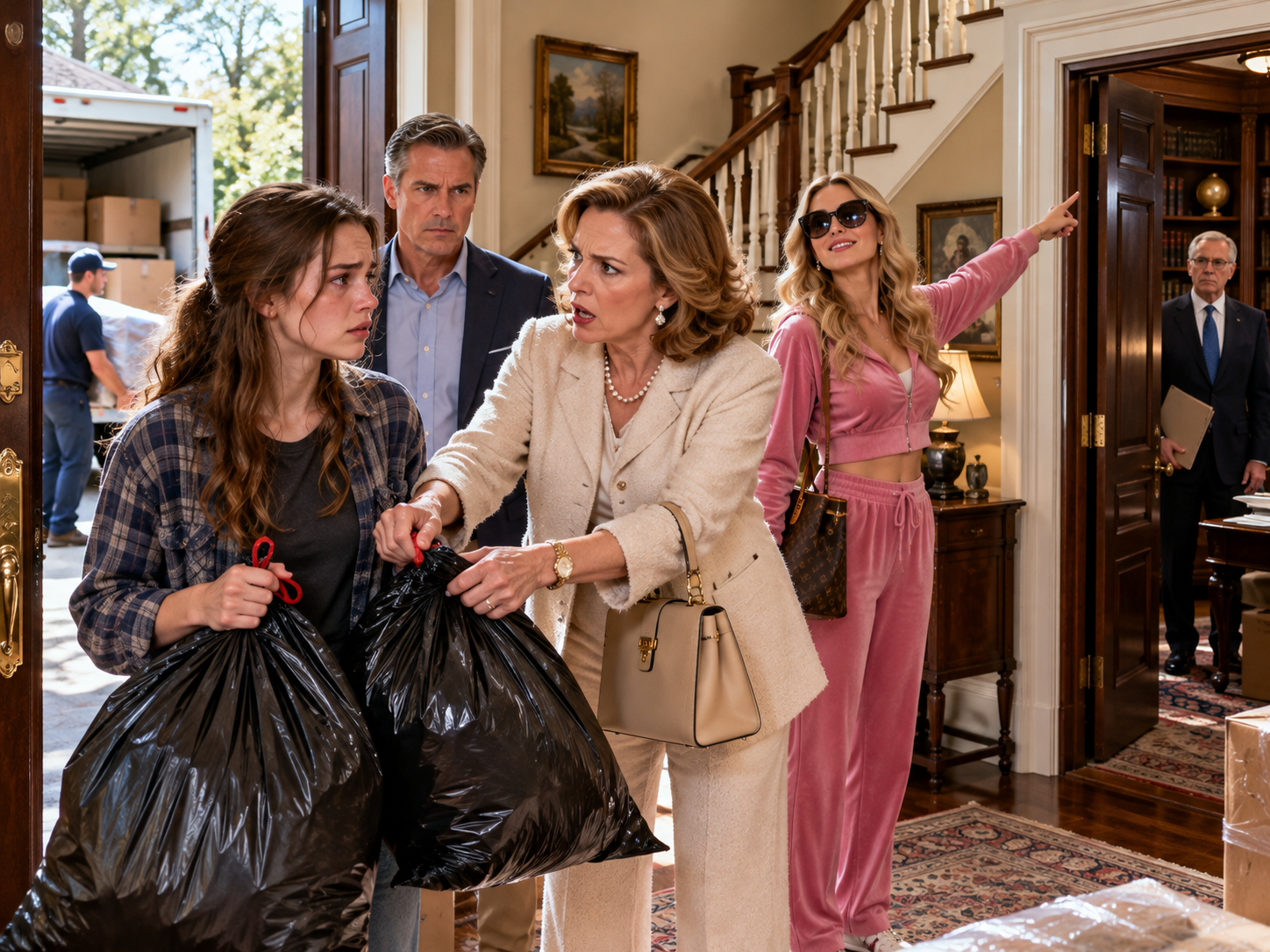
My parents had once left me at Grandpa’s house and promised they would return. For years, I had believed that their return would be the moment my life finally made sense. When they came back with a moving truck, I learned that their presence alone could not give me what I had needed from them.
Their return had not completed my childhood. It had revealed the truth about it.
Grandpa had given me something different. He had given me safety without conditions, affection without a ledger, and a home without asking me to surrender my future. His final instructions had not been about defeating my parents or proving that I deserved the property. He had wanted me to have the freedom to decide what came next.
I had that freedom now.
I could continue rebuilding a relationship with my mother, cautiously and on my terms. I could speak with my father when I was ready and keep the boundaries that protected my peace. I could keep growing closer to Brianna, who was learning to see me as a sister rather than a story someone else had told her. I could stay in the house for another year, another decade, or decide someday that a different place would suit the life I wanted.
None of those choices would make Grandpa’s love smaller.
I finished my coffee and returned inside. The house was quiet, but I no longer mistook quiet for abandonment. I placed the mug in the sink, opened the kitchen window, and let the cool air move through the room.
Then I took Grandpa’s gardening notebook from the shelf and carried it outside.
There were plans to make for spring, seeds to choose, and a few repairs I wanted to finish before the weather changed. I sat at the kitchen table and began a new page in my own notebook. I wrote down what I wanted to plant, what I hoped to repair, and where I might travel when summer came.
At the bottom of the page, I paused.
Then I wrote one final sentence.
I do not have to wait for anyone to come back before I begin living.
I put the pen down and looked toward the photograph on the mantel. Grandpa was smiling beside the apple tree, one hand resting on the ladder, his attention fixed on the little girl standing in the grass.
For a moment, I imagined him looking up from the photograph and telling me not to overthink everything.
I smiled.
“I’m figuring it out,” I whispered.
Then I turned back to my list and continued writing.
The house was mine, the memories were mine, and the future was mine to choose. I would carry Grandpa’s love with me, not as a weight that kept me in one place, but as the steady knowledge that I had once been loved well—and that I could build a life in which I continued to honor that love.
I had spent years waiting for other people to decide whether I belonged.
I no longer needed their answer.
I was home because I had chosen to be, and I was free because I finally understood that the choice had always been mine to make.
The End
Read more original stories on Feel Every Story.
The Morning My Family Came to Claim a House Before They Had Even Asked Who Owned It
Part 20 of 20

