
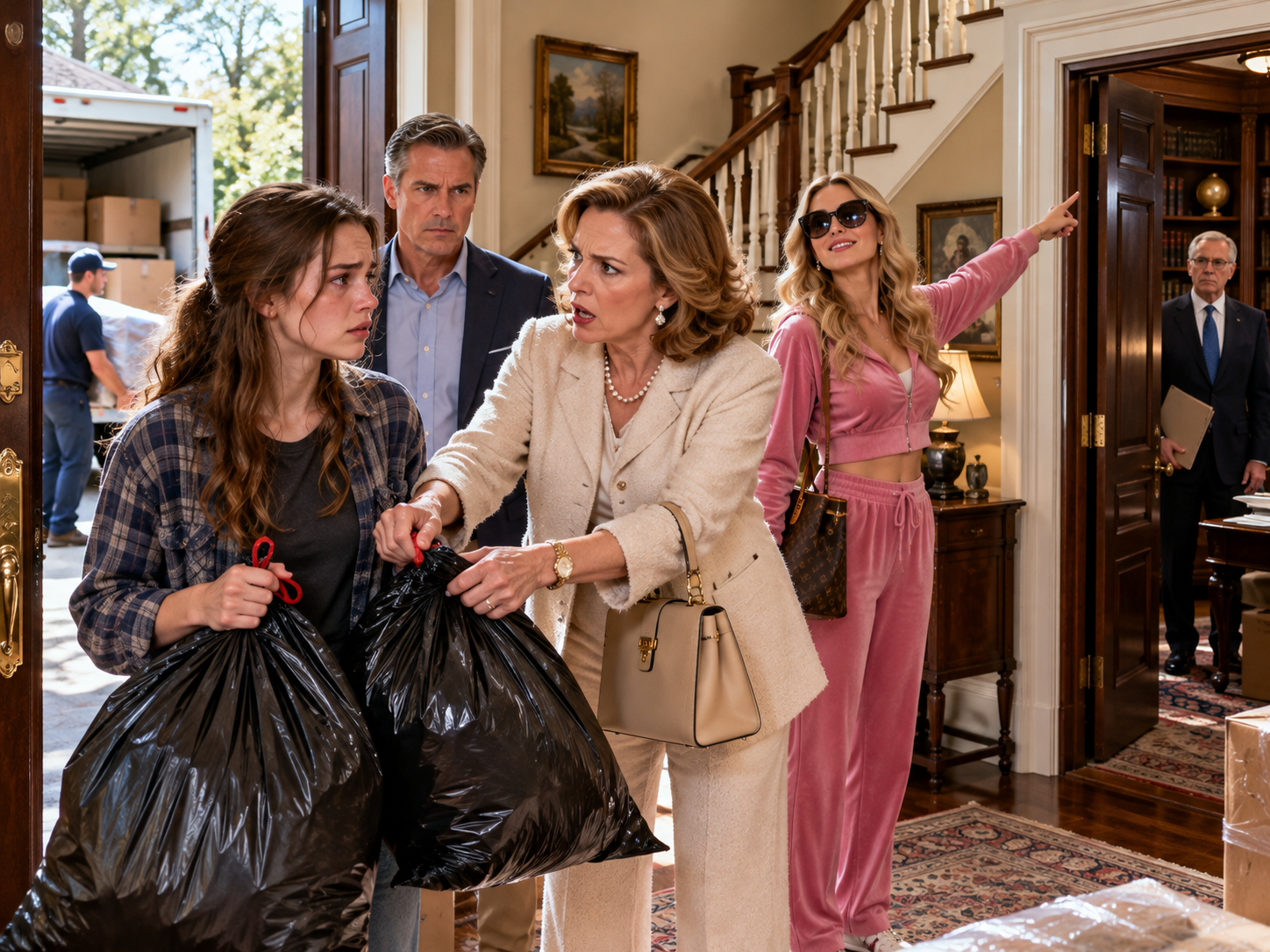
My father waited another month before contacting me. His message arrived on a Tuesday evening while I was reviewing a report for work. The phone lit up with his name, and for a moment I thought about letting it ring until it stopped. I had spoken with my mother, but I had made no promise to reconnect with him. The moving truck, the threat to challenge Grandpa's will, and his insistence that I was making things difficult remained clearer in my memory than any good moment from childhood.
I answered because I wanted to know why he was calling, not because I felt obligated to make peace. His greeting was abrupt. He asked whether I had a few minutes to talk, then began speaking before I could answer. He said he had heard that Mom and I had met and that she believed the conversation had gone reasonably well. He wanted to know whether I would be willing to meet him too. He said there were things he had handled badly and that he did not want the family to remain divided forever.
I told him I could consider a conversation, but I would not discuss the house or the estate. He replied that he had no intention of arguing about property. His tone was controlled, almost businesslike, and I wondered whether he had rehearsed the call. We agreed to meet at a diner near the highway on Saturday afternoon. I chose the location because it was public, familiar, and far enough from the house that I would not feel as though he were entering my space.
For the rest of the evening, I found it difficult to concentrate. I remembered my father standing in the foyer, directing the movers as if he had come to collect a parcel. I remembered him telling me not to make things harder than they needed to be. The phrase had always meant that I should accept whatever he decided without asking questions. I had spent years believing that peace required me to be agreeable. Now I understood that a peaceful conversation could include disagreement, and that I was allowed to end it if it became another demand for obedience.
On Saturday, I arrived early and chose a booth near the window. I ordered coffee and watched cars pass along the road. My father entered five minutes later, wearing a gray coat and carrying no bag or folder. He looked older than I remembered, with more gray in his hair and deeper lines around his mouth. He paused when he saw me, then approached slowly. He asked whether he could sit. I nodded.
For several minutes, we spoke about the weather and the traffic. The small talk felt unnatural, but I let it continue until he seemed ready to say what he had come to say. He began by telling me that he had spent a great deal of time thinking about Grandpa's recording. He said he had always known Grandpa was stubborn, but he had not understood how much resentment he carried about the guardianship arrangement. I corrected him gently: Grandpa had not sounded resentful. He had sounded clear about what had happened.
Dad looked down at the table. He said that he and Mom had been under financial pressure when I was five. They were trying to establish themselves, and caring for two children had felt impossible. Grandpa had offered to help, and they had accepted. They had intended to return for me when things improved, but life became complicated. He said that once the arrangement became formal, they told themselves it was better not to disrupt it.
I listened, then asked why he had never called me on my birthday. He rubbed his thumb along the edge of his coffee cup. He said he had avoided the calls because he did not know what to say. He feared I would ask why he had left me, and he did not want to admit that he had no answer that would make the choice sound acceptable. Over time, he had convinced himself that Grandpa was doing a good job and that I was better off where I was.
“That may explain why you avoided me,” I said. “It doesn't explain why you thought you could come back and take the house.”
His face tightened. He admitted that he had believed the property would eventually pass to him and Mom. Grandpa had never promised it directly, but Dad had assumed that a parent would leave the family home to his children. When he learned that the will favored me, he had reacted with anger. He said he had convinced himself that I was being unfairly rewarded for living with Grandpa while he and Mom had spent years building their own lives.
I asked whether he had considered what Grandpa's home had meant to me. Dad said he had not thought about it that way. He had seen the house as an asset, something that would be part of the family's future. I reminded him that I had lived there since I was five, that Grandpa had raised me there, and that I had cared for him during his illness. Dad nodded slowly. He said he understood now that the house was more than property to me, though I was not sure he understood the depth of that statement.
Then he apologized for the morning of the moving truck. He said he should not have directed the movers before speaking with me, and he should never have allowed Mom to hand me the garbage bags. He admitted that he had treated me as though I were an obstacle to a plan he had already made. His voice faltered when he said he was sorry for calling my presence a problem instead of recognizing that I was grieving.
I had imagined hearing an apology from him many times. In some versions, I had shouted back everything I had kept inside for years. In others, he had arrived at the house with flowers and tears, asking me to forgive him. The reality was quieter and less satisfying than either fantasy. He was sitting across from me in a diner, trying to find words for a past he could not change. I felt anger, sadness, and a strange detachment. I was listening to my father, but I was no longer waiting for him to make me feel whole.
I told him that I appreciated the apology, but I could not pretend it repaired our relationship. He said he understood. Then, after a pause, he asked whether I would consider letting him visit the house someday. He wanted to see Grandpa's study and the garden. He said he had not been there in years and wished he had spent more time with his father before he died. The request unsettled me. It sounded partly sincere and partly like an attempt to reclaim access to a place he had tried to take.
I asked why he wanted to visit now. He said he wanted to remember Grandpa, and he wanted to see how I was living. I told him I was not ready to invite him into the house. The study was still a private space for me, and the garden held memories that were not his to enter on demand. If we continued talking and trust developed, I might reconsider. But I would not use the house as proof that I had forgiven him.
He looked disappointed, though he did not argue. “I suppose I haven't earned that,” he said.
It was the first time I had heard him describe trust as something he needed to earn rather than something he was entitled to receive. I told him that I wanted our conversations to remain honest, even when the truth was uncomfortable. If he wanted a relationship with me, he could not treat disagreement as disrespect or expect me to keep quiet whenever he felt ashamed. He said he would try.
We finished our coffee and left the diner separately. My father offered to pay for my drink, but I declined. It was a small thing, yet I wanted to leave without feeling that I owed him gratitude for a gesture that should have been ordinary. Outside, he asked whether he could call again in a few weeks. I said he could, provided he respected the boundaries we had discussed. He nodded and walked toward his car.
On the drive home, I felt a deep fatigue. The conversation had not been hostile, but it had required me to remain present with feelings I had spent years avoiding. I stopped at a grocery store and bought bread, milk, and a bag of oranges. The ordinary errands helped me return to the day. I did not want to spend the evening replaying every sentence, trying to decide whether my father had meant each word. I had heard what he said. What he did next would tell me more.
That evening, Brianna called to ask how the meeting had gone. I told her that Dad had apologized and that we had discussed the moving truck and the estate. She asked whether I felt better. I said I felt clearer, though not necessarily better. The conversation had shown me that my father could acknowledge some of what he had done, but it had not changed the years of absence. I needed time to see whether his behavior would match his words.
Brianna said she was glad I had spoken to him, but she did not suggest that I should now forgive him. She told me that our parents had been discussing the past more openly since the estate dispute ended. She had challenged them when they tried to describe the abandonment as a temporary arrangement that I had accepted. Dad had become defensive, but he had not repeated the claim that I had chosen to stay. I thanked her for telling me. It mattered that someone else was no longer willing to preserve the old story.
A week later, Dad sent a short message asking whether I had received a box of photographs he had mailed. I had not, but it arrived two days later. Inside were pictures from my first five years, including one of me sitting on his shoulders at a fair. I had almost no memory of the event. In another picture, Mom held me beside a birthday cake while Dad leaned into the frame, smiling. The images showed a family that had existed before the separation, though they did not explain what happened afterward.
I looked through the photographs slowly. I did not use them to prove that my parents had once loved me or to dismiss the fact that they had abandoned me. They were records of moments that had happened, and nothing more. I placed the pictures in an album beside the photographs Grandpa had kept. The two collections told different parts of my life. Neither one canceled the other.
When Dad called again, I thanked him for sending the photographs. We spoke for ten minutes about ordinary things. He asked about my job and the repairs I had made to the house. He did not ask to visit the study. When he mentioned Grandpa, he said he regretted not spending more time with him. I told him Grandpa had always hoped they would reconnect. Dad was silent for a moment, then said he wished he had taken the opportunity when he still could.
I did not offer comfort or tell him it was all right. I simply let the truth remain. His regret belonged to him, just as my grief belonged to me. I could hear it without taking responsibility for easing it. We ended the call politely, and I returned to my work.
Over the next several weeks, Dad contacted me occasionally. He did not always ask for a conversation; sometimes he sent a message about a photograph or a memory he had remembered. I answered when I wanted to and let the messages sit when I needed space. He did not complain about the delay. That consistency mattered more than the apology itself. It was not enough to restore a relationship, but it suggested that he might be learning to respect the limits I had set.
One evening, I walked through the study and stopped beside Grandpa's desk. I thought about the morning when Dad had tried to claim the house, then about the conversation in the diner. The difference between those moments was not that my father had become a different person overnight. It was that I no longer felt compelled to accept his first explanation as the final truth. I could listen, question, disagree, and leave without surrendering my own judgment.
I closed the study door and went downstairs. The house was quiet, the kitchen warm, and the garden visible through the dark window. I had not invited my father back, and I had not promised to forgive him. I had simply allowed a conversation to happen on terms I could accept. For now, that was enough.
Click here to continue reading: PART 12: The Last Box in Grandpa’s Study Held Nothing Valuable Except the Truth I Was Finally Ready to Keep
The Morning My Family Came to Claim a House Before They Had Even Asked Who Owned It
Part 11 of 15

