
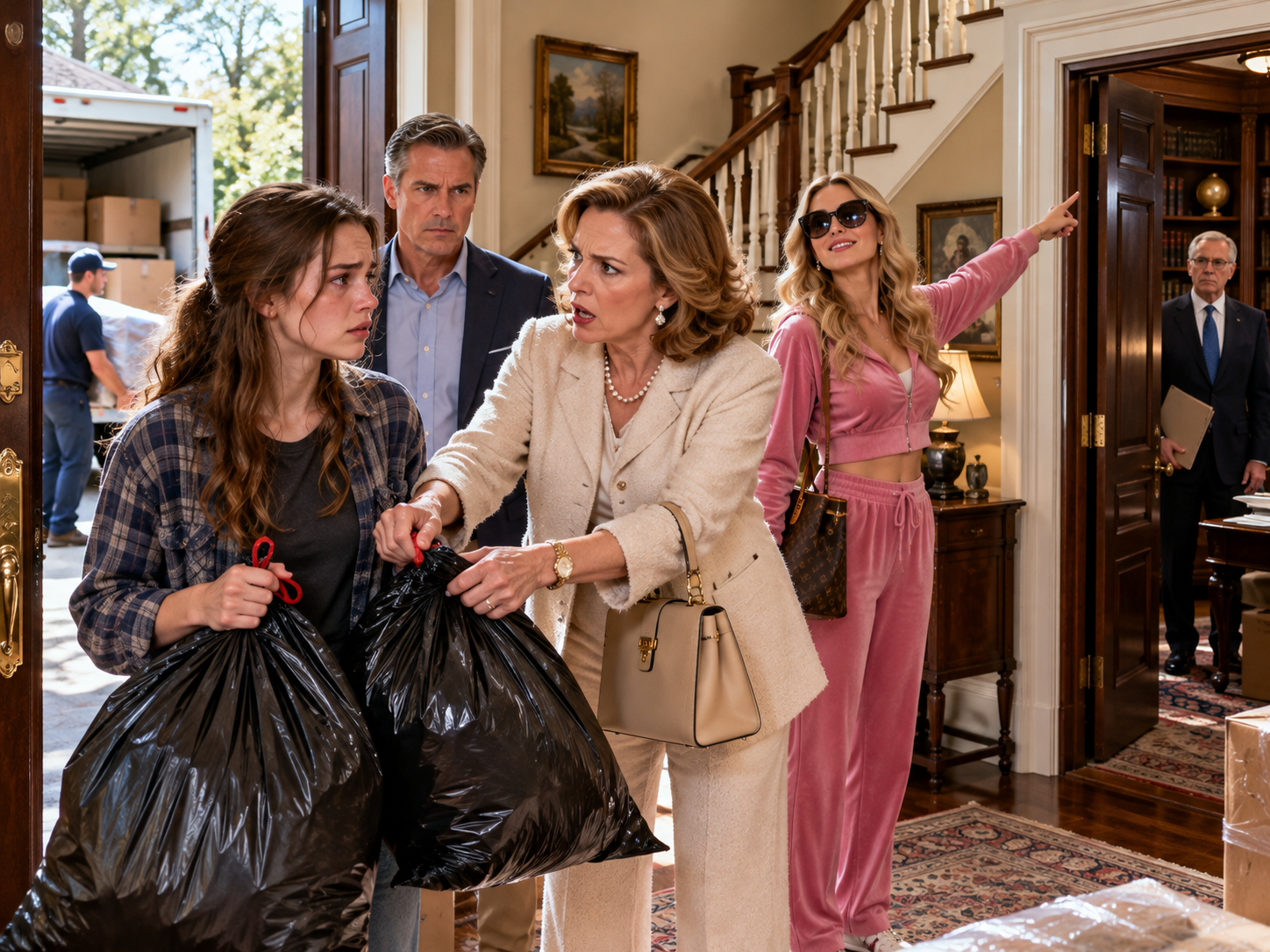
The first thing my father did after stepping into my grandfather's house was tell two strangers to carry the bedroom furniture downstairs. He had not asked permission. He had not taken off his shoes. He had barely looked at the funeral wreath hanging beside the front door. Standing in the foyer with his car keys in one hand, he pointed toward the staircase and spoke with the brisk authority of a man directing a delivery to a property he had purchased. I watched one of the movers glance at me for confirmation. Before I could answer, my mother pressed two black garbage bags against my chest.
“Take your things out of the bedrooms,” she said. “The men need space to work.” Her perfume was sharp enough to cut through the scent of lilies still drifting from the dining room. She wore a cream-colored coat, spotless leather boots, and the impatient expression of someone who had already decided that any resistance would be unreasonable. Seventeen years had passed since I had last seen her. I recognized the shape of her face immediately, but the voice seemed to belong to a stranger who had learned how to imitate my mother.
I was twenty-two years old, exhausted from burying the only parent who had truly raised me, and still wearing one of Grandpa's faded flannel shirts. My coffee had gone cold. I had been standing on the porch when their moving truck turned into the driveway, wondering whether the driver had made a mistake. Then my father climbed out of the passenger seat, followed by my mother and Brianna, and the truth settled over me with a coldness that had nothing to do with the October weather. They had not returned for Grandpa's funeral. They had come the following morning, ready to move in.
Brianna entered behind them, her oversized sunglasses pushed into her hair. She was older than the girl I remembered, with carefully styled blond hair and a leather handbag hanging from her elbow. She glanced at the staircase, then at the dark wooden banister Grandpa had polished every spring. “The big bedroom upstairs is mine,” she announced. “I'm not sleeping in one of those tiny rooms.” She spoke as though she were choosing a hotel suite. Then she wrinkled her nose at the lingering smell of old wood, funeral flowers, and the faint trace of pipe tobacco embedded in Grandpa's coats.
My father was already explaining to the movers that the upstairs furniture would be replaced. He said the old pieces could be taken to storage until he decided what to do with them. One of the men asked whether he wanted the dresser moved first. Dad answered without hesitation. I looked past him toward the hallway, where Grandpa's walking stick still leaned against the wall. Yesterday, I had carried that stick home from the funeral because I could not bear to leave it in the car. Now people who had not visited him in years were discussing his belongings as though he had merely vacated a rental property.
My mother finally examined me. Her eyes traveled from my uncombed hair to the sleeves of the flannel shirt and the worn slippers on my feet. “You look awful, Emily,” she observed. She did not say she was sorry. She did not ask how Grandpa had died or whether I had been with him. When I failed to answer, she pushed the garbage bags harder against me. “Your grandfather looked after you while he was alive. That arrangement is finished. Pack what belongs to you, and don't make this difficult.”
There had been a time when those words would have broken me. At five, I had waited at Grandpa's front window every evening for a familiar car. At six, I had asked whether my parents knew where I lived. At seven, I stopped asking in front of other people because I could see what the question did to Grandpa's face. Now I stood in the same house, holding bags intended for my own belongings, and felt something unexpectedly steady beneath the grief. Grandpa had warned me that this morning might come.
I remembered the day they left me. My mother had packed a small pink suitcase and told me I was going to spend a weekend with Grandpa. I was excited because he let me help feed the birds and always kept peppermint candies in a jar above the refrigerator. My father carried the suitcase inside, spoke quietly with Grandpa near the kitchen door, and promised to return on Sunday. Brianna stayed in the car, waving through the window. I waved back until the vehicle disappeared around the corner. Sunday arrived, then another Sunday, and the suitcase remained beside Grandpa's spare bed.
Grandpa never told me that my parents had stopped loving me. He also never invented comforting stories about why they had not returned. When I asked whether I had done something wrong, he sat beside me and said that grown people sometimes made decisions children could neither cause nor repair. He told me I was welcome in his home for as long as I needed it. Later, when it became clear that the arrangement was permanent, he helped make it legally permanent too. He rarely spoke about the paperwork, and I never understood how much trouble it had taken until I was older.
We lived carefully. Grandpa's pension covered the necessities, but there was little room for extravagance. He repaired appliances rather than replacing them, grew tomatoes and beans behind the garage, and taught me to mend clothing before I learned how to drive. He attended school conferences wearing the same brown jacket, helped with homework even when the subjects confused him, and sat through every performance in which I had so much as one line. On birthdays, he baked a crooked chocolate cake. At Christmas, he wrapped presents in newspaper when proper wrapping paper cost more than he wanted to spend.
I learned the difference between being poor and being unwanted because Grandpa never allowed me to confuse them. Our kitchen chairs did not match, and the living room sofa had a patched armrest, but I never had to wonder whether there would be someone waiting when I came home. When I was sick, he sat beside my bed with a damp cloth. When I failed a mathematics test, he helped me work through the mistakes. When I graduated from high school, he stood in the front row with tears shining behind his glasses. Those ordinary acts had built the life my parents now treated as an inconvenience.
The final months had been difficult. Grandpa's strength declined after a long illness, and I balanced part-time work with helping him through appointments and increasingly quiet days at home. He hated being dependent on anyone, especially me. I reminded him that he had spent seventeen years taking care of me and that I was allowed to return a little of what he had given. Sometimes he laughed. Sometimes he looked away. During his last hospital stay, he seemed less worried about dying than about what might happen after I buried him.
Three days before his death, he asked me to close the hospital room door. His hand was thin beneath mine, but his gaze remained clear. “Emily, if your parents show up after I'm gone, I need you to promise me something.” I tried to interrupt, telling him to save his energy, but he shook his head. “Don't argue with them on the porch. Let them come inside. Listen to what they say. Give them enough room to make their intentions plain.” I asked why he believed they would return. He watched me for a moment before answering, “Because I know what they've wanted from me for a very long time.”
He told me that the answer was in his study. That room had always been his private space, filled with books, old correspondence, a broad wooden desk, and a small brass lamp. He allowed me inside whenever I wanted to read, but he kept important papers in a locked cabinet. During the last year, a woman had visited him there several times, usually carrying a leather briefcase. Grandpa introduced her as Ms. Eleanor Whitcomb, his attorney. I assumed they were organizing his affairs. When I asked about her after the hospital conversation, he squeezed my hand and said, “She'll know when it's time.”
Now, as my mother ordered me to empty my bedroom, I understood that Grandpa had expected this confrontation with unsettling accuracy. I lowered the garbage bags to the floor beside the staircase. My father noticed and frowned. “Emily, your grandfather always wanted this property kept in the family. Your mother and I are handling that now.” He said it with the smooth certainty of someone who had repeated the explanation many times. I looked at him and wondered how he could speak about Grandpa's wishes without knowing the man he had become during the seventeen years they were absent.
“Did you visit him in the hospital?” I asked. The question surprised all three of them. My mother adjusted the strap of her handbag. Dad looked toward the movers. Brianna, already halfway upstairs, called down to ask whether she could paint the largest bedroom white. Nobody answered my question. At last Dad said that the timing had been unfortunate and that there was no point dwelling on things that could not be changed. He turned back to the men and told them to continue.
I could have told them about the nights Grandpa spent coughing until dawn, or the afternoons when he insisted on sitting in the garden because he wanted to feel the sun on his face. I could have described the way he apologized when he needed help standing. None of those details would have mattered to people who had arrived with a moving truck before the funeral flowers had begun to wilt. So I remembered his instructions and kept quiet.
One mover, a broad-shouldered man with a careful manner, approached me while my father examined the staircase. He asked softly whether I lived in the house. I told him I did. He looked at the garbage bags and then at the furniture. “Are you sure we're supposed to move these things?” he asked. Before I could respond, Dad called him away. The man hesitated, and I noticed that he did not immediately lift anything. His uncertainty gave me a little comfort. At least someone in the house understood that the situation was not ordinary.
My mother walked into the dining room and began opening drawers. She found Grandpa's good tablecloth, the one we used only at Christmas, and held it up with two fingers. “Most of this can go,” she said. “The place needs a complete update.” Brianna appeared at the top of the stairs and complained about the dark paneling in the master bedroom. Dad answered that they could renovate once everything was settled. They were discussing paint, furniture, and storage while I was still trying to remember the sound of Grandpa's voice before the illness weakened it.
Then my mother returned to the foyer and pointed at the garbage bags. “I meant what I said, Emily. You were your grandfather's responsibility. He's gone, and this property is ours to manage. You need to make other arrangements.” Her tone was not loud. That made the cruelty more precise. She spoke as though she were explaining a household rule to a child who had failed to understand it.
I looked at the study door at the end of the hallway. It had remained closed since the afternoon Grandpa was taken to the hospital for the last time. I had dusted the handle before the funeral but had not entered. The brass knob caught a thin line of light from the window. Somewhere behind that door, Grandpa had left the answer he wanted me to find. I was frightened of discovering what it might be, but I trusted him more than I feared my parents.
Dad began speaking about changing the locks. My mother said she would contact a cleaning company. Brianna shouted that she had found a closet large enough for her clothes. Their voices overlapped until I could barely separate one from another. I thought of Grandpa telling me to let them speak, to give them the opportunity to reveal what mattered most to them. They had done that within minutes of arriving.
A small metallic click came from the hallway. My father stopped in the middle of a sentence. The movers turned toward the sound. The study door shifted inward, slowly enough that I could see the narrow dark line widen between the door and its frame. My mother took one step backward. The woman standing beyond it wore a charcoal suit and held a leather folder against her side. I recognized Eleanor Whitcomb immediately.
My mother recognized her too. The color drained from her face, and the garbage bags slipped from her fingers, rustling across the floor. Eleanor looked first at me, then at the moving men, and finally at my parents. Her expression was controlled, but there was nothing uncertain about her voice. “Mr. and Mrs. Bennett,” she said, “before anyone removes another object from this house, we need to discuss what your father actually left behind.”
Click here to continue reading: PART 2: The Woman Behind Grandpa’s Study Door Carried Documents My Parents Had Spent Seventeen Years Pretending Did Not Exist
The Morning My Family Came to Claim a House Before They Had Even Asked Who Owned It
Part 1 of 20

