
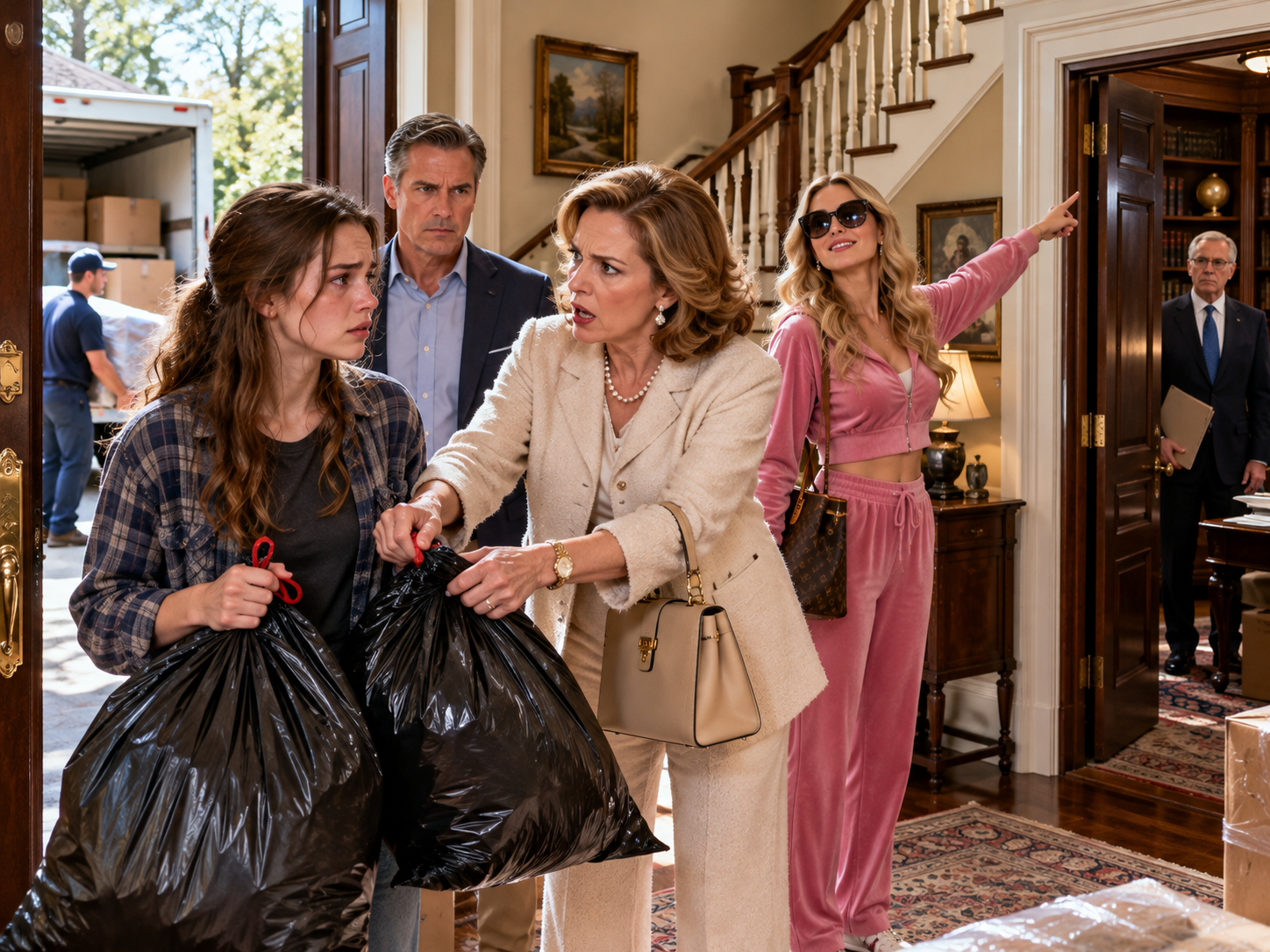
For several seconds after Eleanor Whitcomb spoke, nobody moved. My mother stared at her as though the attorney had stepped out of a memory she had hoped never to revisit. Dad recovered first. He straightened his jacket and asked why she was inside the house without notifying the family. Eleanor glanced toward me. “Emily let me in through the side entrance this morning,” she replied. “Your father arranged for me to be here.” I had opened that entrance shortly before the moving truck arrived, following a message Eleanor sent the previous evening. I had not known she intended to wait in the study.
My father looked at me sharply. “You invited a lawyer here without telling us?” I held his gaze. “I didn't know you were coming.” He opened his mouth, then closed it. It was the first time since his arrival that he seemed to understand that his version of events might not control everyone in the room. Eleanor stepped into the hallway and asked the movers to pause their work. The older mover lowered the corner of a dresser he had begun to lift. His colleague set down a roll of packing material. Both looked relieved to have received a clear instruction.
My mother folded her arms. “This is a private family matter,” she said. “We don't need an audience.” Eleanor answered that the workers were welcome to wait outside while the ownership question was clarified. Dad protested that he had already paid for the truck and the crew. Eleanor did not raise her voice. “Then you may wish to avoid additional charges for moving property you have no demonstrated right to remove.” The words landed with enough force that Dad stopped arguing. He told the men to take a break, and they went onto the porch.
Brianna came downstairs, carrying a small framed photograph she had removed from Grandpa's bedroom. It showed him and me in the garden on my sixteenth birthday. She looked from Eleanor to our parents and asked what was happening. Mom told her to put the photograph down and wait. Brianna set it on the hall table with an irritated sigh. I wanted to take it from her immediately, but I remained where I was. Grandpa had asked me not to begin with an argument, and I had come too far to abandon his instructions now.
Eleanor invited us into the dining room. She placed her leather folder on the table where the funeral guests had gathered the previous afternoon. A vase of lilies stood near the window, their petals beginning to curl at the edges. My father chose the chair at the head of the table, the one Grandpa had used for as long as I could remember. Eleanor waited until everyone sat before opening the folder. I remained near the doorway, uncertain whether I was expected to participate. She noticed and pulled out the chair beside her. “Emily, this concerns you more than anyone.”
My mother gave a short, humorless laugh. “She's barely an adult. Whatever my father intended, we are his children.” Eleanor removed a document from the folder. “You are his daughter, Mrs. Bennett. That relationship is not disputed. But being someone's child does not automatically make you the owner of property that person lawfully transferred or directed elsewhere.” Dad leaned forward. He wanted to see the paper, but Eleanor kept it in front of her. She explained that she represented Grandpa's estate and had been instructed to clarify several matters before any belongings were removed.
She began with the house. Grandpa had owned it outright for many years. There was no mortgage, and no one else held a recorded ownership interest. My parents had never contributed to its purchase or maintenance, and they were not listed on the deed. Dad interrupted to say that he had helped with repairs when he was younger. Eleanor acknowledged that family members sometimes helped maintain a parent's property. Such help, she explained, did not create ownership unless there was a separate legal agreement. Dad looked toward Mom, but she was watching the folder.
Then Eleanor placed a copy of Grandpa's will on the table. She explained that the document had been prepared with legal formalities and witnessed according to the applicable requirements. It named me as the principal beneficiary of his estate and appointed a professional representative to administer it. I had known Grandpa wanted me to remain in the house, but I had not understood how explicitly he had arranged for that wish to be carried out. My fingers tightened around the edge of my chair as Eleanor read the provision concerning his residence and personal belongings.
Dad pushed back from the table. “That cannot be right. He wouldn't leave everything to a twenty-two-year-old.” Eleanor answered that Grandpa had been competent when he signed the document and had reviewed it again during his final illness. She had met with him privately to confirm his wishes. “He understood precisely what he was doing,” she said. “He also understood that some members of his family might be unhappy with his decision.” Mom's face hardened. She accused Eleanor of influencing an elderly man who had been ill and dependent on me.
The accusation made my stomach tighten. Grandpa had hated the idea that his illness might cause people to doubt his judgment. Even during his weakest days, he insisted on choosing his meals, reviewing his bills, and asking questions about every treatment. Eleanor seemed prepared for the attack. She explained that Grandpa's capacity had been assessed and documented, and that the estate records included notes of their meetings. “He was not confused about his family relationships,” she said. “He spoke about them at considerable length.”
Brianna leaned back in her chair. “So Emily gets the house because she lived here?” Eleanor looked at her. “Emily's grandfather made a deliberate decision about the property he owned. Living here is part of the history, but it is not the legal basis for the inheritance.” Brianna's expression shifted from annoyance to disbelief. She asked whether there was at least money set aside for the rest of them. Mom shot her a warning glance, but the question had already been asked. Eleanor said there were additional provisions she would explain in due course.
My father stood and walked to the window. Outside, the moving truck occupied most of the driveway, its rear doors open. He stared at it for a moment before turning back. “We are prepared to contest this,” he said. “My father wasn't in good health. Emily was living here and controlling who saw him. We have every reason to question whether he understood what he signed.” His words were measured, but I recognized the threat beneath them. He was willing to turn the years I spent caring for Grandpa into evidence against me.
I wanted to defend myself. I wanted to tell him about every hospital visit, every meal, every night I stayed awake listening for Grandpa's breathing. Eleanor rested a hand lightly on the table near mine. The gesture reminded me to wait. She told Dad that he was entitled to seek independent legal advice, but that an allegation of undue influence would require evidence. She added that Grandpa had anticipated the possibility of a challenge and had preserved records concerning both his decisions and his relationships with his children.
My mother went still. “What records?” she asked. Eleanor turned another page. She explained that Grandpa had kept correspondence from the period when I first came to live with him. There were letters, notes of telephone conversations, and copies of documents related to his becoming my legal guardian. Some had been written by my parents themselves. Mom immediately said those events were irrelevant. Eleanor replied that they could become relevant if my parents claimed Grandpa had misunderstood the circumstances of my upbringing or had been manipulated into excluding them.
I stared at the folder. Grandpa had never shown me those letters. He had told me only that my parents had made choices he could not control and that I should not carry responsibility for them. I had spent years imagining explanations: financial trouble, illness, some private crisis too painful to discuss. Hearing that written records existed made me realize there might be answers I had never been allowed to see. I was not sure whether I wanted them, but I knew I could no longer pretend they did not exist.
Dad returned to his chair and asked Eleanor to produce the correspondence. She said copies could be provided through the proper process, but first she wanted to establish the immediate issue. No one was authorized to remove furniture, alter locks, occupy bedrooms, or dispose of Grandpa's belongings without approval from the estate's representative. My parents were not residents of the property. They had arrived without an invitation and had attempted to take possession before the estate had been administered. Eleanor advised them to withdraw the movers and leave the house undisturbed.
Mom's composure finally cracked. She leaned forward and pointed at me. “You think she deserves this because she stayed here? We had another child to raise. We had responsibilities. Your grandfather offered to take Emily, and he knew what that meant.” Her voice grew louder as she spoke. “He cannot punish us for accepting his help.” I looked at her, stunned less by the words than by the ease with which she said them. Seventeen years of silence had become, in her telling, an ordinary family arrangement.
Eleanor asked whether Mom wished to discuss the agreement she and Dad had signed when Grandpa assumed responsibility for me. Dad told her to stop. Mom looked confused. “What agreement?” she demanded. Eleanor removed a photocopy from the folder and placed it where both could see. My father's signature appeared at the bottom. So did my mother's. I could not read the entire page from my seat, but I saw my name, my date of birth, and a paragraph marked with a yellow tab.
Dad reached for the document. Eleanor allowed him to examine the copy. His eyes moved quickly across the page, then stopped. Mom leaned toward him, trying to read over his shoulder. Brianna watched them both with growing unease. “What is that?” she asked. Dad folded the paper and placed it facedown. Eleanor asked him to leave it open because it was part of the record under discussion. He did so reluctantly, smoothing the crease with his palm.
Eleanor explained that the document was one of several records showing that my parents had voluntarily agreed to Grandpa becoming my legal guardian after they failed to return for me. The arrangement had not been a weekend visit that accidentally became permanent. There had been discussions, notices, and opportunities for them to resume responsibility. They had chosen not to do so. The paper also contained their acknowledgment that Grandpa would make decisions concerning my care without relying on their participation.
My mother shook her head. “That doesn't mean we stopped being her parents.” Eleanor agreed that the document did not erase the biological relationship. Then she added, “It does show that Mr. Bennett did not take Emily from you or prevent you from raising her. That distinction matters if you intend to argue that he manipulated her relationship with the family.” Mom opened her mouth, but no answer came. For the first time, I saw uncertainty behind her anger.
Brianna turned toward me. “You told people they abandoned you?” Her question was sharp, almost accusing. I looked at her and remembered the little girl waving from the car window. She had been a child too, and I had never known what our parents told her. “I told people I lived with Grandpa,” I said. “When they asked where Mom and Dad were, I said I didn't know. That was the truth.” Brianna looked away, but I could see she was trying to fit my answer into a story she had believed for years.
Eleanor closed the folder halfway. She said there was one more matter Grandpa had instructed her to address if my parents returned and attempted to take possession of the house. It concerned a separate statement he had prepared shortly before his final hospitalization. He had wanted me to hear it in the presence of anyone who claimed that his wishes were unclear. Eleanor glanced toward the study. “He was very particular about how this should be handled.”
Dad immediately objected. He said a statement made by a dying man could not settle a property dispute. Eleanor agreed that no recording could replace the legal documents. “It was not intended to,” she replied. “The documents establish his instructions. The statement explains them.” She stood, picked up the folder, and asked whether we would accompany her to the study. My mother remained seated for several seconds before following.
Inside, Grandpa's desk was exactly as he had left it. His reading glasses rested beside a notebook, and the brass lamp cast a warm circle of light across the blotter. Eleanor opened a drawer and removed a small digital recorder. She placed it on the desk, checked the label, and looked at me. “Your grandfather wanted you to know that he made these decisions freely,” she said. “He also wanted your parents to hear why.”
My father stepped forward. “Turn that off before it starts.” Eleanor's hand remained steady on the recorder. “You are free not to listen,” she told him. “But the statement will remain part of the estate record.” I stood beside Grandpa's chair, looking at the worn indentation where his elbow had rested for years. I had expected documents, perhaps a letter. I had not expected to hear his voice again.
Eleanor pressed the button. A faint hiss filled the room, followed by the sound of Grandpa clearing his throat. Then his familiar voice emerged, slower than I remembered but unmistakably his. “If Emily is hearing this,” he began, “then I have left her with something I should have explained more clearly while I was alive.” I covered my mouth. My mother stared at the recorder. Dad looked toward the door, as though he might still find a way to leave before the truth reached him.
Click here to continue reading: PART 3: Grandpa’s Last Recording Exposed the Promise My Parents Broke and the Reason He Had Prepared for Their Return
The Morning My Family Came to Claim a House Before They Had Even Asked Who Owned It
Part 2 of 20

