
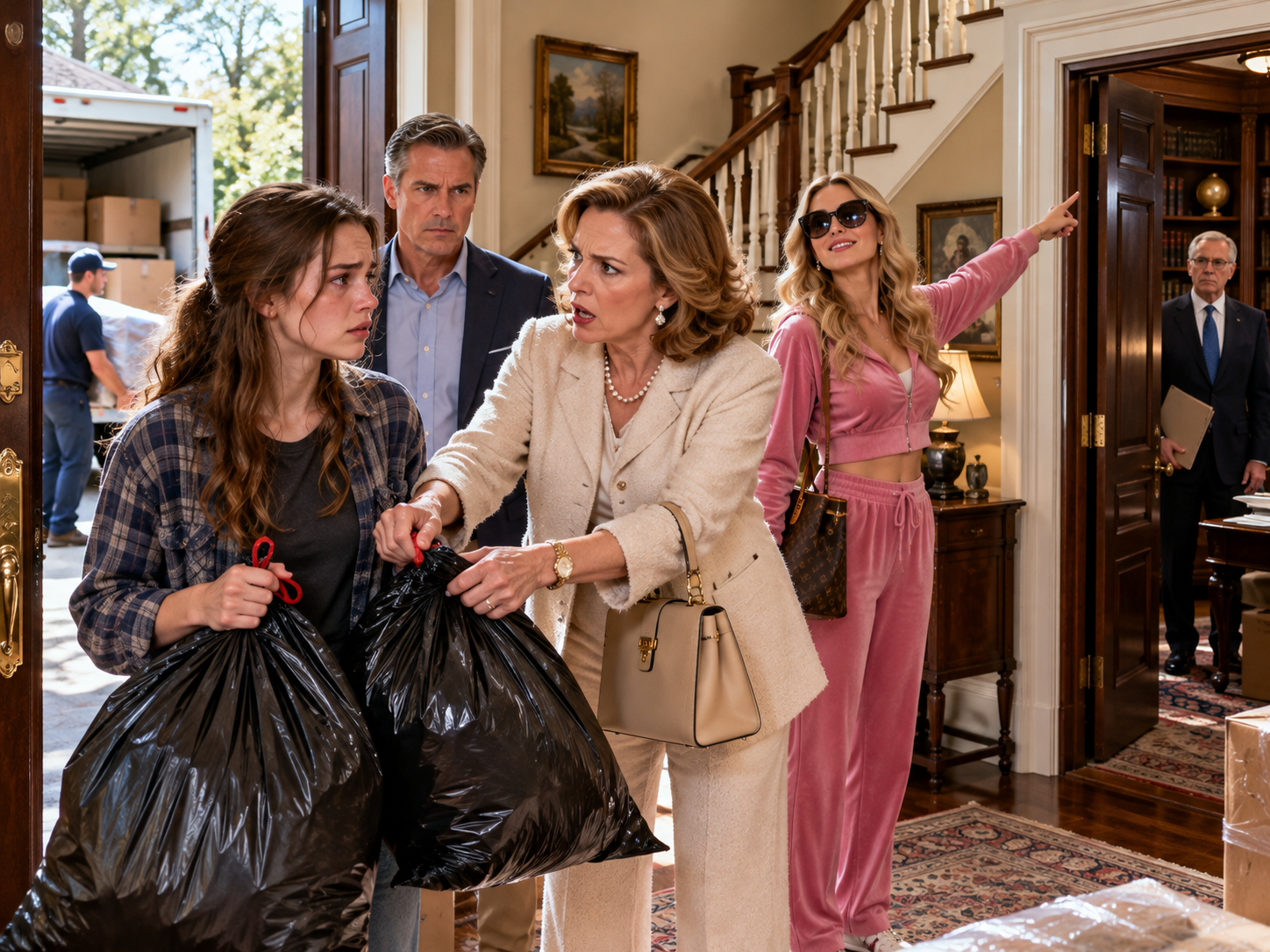
Brianna's next message arrived on a Sunday morning, just as I was preparing to clean out the small bedroom at the back of the house. She asked whether she could visit sometime that week. She made it clear that she would come alone and would not bring our parents. I stared at the message for a long time before answering. Part of me wanted to say yes because I was curious about the person she had become. Another part remembered the way she had walked into Grandpa's home and claimed his bedroom while his funeral wreath still hung on the door.
I finally told her she could come on Wednesday afternoon. I added that I wanted the visit to be a conversation, not another discussion about the house or the will. She replied that she understood. There were no demands, no arguments, and no mention of what she believed she was entitled to. I put the phone away and returned to the bedroom, where Grandpa had kept spare blankets and old suitcases. I had been avoiding the room because it reminded me of the years when I slept there after nightmares about my parents.
By Wednesday, I had cleaned the room and opened the curtains. The light fell across a wooden chest Grandpa had repaired when I was in high school. I had considered donating it, but I decided to keep it for now. It was useful, and the scratches on its surface reminded me of the afternoons when Grandpa taught me how to sand and refinish furniture. I made tea and set two cups on the kitchen table, then spent several minutes rearranging them before forcing myself to stop.
Brianna arrived exactly on time. She wore jeans and a plain sweater, without the designer sunglasses she had worn on the morning of the funeral. She stood on the porch holding a small paper bag. For a moment, neither of us knew whether to hug. We settled for a brief, awkward embrace, then stepped inside. Brianna looked around the foyer, pausing when she saw Grandpa's walking stick still leaning against the wall.
“I remember that,” she said quietly. “He used to keep it by the door when we visited.”
I told her she was welcome to sit in the kitchen. She handed me the paper bag, explaining that she had brought a loaf of banana bread from a bakery near her apartment. She said she did not know whether I liked it, but she remembered Grandpa making it sometimes when the bananas became too ripe. I thanked her. The small gesture was thoughtful, though I could not help noticing that she had brought food rather than an apology written on a card. It felt more natural, less like she had rehearsed what a good sister was supposed to do.
For the first few minutes, we talked about safe subjects. Brianna asked about my job and whether I intended to stay in the house. I told her I was still deciding what I wanted long term, but I had no plans to leave immediately. She said she was glad I had a place to live. The sentence was simple, yet it was the first time she had acknowledged the practical importance of the house to me rather than discussing it as an inheritance.
Eventually, she asked about Grandpa's final days. She wanted to know whether he had been frightened, whether he had known he was dying, and whether I had been alone with him when he passed. I answered as honestly as I could. He had known his illness was serious. He had been tired and sometimes uncomfortable, but he had not spent every moment afraid. I had been with him during his final hours, holding his hand while the room filled with the soft sounds of the hospital.
Brianna's eyes grew wet. She said she had not known how sick he was. Our parents had told her that he was old and declining, but they had not encouraged her to visit. She admitted that she could have looked for him herself once she was older. She had chosen not to because it was easier to accept the distance as normal. That confession mattered more than an elaborate apology. She was not claiming she had been powerless forever. She was admitting that she had made choices too.
I told her I had often wondered whether she remembered me. When I was a child, I imagined that she might have asked about me and been told I was happy without her. Sometimes I imagined that she had forgotten me entirely. Brianna said she remembered the day I left with Grandpa's hand around mine, and the way I had waved from the car window when our parents drove away. She had been told I would come back, and she believed it. When I did not, she asked questions for a while, then stopped.
“Mom said you were better off with him,” she explained. “Dad said you liked the country and didn't want to move. I didn't know they had told you the weekend story. I thought you had been asked to stay.”
I looked at her across the table. “I was five, Brianna. I didn't understand any of it. I just wanted you to come over.”
She lowered her eyes. For several seconds, the only sound was the clock above the kitchen doorway. Then she said she was sorry. Not only for the moving truck or the bedroom, but for accepting an explanation that had made it easier to forget I was waiting. She knew the apology could not give me back the years. She said she was not asking me to make her feel better about it.
I believed she meant that, at least in that moment. I told her I appreciated the apology, but I could not promise that we would become close. We had missed too much of each other's lives. If we wanted to know one another now, we would have to begin as adults who were almost strangers, not pretend that seventeen years could be repaired by one afternoon. Brianna nodded and said she would rather have an honest beginning than a false reunion.
We talked about Grandpa's garden next. Brianna remembered that he let her pick strawberries when she was little, though she admitted she had eaten more than she carried back to the kitchen. I told her about his habit of saving the smallest berries for me because he believed I liked them best. We compared memories and discovered that we remembered different versions of him. She had known the grandfather who played games with visiting children and sent her home with pocket money. I had known the man who worried about bills and sat awake when I had a fever. Both versions were true.
After an hour, Brianna asked whether she could see the master bedroom. I felt my shoulders tense before I could stop myself. She noticed and quickly explained that she did not intend to claim it or ask for anything. She wanted to see the room because she had behaved so carelessly that morning, and she wanted to understand what she had treated as hers. I considered her request, then agreed.
We climbed the stairs together. The room had not changed much since the day of the funeral. Grandpa's dresser remained against the wall, and his books were still arranged on the shelf beside the window. I had washed the bedding and opened the curtains, but I had not yet decided what to do with his clothes. Brianna stood in the doorway and looked around. She did not criticize the dark wood or the old furniture. She asked whether I had slept there after Grandpa died.
I told her I had. The first few nights, I had felt uneasy in every room, as if moving through the house without him might somehow make his absence more real. Eventually, I began sleeping in my own bedroom again. The master bedroom remained a place where I could sit when I wanted to remember him, but I had not wanted to turn it into a shrine. Brianna nodded. She ran her fingers along the dresser's edge and said she was ashamed of how she had spoken about it.
I told her that Grandpa would have preferred she remember the room as a place where she had been welcome as a child. She looked at me and asked whether he had ever spoken about our parents. I said he had tried not to poison my relationship with them. He answered my questions, but he did not tell me to hate them. He wanted me to have a life that was larger than the choices they had made. Brianna said that sounded like him, though she had not thought about him in years.
When we returned downstairs, she asked about the estate dispute. I explained that Eleanor had responded to the legal requests and that the documents supported Grandpa's intentions. My parents were still consulting their attorney, but no hearing had been scheduled. Brianna said she had tried to persuade them not to continue fighting. They told her the matter was between them and me, and that she should stay out of it. She said she did not know whether they would listen to her, but she had told them she would not help them take the house.
I was surprised. “You don't have to choose sides,” I said.
“I'm not choosing a side about the house,” she replied. “I'm choosing not to pretend they didn't leave you. I can love them and still admit that what they did was wrong.”
Her answer was more mature than I had expected, and it made me reconsider how much of Brianna's behavior had been learned from our parents. She had been given the same family story for years, and she had accepted it because it protected her from difficult questions. Now she was willing to challenge it, even if doing so created tension at home. That did not erase her actions, but it gave me a reason to believe she might change.
Before she left, Brianna asked whether she could call me again. I told her she could, provided we both respected the boundaries we had discussed. She promised she would. At the door, she hesitated, then said she had not brought up the inheritance because she knew Grandpa had left the house to me. She did not expect me to give her anything. She only wanted me to know that she was no longer pretending the property had been promised to the whole family.
After she drove away, I stood on the porch and watched her car turn onto the road. I felt neither the sudden joy of a restored family nor the anger I had felt when she first arrived. Instead, I felt cautious relief. A conversation had taken place without anyone demanding that I surrender my memories or my home. We had acknowledged what happened without pretending that acknowledgment could repair everything.
The following week, Brianna sent me a photograph of Grandpa's old garden from one of her childhood visits. In the picture, she stood beside the strawberry patch, holding a bowl that was nearly empty. Grandpa stood behind her, smiling at the camera, while I appeared at the edge of the frame, squinting into the sunlight. I had not seen the photograph before. On the back, in Grandpa's handwriting, was a date and a note: Both girls helped pick berries. Most were eaten before we got inside.
I laughed when I read it. Then I placed the photograph beside the one of Grandpa and me in the garden. It was not proof that our family had been happy in every way. It was proof that Brianna and I had once shared a small, ordinary moment before the years apart became the only story we knew. I could keep that memory without pretending our relationship was already repaired.
Later that month, Eleanor called to say that my parents' attorney had indicated they were unlikely to pursue a formal challenge to the will. The guardianship records and the evidence of Grandpa's capacity had made their position difficult to support. There were still administrative steps to complete, but the immediate threat to the estate appeared to be fading. I thanked her and sat at the kitchen table for a long time after the call ended.
The house was safe, at least for now. I no longer had to prepare myself for a legal fight every time the mail arrived. I could begin making decisions about repairs, savings, and my future without waiting for someone else to tell me whether I was allowed to stay. The relief was enormous, but it did not erase the grief. Grandpa was still gone. My parents had still left me. Brianna and I still had seventeen years of silence between us.
That evening, I opened the back door and looked out at the garden. The beds needed clearing, and the shed door had begun to sag on its hinges. I made a list of repairs and placed it beside my calendar. The future was becoming practical again: expenses, projects, visits, and ordinary choices. I did not know whether Brianna and I would become close, but I knew I no longer had to make that decision in a single afternoon.
I turned off the kitchen light and walked upstairs. Grandpa's study remained closed, not because I was afraid of what was inside, but because I had finally learned that I could open it whenever I chose. The documents were safe. His letter was safe. The truth was safe. And for the first time since the moving truck arrived, I felt that I could let the house be a home again.
Click here to continue reading: PART 8: When the Legal Fight Finally Ended, I Had to Decide Whether Grandpa’s House Was My Past or My Future
The Morning My Family Came to Claim a House Before They Had Even Asked Who Owned It
Part 7 of 20

