
The call from Eleanor came on a bright Thursday morning while I was standing in the kitchen, trying to decide whether the last of the apples should become a pie or be eaten as they were. She told me that my parents' attorney had confirmed they would not pursue a formal challenge to Grandpa's will. They would accept the estate documents and allow the transfer to proceed according to the established process. There were still signatures and administrative matters to complete, but the threat of a prolonged dispute had receded.
I thanked her, then stood with the phone in my hand long after the call ended. I had expected to feel triumphant. Instead, I felt a tiredness so deep that I leaned against the counter and closed my eyes. For weeks, I had been preparing myself for the possibility that my parents would drag the matter through court, question Grandpa's judgment, and turn my years of caring for him into evidence against me. Now the immediate conflict was ending, and I had no idea what to do with the energy I had spent preparing for it.
I made the apple pie. The process was familiar enough to steady me: washing the fruit, peeling the skins, measuring flour, and cutting cold butter into the mixture. Grandpa had taught me how to make pastry when I was thirteen. He used to say that the secret was not to overwork the dough, because trying too hard could ruin something that needed a gentle touch. I remembered his hands moving over the counter and the flour dusting the front of his shirt. By the time the pie went into the oven, the kitchen smelled like cinnamon and warm apples.
While it baked, I called Eleanor back to ask about the final paperwork. She explained that the estate would be closed once the remaining accounts were settled and the required documents filed. The house would be transferred to me without the challenge my parents had threatened. She advised me to keep the records and copies of the legal correspondence, but I would not need to continue preparing for a hearing. I thanked her again and promised to sign the documents as soon as they were ready.
The pie came out with one edge darker than the rest. I cut a small slice and ate it standing beside the counter. It tasted like Grandpa's recipe, though the crust was a little thicker than he would have liked. I found myself smiling at the thought of him pretending to criticize it before asking for another piece. The memory did not make the loss smaller, but it made the kitchen feel inhabited by more than grief.
That weekend, I began sorting the rooms I had avoided since his death. I did not want to throw everything away, and I did not want to preserve every object simply because it had belonged to him. I worked slowly, setting aside things I used, things I wanted to keep, and things that could be donated. His winter coats went to a local organization that provided clothing to people who needed it. I kept his favorite flannel shirt, the old gardening gloves, and a small box of photographs.
The study took the longest. I organized his books by subject, cleaned the shelves, and placed the legal folders in the locked cabinet Eleanor had recommended. His notebooks contained lists of household repairs, records of garden planting dates, and occasional observations about the weather. Most pages were ordinary. One contained a note that I had a school presentation on a particular day and needed a ride if the rain continued. Another reminded him to buy my favorite cereal. The details made me pause more often than the legal papers had.
I wondered how many times he had written reminders like those because he was afraid he might forget something I needed. He had been in his seventies when I first came to live with him, and by the time I reached adulthood, he had become slower and more forgetful about small things. Yet he never forgot my appointments, my favorite meals, or the dates of important exams. His notebooks revealed how much work had gone into making his care look effortless.
I found a photograph tucked inside one of his gardening books. It showed Grandpa standing beside a young apple tree in the backyard, one hand resting on the trunk. The tree was barely taller than his shoulder, and the photograph had been taken years before I was born. On the back he had written, Planted in the spring. We'll see what comes of it. The tree still stood outside the kitchen window, taller now than the roofline. I went outdoors to look at it, surprised that something he had planted long before my arrival had become part of my own memories.
For the next few days, I thought about what I wanted the house to become. I could stay there indefinitely, maintaining the rooms as Grandpa had kept them. I could sell it and use the money to build a life somewhere else. I could make changes gradually and decide later. For the first time, I understood that none of those choices would betray him. He had left the house to give me freedom, not to make me prove my loyalty by staying.
I discussed the question with Eleanor during our final meeting. She reminded me that the legal process would soon be complete and that I did not have to decide immediately. Grandpa had made it clear that the property was mine to manage. If I chose to sell in the future, I would be free to do so. If I chose to remain, I could make repairs, update the rooms, or leave them as they were. The decision belonged to me, and that was precisely what Grandpa had intended.
I told her I wanted to stay for now. I had a job nearby, the house was familiar, and I liked the garden. I also wanted time to learn what it felt like to live there without expecting someone else to challenge my right to be there. Eleanor smiled and said that sounded sensible. She gave me the final papers to sign, then explained how to store the originals and keep track of the property expenses.
When I signed the documents, my hand did not shake. The legal language was dry and formal, full of references to property, transfer, and administration. Yet every page represented years of Grandpa's careful planning. I thought of him reviewing the paperwork with Eleanor, asking questions until he understood every detail. He had not left me a vague promise that I would be looked after. He had created a practical arrangement that could stand even when he was no longer alive to explain it.
The estate was formally settled a few weeks later. Eleanor sent a final letter confirming that the remaining administrative work had been completed. I placed it in the cabinet, closed the door, and turned the key. The sound was small, but it marked the end of a period in which every part of my life seemed to require proof. I could still remember what had happened, and I would preserve the records, but I no longer had to wake each morning expecting another demand from my parents' attorney.
Brianna called after she heard the news. She said she was relieved that the dispute had ended and that she hoped I could finally enjoy the house. I thanked her. We had spoken several times since her first visit, usually for short conversations about work, childhood memories, or things we had discovered in old photographs. We were not suddenly inseparable. We were learning how to speak without the story our parents had given us standing between every sentence.
She asked whether I would consider meeting for lunch sometime. I agreed, choosing a small café halfway between our homes. We talked about our jobs, the places we had lived, and the interests we had developed during the years apart. There were long pauses, but neither of us tried to fill them with forced affection. When she mentioned our parents, she did not defend them or ask me to forgive them. She simply said she was still trying to understand what she had been told.
I told her I was doing the same. I had spent years assuming that the only possible explanation for being left behind was that something about me had been wrong. The records had shown that the decision belonged to our parents, but understanding the facts did not instantly remove every old feeling. Sometimes I still remembered the little girl at the window, waiting for a car that did not arrive. I was learning to comfort her without allowing that memory to define the rest of my life.
Brianna said she remembered being told that I was happy with Grandpa and did not want to come back. She had believed the explanation because it made sense of my absence without requiring her to question our parents. Now she understood that she had been given a version of events that protected them. She apologized once more, then added that she knew she could not ask me to make up for the years we had lost.
I appreciated the honesty. I told her that we could keep talking and see what kind of relationship developed, but I would not promise that we could become the sisters we might have been if our childhoods had been different. She said she did not expect that. We finished lunch and walked together to the parking lot. Before leaving, she asked whether I would send her a photograph of the apple tree in the garden. She remembered Grandpa saying he had planted it long before either of us could reach the branches.
I took the photograph that afternoon and sent it to her. The tree stood against a clear blue sky, its branches moving slightly in the wind. She replied that it looked much bigger than she remembered. I told her it had grown slowly, and that Grandpa had always been pleased when it produced fruit. She sent back a heart, then a photograph of the garden from her childhood visit. It was a small exchange, but it felt like the beginning of a relationship built on what we could honestly share.
As winter approached, I began making changes to the house. I repaired the loose banister, replaced a cracked kitchen tile, and painted the small bedroom a pale green. I did not renovate the master bedroom because I liked its dark wood and the quiet it offered. I placed a comfortable chair beside the window and used it to read in the evenings. The room became a place where I could remember Grandpa without feeling that I had to preserve every detail exactly as he had left it.
I also began setting aside money for repairs and future plans. Grandpa had taught me to keep a little for emergencies, even when there was not much to save. I reviewed the household expenses, created a budget, and made a list of things that needed attention over the next year. The work was ordinary, but it gave me a sense of ownership that went beyond the legal papers. I was not simply defending a house. I was caring for a place where I intended to live.
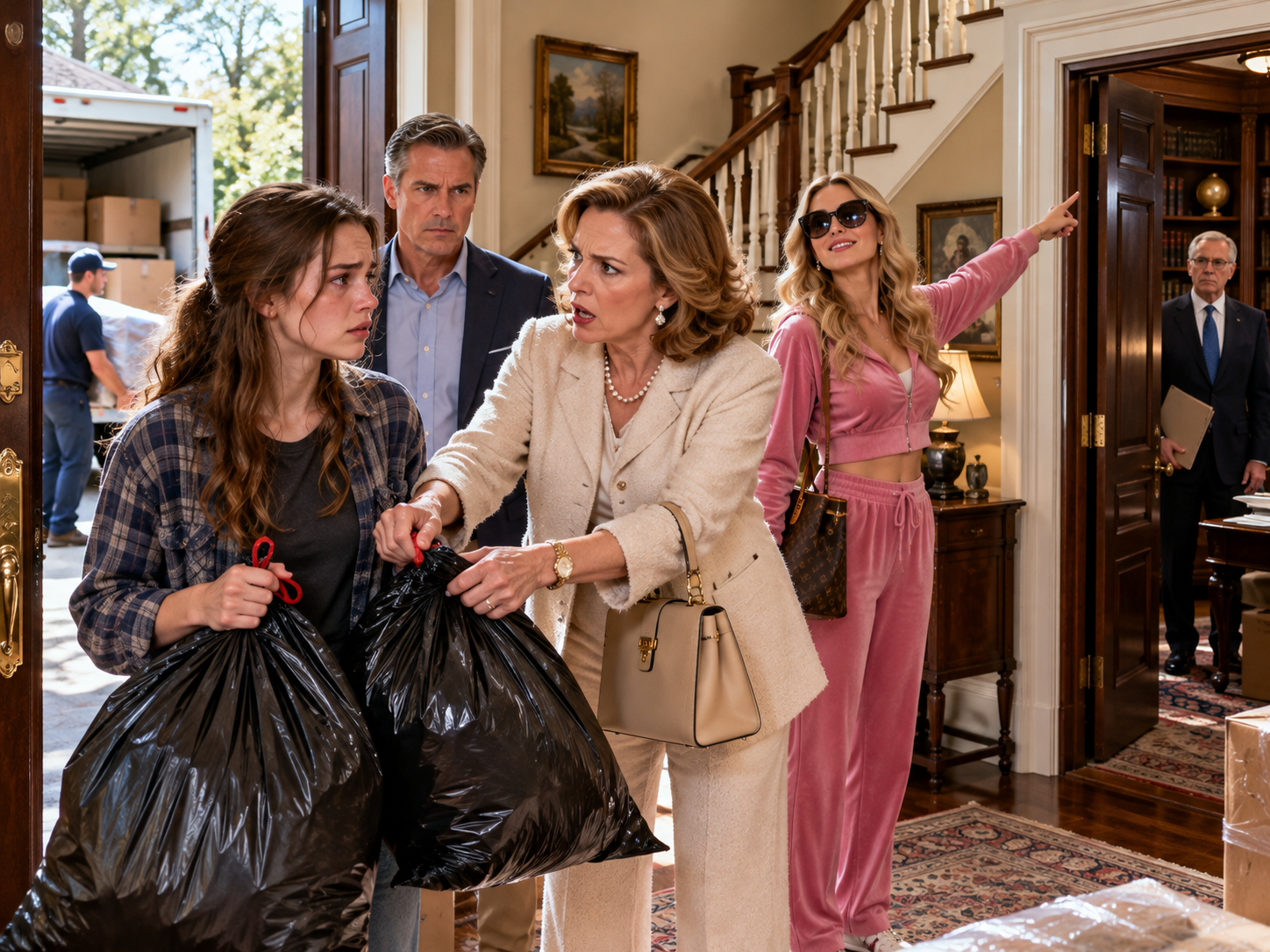
One evening, I found myself standing in the foyer, looking at the spot where my mother had dropped the garbage bags. I could still picture her face when Eleanor opened the study door. At the time, I had thought that moment would be the end of the story. In one sense, it had been the end of their attempt to take the house. But it had not ended the grief, the questions, or the work of learning how to live without Grandpa.
I no longer needed to turn that morning into a victory. My parents had left because the documents made it impossible for them to claim the property as they had expected. The truth had been established, but I had not won back seventeen years of childhood. I had not gained the parents I wished I had. What I had gained was the ability to stop defending my existence to people who had chosen not to be present for it.
I took down the black funeral wreath from the front door and carried it to the trash. Its flowers had dried, and the ribbon had faded. I replaced it with a simple autumn decoration I had bought at a local market. The front porch looked different afterward, but not unfamiliar. I stood on the steps and looked out toward the road where the moving truck had once parked. The driveway was empty, and the house behind me belonged to me in a way I was finally beginning to feel.
That night, I opened Grandpa's letter once more. I read the lines about the birthday cake, the crooked frosting, and the way he had hoped I would make my own choices. I folded the pages and returned them to the drawer. Then I turned off the study lamp and walked through the house, checking the doors as I always did before bed. I paused at the kitchen window to look at the apple tree in the dark.
I had once believed that home was something other people could give and take away. My parents had left me with Grandpa, and for years I had thought that their decision meant I was unwanted. Grandpa had shown me otherwise, but his death had forced me to learn that belonging could not depend entirely on the person who first made me feel safe. I had to learn to trust my own place in the world, even when the person who taught me how to find it was no longer here.
I went upstairs, changed into my pajamas, and settled into bed. The house creaked softly as the temperature dropped. I listened for a moment, then turned onto my side. There was no reason to fear the sounds. The study door was closed, the legal papers were secure, and the future was no longer waiting outside with a moving truck.
For the first time in months, I fell asleep without wondering what would happen if my parents returned. I had no way to know whether they would ever become the people I needed them to be. I no longer had to wait for that possibility before living my life. Grandpa had given me the house, but the choice to make it my home was mine.
Click here to continue reading: PART 9: The First Christmas Without Grandpa Forced Me to Decide Which Family Traditions Deserved to Survive
The Morning My Family Came to Claim a House Before They Had Even Asked Who Owned It
Part 8 of 11

