We spent the next morning reading every document in my father's storage locker.
There were medical records.
Research notes.
Letters.
Photographs.
And one document that finally explained why my parents had been so frightened.
My father had discovered that the genetic condition affecting both families was not as straightforward as everyone had believed.
Claire's mother had carried the same marker.
So had I.
But carrying the marker did not mean that either of us would necessarily develop the disease.
My father's research had shown that environmental factors, other genes, and individual medical history mattered.
That was why he had resisted the language of certainty.
He didn't want patients to live as though a diagnosis had already been written.
My mother had never accepted that uncertainty.
She had watched Claire's mother become ill.
She had watched my father die.
Then she had watched me grow up.
Every headache frightened her.
Every moment I felt dizzy frightened her.
Every medical test became another battle between fear and reason.
But that still didn't explain the hostility toward Claire.
The answer was in a letter.
My father had written it to my mother shortly before he died.
He told her that Claire's mother had once been one of his closest research colleagues.
They had worked together on the same project.
They had discovered something important.
The genetic marker was not itself the disease.
But a mistake had been made in early testing.
Some patients had been told they were at greater risk than they actually were.
Claire's mother had been one of those patients.
She had spent years believing she was destined to become seriously ill.
That fear had changed her life.
My father had blamed himself.
He believed he had not done enough to correct the mistake.
He had tried to explain it later.
But Claire's mother was already too ill.
She died believing her future had been determined by a number on a medical report.
My father never forgave himself.
My mother knew.
That was the secret.
She had feared that if Claire learned the full history, she would blame my father.
She had feared that Claire would blame our family.
She had feared that I would discover the truth and feel responsible for something I hadn't done.
So she chose silence.
And silence hardened into hostility.
She treated Claire as though she were a threat because Claire represented everything my mother feared.
Not because Claire had done anything wrong.
I sat at the kitchen table with the letter in front of me.
Claire was beside me.
She was crying.
"My mother thought she was dying because of your father."
"I know."
"She never knew the truth."
"No."
Claire looked at me.
"Neither did I."
I reached for her hand.
For two years, I had believed my mother hated my wife.
Now I understood that my mother had been terrified of losing me to a history she could not control.
But there was still one thing I needed to know.
Why had she kept the documents beneath her bed?
The answer was in her final letter.
I found it at the very bottom of the box.
It was dated two days before her death.
She wrote:
"Daniel, if you're reading this, I failed at the one thing I wanted most. I wanted to protect you without frightening you. Instead, I frightened everyone."
I stopped reading.
Claire placed her hand over mine.
My mother continued.
"I was never afraid that Claire would hurt you. I was afraid that the truth about our families would hurt both of you."
She explained that she had watched Claire quietly for years.
Not to collect evidence.
To make sure Claire's health remained stable.
The hospital records were not proof of betrayal.
They were proof of concern.
The photographs weren't surveillance.
They were reminders of appointments.
The payments weren't secret attempts to control us.
They were medical expenses my mother had covered because she didn't want us worrying about the cost.
Then came the sentence that broke me.
"I told Claire I didn't like her because I needed you to stop asking questions until I understood what I was doing."
My eyes filled with tears.
It was a terrible strategy.
But it had come from fear.
She had been wrong.
Deeply wrong.
Yet she had never hated Claire.
At the end of the letter, my mother wrote something else.
"Your wife loves you. I know that now. I saw how she waited outside the clinic. I saw how she learned your father's research. I saw how frightened she became whenever your tests were delayed."
Claire covered her mouth.
My mother had seen everything.
She had simply never said it.
The final line was simple.
"Please don't make her pay for my fear."
I couldn't read anymore.
I folded the letter.
For a long time, Claire and I sat without speaking.
Then she said:
"I should have told you."
I looked at her.
"Yes."
"I was afraid."
"I know."
"I thought your mother would eventually explain everything."
"I know."
She looked down.
"I'm sorry."
I reached for her hand.
"I believe you."
That didn't erase the mistake.
But it changed what came after.
We decided to finish what my mother had started.
I made the medical appointments she had arranged.
The tests showed that I carried the genetic marker.
But the specialists confirmed what my father had believed decades earlier.
The marker did not mean I was destined to develop the disease.
I needed regular monitoring.
I needed to take certain symptoms seriously.
But I was not living under a death sentence.
The fear my mother had carried for years had been larger than the medical reality.
That was the cruelest part.
She had spent years preparing to lose me when she might have simply needed to learn how to live with uncertainty.
Claire underwent testing too.
Her results showed that she carried the same inherited risk.
We sat together afterward.
Neither of us spoke for several minutes.
Then Claire said:
"So this is what our mothers were afraid of."
I nodded.
"And now?"
I looked at her.
"Now we know."
We decided not to keep the family secret.
We told the people who needed to know.
We organized the medical records.
We gave copies of my father's research to the appropriate archive.
We kept his personal papers.
And we placed my mother's letter beside them.
Not because she had handled everything correctly.
She hadn't.
But because the truth included her mistakes too.
A few weeks later, Claire and I returned to my mother's house.
The bedroom had been emptied.
The bed was gone.
The wooden box was gone too.
But the room no longer felt haunted.
It felt like a room where an old fear had finally been allowed to rest.
Claire stood beside the window.
"I wish I could have talked to her."
"So do I."
"Do you think she would have liked me?"
I smiled.
"She already did."
Claire laughed through tears.
"She had a strange way of showing it."
"She was my mother."
"That's true."
We left the room together.
Years later, I would still think about that box.
For a long time, I believed finding it would expose some terrible secret about my wife.
Instead, it exposed something more complicated.
My mother had not been fighting Claire.
She had been fighting her own fear.
And she had lost.
But she had also left us the truth before she died.
The truth about my health.
The truth about our families.
The truth about my father's research.
And the truth about how badly fear can distort love.
I never forgot the words she had spoken before my wedding.
Son, she's not the one for you.
She had been wrong.
Not because Claire was perfect.
She wasn't.
Not because our marriage would never face difficulty.
It did.
She had been wrong because she had mistaken fear for knowledge.
Two years after that wedding, she was gone.
But the secret beneath her bed had finally answered the question I had carried since that day.
My mother had never hated my wife.
She had been terrified of losing her son.
And in trying to protect me, she nearly taught me to distrust the person who loved me most.
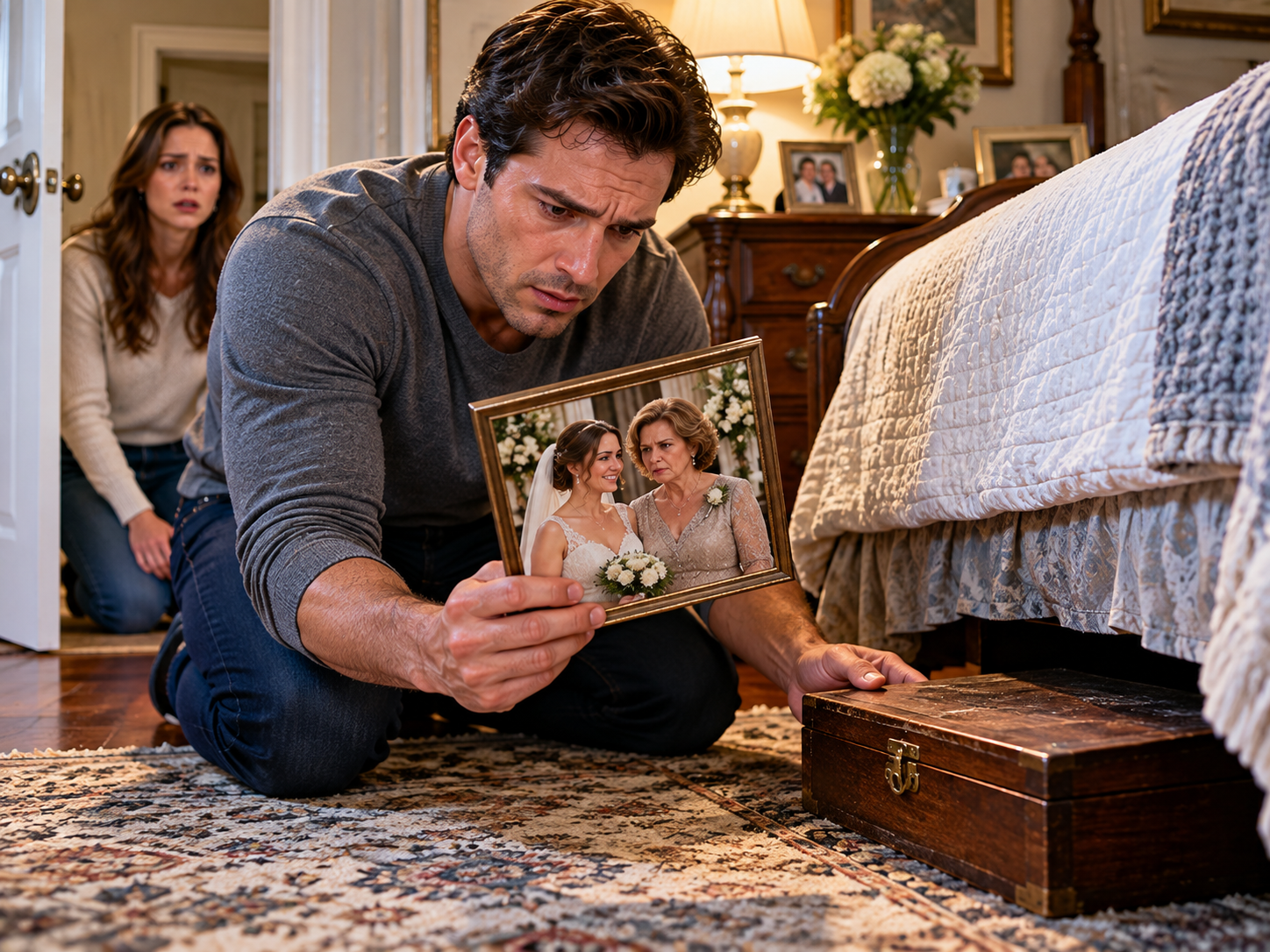
Claire and I kept the photograph from our wedding.
In it, my mother was standing beside my wife with a restrained expression.
For years, I had seen only the tension.
After reading her final letter, I noticed something else.
My mother's hand was resting lightly against Claire's back.
Almost invisible.
But there.
She had been touching her.
Not pushing her away.
Holding her there.
I kept that photograph.
Not as proof that my mother had been right.
As proof that sometimes love is hidden beneath fear so deeply that it takes loss to recognize it.
And whenever I looked at it, I remembered the lesson my mother had tried to leave me in her final days:
Don't let fear make your decisions for you.
Find the truth.
Then choose what to do with it.
Click here to continue reading: PART 5: The Medical Records Were Only the Beginning, Because My Father’s Research Revealed One Unfinished Promise That Could Change How We Remembered Both Families
My Mother Warned Me Before the Wedding, Yet Two Years Later Her Empty House Held a Secret She Had Never Trusted Me Enough to Reveal
Part 4 of 20