
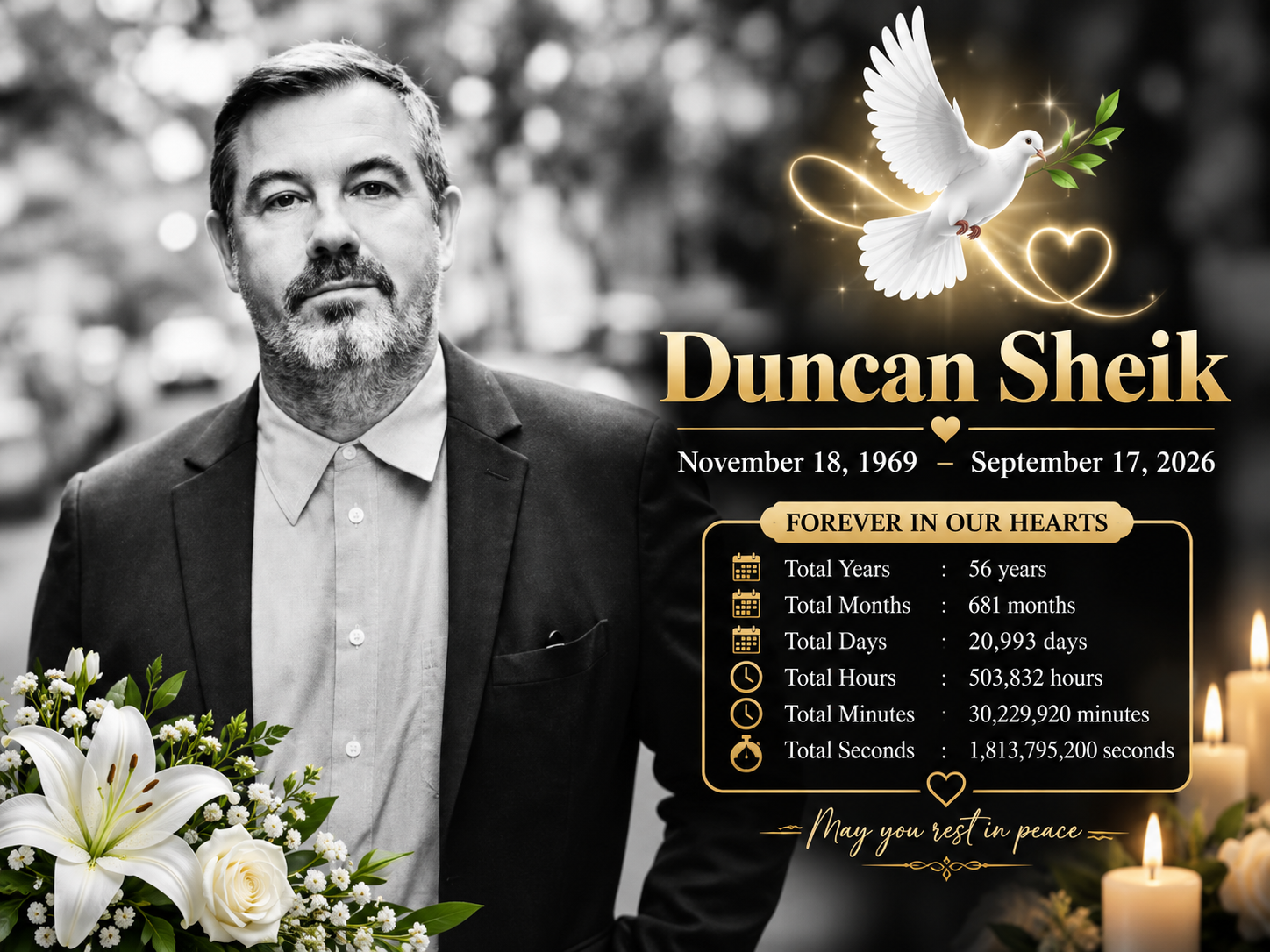
On September 17, 2026, Duncan Sheik died in Manhattan at the age of 56, only days before two theatrical projects connected to his music were expected to reach New York audiences. The timing made his death especially stark: one of his most important works, Spring Awakening, was preparing for a new production, while his newer musical Memoirs of Amorous Gentlemen was scheduled to begin performances later that month. His career had never followed a straight line. It had moved from quiet songwriting to unexpected pop fame, then away from the spotlight and toward musical theater. ([Reuters][1])
The photograph associated with his remembrance shows a man in a dark suit, looking directly toward the camera, his expression controlled rather than theatrical. That restraint suited much of the public image Sheik developed over the years. He was not known primarily for grand gestures or for chasing the identity of a conventional pop star. His most famous song, “Barely Breathing,” made him recognizable to millions, but the success also created a problem he would spend years trying to understand: what happens when the public version of an artist becomes more famous than the artist’s own sense of himself?
Duncan Scott Sheik was born on November 18, 1969, in Glen Ridge, New Jersey. He grew up between New Jersey and South Carolina after his parents divorced, and music entered his life early. His grandmother, who had studied at Juilliard, taught him piano when he was a child. Later, the guitar became the instrument that opened another door. By his early teens, he was already playing electric guitar with older students in a cover band, learning the physical discipline of playing with other musicians while absorbing the rock music around him. ([Wikipedia][2])
That early musical education mattered because Sheik never developed only as a singer. He became interested in the structure beneath music—the way words, melody, harmony and rhythm could change the meaning of a scene or a feeling. He attended Phillips Academy in Andover, Massachusetts, graduating in 1988, and then entered Brown University. There he studied semiotics, a field concerned with signs, symbols and meaning. At the same time, he continued writing and recording music, refusing to treat academic life and music as completely separate worlds. ([Pitchfork][3])
Brown also gave him an important musical connection. He played guitar with fellow student Lisa Loeb, who would later become a successful singer-songwriter herself. Their paths would eventually separate professionally, but the college years were part of the network of relationships through which Sheik developed his own musical voice. After graduating from Brown in 1992, he moved to Los Angeles, where the professional side of his life began to take shape.
Los Angeles offered opportunity, but it also demanded patience. Sheik worked toward a recording career while developing songs that did not fit neatly into the louder styles dominating much of popular music. His voice was restrained, his songwriting often inward-looking, and his arrangements could leave space around the vocal rather than filling every second with sound. The approach was distinctive enough to attract attention, but the real turning point came when one particular song found its way onto his first album.
That song was “Barely Breathing,” released as the lead single from his self-titled 1996 debut album. It did not arrive as the kind of oversized rock anthem that announced a future superstar. Instead, it was built around a carefully controlled vocal and a sense of emotional distance. The song’s narrator was observing a relationship that had already changed, and the music gave the words room to remain uncertain rather than resolving everything for the listener.
The song became a major commercial success. It reached No. 16 on the Billboard Hot 100 and remained on the chart for 55 weeks. Sheik received a Grammy nomination for Best Male Pop Vocal Performance, and his self-titled album eventually received gold certification. A young musician who had spent years writing and recording was suddenly being treated as a major pop figure. ([Pitchfork][3])
The speed of the change was difficult for him to absorb. In later interviews, Sheik recalled being pushed onto major television programs after having released only one album and performed a relatively small number of shows. The machinery surrounding the success moved faster than his own experience. He had become famous before he had necessarily decided what kind of public performer he wanted to be.
That distinction would become important. The music industry could sell an image quickly: a young singer, a guitar, a successful single, a recognizable face. But Sheik was increasingly interested in questions that could not be reduced to a photograph or a radio format. He had studied meaning at Brown, practiced Buddhism, and listened closely to artists whose work challenged easy categories. The public wanted another “Barely Breathing.” Sheik wanted to find out what else he could make.
His second album, Humming, arrived in 1998. Rather than simply reproducing the sound that had made him successful, he continued exploring a more textured and personal style. The commercial expectations created by his debut remained, but the music itself suggested that he was not interested in becoming permanently attached to one formula.
Then came Phantom Moon in 2001, an album that became particularly important because of Sheik’s growing collaboration with playwright and lyricist Steven Sater. The relationship between the two men would eventually reshape both of their careers. What began through songwriting would develop into a partnership in musical theater, where Sheik could use music not simply to support a singer but to help create characters, atmosphere, conflict and dramatic movement. ([IMDb][4])
The shift was not instantaneous. Sheik continued releasing records, performing and working as a singer-songwriter. But theater offered him something pop music could not easily provide: a larger structure in which songs could belong to a story rather than standing alone. A song could return in altered form. A melody could attach itself to a character. A musical phrase could reveal something before a character said it aloud.
At the same time, his relationship with fame remained complicated. The success of “Barely Breathing” had given him opportunities that most musicians spend years pursuing, but it also placed him inside a public identity he did not fully control. He later described a sense of disconnection between the expectations surrounding his pop career and the person making the music. That tension helps explain why his career did not simply proceed from one commercial album to another.
Instead, he began moving toward theater. In 2002, he wrote music for a production of Twelfth Night, and his collaboration with Sater continued to develop. The work was different from making a pop album because the music had to live inside a dramatic world. It had to serve people who existed onstage, not merely the performer holding the microphone.
That change required a different kind of discipline. A singer-songwriter can build a performance around his own voice and personality. A theater composer has to imagine how actors will inhabit the material, how an audience will understand it without explanation, and how music can carry emotional information that dialogue alone cannot. Sheik increasingly worked inside that more complicated machinery.
The clues to his eventual transformation were already visible. He had the pop success, but he was not satisfied with simply repeating it. He had the academic background that encouraged him to think about meaning and interpretation. He had developed a partnership with Sater. And he was increasingly willing to place himself inside projects where the music mattered as part of a larger narrative.
Still, nothing guaranteed that the next stage would succeed. Theater projects can disappear in workshops, change writers, lose financing or fail to find an audience. Sheik had already learned that a finished song could travel beyond its creator’s intentions. The next question was more difficult: could he help build an entire musical that would survive the pressure of a professional stage?
That question led him to a work based on Frank Wedekind’s 1891 play Spring Awakening, a story about adolescents confronting sexuality, authority, education and the restrictions imposed on them by adults. Sater had been working on the adaptation, and Sheik was asked to create its music. The subject matter was darker and more confrontational than the world of a conventional Broadway musical.
The material demanded a musical language that could make young characters sound immediate rather than historical. Sheik responded with a score drawing on rock and alternative influences instead of attempting to imitate the musical theater traditions audiences might expect from a period story. The decision would eventually become central to the show’s identity.
But before the awards, before Broadway, before the songs were sung by actors whose names would become familiar to theater audiences, there was a more basic risk. Sheik had to prove that his musical instincts could serve a dramatic story. The pop singer who had once been defined by a single hit was now attempting something much larger.
And the irony was beginning to sharpen. The man who had struggled with being turned into a pop image was preparing to enter a theater where the music would belong to an entire ensemble. If the experiment worked, “Duncan Sheik” would no longer describe only the singer behind “Barely Breathing.” It would describe a composer capable of changing the sound of a stage.
Click Here to continue read next: PART2: The singer who had once been reduced to a single radio hit found himself building a darker musical world where young voices carried the story
Days before new work was supposed to reach New York audiences, Duncan Sheik’s story suddenly ended, leaving behind a career that had begun far from Broadway
Part 1 of 16

