
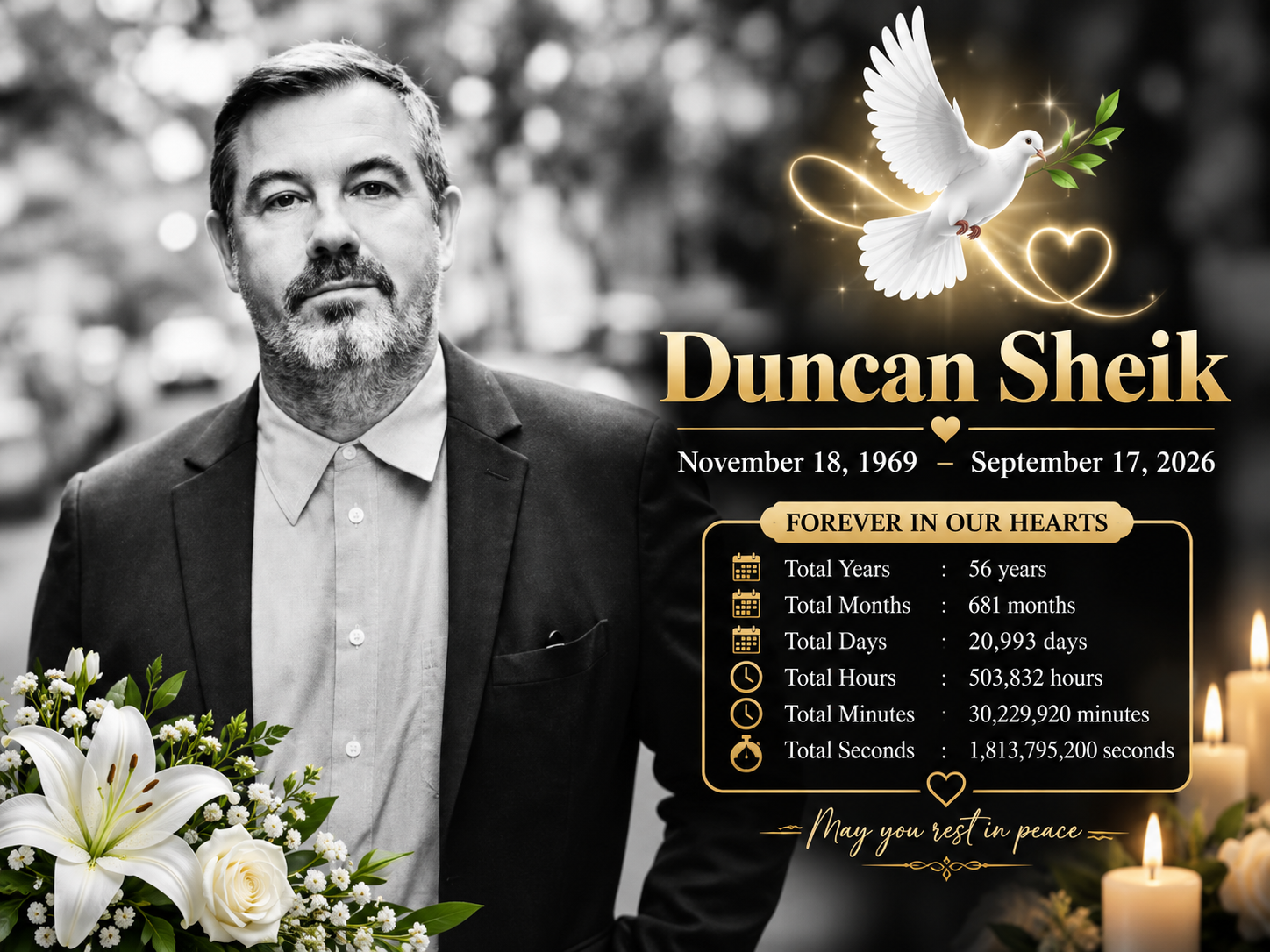
Duncan Sheik died on September 17, 2026, in Manhattan, New York City. He was 56 years old. He had been receiving medical care after a period of serious illness, and his family had publicly requested privacy shortly before his death. His mother, Suzanne Sheik, told The New York Times that the cause of death was cardiac arrest. Reuters likewise reported cardiac arrest based on the family’s information. ([CBS News][11])
Some published reports have described the medical circumstances differently, including references to organ failure or heart failure leading to cardiac arrest. Because the immediate family’s reported explanation is the clearest direct account available, cardiac arrest is the appropriate cause to state, while the more specific underlying medical details should not be presented as established fact without additional documentation. ([Los Angeles Times][12])
His dates therefore form a simple line: November 18, 1969, to September 17, 2026. Fifty-six years separated those dates. The memorial image gives the number as 56 years, and contemporary obituaries confirm his age at death. The photograph’s other figures—months, days, hours and seconds—are commemorative calculations rather than independently documented biographical facts.
The most important accomplishments of those 56 years were spread across two very different musical worlds. In 1996, Sheik became known internationally through “Barely Breathing,” the song from his self-titled debut album that reached No. 16 on the Billboard Hot 100 and remained there for 55 weeks. The song earned him a Grammy nomination for Best Male Pop Vocal Performance. ([Pitchfork][3])
A decade later, he had become a Broadway composer. Spring Awakening, created with Steven Sater, won eight Tony Awards in 2007, including Best Musical. Sheik won Tony Awards for Best Original Score and Best Orchestrations, and the original cast album later received the Grammy for Best Musical Show Album. ([Broadcast Music, Inc.][6])
Those achievements could easily be presented as two separate careers, but they were connected by the same underlying habit: Sheik kept searching for a musical form that could express more than the obvious version of himself. Pop made him visible. Theater gave him a larger dramatic structure. His later recordings gave him another space to experiment.
His theater catalog extended well beyond Spring Awakening. He composed for projects including Whisper House, Alice by Heart, American Psycho and The Secret Life of Bees, among others. He also worked on music for other theatrical productions and continued recording outside theater. The variety of those projects is significant because it shows that his identity as a composer did not depend on reproducing one successful score. ([Atlantic Theater][7])
The Secret Life of Bees represented another stage in that development. The musical, based on Sue Monk Kidd’s novel, gave Sheik an opportunity to work with a different emotional and cultural landscape from the adolescent rebellion of Spring Awakening. His theatrical career increasingly became a sequence of collaborations rather than a single defining production.
Meanwhile, he continued making recordings. Covers 80s demonstrated his interest in reinterpreting music from an earlier period, while Claptrap, released in 2022, moved toward ambient electronic textures. His final studio album was therefore not a return to the sound of his 1990s breakthrough. It belonged to the later, more exploratory stage of his career. ([Inquirer.com][5])
That refusal to remain fixed also explains why the projects scheduled around his death matter. Memoirs of Amorous Gentlemen, featuring Sheik’s music and lyrics and based on Moyoco Anno’s manga, was scheduled to begin Off-Broadway performances on September 25, 2026. A new production of Spring Awakening was scheduled to begin previews in November. ([San Francisco Chronicle][13])
The dates are difficult to ignore. Sheik died eight days before Memoirs of Amorous Gentlemen was scheduled to begin performances. The new Spring Awakening production was still weeks away. Both belonged to a future in which audiences would hear his work without the composer standing in the room to witness the response.
His death therefore did not end his catalog. It changed the meaning of what was still waiting to happen. A new production can still be rehearsed. A score can still be performed. An old song can still be recorded by another artist. But the person who created the original musical decisions can no longer make revisions or answer questions about what he intended.
That distinction is especially important for theater. A stage work is never completely frozen. Different casts discover different details. Directors make choices. Orchestrations can change. Audiences hear the same melody under different circumstances. Sheik’s work was already accustomed to that process.
Spring Awakening provides the clearest example. The original Broadway production began in 2006, the show returned in a Broadway revival in 2015, and another production was being prepared for 2026. The work had therefore already survived the departure of its first cast and moved through different theatrical generations. ([Inquirer.com][5])
The people who worked with him remembered more than awards. Following his death, performers associated with Spring Awakening shared tributes describing Sheik’s influence on their careers and their memories of working with him. These accounts are personal recollections rather than objective measurements, but together they show that his role was not limited to supplying notes on a page. ([People.com][10])
His family also became part of the public record after his death. Reports identified Nora Ariffin as his longtime partner or wife and their daughter Ines, born in 2018. He was also survived by his parents and half-siblings, including Kacie Sheik, a Broadway actress. The family’s public statement emphasized his place not only as an artist but as a father, partner, son, brother and friend. ([Reuters][1])
There is a temptation in a memorial biography to make the final days seem to explain everything that came before them. But Sheik’s career resists that kind of ending. His death was sudden enough that unfinished work remained. His final album had already appeared years earlier, but his creative life had not stopped. The projects awaiting production make that clear.
The same is true of his early success. “Barely Breathing” never disappeared simply because Sheik moved toward theater. It remained the song through which many listeners first encountered him. Yet his own career demonstrated that a first impression could be incomplete.
The young musician who once stood behind a microphone with a guitar eventually became a composer whose music could be carried by an entire cast. He received major awards, but he also experienced projects that closed quickly or remained in development. He made commercially successful work and experimental work. He stepped into public view and later found ways to work from behind the performers.
That complexity is part of what makes his biography difficult to reduce to a single sentence. Duncan Sheik was a singer-songwriter, guitarist, composer and theater artist. His professional life crossed pop music, alternative rock, musical theater and other forms of composition. His best-known recording and his most celebrated stage work came a decade apart, but both emerged from the same desire to build songs with a strong emotional and structural identity.
His education also remained visible in the way he approached art. Studying semiotics at Brown University gave him an academic background centered on meaning, while his early musical training gave him practical fluency. His grandmother introduced him to piano, he moved into guitar, and he eventually became a composer working with actors and dramatic texts. ([Wikipedia][2])
His Buddhist practice formed another part of his public perspective. Interviews over the years showed an artist interested in impermanence, interpretation and the limits of personal control. Those ideas became especially relevant after his death because his music had already begun to live independently of him.
Once a song is recorded, it can outlast its creator. Once a musical is staged, its future belongs partly to performers, directors and audiences. Sheik had spent much of his career working inside that reality. His death simply made the separation between artist and artwork permanent.
There is also a final chronological irony. On August 20, shortly before his final hospitalization became public, Sheik had posted about wanting to be home making music. Days later, his family announced that he was receiving medical care. The public was asked to give them privacy. On September 17, the news changed from concern to mourning. ([The Guardian][14])
The final image is therefore not of a career that had run out of possibilities. It is of an artist whose work was still moving forward when his own life stopped. The upcoming productions, the recordings already released, the performances preserved onstage and the songs carried by other voices all remain part of the record.
Duncan Sheik was born November 18, 1969, in Glen Ridge, New Jersey, and died September 17, 2026, in Manhattan, at 56. His reported cause of death was cardiac arrest. From “Barely Breathing” to Spring Awakening, from pop radio to Broadway, and from early songwriting to his final theatrical projects, his career was marked by movement rather than repetition. ([CBS News][11])
The unanswered question at the beginning—what would happen to the work still waiting for him—has no single dramatic answer. The work will move forward without him, as theater and recorded music have always done. Audiences will hear new performances, new interpretations and perhaps new meanings in songs he completed years ago. What cannot continue is the part only Duncan Sheik could provide: another song, another revision, another unexpected turn.
That is where the documented story reaches its final point. The man died in Manhattan at 56, but the music did not stop with him. The next voices to sing it, play it and interpret it will determine how future audiences encounter what he left behind.
Click Here to continue read next: PART5: The work Duncan Sheik left behind was already moving toward new stages, forcing collaborators to separate the living artist from the music he had set in motion
Days before new work was supposed to reach New York audiences, Duncan Sheik’s story suddenly ended, leaving behind a career that had begun far from Broadway
Part 4 of 16

