
The story of Duncan Sheik begins with a child learning piano from his grandmother and ends with a composer whose music was still scheduled for the stage after his death. Between those points were more than three decades of professional work, beginning with the 1996 album that made him famous and extending into theater productions that changed how audiences understood him.
He was born Duncan Scott Sheik on November 18, 1969, in Glen Ridge, New Jersey. He grew up between New Jersey and South Carolina after his parents’ divorce. His grandmother had studied at Juilliard and introduced him to piano. Guitar followed, and by his teenage years he was playing with other musicians. At Brown University, he studied semiotics while continuing to develop as a musician. Those early experiences became the foundation for a career that would eventually cross several musical forms. ([The Washington Post][7])
The first major public chapter arrived with his self-titled debut album in 1996. “Barely Breathing” became the defining hit, remaining on the Billboard Hot 100 for 55 weeks. The album went gold, and Sheik received a Grammy nomination for Best Male Pop Vocal Performance. The success made him widely recognizable and placed expectations around him before he had accumulated a long recording history. ([Los Angeles Times][6])
That fame did not determine the rest of his career. Sheik continued recording but gradually moved toward music that was less easily classified. His albums changed in sound and subject, and his interest in theater became increasingly important. His collaboration with Steven Sater developed through the early 2000s and eventually produced the project that would define the second half of his public career.
Spring Awakening opened on Broadway in 2006. Based on Frank Wedekind’s play, it followed young people in 19th-century Germany as they encountered sexuality, authority, education and the consequences of social repression. Sheik’s rock-influenced score gave the production a contemporary musical language, while Sater supplied the book and lyrics. The contrast between historical setting and modern sound became one of the show’s central artistic features.
At the 2007 Tony Awards, Spring Awakening won eight awards, including Best Musical. Sheik and Sater shared the award for Best Original Score, and Sheik also won for orchestrations. The original cast recording later received the Grammy for Best Musical Show Album. These awards established facts about the production’s formal recognition, but the show’s continuing life depended on more than trophies. It became a work that later companies could reinterpret. ([Reuters][3])
Sheik then continued into projects that were not simply variations on Spring Awakening. American Psycho brought a darker and more experimental subject to the stage. Alice by Heart placed an adaptation of Alice’s Adventures in Wonderland in wartime London. The Secret Life of Bees gave him another literary source and another dramatic environment. Some projects achieved substantial attention; others had shorter theatrical lives. Together they show that his career after Broadway’s recognition remained exploratory.
He also continued working as a recording artist. Covers 80s revisited music associated with British acts of the 1980s, while Claptrap, released in 2022, moved toward an ambient electronic sound. That final studio album demonstrated that Sheik’s musical curiosity had not narrowed into a single recognizable formula. The sound of the later work was far removed from the radio-friendly identity created by “Barely Breathing.”
The final years of his career were therefore still active. Memoirs of Amorous Gentlemen was developed as a new musical with music and lyrics by Sheik, a book by Leah Nanako Winkler, direction and choreography by Rob Ashford and musical supervision by Or Matias. It was based on Moyoco Anno’s manga and scheduled to begin performances Off-Broadway on September 25, 2026. ([DKC/O&M][1])
That date became part of his biography only because his life ended eight days earlier. On September 17, Sheik died at a Manhattan hospital. His family had announced shortly before his death that he was receiving medical care and was in critical but stable condition. The following announcement confirmed that he had died at 56. ([CBS News][8])
Public reporting about the cause of death has used somewhat different formulations. Suzanne Sheik, his mother, was reported by The New York Times as saying that he died from organ failure. Other outlets reported heart failure leading to cardiac arrest, while Reuters reported cardiac arrest based on the family’s statement and confirmation. Because those accounts differ in wording and the family did not publicly provide a detailed medical diagnosis, the biography should not go further than the documented reports. ([Los Angeles Times][6])
His death therefore occurred without a conventional final retirement. There was no announcement that he had completed his career. There was no last concert designed as a farewell. There was no final public statement explaining what he believed his artistic future would be. There was simply a medical crisis, a final hospitalization and a death that interrupted projects already underway.
That interruption was especially visible in theater. Memoirs of Amorous Gentlemen had a complete cast and a production schedule. Spring Awakening was also preparing for another New York production. The first work represented something entirely new, while the second returned to the musical that had changed Sheik’s career twenty years earlier. The two projects together formed an accidental closing frame around his life as a theater composer.
His family and collaborators then had to continue without him. The actors would perform. Directors would direct. Musicians would play the score. Audiences would listen. None of those activities could restore the person who created the music, but they could preserve the work itself.
That distinction is central to understanding Sheik’s legacy. His influence does not depend on claiming that every later production will be successful or that every audience will interpret his music in the same way. Those are questions future performances will answer. What can be established is that his music has entered a body of work capable of being performed by people other than its creator.
Spring Awakening demonstrates that durability most clearly. Its original Broadway production ended, but the musical returned in 2015 and was scheduled for another production in 2026. The score had already crossed generations of performers. Sheik’s death added another historical layer, but it did not create the work’s ability to continue.
The same principle applies to “Barely Breathing.” The original recording remains tied to Sheik’s own voice. Unlike a musical, it does not need a new cast every time it is heard. A listener can return to the 1996 recording and encounter the performance exactly as it was preserved. The song that first made him famous therefore remains a direct connection to the beginning of his public career.
The distance between that recording and his final projects is substantial. In 1996, he was a young singer whose career was suddenly expanding. In 2026, he was a 56-year-old composer with decades of experience moving among pop, rock, electronic music and theater. The two moments belong to the same person, but they represent very different artistic circumstances.
His life also contained experiences that were not simply professional. Reports after his death identified his wife, Nora Ariffin, and their daughter, Ines, along with his parents and half-siblings. His family statement described him as a father, husband, son, brother and friend. Those roles existed alongside his public identity and cannot be measured by album sales or awards. ([Monorepo Sample1][2])
The personal dimension also explains why a biography should resist turning his death into a purely artistic metaphor. He was not only a composer whose work happened to continue after him. He was a person whose family lost someone close to them. The public knew the artist through recordings and performances; those closest to him knew the private person beyond the stage.
The available record does not permit a detailed reconstruction of his final private hours, and there is no need to invent one. What is known is enough: he was hospitalized, his condition was publicly described as critical but stable, and he died on September 17 in Manhattan. His death was announced by his family, and tributes followed from colleagues and performers who had worked with him. ([CBS News][8])
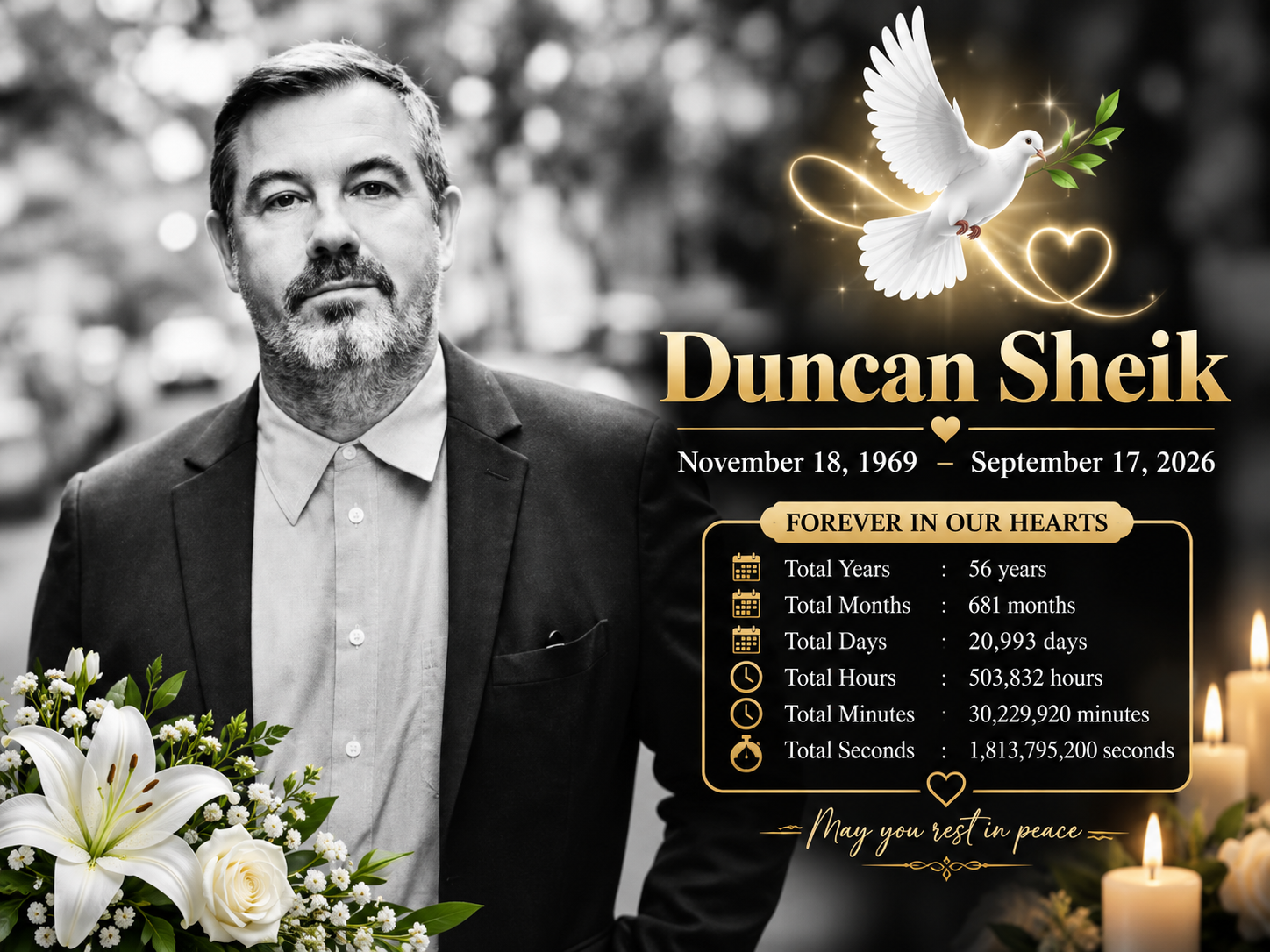
His age at death was 56. His birth date was November 18, 1969. His death date was September 17, 2026. The memorial image’s calculation of 56 years is therefore consistent with the documented dates. Its totals for months, days, hours and seconds are commemorative calculations rather than official biographical measurements and should not be treated as exact historical facts.
The strongest documented achievements remain clear. He had a major 1990s pop hit with “Barely Breathing.” He received a Grammy nomination for that recording. He later composed Spring Awakening with Steven Sater and won two Tony Awards connected to the production. The musical won Best Musical, and its cast album received a Grammy. He subsequently worked on numerous theater projects while continuing to release recorded music. ([The Washington Post][7])
But the most revealing fact about his career may be what happened between those awards. He kept changing. He moved from singer-songwriter to theater composer without abandoning songwriting. He worked on celebrated productions and projects with shorter runs. He experimented with different musical textures. He collaborated with writers, directors, performers and musicians rather than remaining solely inside the identity created by his first hit.
That pattern gives the ending its proper shape. His career was not a straight climb toward one final achievement. It was a sequence of choices, some highly visible and others known mainly within theater and music communities. Each project changed the circumstances of the next one.
The final project waiting for an audience after his death therefore matters not because it can be declared his greatest or most important work, but because it confirms that he was still creating. Memoirs of Amorous Gentlemen was not a memorial project. It was a new musical that had been prepared for performance while he was alive. Its existence records the fact that his creative life had continued into 2026.
The planned Spring Awakening production adds another layer. It returns to the work that transformed his career, but it does so without the composer who first created its score. Future performers will carry the songs forward, just as previous performers did. They will bring their own voices, experiences and interpretations.
That process reaches back to one of Sheik’s own ideas about authorship. Once an artwork has entered the world, its creator cannot completely control what it becomes. After his death, that principle became permanent. He cannot explain a new interpretation, correct a listener’s understanding or revise a future production. The work has entered the hands of everyone who encounters it.
There is no final speech from Duncan Sheik that can neatly close the story. There is no documented final artistic statement that tells audiences exactly how they should remember him. There are recordings, scores, collaborations, awards, performances and the memories of people who knew him.
So the ending remains where the facts place it: Duncan Sheik was born on November 18, 1969, and died in Manhattan on September 17, 2026, at 56. Public reports described his death through organ failure and, in other accounts, cardiac arrest or heart failure leading to cardiac arrest; no more specific underlying cause should be invented. His family, colleagues and audiences were left with the work he had already completed and the productions he had already set in motion. ([Los Angeles Times][6])
The young musician who once became unexpectedly famous for “Barely Breathing” had spent the following decades refusing to let one song define the boundaries of his career. He became a theater composer, a Tony Award winner, an arranger, a collaborator and an artist who continued experimenting with sound. The stages waiting for his music after September 17 could not give him another chapter, but they could give his existing work another life.
And that is where the story finally comes to rest—not with a manufactured final scene, but with the simple fact that Duncan Sheik’s life ended while his music was still moving forward. The man could no longer write another song. The recordings could still play. The actors could still sing. The musicians could still perform. The audience could still listen.
The career had stopped. The work had not.
Click Here to continue read next: PART9: After the funeral notices faded, the unfinished productions became the clearest evidence that Duncan Sheik’s creative life had been moving forward until the very end
Days before new work was supposed to reach New York audiences, Duncan Sheik’s story suddenly ended, leaving behind a career that had begun far from Broadway
Part 8 of 16

