
There is a natural temptation to end the biography of a musician with one image: the singer behind the microphone, the composer at the piano, or the celebrated artist receiving an award. Duncan Sheik’s career resists that kind of single frame. His public identity changed too many times, and the work he left behind exists in too many forms.
The first frame belongs to a young musician whose debut album produced “Barely Breathing.” Released in 1996, the song remained on the Billboard Hot 100 for 55 weeks and earned Sheik a Grammy nomination. The success made him widely known, but it did not establish the boundaries of the career that followed. ([The Washington Post][3])
The second frame belongs to a composer standing behind a Broadway production. Spring Awakening opened in December 2006 after years of development. The musical’s rock score, written by Sheik with lyrics and book by Steven Sater, transformed Wedekind’s historical drama into a contemporary theatrical experience. Its success brought eight Tony Awards in 2007, including Best Musical, with Sheik receiving awards for original score and orchestrations. ([Broadway.com][1])
The third frame belongs to the artist who refused to stop there. He worked on American Psycho, Alice by Heart, The Secret Life of Bees, Whisper House, Because of Winn-Dixie, Bob & Carol & Ted & Alice, Noir and other projects. He continued releasing solo albums, eventually arriving at Claptrap in 2022. His catalog became much larger than the song that first made his name familiar. ([Broadway.com][1])
The fourth frame belongs to the composer still creating in 2026. Memoirs of Amorous Gentlemen was moving toward its first performances, while a new Spring Awakening production was preparing to return to New York. These projects were not retrospective exercises. One was new material; the other was a new interpretation of an older work. ([Broadway.com][1])
The fifth frame is the one that changed everything: September 17, 2026. Sheik died in Manhattan at 56. His family had announced only shortly before that he was receiving medical care and was in critical but stable condition. His death was therefore not the culmination of a long public farewell but the interruption of an active creative life. ([San Francisco Chronicle][5])
The cause of death should be stated carefully because public reports have differed. The Washington Post reported cardiac arrest from information provided by his mother, Suzanne Sheik. Broadway.com, citing The New York Times, reported organ failure. People reported heart failure leading to cardiac arrest. Without a publicly released detailed medical record, those reports should not be expanded into a more specific diagnosis. ([The Washington Post][3])
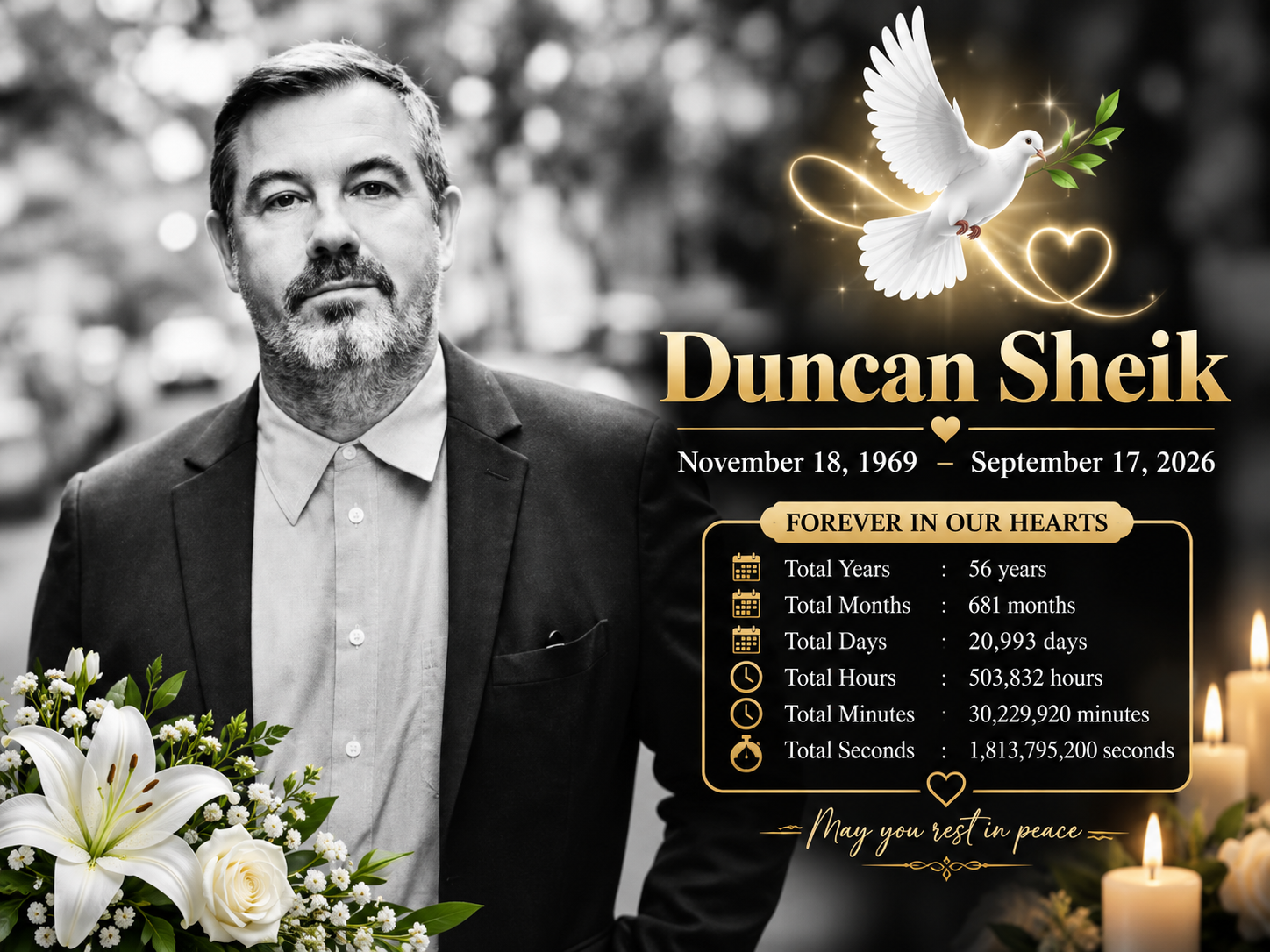
What does not require uncertainty is his age and the basic chronology. He was born on November 18, 1969, and died on September 17, 2026. He was 56. He had spent the final decades of his life moving between recording and theater, with Spring Awakening providing the most prominent connection between those worlds.
The memorial image that accompanies this story calculates his life in years, months, days, hours and seconds. Those figures can be understood as commemorative measurements, but the exact historical record is better anchored by the two dates. The important fact is not a calculated number of seconds. It is the span between the birth of an artist and the end of his life.
That span included a childhood shaped by music. His grandmother, a Juilliard-trained musician, introduced him to piano. He later learned guitar and developed through school and university, studying semiotics at Brown. Those experiences helped form a musician whose interests eventually extended beyond conventional pop songwriting. ([Broadway.com][1])
His education is relevant because it provides context for the later career without requiring a romantic explanation. Studying semiotics did not automatically make him a theater composer. But it placed him in an academic environment concerned with how meaning is created and interpreted. His later work repeatedly involved those questions, particularly when music was used to carry dramatic information.
His personal spiritual practice also became part of his public story. Sheik was a practicing Buddhist and discussed Buddhist ideas when talking about his artistic work. In a 2015 interview, he connected Spring Awakening with the idea that human beings move among different emotional and psychological states. That was his own explanation of an artistic influence, not a definitive explanation of the entire score. ([The Washington Post][3])
His public relationship with fame was similarly documented through interviews. The success of “Barely Breathing” placed him inside a commercial pop environment that he later described as producing personal dissonance. The transition into theater allowed him to approach music through narrative and collaboration rather than celebrity performance alone. ([The Washington Post][3])
That transition became the most consequential decision of his professional life. Spring Awakening gave him a second identity, one that could exist independently of the recording artist image. It also gave performers songs that became part of their own professional histories.
Jonathan Groff, Lea Michele and John Gallagher Jr. were among the performers whose careers were connected to the original production. Later companies inherited the material. The 2015 Deaf West revival brought another physical and linguistic dimension to the musical. The 2026 production would bring still another cast and staging. ([Broadway.com][1])
That repeated reinterpretation is part of the reason his work can continue after his death. A theatrical score is not consumed once. It is performed again, sometimes decades later, by people who have no direct relationship to the original creator.
Studio Seaview’s 2026 production illustrates that process. Its performances are scheduled from November 27 through February 14, with Danya Taymor directing and Celia Rowlson-Hall choreographing. The production is planned as an intimate staging, with accessibility options including audio-described, open-captioned and ASL-interpreted performances. ([Studio Seaview][2])
Memoirs of Amorous Gentlemen illustrates the process from another direction. Instead of reviving an established musical, it introduces a new score to audiences. Sheik’s music and lyrics become part of a production shaped by Winkler, Ashford, Matias and the cast. The first public performances are therefore also the first opportunity for audiences to decide what the new work means to them. ([Studio Seaview][2])
No one can honestly predict how these works will be regarded decades from now. A new production may lead audiences to discover an old score. A lesser-known piece may eventually find a new life. A work celebrated during one period may become less frequently performed. These are decisions made by future artists, institutions and audiences.
That uncertainty should not be mistaken for weakness in the historical record. A biography records what has happened. It does not decide what future generations must value. Sheik’s awards, chart history, albums and theatrical credits are facts. Their future cultural significance belongs to history as it unfolds.
The same principle applies to the question of his greatest accomplishment. “Barely Breathing” was his major commercial breakthrough. Spring Awakening was his major theatrical breakthrough and brought substantial awards. His later projects demonstrate continued experimentation. Different listeners may attach different importance to each part of the catalog, and the evidence does not require one single answer.
What can be said with confidence is that his career crossed boundaries. He was not only a pop singer. He was not only a Broadway composer. He was not only the writer of one famous musical. He worked across forms, and his work changed as the circumstances around him changed.
His family survives him, including Nora Ariffin and their daughter Ines, as well as his parents and half-siblings. The family statement described him as a father, husband, son, brother and friend. Those descriptions are reminders that the public career was only one portion of his existence. ([Just Jared][6])
The private details of his final moments should remain private unless his family chooses to disclose them. There is no need to invent a final conversation, a final musical note or a dramatic farewell. The documented record already provides a complete ending: hospitalization, a critical condition, death on September 17, and the immediate continuation of projects he had helped create. ([San Francisco Chronicle][5])
That ending is also consistent with the way Sheik understood authorship. Once music leaves its creator, it begins a life shaped by other people. Actors interpret it. Musicians perform it. Directors place it in new environments. Audiences attach their own experiences to it.
His death makes that process irreversible. He can no longer revise an old song or explain a new interpretation. But he had already built a career around collaboration, so his work was never dependent upon his physical presence alone.
The next performer who sings one of his songs will bring something Sheik could not have predicted. The next director who stages Spring Awakening will make choices he never made. The next listener who discovers “Barely Breathing” may know nothing about the theater career that followed. Another listener may encounter Spring Awakening first and only later discover the singer who made his name in the 1990s.
Those different entry points are not contradictions. They are different routes into the same body of work.
The final historical facts remain straightforward. Duncan Scott Sheik was born November 18, 1969, in Glen Ridge, New Jersey. He became widely known through “Barely Breathing,” then developed a second major career in musical theater. His collaboration with Steven Sater produced Spring Awakening, which won eight Tony Awards in 2007 and brought Sheik awards for original score and orchestrations. He continued writing for theater and recording music until the final years of his life. ([Broadway.com][1])
He died September 17, 2026, in Manhattan at 56. Public reporting has described the medical cause as organ failure, cardiac arrest, or heart failure leading to cardiac arrest, depending on the source. The family’s public information does not establish a more detailed underlying diagnosis, so the record should stop there. ([Broadway.com][1])
At the time of his death, new work was still waiting. Memoirs of Amorous Gentlemen was scheduled to begin performances on September 25. Spring Awakening was scheduled to return to New York beginning November 27. The calendar had already been arranged before his final illness, and neither production was created as a farewell. ([Broadway.com][1])
That is the true ending of Duncan Sheik’s story: not a final invented speech, not a manufactured prediction about his legacy, and not a claim about which work future audiences must value most.
It is the image of an artist whose life stopped while his music was still moving toward the stage.
The singer could no longer perform another song.
The composer could no longer write another score.
But the songs already written remained.
The musicians could still play them. The actors could still sing them. Directors could still reinterpret them. Audiences could still discover them.
And somewhere between the first quiet notes of “Barely Breathing” and the theatrical worlds he built decades later, the record of Duncan Sheik’s life remains—not as a finished answer to every question, but as the work he left behind when there was no longer time to write another chapter.
The End
Read more original stories on Feel Every Story.
Days before new work was supposed to reach New York audiences, Duncan Sheik’s story suddenly ended, leaving behind a career that had begun far from Broadway
Part 16 of 16

