
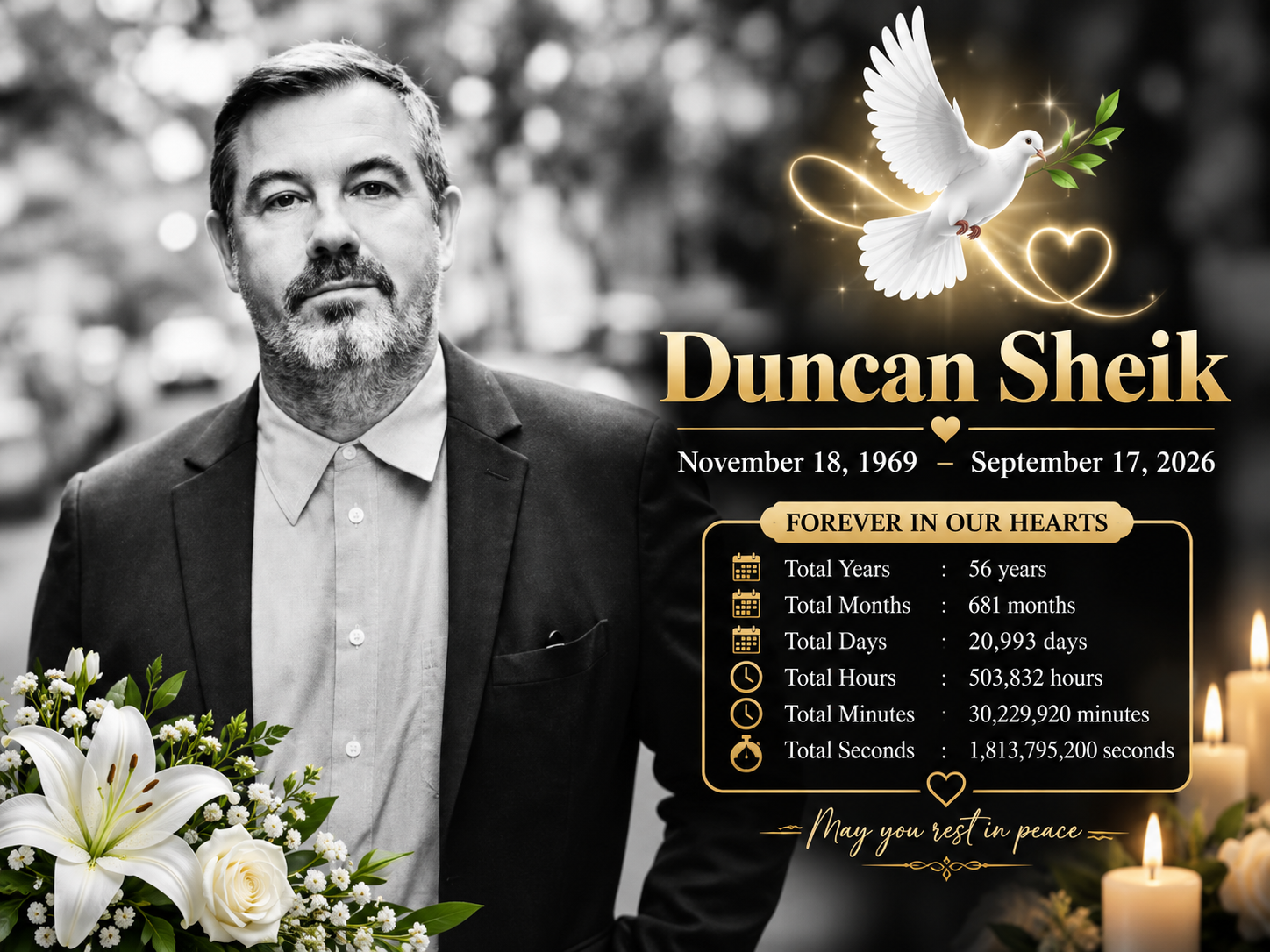
Duncan Sheik’s life cannot be reduced to the dates printed beneath his photograph. November 18, 1969, marks his birth. September 17, 2026, marks his death. Between those dates, however, the shape of his career changed repeatedly. He began as a musician influenced by piano, guitar and alternative music, became an unexpected pop success, and eventually built a second major career as a composer for theater.
The earliest foundation was musical but also academic. His grandmother, who had studied at Juilliard, introduced him to piano. He later learned guitar and played with other young musicians. At Phillips Academy and Brown University, he continued developing his interests, eventually studying semiotics. That academic field concerned signs and meaning, a subject that would sit naturally beside his later interest in songwriting and theatrical storytelling. ([Broadway.com][1])
After graduating from Brown in 1992, Sheik moved to Los Angeles to pursue music professionally. Four years later, his self-titled debut album produced “Barely Breathing.” The song became his breakthrough, staying on the Billboard Hot 100 for 55 weeks and earning a Grammy nomination for Best Male Pop Vocal Performance. It was the moment when a private musician became a public figure whose name was suddenly familiar far beyond the music industry. ([The Washington Post][7])
But the success carried an unexpected consequence. The public had a simple story available: young singer, successful song, new star. Sheik’s own interests were more complicated. He had never been limited to one musical category, and the later career demonstrates that he did not want the 1996 success to become the boundary of his identity.
His move toward theater provided another language for that complexity. With Steven Sater, he developed Spring Awakening, using rock music to give contemporary force to a story originally written by Frank Wedekind in the 19th century. The production reached Broadway in 2006, and its success changed Sheik’s professional identity almost as dramatically as “Barely Breathing” had a decade earlier. ([Broadway.com][1])
The Tony Awards followed in 2007. Spring Awakening won eight, including Best Musical. Sheik received awards for Best Original Score and Best Orchestrations, while the original cast album later won the Grammy for Best Musical Show Album. Those are the clearest formal markers of his theatrical accomplishment. ([Broadway.com][1])
But the awards did not end his search. He continued writing for theater, moving through productions that required different tones and different collaborators. American Psycho, Alice by Heart, The Secret Life of Bees and other projects demonstrate that he did not simply remain attached to the sound that had made Spring Awakening successful.
His recording career continued as well. He released albums after the early 2000s and eventually produced Claptrap in 2022. The later album’s ambient electronic character showed a willingness to move away from the sound of his first record. That willingness to change became one of the clearest recurring features of his professional life. ([Broadway.com][1])
The final phase brought him back into theater with new projects. Memoirs of Amorous Gentlemen represented an entirely new musical, with Sheik writing music and lyrics and Leah Nanako Winkler writing the book. Rob Ashford directed and choreographed, while Or Matias served as musical supervisor. The production was based on Moyoco Anno’s manga and was scheduled for performances beginning September 25, 2026. ([Memoirs of Amorous Gentlemen][2])
The timing transformed the project’s place in his biography. When the production was announced, it was simply a new work. After September 17, it became the newest major piece of Sheik’s catalog to reach audiences without him. That change came from circumstances outside the creative plan.
Spring Awakening faced a similar transition. The 2026 revival was scheduled to begin performances in November at Studio Seaview under the direction of Danya Taymor. The cast was largely younger than 26, creating a new generation’s encounter with material first staged two decades earlier. ([Vanity Fair][4])
The revival therefore connects two moments in Sheik’s history. In 2006, he was establishing himself as a theater composer. In 2026, he was a deceased composer whose work was being handed to performers born after the musical’s original premiere. The score had crossed an entire generation.
That passage of time changes what a revival can mean. The actors are not required to reproduce the original performers. The director is not required to recreate the original staging. The audience is not the same audience. A revival exists because the work can withstand those differences.
Sheik’s contribution to that durability lies in the music itself. The songs are constructed to function dramatically rather than simply as isolated recordings. They can be sung by different performers and still remain part of the same story. Their survival depends on interpretation.
This is also why his final musical matters. Memoirs of Amorous Gentlemen was not a piece preserved from the past. It was a contemporary work whose first public life was beginning after its composer’s death. Its performers became the first people responsible for translating those songs to an audience.
The official production information describes the show as an immersive experience centered on Colette, a character who moves from being observed to becoming an observer and writer of her own story. That subject gives the musical its own dramatic identity. It should not be treated as a coded autobiography of Sheik simply because the production opened after his death. ([Memoirs of Amorous Gentlemen][2])
The responsible way to understand the timing is simpler. Sheik wrote the music and lyrics while alive. The production continued after his death. The audience then encountered the work under new circumstances. No further meaning needs to be invented.
His family’s experience was different. Reports identified his wife or longtime partner Nora Ariffin, their daughter Ines, his parents and half-siblings among his survivors. Public tributes from collaborators emphasized the loss of a colleague and friend as well as a composer. Those personal accounts cannot be expanded beyond what people actually said, but they establish that his death affected a network much larger than the audience that knew him from recordings. ([Broadway.com][1])
His death itself should be recorded with the same precision. Duncan Sheik died on September 17, 2026, in Manhattan, at age 56. Major reports have described the cause as organ failure or cardiac arrest, with some reports specifying heart failure leading to cardiac arrest. Because the published accounts vary in wording, a detailed underlying diagnosis should not be supplied without stronger documentation. ([Los Angeles Times][6])
The public record does establish that he had been receiving medical care shortly before his death. His family announced that he was in critical but stable condition, and his death followed soon afterward. The speed of that progression explains why his final projects remained active even as his health deteriorated. ([EW.com][8])
There was no planned final concert. There was no retirement announcement. There was no completed farewell production created to summarize his career. Instead, his death interrupted work that was already moving toward audiences.
That interruption gives his biography an unresolved quality, but not because the facts are incomplete. The facts are clear about what happened. What remains unknown is what he would have written next.
That is a question no biography can answer. A musician’s future cannot be reconstructed from a finished discography. A composer’s next musical cannot be inferred simply from the style of the previous one. Sheik had spent his career changing direction, so any confident prediction about his next work would be especially artificial.
What can be traced is the pattern of his choices. He repeatedly moved away from being defined by his previous success. After “Barely Breathing,” he did not spend his career making copies of that song. After Spring Awakening, he did not spend the rest of his life recreating that musical. He kept entering unfamiliar material.
The result was a body of work with several distinct identities. There is the singer-songwriter whose voice remains attached to a famous 1996 recording. There is the theater composer whose score helped Spring Awakening win eight Tony Awards. There is the later composer who worked on projects with different writers, directors and performers. There is the musician who released Claptrap in 2022 and continued developing theater until the final months of his life.
None of these identities needs to be declared the “real” Duncan Sheik. They are all documented parts of his career. The changes between them are what make the biography coherent.
The photograph used for the memorial emphasizes the individual face, but the career extends far beyond the person visible in it. The music exists in recordings. The theatrical scores exist in scripts and orchestrations. The productions exist in memories, cast recordings and revivals. The collaborators carry their own recollections.
That is why the final image is not necessarily one of disappearance. It is an image of separation. The person is gone, but the work has moved into places he can no longer control.
The first audience for Memoirs of Amorous Gentlemen would hear songs written by a composer who had died days before their performance. The new Spring Awakening company would sing a score written twenty years earlier by a man who would never hear their interpretation. Listeners could still play “Barely Breathing.” Future theaters could still discover other works.
The career therefore ends without pretending that every question has an answer. We know when Duncan Sheik was born. We know when he died. We know the major achievements that marked his public life. We know the productions already scheduled at the time of his death. We know that his final years were still creatively active.
We do not know what his next album would have sounded like. We do not know what future musicals he might have written. We do not know how he would have responded to every new production of Spring Awakening. Those unknowns should remain unknown rather than being filled with imagined scenes or invented final words.
What remains is enough for a complete record. Duncan Sheik was born November 18, 1969, in New Jersey. He became nationally known through “Barely Breathing” in 1996. He later transformed his career through Spring Awakening, winning Tony Awards for original score and orchestrations and sharing a Grammy for the original cast album. He continued creating music for theater and recording through the following decades. ([Broadway.com][1])
He died September 17, 2026, in Manhattan, at 56. His reported cause was organ failure or cardiac arrest depending on the source’s wording, with family reports providing the basis for the major accounts. He was survived by his family, including Nora Ariffin and their daughter Ines. ([Los Angeles Times][6])
And his work was still moving. Memoirs of Amorous Gentlemen had performances scheduled beginning September 25. Spring Awakening was preparing for another New York production later in the year. His recordings remained available. His theatrical catalog remained open to future interpretation. ([Memoirs of Amorous Gentlemen][2])
The final outcome is therefore not a single sentence about how he should be remembered. It is the documented record of what he created and the fact that other people continue to encounter it. His life ended, but the works already released into the world entered the ordinary process of being performed, recorded, interpreted and remembered by others.
The boy who learned piano from his grandmother became the singer of a major 1990s hit. The singer became a theater composer. The theater composer became a Tony Award winner. The Tony winner continued experimenting rather than stopping at his greatest success. And the composer died while new music was still waiting for its first audiences.
There is no need to manufacture a final speech to make that ending meaningful. The timeline itself provides the conclusion. Duncan Sheik’s last chapter was not written as a farewell. It was interrupted.
What came afterward belonged to the music.
Click Here to continue read next: PART13: The city that had once heard Duncan Sheik’s first hit was preparing to hear his newest music without him, and the difference was impossible to ignore
Days before new work was supposed to reach New York audiences, Duncan Sheik’s story suddenly ended, leaving behind a career that had begun far from Broadway
Part 12 of 16

