
By the time February arrived, the snow around Birch Lake had begun to soften at the edges. The days were growing longer, although the mornings remained bitterly cold. I spent more time at the cabin again, clearing the porch steps and checking the outdoor faucets whenever the temperature rose enough to make thawing possible.
I also began planning a small gathering for the end of winter. I wanted to invite Brian, Tanya, the girls, and Mrs. Ellis for a final meal before the roads became muddy and the cabin entered its quieter spring season. The invitation was not a reward for their apologies, nor was it a test designed to catch them making another mistake. I simply wanted to share the place I loved with people I loved.
I chose a Saturday when the forecast promised clear skies and sent everyone a message with the time. I explained that lunch would be served at noon and that we would need to finish by late afternoon. Brian replied that they would be there. Tanya asked whether she could bring dessert, and I told her that would be fine.
The exchange was ordinary, which was precisely what I wanted.
On the morning of the gathering, I woke early and drove to the cabin. The lake was covered in a thin layer of ice, but dark water had begun appearing near the far shore. The cedar porch was dry beneath the pale sun. I brushed away the last of the snow, set the chairs around the small table, and carried the old wooden box from the cabinet to the shelf beside the window.
Walt's letter remained inside it. I did not intend to read it during lunch, but I wanted it close. It had become a quiet reminder of the reason I had bought the cabin and the kind of life I was trying to protect.
I prepared a roast, vegetables, and a simple apple dessert. As the food cooked, I opened the windows briefly to let the kitchen air circulate, then shut them when the cold became uncomfortable. I set the table with the dishes I had saved from our old home, including the blue-rimmed plates Walt had always insisted were too delicate for everyday use.
When the family arrived, Brian parked in the driveway and helped the girls out of the car. Tanya carried a covered dish, while Mrs. Ellis brought a small bouquet of flowers wrapped in brown paper. They all approached the front door together, but Brian stopped on the porch and waited for me to open it.
I noticed the pause.
“Come in,” I said.
He smiled. “Thank you.”
It was a tiny exchange, so ordinary that nobody else seemed to notice. But I felt its significance. The door was mine to open, and he had waited.
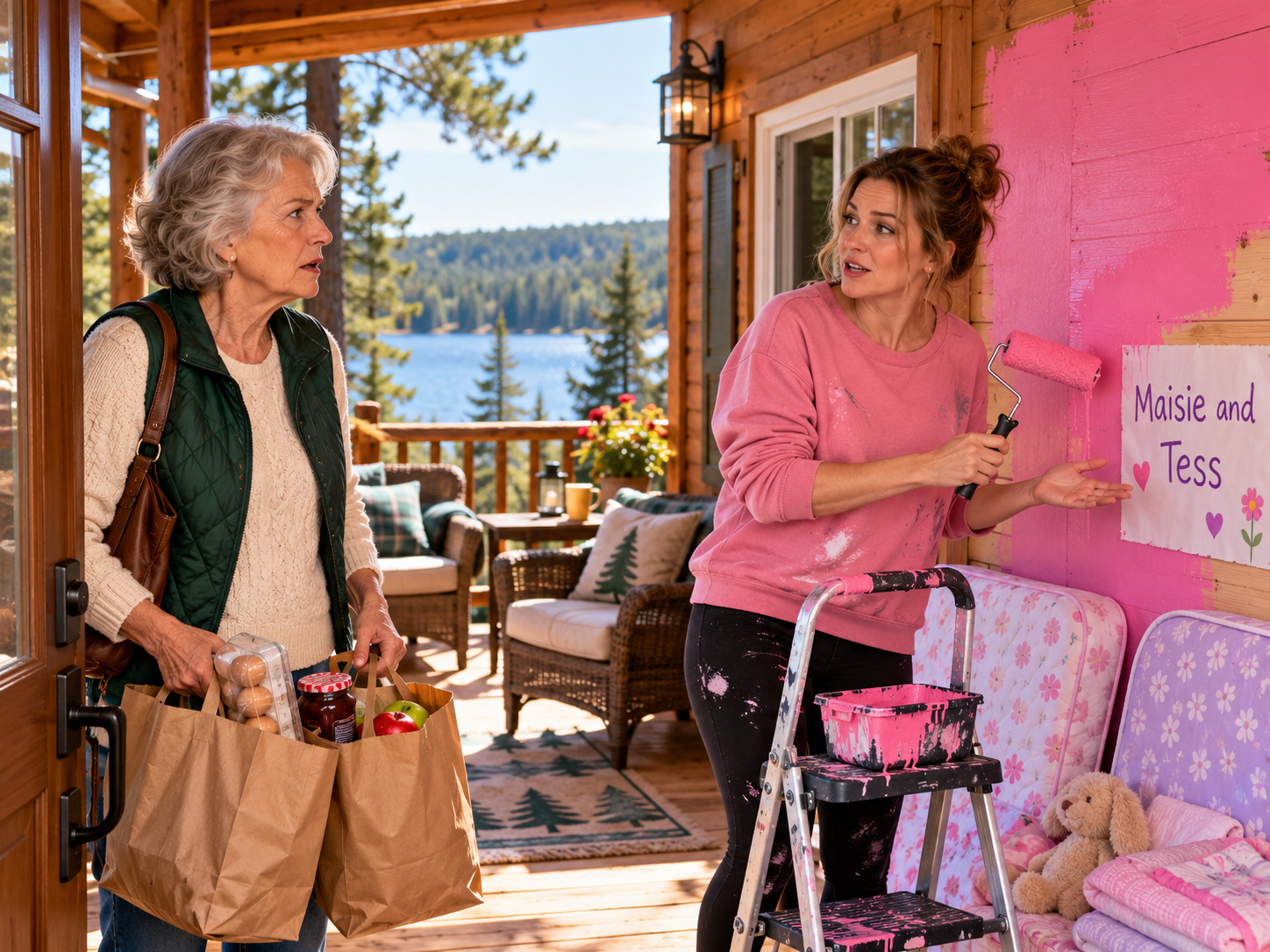
The girls hugged me and hurried inside to show me a new drawing they had made together. It showed the cabin beside the lake, with the porch drawn in brown and the roof covered in white snow. Four people stood outside. This time, Maisie had written Grandma's Cabin at the top and added a smaller line beneath it: Grandma lets us visit.
I read the words twice.
“That's right,” I told her. “And I love having you here.”
Tess pointed at the picture. “Daddy said we have to ask before we use other people's things.”
Brian, standing behind her, gave a small, embarrassed smile.
“He's learning too,” I said.
We spent the first hour talking about school, the girls' activities, and the changes in the weather. Mrs. Ellis told me about a community class she had joined, and Tanya described a project she was working on at her job. Brian mentioned that their household budget had become easier to manage since they started reviewing it every month.
He did not present the improvement as a victory or ask me to praise him. He simply described what they had changed and what they still needed to work on.
After lunch, the girls asked whether they could go down to the shore. I gave them their jackets and told Brian to keep them away from the sections where the ice was beginning to melt. He went with them while Tanya helped me clear the dishes.
When we were alone in the kitchen, she looked toward the porch.
“I'm glad you kept the cedar,” she said.
“So am I.”
“I've thought about that first day more than I want to admit. I remember standing on the stool, looking at the wall, and feeling certain that I was doing something good for the girls. I didn't stop to ask whether I had the right to do it.”
I rinsed a plate and placed it in the rack.
“You were thinking about what you wanted to happen.”
“Yes. And I convinced myself that because it was for the family, it couldn't really be wrong.”
I turned off the tap.
“Good intentions don't give us permission to make decisions for other people.”
“I understand that now.”
She looked uncomfortable, but she did not turn away from the subject.
“I also know that apologizing doesn't mean you have to trust me immediately. I don't expect you to forget what happened.”
“I'm glad you understand that.”
She dried her hands and folded the towel neatly over the oven handle.
“I hope one day you won't feel you have to check every lock because we're coming to visit.”
I considered the question before answering.
“I don't check the locks because you're visiting. I check them because they're part of taking care of my home. I want to be able to welcome you without giving up the things that make me feel safe.”
Tanya nodded slowly.
“That makes sense.”
I did not tell her that trust would return completely or that I would never again remember the pink wall when I saw her approaching the cabin. I could not promise either thing. What I could do was acknowledge that she was trying to understand the difference between being welcome and being entitled.
When Brian returned with the girls, he carried a small bag of smooth stones they had collected along the shore. He asked where I wanted them placed.
“On the porch table for now,” I said. “I'll decide later what to do with them.”
He set the bag down without opening it.
The family spent the next hour outside, enjoying the weak winter sunlight. The girls arranged the stones into a pattern and argued over which ones were most beautiful. Mrs. Ellis sat in one of the chairs with a blanket across her knees, and Tanya took photographs of the lake. Brian helped me bring the remaining dishes to the kitchen, then asked whether I wanted him to take the rubbish to the bin.
I said yes.
When he returned, he stood beside the front door for a moment.
“Mom, could I ask you something?”
I felt the old instinct to prepare for a request. Then I reminded myself that asking was not the same as taking.
“Of course.”
“Would you ever consider letting me keep a spare key for emergencies? Not now, and not because I expect to come here whenever I want. I just wondered whether that might be something you'd feel comfortable with eventually.”
I looked at him. He seemed nervous, but he was not pressuring me. He had asked a question and left room for an answer he might not like.
“I'm not ready to give you a key,” I said. “If there's an emergency, you can call me, and we can decide what to do. If I ever change my mind, I'll tell you.”
He nodded.
“Okay.”
“You're not angry?”
“No. I asked because I wanted to know. I understand that it's your decision.”
I felt something loosen inside me. Not because he had asked for a key, but because he had accepted the answer without treating it as a rejection of our relationship.
“Thank you for understanding,” I said.
He glanced toward the girls, who were now trying to balance a stone on top of a small pile.
“I think I used to believe that if you loved me, you would trust me with whatever I asked for,” he said. “I didn't understand that trust has to do with what I do, not just who I am.”
“That is an important distinction.”
“I wish I'd understood it sooner.”
“So do I.”
He smiled faintly. “I'm working on it.”
“I can see that.”
When it was time for the family to leave, the girls hugged me and asked when they could visit again. I told them I would check my calendar and call their father during the week. They accepted the answer and climbed into the car without protest.
Tanya thanked me for lunch and said she would send me the photographs she had taken. Mrs. Ellis hugged me gently and wished me a peaceful spring. Brian remained on the porch after the others had gone to the car.
“I'm glad you invited us,” he said.
“So am I.”
“I know I can't undo what happened.”
“No, you can't.”
“But I can keep trying to do better.”
“Yes,” I said. “You can.”
He leaned forward and hugged me. This time, there was no hesitation, but there was also no assumption that the embrace settled everything between us. It was simply a hug between a mother and her son, offered and accepted freely.
I watched the car disappear down the road. Then I went inside, locked the door, and put the leftover food away. The cabin was quiet, but the silence felt comfortable. The gathering had not required me to surrender anything. I had shared my home on my terms, and my family had respected those terms.
That evening, I opened the wooden box and took out Walt's letter. I sat at the kitchen table and read it one last time before putting it back in its envelope.
The words about kindness and boundaries had become more meaningful with every passing month. I had once believed that protecting my peace meant choosing between my home and my family. Now I understood that the real choice was whether I would continue living according to other people's expectations or finally allow myself to have a life of my own.
I had chosen the cabin because Walt and I had dreamed of mornings beside the water. I had kept it because it represented years of work, sacrifice, and a promise I had made to myself after his death. The pink paint had threatened to turn that promise into another obligation. The copied key had shown me how easily love could be used to excuse an intrusion. The recordings had forced me to acknowledge that my son had continued making plans after I had clearly refused.
Those facts did not disappear because Brian had apologized. They became part of the history we would have to remember if we wanted our relationship to be different.
But there were other facts now, too. Brian had begun asking rather than assuming. Tanya had acknowledged her responsibility. The girls were learning that a loving invitation was not the same as a permanent claim. And I had learned that saying no did not mean I had stopped being a mother.
I walked to the porch and sat in my chair. The lake was darkening, the last sunlight stretching across the ice. I rested my hands on the arms of the chair and listened to the soft movement of the screen in the breeze.
I thought of Walt sitting beside me in the life we had once imagined. I could almost picture him looking at the cedar wall, inspecting the repaired boards, and telling me that the porch had turned out well enough after all.
I smiled at the thought.
The cabin had not solved every problem in my family. It had not made anyone perfect or erased the hurt that had come before. It had given me a place to recognize what I needed and the courage to protect it.
I would continue to invite my family when I wanted their company. I would continue to help when I could do so freely. I would listen to Brian's troubles without taking responsibility for every outcome, and I would love my granddaughters without allowing anyone to use that love as a reason to decide how I should live.
The locks would remain. The cameras would remain. The key would stay in my pocket, and the choice about who entered my home would remain mine.
As the first stars appeared above Birch Lake, I went inside and turned on the kitchen light. The cedar porch glowed warmly through the window, its natural color restored, with only faint traces of the old damage visible if I looked closely.
I no longer needed the wall to be perfect.
I needed to remember that it was mine to care for, mine to repair, and mine to share when I chose.
That was the peace I had worked thirty-five years of night shifts to earn. It was the promise Walt and I had carried through all the years when our dream seemed too expensive, too distant, or too easily postponed.
And now, at sixty-seven, I was finally living it.
Click here to continue reading: PART 13: The First Time My Family Returned to the Cabin Without Asking for Anything, I Began to Understand How Slowly Trust Could Grow Back
I Bought the Cabin for Peace, but My Daughter-in-Law Had Already Decided Which Parts of My Life She Could Take
Part 12 of 20

