
The letter was inside a wooden box I had not opened since the move.
I found it on a rainy afternoon while searching through a cabinet for the warranty papers from the porch restoration. The box had belonged to Walt. It was made of dark oak, with a brass latch and a shallow scratch across the lid where he had once dropped a screwdriver. Inside were old receipts, folded maps, a few photographs, and envelopes containing papers from the years when we were still planning the retirement we never quite managed to share.
I almost put the box back.
Then I saw my name written on a small envelope in Walt's careful handwriting.
Dorothy.
There was no date on the outside. I sat at the kitchen table before opening it, smoothing the paper with the side of my hand. The letter was only two pages long, written in blue ink on the stationery we had kept in the desk drawer for birthdays and thank-you notes.
My dearest Dorothy,
If you're reading this, you have probably found one of the boxes I never finished sorting. I kept meaning to go through them, but there was always something else to do. I suppose that is how a person can spend a lifetime preparing for a quieter day and never quite reach it.
I smiled at that line. Walt had been good at finding humor in our habits, especially the way I would put off a rest day because there was always another errand to run.
He wrote about the cabin we had once imagined buying. We had looked at photographs of lake houses while sitting on the couch after my night shifts. Some had large windows and wide decks. Others were simple places with screened porches and little kitchens. We had never chosen a property because our savings had to cover more urgent things.
He had kept a brochure from one of those searches, folded in half and tucked beneath the letter.
I remembered it immediately. The brochure showed a small cedar cabin with two bedrooms, a loft, and a porch overlooking a lake. It was not the cabin I eventually bought, but it had the same feeling of quiet. Walt had circled the porch in blue ink and written, Morning coffee here.
The letter continued.
I know how much you have given to our family. You have given your time, your sleep, your patience, and more money than you ever wanted to discuss. You do it because you love people, and because when someone you love is in trouble, you cannot bear to stand by without trying to help.
But I hope you remember that helping someone is not the same as living their life for them. You cannot take every difficult thing away from the people you love. Sometimes they need to find their own way through it. Sometimes they will be angry when you let them.
That does not mean you have failed them.
I read the paragraph twice.
For years, I had treated my ability to help as a responsibility. When Brian struggled, I would imagine what might happen if I refused. Would he fall behind on the mortgage? Would the girls go without something they needed? Would he feel abandoned? I had often answered those fears by offering money or time before he had fully explained the problem.
Walt had seen that tendency in me long before the cabin existed.
The letter went on.
If we ever get our place by the water, I want you to enjoy it. I don't want you spending every morning worrying about who might need something from you. I want you to drink your coffee while it's hot. I want you to read a book without stopping every ten minutes to check the clock. And if someone asks you for more than you can give, I hope you will remember that a kind answer can still be a firm one.
You do not have to become hard to protect your peace. You only have to remember that your life belongs to you, too.
I reached the end of the page and realized I was crying.
It was not the kind of grief that arrived like a storm. It was quieter, a pressure behind my eyes and a tightness in my throat. I had missed Walt in thousands of small ways since his death: when I cooked too much food, when I heard a joke he would have liked, when I woke before dawn and found the other side of the bed empty.
This was different. I felt as though I had stumbled upon a conversation we had never finished.
I folded the letter carefully and held it against my palm.
Walt had not known about the cabin I would eventually buy. He had not known that Brian would one day try to move his family into it without my permission. Yet the words seemed to reach directly into the conflict that had consumed me for weeks.
I had spent so much energy trying to understand how my son could love me and still treat my choices as obstacles. I had asked whether I had spoiled him by helping too much, whether I had been selfish to want a home of my own, and whether protecting the cabin would cost me the closeness I wanted with my family.
Walt's letter did not answer every question. It reminded me that love did not require me to give away the life I had worked for.
I carried the letter to the porch and sat in the chair beside the window. The restored cedar smelled faintly of the protective treatment the carpenter had applied. Outside, rain moved across Birch Lake in fine gray lines, and droplets tapped against the screen.
I read the letter again, more slowly this time.
When I finished, I put it in the wooden box and returned the box to the cabinet. I would keep the letter at the cabin, where I could read it whenever I needed to remember why I had bought the place.
The next morning, I called Brian.
He answered while driving to work, so I asked him to call me back when he had time to talk. He returned the call that evening.
“Is everything all right?” he asked.
“Yes. I found something of your father's.”
I told him about the box and the letter. I read him a few lines, including the passage about helping someone without living their life for them. I expected him to become defensive, but he listened quietly.
When I finished, he said, “That sounds like Dad.”
“It does.”
“He always knew how to say something that made you think he was joking until you realized he meant it.”
I laughed softly. “He did.”
We talked about Walt for nearly an hour. Brian remembered how his father used to sit on the back steps and repair broken toys rather than throw them away. He remembered a camping trip when Walt had insisted that the family could navigate by the stars, then admitted the next morning that he had been looking at the wrong constellation.
For a while, we were simply a mother and son remembering the man we had both loved.
Near the end of the call, Brian grew quiet.
“Mom, I think I understand why you needed the cabin so much,” he said.
I did not answer immediately.
“I knew you'd worked hard,” he continued. “I knew you wanted to retire somewhere quiet. But I think I saw the cabin as a solution to our problems before I really thought about what it meant to you.”
“What do you think it meant to me?”
“A place where you didn't have to keep fixing things for everyone else.”
I looked through the window at the lake. “That's part of it.”
“I should have listened when you told me no.”
“Yes.”
“I can't change what I did. I can try not to repeat it.”
“That is what matters now.”
He did not ask whether he could have a key. He did not ask whether I would ever let them move in. He simply said he was sorry again and asked whether I would like to have dinner with him and the girls the following week.
I agreed.
Over the next month, our relationship continued in small, ordinary ways. Brian called to tell me about the girls' school projects. Tanya sent a photograph of a cake Maisie had decorated with far more frosting than the recipe required. I invited the family to the cabin one Saturday, and they arrived with lunch and left everything in its proper place.
The girls learned that they could visit the porch, look at the lake, and play outside, but they could not assume that every visit meant another one had already been promised. They began asking when they wanted to come back. Sometimes I said yes. Sometimes I suggested a different day. When I said I had plans, they accepted the answer more easily than the adults had at first.
I tried to model the same respect. I did not question Brian about every financial decision, and I did not offer advice unless he asked for it. When he mentioned a problem, I listened before suggesting a solution. If he wanted help finding information, I helped. If he wanted to make his own decision, I let him.
The difference felt strange at first. I had spent so many years anticipating the next thing he might need that allowing him to manage his own life sometimes felt like neglect. I had to remind myself that he was a grown man with a family of his own. My job was not to prevent him from ever struggling. It was to love him without making his choices for him.
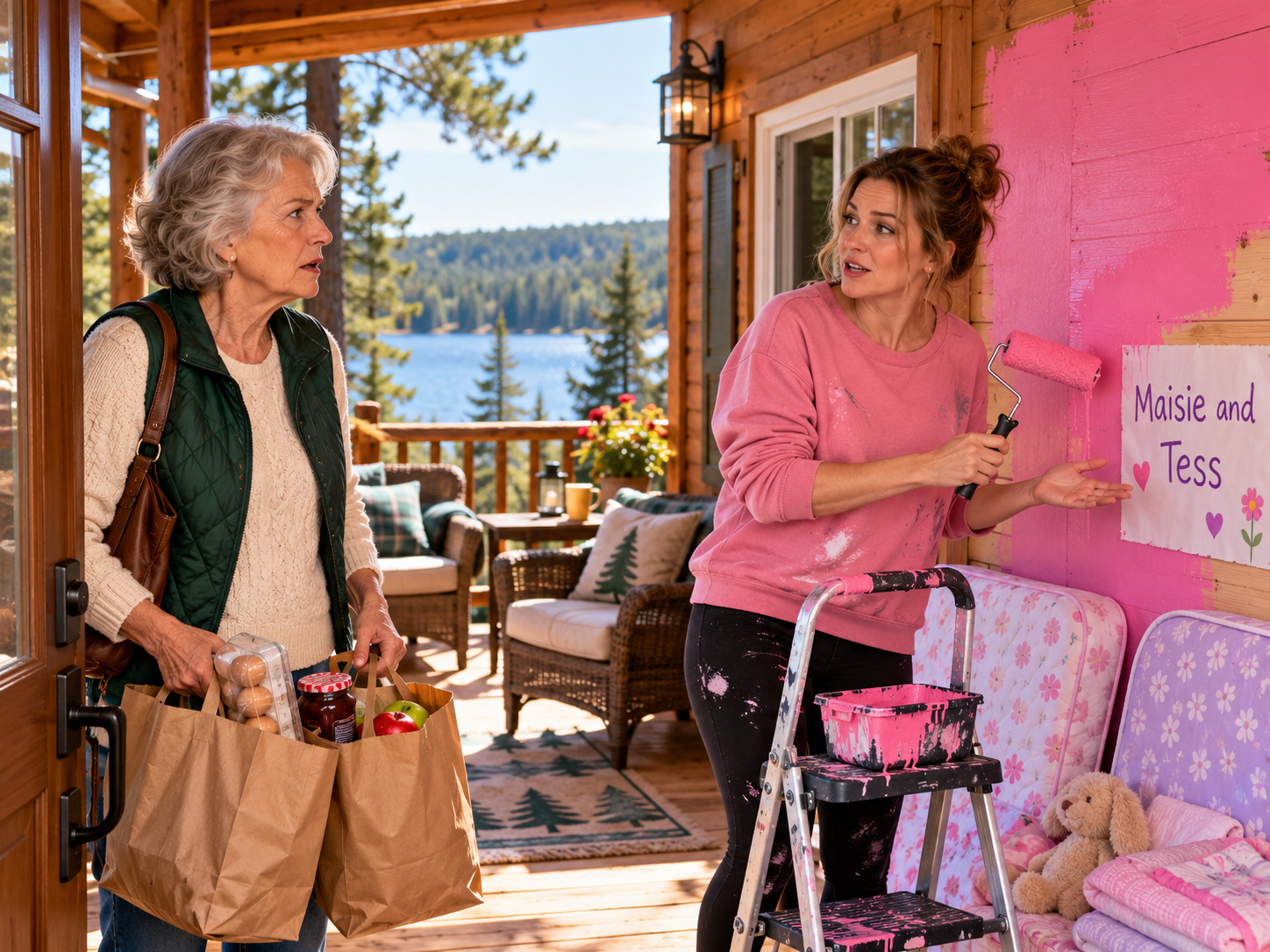
Tanya and I became more comfortable with one another, though we were not suddenly close. We could talk about the girls, share a meal, and discuss ordinary matters without the cabin dominating every conversation. The memory of the pink wall remained between us, but it no longer had to control every interaction.
One afternoon, she stood with me at the kitchen counter while the girls played outside.
“I've been thinking about something,” she said.
I turned from the sink.
“Go ahead.”
“When we first came here, I thought that because you had more space than you needed, it was selfish to keep it for yourself. I didn't think of it as your retirement. I thought of it as a house that could solve our problems.”
“That was how it felt to me.”
“I know. I think I was so worried about our family that I stopped seeing you as someone who had her own family needs.”
I dried my hands on a towel.
“I have always wanted you and the girls to have a good life. That hasn't changed.”
“I know that now.”
She glanced toward the porch, where the cedar wall glowed in the afternoon light.
“I won't ever paint anything here again without asking,” she said.
I smiled slightly. “That would be wise.”
She laughed, and the tension eased.
Later, I found Brian sitting on the porch steps while the girls collected leaves for a school project. He had brought a small packet of screws and a screwdriver.
“What are those for?” I asked.
“The handrail you mentioned. I thought I could tighten the loose bracket while we're here, if you want me to.”
I looked at the steps. The bracket had loosened slightly over the summer, and I had planned to call a handyman.
“You can take a look,” I said. “If it needs more than tightening, stop and tell me before doing anything else.”
He nodded and got to work.
It was a small task, but I watched him carefully. He examined the bracket, tightened the screws, and tested the rail with his hand. When he finished, he showed me what he had done and asked whether it felt secure.
“It does,” I said. “Thank you.”
He packed the screwdriver away.
“I'm glad I can help,” he said.
There was no suggestion that the work entitled him to anything. No implication that fixing a bracket meant he could decide what else needed changing. He had asked, completed the task, and left the decision about the result with me.
I realized that this was what I had wanted all along. Not distance from my family, not punishment, and not a life in which I never helped anyone again. I wanted to be able to offer love freely, without having it turned into an obligation. I wanted to share my home without losing control of it. I wanted Brian to understand that I could say no and still love him just as much.
That evening, I placed Walt's letter in a small folder and set it on the shelf beside the old coffee mug. I would keep both at the cabin. One reminded me of the years we had spent dreaming about a quieter life. The other reminded me that I was finally living it.
I sat on the porch after my family had driven away. The sky was clear, the lake reflected the first stars, and the repaired handrail felt solid beneath my palm.
The cabin had not made me less generous. It had taught me that generosity meant more when it was chosen freely. My son had not become perfect, and neither had I. We still had habits to unlearn, conversations to have, and trust to rebuild.
But I no longer felt that preserving my peace required me to abandon my family.
I could keep the porch, keep the keys, and keep the life I had worked for. I could welcome Brian, Tanya, Maisie, and Tess when I wanted to see them. I could forgive without pretending the past had not happened, and I could hope for a better future without handing over control of it.
I lifted my coffee mug and watched the moonlight spread across Birch Lake.
For the first time, I understood that the home Walt and I had dreamed about was never meant to be a place where nobody needed me. It was meant to be a place where I could decide, without fear or guilt, what I had to give.
Click here to continue reading: PART 9: The Quiet Life I Had Fought to Protect Began to Change When Brian Asked Me to Trust Him With Something Important
I Bought the Cabin for Peace, but My Daughter-in-Law Had Already Decided Which Parts of My Life She Could Take
Part 8 of 20

