
Tanya did not contact me directly for nearly a month after the first family visit. I heard about her through Brian, mostly in passing. He said the girls were doing well at school and that they had started a new activity on Saturday mornings. He mentioned that he and Tanya were reviewing their household expenses and looking for ways to reduce their monthly payments.
He did not ask me to contribute money. That absence was so unusual that I noticed it immediately.
I wondered whether he had finally understood that I could offer help without becoming responsible for every difficulty in his household. I also wondered whether he was simply waiting for a better moment to ask. Both possibilities seemed reasonable, and I decided not to turn uncertainty into suspicion.
I had enough to occupy me. I arranged for a few loose porch boards to be secured, planted small pots of herbs near the kitchen window, and bought a comfortable outdoor rug that did not cover the cedar floor. I wanted the cabin to feel like mine again, not because I needed to erase every trace of what had happened, but because I wanted to make new memories there.
One afternoon, while I was pruning a small shrub beside the steps, Brian called.
“Tanya wants to ask you something,” he said.
I stopped with the pruning shears in my hand.
“What does she want?”
“She'd like to apologize in person.”
I looked at the shrub, where one branch had grown too close to the walkway. I clipped it carefully and set the shears down.
“Why now?”
“She's been thinking about what happened. I think she understands how serious it was.”
“Does she understand what she did, or does she want me to tell her everything is fine?”
“I can't answer that for her.”
That was a better answer than I expected.
“Did she ask you to arrange this?”
“Yes. She was nervous about calling you directly.”
I leaned against the porch railing. “I am willing to listen. I am not promising that we will settle everything in one conversation.”
“I'll tell her.”
“And Brian?”
“Yeah?”
“Don't turn this into a promise that I'll forgive her. Let her speak for herself.”
He agreed.
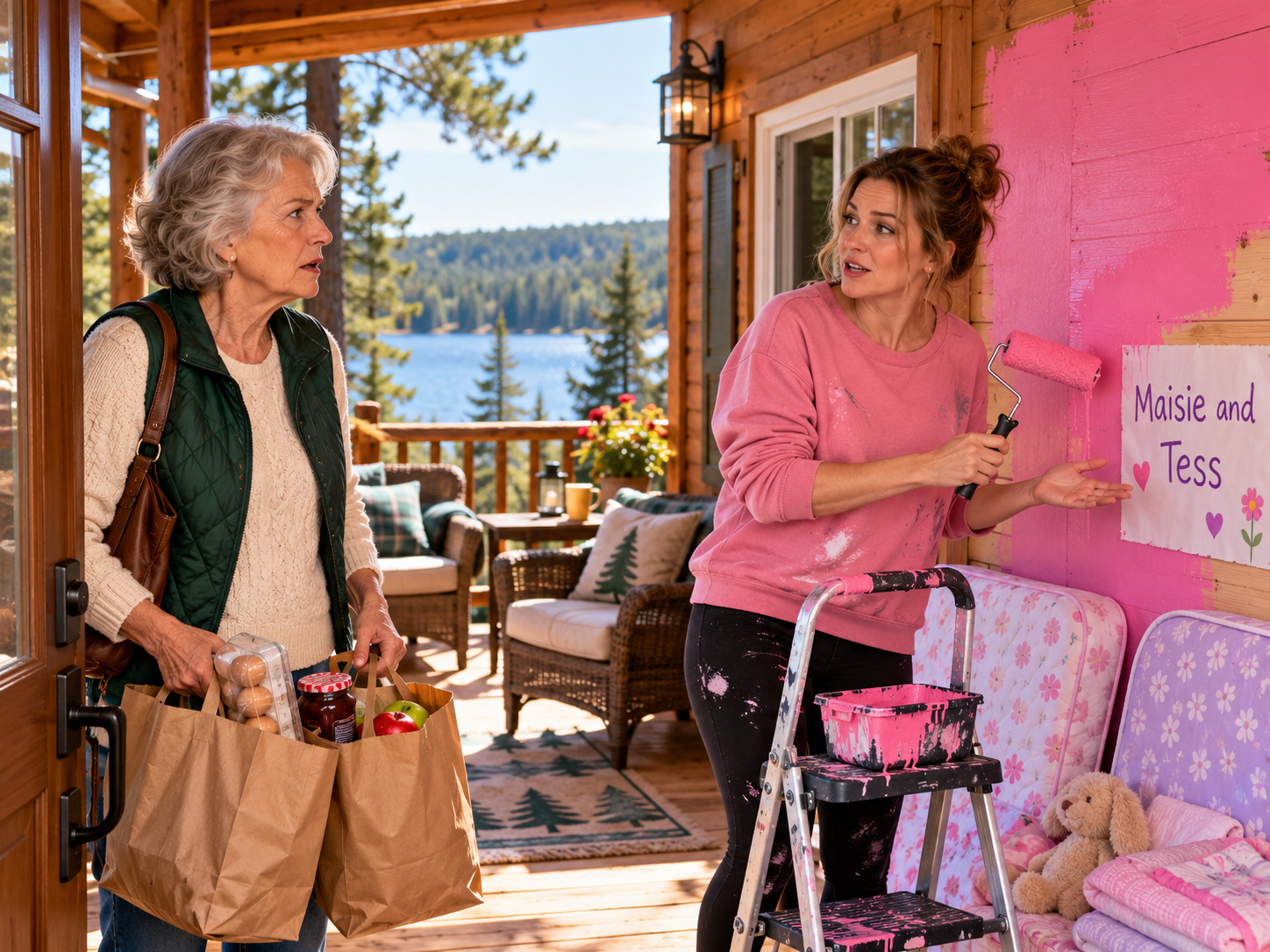
Two days later, Tanya called. Her voice was quieter than I remembered, stripped of the breezy confidence she had used when she stood beside the pink wall and told me the loft would be perfect for one person.
“Dorothy, thank you for agreeing to talk to me.”
“You're welcome.”
“I know I should have called sooner.”
I waited.
She took a breath. “I want to say I'm sorry for entering your cabin and painting the porch without permission. I shouldn't have done either thing. I shouldn't have accepted Brian's explanation that you would agree later.”
I felt my shoulders relax slightly, although I kept my hands folded on the table.
“Why did you believe you could do that?” I asked.
She was silent for a moment.
“I think I was desperate for a solution. We were running out of room, and I was frightened about money. My mother needed somewhere to stay, the girls were sharing a bedroom, and every month seemed harder than the last. Brian told me the cabin had space. I convinced myself that if we started preparing it, you would see how much sense it made.”
“You knew I had already said no.”
“Yes.”
“Then you weren't preparing a room for the girls. You were trying to make my decision for me.”
Her voice faltered. “I know that now.”
I looked through the kitchen window at the lake. A pair of ducks moved across the water, leaving faint lines behind them.
“Why did you paint the porch?”
“The girls wanted a room that felt like theirs. I thought pink would make it cheerful. I didn't stop to consider that the cedar mattered to you.”
“The color wasn't the main problem.”
“I understand.”
“Do you? Because you could have painted the entire cabin white, and it still would have been wrong if you had done it without permission.”
“I know.” She paused. “I think I was acting as though the house was already ours. Brian had talked about the move for so long that I started imagining where everything would go. I treated your refusal like a delay instead of an answer.”
There was something painfully familiar about that description. It matched what I had seen in Brian: the belief that a clear no might be overcome with enough planning, enough pressure, or enough evidence that the other person should agree.
“What about the key?” I asked.
“I knew Brian had copied it. I didn't ask how he did it because I didn't want to think about whether it was wrong. I told myself he was your son and you wouldn't really mind.”
“But you knew I hadn't given you permission.”
“Yes.”
I appreciated that she did not try to make the answer sound better than it was.
We spoke for nearly half an hour. Tanya admitted that she had been embarrassed when I asked her to leave, and that her first reaction had been to blame me for humiliating her. She said she had complained to friends that I was being selfish, then felt ashamed when she realized she had never told them the full story.
“I kept saying we needed help,” she told me. “I didn't want to admit that I had decided what kind of help you were supposed to give us.”
I listened without interrupting. I did not tell her that I understood everything or that she had been under too much pressure to think clearly. She was allowed to explain what had driven her choices. I was allowed to remember what those choices had cost me.
At last, she asked, “Do you think we can get past this?”
“I think we can build something better than what we had,” I said. “But I can't promise how quickly that will happen.”
“I understand.”
“And if you visit the cabin again, you need to remember that it belongs to me. You don't rearrange things, change the property, or bring anyone without asking.”
“I won't.”
“I'm serious, Tanya. I need to know that I can invite you into my home without wondering whether you'll take the invitation as permission to make other plans.”
“I understand,” she repeated, and this time the words sounded less like a way to end the conversation.
When we hung up, I sat for a long time without moving. I had expected the call to leave me angry or relieved. Instead, I felt tired, as though I had been carrying something heavy and had finally set it down without knowing whether I would need to pick it up again.
An apology did not make the memory disappear. I could still picture the roller in Tanya's hand and the mattresses stacked in the corner. I could still hear her explaining that the loft was suitable for one person, as if my age and retirement made me a guest in a home I had purchased myself.
But she had acknowledged the choices she made. She had not demanded that I forget them. That mattered.
I called Karen to ask whether she thought I should remove the cameras now that the family was communicating more calmly. She reminded me that the cameras were ordinary security equipment and that I had no obligation to remove them to reassure anyone.
“You can decide based on what makes you comfortable,” she said. “You don't have to use them to monitor your family, and you don't have to take them down to prove you trust them.”
I thanked her. That distinction helped me see the cameras differently. They were not a punishment. They were a practical part of protecting a property that had already been entered without permission.
A week later, Tanya sent me a message asking whether she could bring the girls to the cabin for a short visit. She wrote that she would not bring anything except their swimsuits and a bag of snacks, and that she would leave whenever I wanted.
I appreciated the specificity. She was not asking me to agree to an open-ended arrangement. She was asking about one afternoon.
I replied that Saturday would work if the weather held.
When they arrived, Tanya stayed near the car while the girls ran to greet me. She waited until they had finished hugging me before approaching the porch.
“Would it be all right if I came inside?” she asked.
The question was so simple that I felt a small ache behind my eyes.
“Yes,” I said. “Come in.”
She followed me through the front door and stopped just inside, looking around without touching anything. Her gaze moved to the cedar wall. The paint had been removed, and the natural wood was visible again, although a few faint marks remained.
“It looks beautiful,” she said.
“Thank you.”
“I am sorry I damaged it.”
I nodded. I did not need her to repeat the apology, but I appreciated that she did not pretend the damage had never occurred.
The girls spent the afternoon collecting stones, drawing pictures, and eating snacks at the kitchen table. Tanya helped them wash their hands before lunch and asked whether I needed anything from the store. When I said no, she accepted the answer.
At one point, Tess asked whether she could put a picture on the refrigerator.
“Of course,” I said.
She reached for a magnet, then paused and looked at me. “Can I put it here?”
I smiled. “Yes, sweetheart. That's fine.”
The moment was small enough that the adults could have missed it. I did not. The girls were learning that asking was normal, that permission did not diminish affection, and that a home belonged to the person who lived in it.
Before leaving, Tanya stood beside me on the porch while Brian helped the girls into their jackets.
“I know this doesn't fix anything,” she said, “but I wanted you to know that I am not expecting to move here anymore. We have to work out our own situation.”
“I'm glad you've made that decision.”
She looked toward the lake. “I think I was so focused on what we needed that I stopped seeing what you needed.”
I let the words settle before answering.
“I needed a place where I didn't have to negotiate for every quiet morning.”
She nodded.
“I hope you get that,” she said.
“I intend to.”
When they left, I locked the door and put the girls' drawing on the refrigerator. It showed the cabin, the lake, and a row of flowers beside the steps. The porch was brown again. In the corner, Maisie had drawn four people standing together, each with a small smile.
I did not know whether Tanya and I would ever become close. We might always remember that afternoon differently. She might remember being frightened and desperate; I would remember the shock of finding someone changing the house I had bought with my own savings. Both memories could exist without making her behavior acceptable.
That evening, I sat on the porch with my coffee and watched the light fade across the water. Forgiveness, I realized, did not have to be a door that swung wide open all at once. It could be a series of smaller choices: hearing an apology, allowing a visit, accepting a respectful question, and seeing whether the next decision matched the words that came before it.
I was willing to take those steps.
I was not willing to surrender the ground I had finally learned to stand on.
Click here to continue reading: PART 7: When Brian Faced Another Financial Crisis, I Learned Whether His New Respect for My Boundaries Would Survive a Real Test
I Bought the Cabin for Peace, but My Daughter-in-Law Had Already Decided Which Parts of My Life She Could Take
Part 6 of 20

