
For three weeks after our afternoon at the park, Brian did exactly what he had promised. He called before making plans, asked whether I was available, and accepted my answers without turning them into arguments. The change was so noticeable that I found myself waiting for the old reaction to appear. Whenever I told him I had other plans, I expected a sigh, a pointed silence, or a reminder that the girls missed me. Instead, he would say he understood and ask about another day.
I wanted to be encouraged by that. I also knew that three weeks was not long enough to tell me whether he had truly understood what happened at Birch Lake. It was easy to behave respectfully while the memory of the locksmith and Karen's letter remained fresh. The harder question was what he would do when his family needed something and my answer was inconvenient again.
I kept that question to myself. I did not want every conversation with my son to become an examination he could never pass. We had to find a way forward that allowed him to change without requiring me to forget why the change mattered.
Meanwhile, the cabin slowly returned to the place I had imagined when I first walked through it with the real estate agent. The carpenter finished the last section of cedar and applied a protective treatment that deepened the wood's natural color. A few marks remained near the window where the paint had settled into the grain, but they were visible only if I stood close and knew where to look.
I had considered replacing the damaged boards entirely. The carpenter explained that doing so would cost considerably more and might make the repaired section look newer than the rest. In the end, I decided to keep the original wood. The faint traces of the damage did not please me, but neither did they prevent me from enjoying the porch.
On the first morning after the work was completed, I carried two cups of coffee outside by habit, then stopped when I reached the table. Walt had been gone for four years, yet some routines had survived as stubbornly as the old mug I kept wrapped in newspaper. I put one cup down, returned the other to the kitchen, and sat facing the water.
The sun rose slowly above the trees. A fishing boat crossed the far end of the lake, leaving a narrow wake that widened behind it. I could hear the soft ticking of the porch screen shifting in its frame. Nothing about the morning demanded anything from me.
That was what I had paid for.
The following Saturday, Brian called while I was sorting through a box of photographs in Rockford. He asked whether I would be comfortable meeting him and the girls at the cabin the next weekend.
I took a breath before answering.
“Are you asking to visit, or are you asking whether I've changed my mind about letting you move in?”
He was quiet long enough that I wondered if I had offended him.
“I'm asking to visit,” he said finally. “We have our own place. We haven't made any other plans for your cabin.”
“Good.”
“I thought the girls might like to see the lake. They keep asking about the porch.”
I glanced at the photographs spread across my dining table. There was one of Walt standing beside a canoe, his hair blown across his forehead, and another of Brian at about twelve years old, holding a fish so small he had insisted it needed its own picture. I wanted my granddaughters to have memories of this place. I wanted them to associate it with family and warmth, not the argument that had surrounded its first few weeks.
“You can come on Sunday,” I said. “For lunch and the afternoon. I need you to understand that this is a visit, and I want the house left as we find it.”
“Of course.”
“And please don't bring furniture or supplies for a longer stay.”
“I won't, Mom.”
I gave him the address again, although he already knew it. Then I told him I would make a simple lunch and that the girls could bring their swimsuits if the weather was warm enough to use the lake.
After the call, I felt both relieved and uneasy. Inviting them back meant allowing myself to hope that we could share the cabin without repeating what had happened. It also meant trusting Brian to respect a limit I had stated plainly.
I decided not to make the visit into a test. I would prepare lunch, welcome my family, and pay attention to what happened without searching every gesture for a hidden intention.
On Sunday morning, I made chicken salad, cut strawberries into a bowl, and baked a small pan of cornbread. I set four places at the table and added two extra glasses of water because the girls always seemed thirsty after a car ride. Before they arrived, I walked through the cabin, checking the bathroom towels, the screen door, and the porch furniture.
The camera above the front entrance remained in place. I had considered removing it once the immediate conflict settled, but I decided against it. The device did not have to represent suspicion. It could simply be part of protecting a property I owned.
When Brian's car turned into the driveway, I watched from the window. He parked where visitors usually parked, not directly beside the porch as he had done during the first incident. He helped Tess out of the back seat, then waited while Maisie gathered a small backpack and a stuffed rabbit.
Neither girl carried a box.
I was surprised by how much that detail eased my mind.
They ran toward me, calling my name, and I opened my arms. Maisie hugged me tightly enough to knock my sunglasses sideways. Tess held up a drawing she had made during the week. This one showed the cabin with brown walls and a blue lake. A row of pink flowers grew beside the steps.
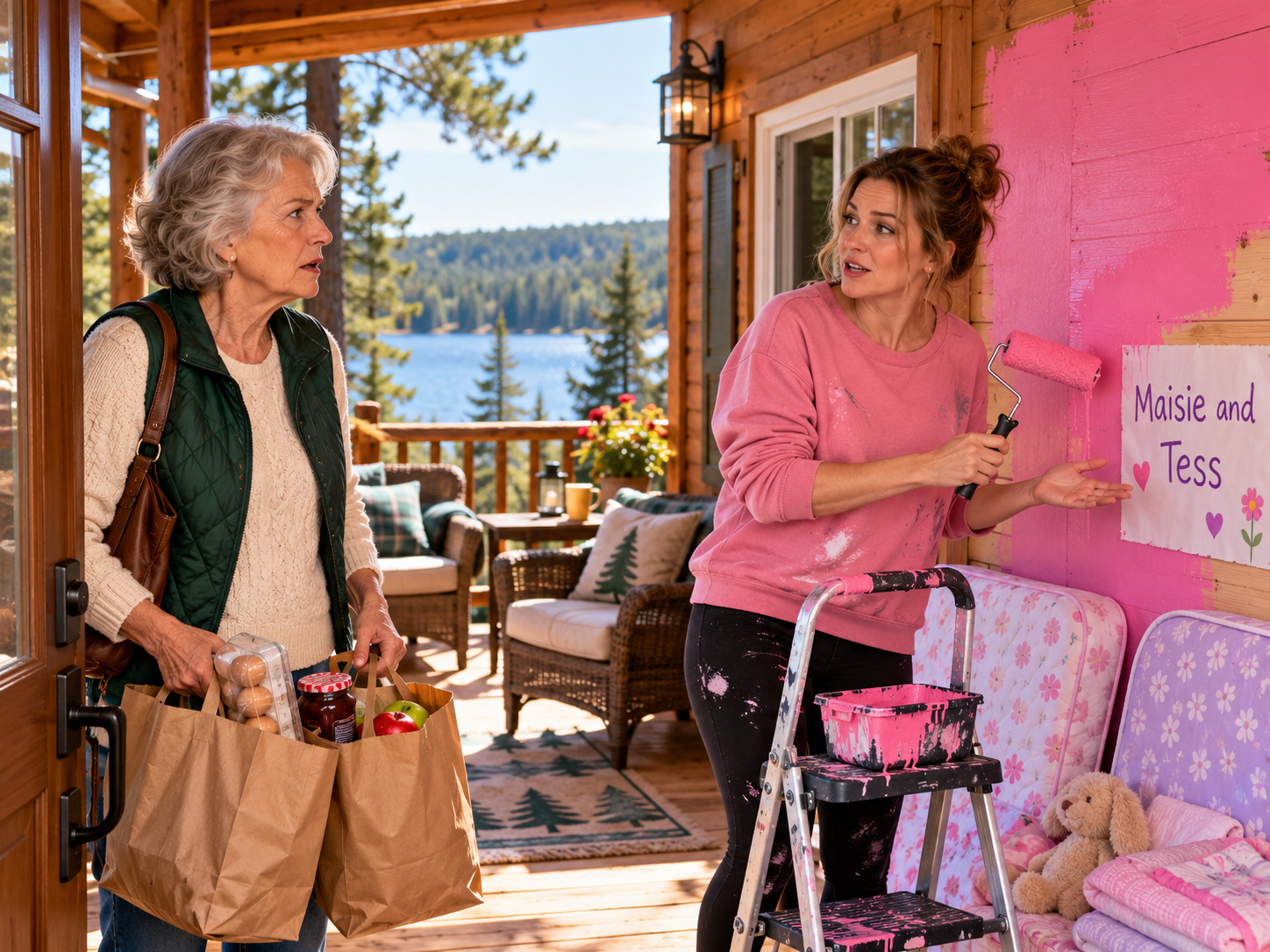
“I used pink for the flowers,” she explained, “not the house.”
I smiled. “That's a lovely choice.”
Brian heard her and lowered his gaze. I did not comment. The girls did not need to understand the history of the paint, and I was not going to make them responsible for their mother's decision.
We ate lunch on the porch. The girls talked about school, a classroom project, and a disagreement over whose turn it was to feed their pet rabbit. Brian asked me about the carpenter's work and listened while I explained how the cedar had been restored.
“I'm glad it came out well,” he said.
“So am I.”
He glanced at the wall beside the window. “I'm sorry that happened.”
I set down my fork. “Thank you.”
He did not add that Tanya had only meant well or that the color could have been changed. He did not ask me to forgive her on his behalf. For once, he allowed the apology to stand without attaching a defense to it.
After lunch, the girls went outside to look for smooth stones near the shore. Brian helped me carry the dishes into the kitchen, then began wiping the table.
“You don't have to do that,” I told him.
“I know. I can still help.”
I handed him a clean cloth and let him finish.
It was a small moment, but I noticed the difference. Before, he had treated the cabin as a problem to solve, a space to rearrange, a resource that would be more useful if his family could occupy it. Now he was helping care for a place that belonged to someone else.
I did not mistake a clean table for proof that everything was repaired. I did appreciate the gesture.
Later, while the girls built a little arrangement of stones on the beach, Brian asked whether I had ever considered having family members stay overnight occasionally.
The question was reasonable, but I felt myself tense.
“I have considered it,” I said. “I haven't decided what I want.”
He nodded. “Okay.”
“I'm not going to promise overnight visits just because we have a good afternoon. I want to enjoy the cabin without feeling that every invitation might become a discussion about moving in.”
“I understand.”
I looked at him. “Do you?”
He rubbed his thumb along the edge of his watch. “I'm trying to. I thought that if I could show you how much easier things would be for us, you'd see it the way I did. I didn't think enough about what it meant for you.”
“That is what hurt me.”
“I know.”
I waited to see whether he would continue. He looked toward the water, where Tess was holding a stone above her head and announcing that it was the most beautiful one she had ever found.
“I think I treated your help like something I could count on,” he said. “When you said no, I felt as though you were taking something away from me. I didn't stop to think that it was never mine.”
I had wanted to hear him recognize that distinction. Now that he had, I found myself struggling to answer.
“You were never wrong to ask me for help,” I said. “But you were wrong to decide what my answer should be.”
He nodded.
The conversation did not end with an embrace or a dramatic promise. Brian returned to the beach, and I began collecting the empty glasses from the porch. The afternoon continued around us, ordinary and pleasant, with the girls calling for help when their stone arrangement collapsed and asking whether they could have more strawberries.
When it was time to leave, Brian made sure the girls had their jackets and checked that they had not left anything behind. He walked to the car, then turned back toward me.
“Would it be all right if I called next week?”
“Of course.”
“And if I wanted to come back sometime?”
“You can ask.”
He accepted the answer. Then he drove away with the girls waving through the rear window.
I watched until the car disappeared between the trees. The cabin grew quiet again, but the quiet felt different from the silence after Tanya had left. I had allowed my family to visit without giving up my right to decide what happened next.
That evening, I checked the front camera recording. It showed Brian arriving, carrying nothing but the bag of food he had brought for lunch, and leaving with the same belongings he had brought. I saved the clip, not because I expected trouble, but because I wanted a clear record of the visit.
Then I closed the app and went outside.
The porch smelled of clean cedar. I sat in Walt's old chair, wrapped a light blanket around my legs, and watched the last sunlight disappear from the lake.
I had spent years believing that a good relationship meant making people comfortable around me. Now I was learning that a good relationship also required me to feel comfortable in my own home.
Brian had taken a step toward understanding that. I could be grateful for it without pretending he had already come the whole way.
Click here to continue reading: PART 6: Tanya’s Request to Apologize Forced Me to Consider Whether Forgiveness Could Begin Before I Was Ready to Trust Her Again
I Bought the Cabin for Peace, but My Daughter-in-Law Had Already Decided Which Parts of My Life She Could Take
Part 5 of 20

