
By December, the first serious cold had settled over Birch Lake. The mornings arrived pale and sharp, with frost along the porch railings and a thin crust of ice forming in the sheltered corners near the shore. I had begun preparing the cabin for the deepest part of winter, checking the pipes, bringing extra wood inside, and making sure the heating system was working properly before I returned to Rockford for longer stretches.
I was in the kitchen one afternoon, writing a list of supplies I wanted to bring on my next trip, when Brian called. His voice sounded tired, but not frantic. I had learned to notice the difference.
“Mom, could I get your opinion about something?” he asked. “You don't have to solve it. I just want to talk it through with you.”
I set down my pen. “All right. What's going on?”
He explained that the financial counselor had helped him and Tanya build a more realistic monthly budget. They had reduced several recurring expenses, adjusted their savings plan, and stopped using their credit cards for purchases they could not pay off promptly. It had been uncomfortable, he said, because they had needed to admit how much of their previous spending depended on the assumption that someone would step in if they fell short.
Now they were considering whether to renew their rental lease for another year or look for a less expensive place farther from the girls’ school. The cheaper option would reduce their housing costs, but it would lengthen the daily commute and require the girls to adjust their routines.
“I keep thinking we should move,” Brian said. “Then I think about changing schools, the drive, everything else. Tanya thinks we should stay another year and save more. We disagree, and I don't want us making a decision just because we're scared.”
It was an ordinary problem. Families faced versions of it every day. But as I listened, I remembered the way Brian had once approached the cabin: he had chosen the outcome he wanted and then treated the practical details as obstacles to be rearranged. He had copied my key because he thought access would make his plan possible. He had discussed housing as if my home were an available solution. He had mistaken his need for a reason that should settle the question.
This time, he was asking what I thought.
I asked him how much the cheaper rental would save each month, whether the girls would remain in the same school district, and whether the longer commute would interfere with his work. We talked about transportation costs, the value of an emergency fund, and the risk of choosing a home that was affordable only if everything went perfectly.
I did not tell him which place to choose. Instead, I suggested that he and Tanya compare the full annual costs of both options, including gas, deposits, moving expenses, and any change in childcare arrangements. I also encouraged him to ask the school whether the proposed move would affect the girls’ transportation or after-school activities.
“You don't have to make the cheapest decision just because it looks responsible on paper,” I said. “You need to make the decision your family can actually live with.”
He was quiet for a moment. “That makes sense.”
“And whatever you choose, make sure Tanya is part of the decision. You two have to carry the consequences together.”
“I know,” he said. This time, I believed he was trying to understand what that meant rather than simply agreeing because I was his mother.
Before we ended the call, Brian asked if I knew anyone who had recently moved into a smaller rental in the area. I told him I would ask around, but I made no promises. He thanked me and said he would send me the figures once they had compared the options.
Afterward, I returned to my list. I had helped him think, but I had not taken the decision away from him. That distinction mattered to both of us.
A week later, he sent me a simple spreadsheet showing the estimated monthly costs for each rental. He had included the expenses they had once overlooked, and he and Tanya had added notes about the girls’ routines and the effect of the commute. Their preferred option was not the cheapest one, but the difference was manageable if they continued saving and kept their spending within the new budget.
At the bottom of the message, Brian wrote, We think staying for another year makes the most sense. We can save more, and we won't have to rush into another move. We decided together.
I replied that it sounded thoughtful and that I hoped the next year would give them some breathing room.
He did not ask me to review the lease, offer to guarantee the rent, or suggest that I could cover a shortfall. He simply thanked me for listening.
For the first time, I felt the kind of pride that had nothing to do with a child obeying a parent. Brian had considered the facts, listened to his wife, and made a decision without turning my resources into part of the calculation.
A few days later, Tanya sent me a photograph of the girls decorating their bedroom for winter. The room was small, and the decorations were inexpensive, but the girls had arranged paper snowflakes along the window and made a little calendar for the days before the holidays. Tanya wrote that they had decided to keep their plans modest this year.
The girls are excited about making things instead of buying so much, she added. It turns out they enjoy deciding what to create.
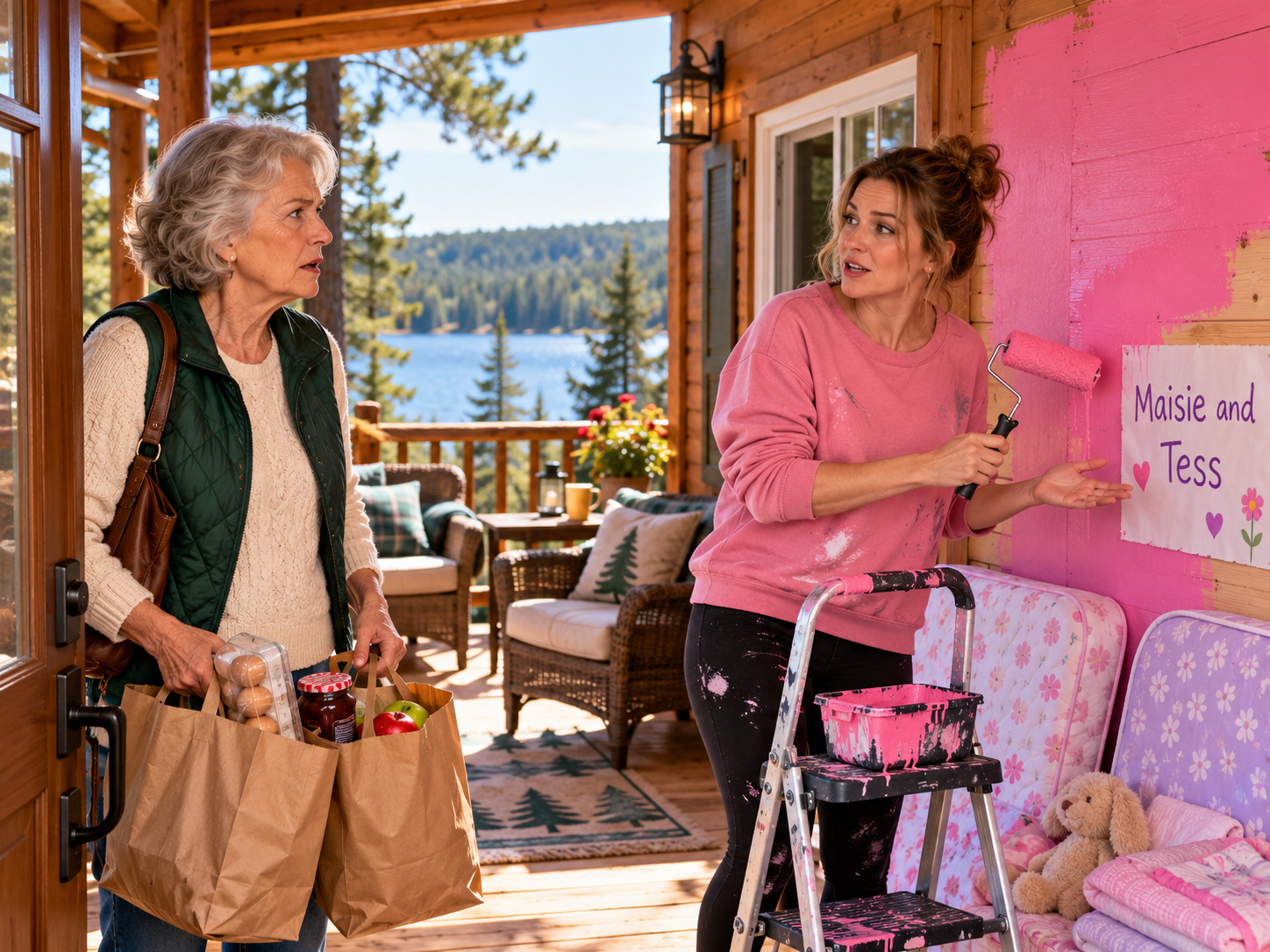
I answered that their snowflakes looked lovely. I did not mention that the photograph made me think about the pink porch. I had no desire to use every ordinary exchange as an opportunity to revisit the worst thing Tanya had done. The past had a place in our family, but it did not need to sit at every table.
As Christmas approached, Brian asked whether I would be comfortable having them visit the cabin for an afternoon if the weather allowed. He was careful to say that he understood I might prefer to spend the holiday alone, and he offered to host me at their rental instead if I wanted company.
I looked at the calendar on the kitchen wall. I had planned to spend Christmas Eve at home in Rockford and come to the cabin a few days later. The idea of a short visit did not trouble me. In fact, I found that I wanted to see the girls.
“You can come on the twenty-seventh,” I said. “If the roads are clear. We’ll have lunch, and then you can head home before it gets dark.”
“Would you like us to bring anything?”
“Bring whatever you would like to eat. I’ll make soup.”
“Okay. We'll check the weather first.”
He did not ask whether they could stay overnight. He did not mention the loft. He accepted the hours I had offered and began planning around them.
On Christmas morning, I sat at my kitchen table in Rockford with a small plate of toast and a mug of tea. The house felt different without Walt, as it always did during the holidays, but the loneliness no longer had the same sharp edges. I could miss him without needing to fill every quiet moment with activity.
I thought about the years when Brian was little, how I had worked nights and slept in fragments, how I had made Christmas happen even when I was exhausted. I remembered the gifts I had wrapped at the kitchen table after coming home from the hospital, my hands still smelling faintly of antiseptic. I had always believed that love was measured by how much inconvenience I could absorb without complaint.
That belief had made me dependable. It had also made it difficult for me to recognize when people were asking too much.
Walt had understood this long before I did. He had often told me that helping someone was a choice worth making, not a debt I owed for being loved. I had listened, but I had not always believed him. Now, with the cabin waiting beside the lake, I was learning to accept his wisdom without treating it as an excuse to withdraw from the people I cared about.
On the twenty-seventh, the sky was clear and cold. I arrived at the cabin early, warmed the kitchen, and set the table for five. I had made vegetable soup and baked bread the evening before. I placed the girls’ drawings in the living room where they could see them, then checked the porch doors and the back lock.
The family arrived just after eleven. Brian carried a bag of groceries, Tanya brought a covered dish, and the girls came through the door holding a paper bag filled with small gifts they had made. They waited until I invited them inside, then hurried toward the living room to see whether their drawings were still on the wall.
“They are!” Tess exclaimed. “Grandma kept them!”
“Of course I did,” I told her.
Maisie studied the cabin for a moment, then asked if she could help set the table. I handed her the napkins and showed Tess where to place the spoons. They worked together, occasionally bumping elbows and laughing, while Brian and Tanya unpacked their food in the kitchen.
No one rearranged the furniture. No one commented on how much better a different color might look on the porch. Tanya asked before opening a cupboard, and Brian checked with me before carrying a chair outside to wipe the frost from its legs.
Each small question reminded me that respect was not a grand declaration. It was the habit of recognizing that another person had the right to decide what happened in their own home.
During lunch, the girls talked about school, their paper snowflakes, and a project they wanted to make during the winter break. Brian and Tanya discussed their budget only when I asked how the new plan was working. They explained that the first month had been difficult, especially when an unexpected bill arrived, but they had been able to handle it without using money they had set aside for rent.
“We had to say no to a few things,” Tanya admitted. “But it was better than pretending we could afford everything.”
“It's hard at first,” I said. “But knowing what you can manage is a kind of freedom.”
She nodded. “I'm beginning to see that.”
After lunch, the girls asked if they could go down to the shore with their father. Brian looked at me before answering, and I told them they could go as long as they stayed away from the icy rocks and remained where he could see them. He helped them into their coats and walked them down the path.
Tanya and I stayed behind to clear the table. For several minutes, we worked without speaking. It was not an uncomfortable silence, but neither of us tried to pretend that we had become close overnight.
Then she said, “I was thinking about your letter—well, the letter I wrote you. I wanted to say something else, but I didn't want to put it in there because it would have sounded like I was asking you to take care of my feelings.”
I set the dish towel down. “You can say it now, if you want to.”
She looked toward the window. “I used to think that because we were family, we could work out the details after we made a decision. I didn't think about what it meant to make a decision that belonged to someone else. I don't want to be that person anymore.”
I considered her words before answering. “Then don't decide what other people will accept. Ask them. And if they say no, you have to let that be the answer.”
“I know.”
“You may know it today and still need to remind yourself tomorrow.”
She gave a small, rueful smile. “That sounds fair.”
When Brian and the girls returned, their cheeks were red from the cold. Tess announced that she had found a frozen leaf near the water and wanted to keep it until it melted. Maisie had collected a few smooth stones from the dry edge of the shore. They laid their treasures on the table, and we spent the next twenty minutes talking about how water could freeze around things without changing what they were.
The visit ended at three, as planned. Tanya packed the leftover food, Brian carried the empty containers to the car, and the girls hugged me before leaving. I watched them drive down the lane, then went inside and locked the door.
The cabin was quiet again. I stood in the kitchen, listening to the furnace hum, and realized I had enjoyed the afternoon without feeling that I had surrendered any part of myself to make it possible.
That was new.
I washed the dishes, dried the table, and returned the extra chairs to their places. Then I settled into the porch chair with a blanket over my knees. The lake had begun to darken beneath the winter sky, and the first stars were appearing above the trees.
My family was still my family. Their problems had not vanished, and the hurt of what they had done remained part of our history. But I was no longer confusing love with permission to cross every boundary.
I could open the door because I wanted company. I could close it when I wanted solitude. Neither choice made me less of a mother or grandmother.
For the first time, I understood that I did not have to choose between loving my family and belonging to myself.
Click here to continue reading: PART 15: An Unexpected Call About My Cabin Forced Me to Decide Whether the Trust I Was Rebuilding Could Survive One More Difficult Conversation
I Bought the Cabin for Peace, but My Daughter-in-Law Had Already Decided Which Parts of My Life She Could Take
Part 14 of 20

