
Karen's letter arrived three days later.
She sent copies to Brian and Tanya by certified mail and kept proof of delivery. The language was direct: I was the sole owner of the cabin, neither of them had permission to enter or occupy it, and any future access had to be arranged with me. The letter also stated that attempts to alter the locks, remove property, or begin renovations without authorization would be documented and addressed through the appropriate legal channels.
I read it at my kitchen table with a cup of coffee beside me. There was nothing cruel in it. No accusations about Brian's character, no mention of old arguments, no demand that he apologize. It simply established what should never have needed to be written down.
For two days, neither of them contacted me.
On the third evening, Brian sent a text.
I received the letter. I understand what you're saying. Can we talk in person?
I stared at the message for a long time before answering. I wanted to believe that the formal notice had finally made him understand. I also knew that a request to talk could mean anything, from a sincere attempt to repair the damage to another effort to persuade me to surrender.
We agreed to meet at a coffee shop in Rockford the following afternoon. I chose a public place, told Karen about the meeting, and left the cabin locked and empty.
Brian was already seated when I arrived. He had ordered a black coffee, but the cup remained untouched in front of him. He looked tired. The skin beneath his eyes had darkened, and his shirt was creased at the elbows.
For a moment, I saw the boy who used to wait for me at the kitchen window when I came home from an overnight shift. He would pretend he had not stayed awake, even though he would be sitting on the couch with a blanket around his shoulders and a bowl of cereal balanced on his knees.
That memory made it harder to sit down.
“Thank you for coming,” he said.
I placed my purse beside the chair. “You wanted to talk.”
He rubbed his palms together, then wrapped both hands around his cup.
“I know I shouldn't have copied the key.”
“No, you shouldn't have.”
“And Tanya shouldn't have painted the porch.”
“No.”
He looked up, perhaps expecting me to make the conversation easier for him. When I didn't, his shoulders sank.
“I was trying to make things work,” he said. “We have been under pressure for months. The mortgage, the bills, school expenses. Tanya's mother came to stay because she couldn't manage on her own, and we thought it would only be temporary. Then it became one problem after another.”
“I understand that you're under pressure.”
“I don't think you do.”
“Brian, I have listened to you describe your financial problems. I've helped you with them. I know things have been difficult.”
He shook his head. “You can always go back to your quiet little house and your retirement. We can't.”
I looked at him carefully.
“You think I owe you the life I've worked for because yours is difficult.”
“That's not what I said.”
“It's what you keep asking me to do.”
He stared at his coffee. The silence between us was uncomfortable, but I let it remain. I had spent years rushing to fill silence whenever Brian seemed upset. I would offer reassurance, suggest a solution, or reach for my purse. This time, I wanted to hear what he would say when I did not rescue him from his own thoughts.
Finally, he admitted that he had spoken to a moving company before the first visit to the cabin. He and Tanya had discussed how they might arrange the bedrooms, where the girls' beds would go, and what they could sell once they moved. He said they had assumed I would eventually agree.
“When?” I asked.
“After you saw how much sense it made.”
“You had already decided before asking me.”
He did not deny it.
“What about the locksmith?” I asked.
His fingers tightened around the cup. “Tanya found someone who said he could open the door if we had a key that no longer worked. I thought we could get inside and move a few things before you came back.”
“You thought that because you had once possessed a key, you could keep entering my home after I changed the locks.”
“I wasn't thinking clearly.”
“You were thinking clearly enough to hire someone.”
His face reddened. For a moment, I thought he would argue. Instead, he looked down and whispered, “I know.”
I had waited for those words, but hearing them did not bring the relief I expected. An apology could begin a repair. It could not undo the decision that had made it necessary.
“What did you tell the girls?” I asked.
“That they might be able to stay at the cabin.”
“Did you tell them they were moving there?”
He nodded.
“Then you need to correct that. They should not have to carry the disappointment of a promise you had no right to make.”
“I will.”
“And Brian, I need you to understand something. You can ask me for help. You can tell me when you're frightened or struggling. But you cannot decide that the answer I give you is only temporary because it isn't the answer you wanted.”
He looked at me, and for the first time during the conversation, his expression seemed to soften.
“I don't know how to fix this.”
“Start by not trying to fix it for me.”
We spoke for another twenty minutes. I offered to help him review his household budget and look at less expensive housing options, but I made it clear that I would not give them the cabin or become responsible for their mortgage. If he wanted financial advice, I would help him find a qualified professional. If he wanted to discuss a specific emergency, I would listen before deciding whether I could help.
He did not like every condition. I could see it in the way his mouth tightened. But he did not argue.
When we stood to leave, he reached toward me, then hesitated.
“Can I hug you?”
The question hurt more than I expected. Once, he would have crossed a room without asking. Now we were learning that affection could not be used to bypass a boundary any more than a key could.
“Yes,” I said.
He held me briefly. His jacket smelled faintly of laundry detergent and the cold air outside. I rested my hand against his back, loving him as completely as I had the day he was born, while knowing that love alone could not make him safe to trust.
“I am sorry, Mom,” he said against my shoulder.
“I hear you.”
It was all I could offer that afternoon.
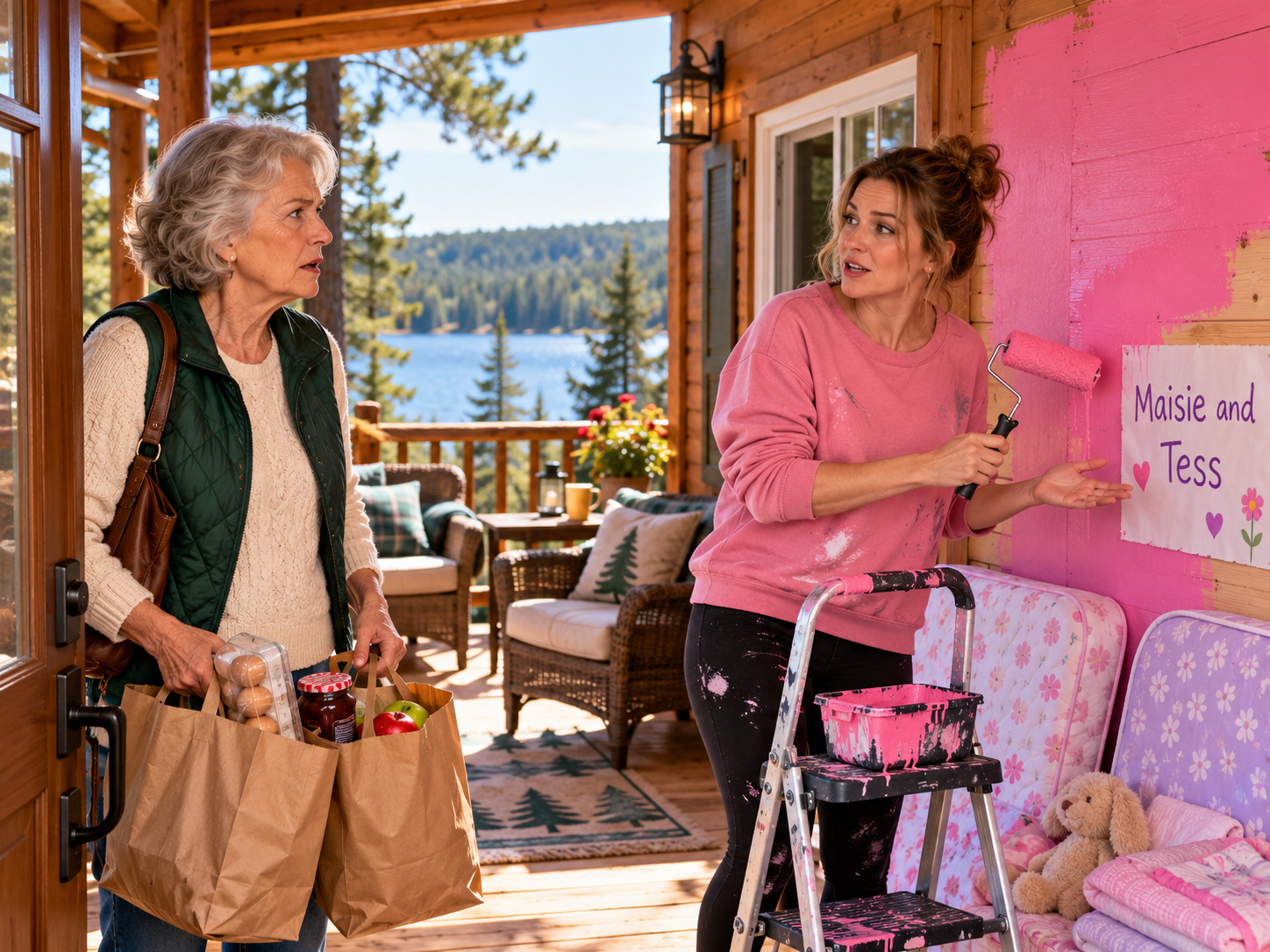
The following week, I returned to Birch Lake. The carpenter had begun removing the paint, working in small sections so the cedar would not be damaged unnecessarily. The porch looked rougher before it looked better. Pale strips of exposed wood alternated with pink marks that remained deep in the grain.
I stood beside him while he explained the next steps.
“It's going to take a little time,” he said. “But the wood is in good shape. We can restore most of the natural color.”
“That's all I wanted.”
He gave me a sympathetic smile and returned to his work.
For the first time since Tanya had entered the cabin, I could imagine enjoying the porch again. I moved my chair toward the window and set my coffee on the narrow table. The lake was bright that morning, sunlight flashing on the water whenever the wind shifted.
I did not invite Brian or Tanya to visit. I needed time, and I had learned that time was not something I had to justify.
Still, I checked the cameras every day.
Nine days after Brian's visit with the locksmith, I received another motion alert from the back entrance. I opened the app and found a clip showing Tanya standing beside the rear steps. She had no tool case, no paint roller, and no children with her. She looked directly toward the camera, then walked away without touching the door.
I saved the recording and sent it to Karen.
The next morning, there was another alert. This time Brian stood at the front entrance, holding an envelope. He remained on the porch for almost a minute before slipping the envelope beneath the doorbell camera's small protective hood, where it would be sheltered from rain. Then he stepped back, looked at the door, and left.
I waited until the recording finished saving before driving to the cabin. The envelope was still there. Inside was a handwritten letter and a key.
Not my old key. Not the duplicate he had made from the photograph. This one was a copy of the new key, cut from a code he had apparently obtained when the locksmith who changed my locks had given me the paperwork.
My stomach tightened as I looked at it.
The letter was short.
Mom,
I wanted to leave the key because I thought you might eventually want us to have access again. After thinking about it, I understand that leaving it was another way of making the decision for you. I should have asked first. I'm not asking you to use it or forgive me. I'll wait for you to tell me if you want us to visit.
Brian.
I called Karen before doing anything else. She advised me to have the lock checked and replaced again, and to confirm with the locksmith how the key code might have been accessed. The original technician came out that afternoon, examined the lock, and told me the key itself would work. He could not say how Brian had obtained the information, but he agreed to replace the cylinder and secure the paperwork.
I did not accuse Brian of anything beyond what the evidence showed. I saved the recording, photographed the envelope, and kept the letter.
The discovery made me uneasy, but it also clarified something I had been trying to understand. Brian still wanted access. He still believed he might eventually be invited back into the cabin. The difference was that this time he had acknowledged that wanting access did not entitle him to it.
It was not enough to restore my trust. It was, at least, a beginning.
Ten days after the first doorbell alert, Karen called to discuss the recordings. We reviewed the sequence together: Brian arriving with the locksmith, his attempt to have the lock changed, Tanya's later visit, and the envelope with the new key. Nothing in the footage suggested a break-in had occurred, but it documented a pattern of unauthorized attempts to control access to the property.
Karen recommended keeping the files and continuing to arrange any visits in writing. She also advised me not to hand over a key until I was genuinely comfortable doing so.
I thanked her and returned to the porch.
The last traces of pink were being removed. The cedar had a few faint marks, and one section would need a little more sanding, but the wall was coming back to itself. I ran my palm over the wood and felt the grain beneath my skin.
I thought about Walt's dream of a house beside the water. He had never imagined it as a place where our family would be tested. He had imagined quiet mornings, the sound of the lake, and the two of us sitting side by side with nothing urgent demanding our attention.
For a long time, I had believed that being a good mother meant keeping the door open no matter what happened. I had confused forgiveness with immediate access and generosity with an obligation to keep giving. I had assumed that because I loved Brian, I should be willing to absorb the consequences of his decisions.
But I could love my son without surrendering my home. I could love my granddaughters without allowing their parents to make promises on my behalf. And I could leave the possibility of reconciliation open without pretending that nothing had happened.
The next Sunday, Brian called and asked whether he could bring the girls to visit the following month.
“Just for an afternoon,” he said. “We can meet somewhere else if you'd prefer.”
I considered it. I wanted to see Maisie and Tess. I missed their chatter, their questions, and the way they collected ordinary objects as if each one might become a treasure. But I was not ready to invite them into the cabin while the conflict remained so fresh.
“We can meet at the park in Rockford,” I said. “Let's start there.”
“Okay.”
“And I need you to tell them the cabin is my home, not a place they're going to move into.”
“I already did. I told them I made a mistake by promising something that wasn't mine to promise.”
I closed my eyes briefly. It was the first time he had described his actions without blaming my reaction.
“Thank you,” I said.
When the visit came, the girls ran toward me before Brian had finished parking. Maisie wrapped her arms around my waist, and Tess held up a small drawing of a house beside a lake. This time, there were three figures on the porch, and a fourth stood beside them holding a paintbrush.
“That's you, Grandma,” Tess explained. “And that's Daddy. He said he made a bad choice, and he's going to ask before he does things now.”
I crouched to look at the picture. “That sounds like a good plan.”
“Can we still see your cabin?”
“Yes,” I told her. “When I invite you.”
She nodded, satisfied, and ran toward the swings with her sister.
Brian remained beside me. He did not ask whether I had changed my mind about the cabin. He did not mention the locks, the porch, or the letter. For the first time in weeks, we spent an afternoon together without trying to settle the entire future of our relationship.
It was not a return to the way things had been. I no longer wanted that if it meant pretending I had never been hurt.
When I drove back to Birch Lake that evening, the sun was low over the water. The porch was almost restored. The cedar had been cleaned, sanded, and treated, and the final section glowed softly beneath the porch light. I placed my chair by the window, set my coffee on the table, and listened to the water move against the shore.
I still loved Brian. I still hoped he would become someone who could hear no without treating it as a personal attack. I hoped the girls would grow up knowing that family could be loving without being controlling, generous without being entitled, and close without demanding ownership of one another's lives.
But I did not leave the door unlocked to prove any of those things.
I turned the key, checked the latch, and settled into my chair. Beyond the screen, Birch Lake reflected the last pale light of the day. The porch had been damaged, but it had not been taken from me. The cabin remained mine, not because I had won an argument, but because I had finally stopped allowing other people to decide what my sacrifices were supposed to purchase for them.
Walt had wanted a place where we could stop rushing. I had spent years believing that peace was something I could earn only after everyone else was satisfied.
That evening, for the first time since buying the cabin, I let the quiet belong to me without apology.
Click here to continue reading: PART 5: The First Time Brian Asked Permission to Visit My Cabin, I Realized an Apology Could Be Sincere Without Making Trust Return Overnight
I Bought the Cabin for Peace, but My Daughter-in-Law Had Already Decided Which Parts of My Life She Could Take
Part 4 of 20

