
Brian did not call the next morning. Neither did Tanya. I woke before sunrise, as I usually did, and carried my coffee to the porch despite the damage. The air smelled of damp earth and lake water. A thin mist hovered over Birch Lake, and somewhere across the shore a loon called once, then went quiet.
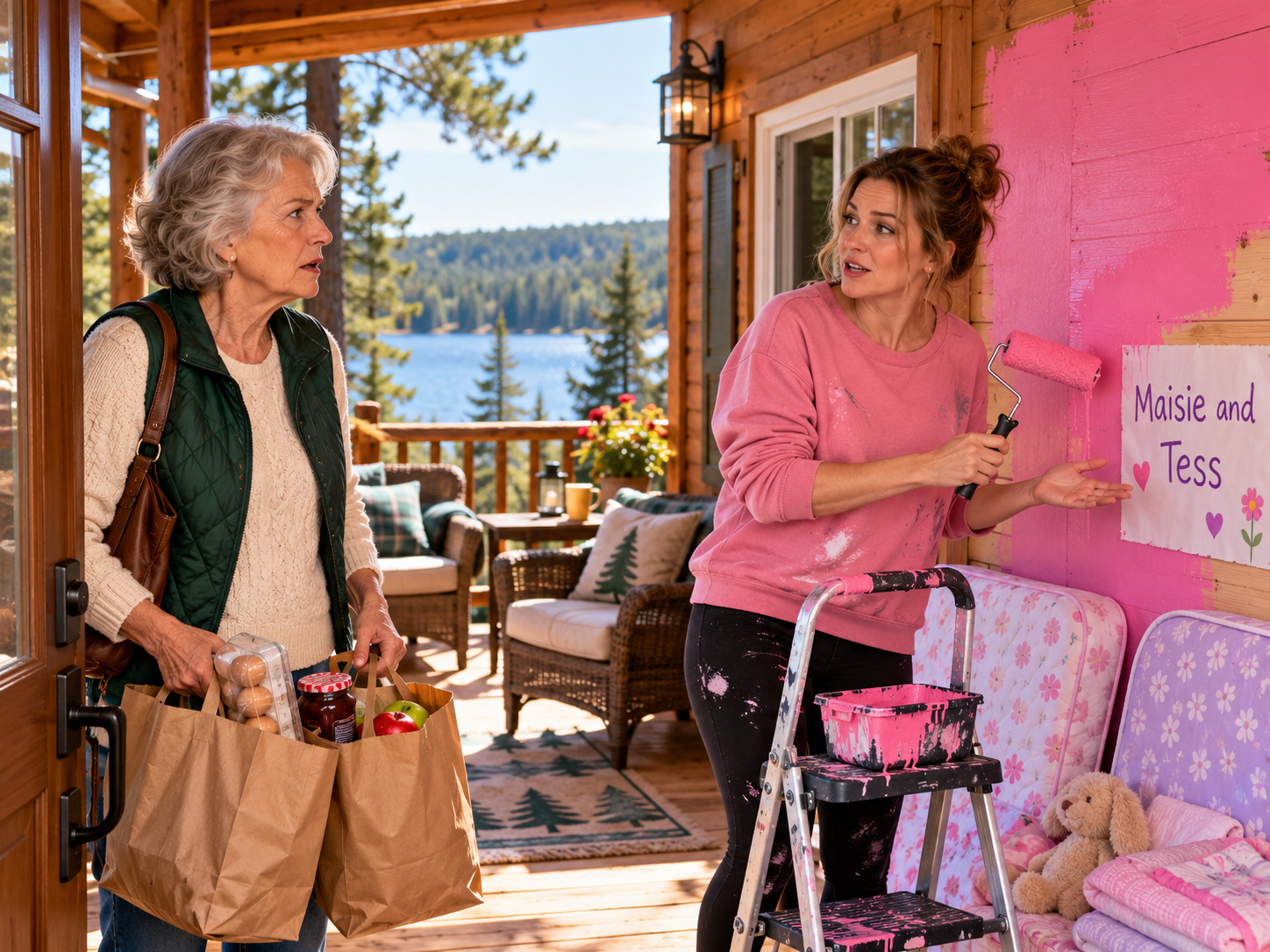
The pink paint looked worse in daylight.
It had dried unevenly, with small ridges where Tanya had pressed too hard and thin patches where the cedar grain showed through. She had covered the wall beside the screen door and most of the boards near the window. Whoever had sold her the paint had apparently never warned her how sharply it would clash with the warm brown wood.
I could have spent the morning being angry about the color. Instead, I made a list of what needed to be done: find a contractor who understood cedar, confirm that the locks had been changed properly, check the camera recordings, and ask a lawyer what options I had if Brian or Tanya tried to enter again.
The last item made me uncomfortable. I had never imagined needing legal advice about my own child.
Still, I wrote it down.
After breakfast, I opened the camera app. The technician had shown me how to view motion alerts and save clips, but I was still learning the controls. The front camera showed the driveway, steps, and door. The back camera covered the rear entrance and a narrow path that led toward the woods.
There was one alert from the previous evening, when the locksmith had arrived, and another from a rabbit that had wandered near the back steps. Nothing else.
I saved the installation clip and closed the app.
Then I called a local carpenter recommended by the locksmith. He said he could inspect the porch the following week and give me an estimate for removing the paint without damaging the cedar. I made the appointment and spent the afternoon reading on the screened porch, moving my chair to avoid looking directly at the wall.
It should have been peaceful. The cabin was quiet, the sun warm on my knees, and the water moved in small ripples against the shore. Yet every time a vehicle passed on the road, I found myself listening for it to turn into the driveway.
I hated that feeling.
By Sunday afternoon, I drove back to Rockford. I had intended to spend three nights at the cabin, but the idea of another confrontation made me reluctant to stay. I locked the door behind me, tested the handle, then stood on the steps for a moment looking at the place I had worked so hard to buy.
“I'll be back,” I said aloud.
The words sounded like a promise I was making to the cabin rather than to myself.
At home, I found two missed calls from Brian and a message from Tanya. She had written that she was sorry things had become uncomfortable and hoped I would think about what was best for the girls. There was no mention of the copied key or the paint.
I read the message twice, then put the phone down without replying.
That evening, Brian called again.
“Can we talk without you getting upset?” he asked.
“I wasn't the one who entered my house without permission.”
“Mom, please. Tanya's embarrassed.”
“Is she?”
“She knows the paint was a mistake.”
“Was copying my key a mistake too?”
He paused. “I should have asked.”
“Yes.”
“But you could have handled it differently.”
I looked toward the kitchen window. Walt and I had hung a small wooden clock above the sink years ago, and it still ticked steadily, though the finish had faded near the bottom. I had kept it through the sale of our old house because it reminded me of the life we built together.
“What would you have preferred?” I asked. “That I let her finish painting? That I carry my groceries upstairs and sleep in the loft? That I pretend I agreed because you were too embarrassed to ask?”
“No one was trying to throw you out.”
“Tanya told me where I could sleep in my own home.”
“She thought you might enjoy having the girls there.”
“She could have asked me.”
Brian's voice grew tense. “We need more room, Mom. You know that. The girls are sharing a bedroom, Tanya's mother has been staying with us, and every month we fall further behind. You have a whole cabin that you visit once or twice a month.”
The details were not new. He had told me about their financial troubles over dinner and during phone calls. I had offered help when I could, but I had never agreed to house the entire family.
“Your circumstances don't give you the right to make decisions for me,” I said.
“I thought you would want to help.”
“I have helped.”
“That sounds like you're keeping score.”
“I'm reminding you that I have never abandoned you. I have also never promised you this property.”
He went quiet. When he finally spoke, the hurt in his voice sounded real, even if the accusation was unfair.
“I guess I know where I stand now.”
I closed my eyes.
“Brian, you know where you stand. You're my son. You can call me, visit me when I invite you, bring the girls to see me, and tell me when you're struggling. But being my son does not give you permission to take my keys or decide how I live.”
He said he had to go. The call ended before I could tell him I loved him.
For the next several days, the silence between us widened. I went to the grocery store, met an old nursing colleague for lunch, and attended a retirement association meeting. I kept busy because the alternative was replaying every conversation and searching for the moment when my relationship with Brian had changed.
Perhaps there had been no single moment. Perhaps it had happened gradually, each time I solved a problem before he had to face it, each time I agreed to help because I did not want the girls to suffer, each time I accepted a request that was really an expectation.
I could not undo those years. I could decide what happened next.
On Wednesday, the carpenter inspected the porch. He wore a canvas jacket with sawdust caught in the seams and carried a small scraper, a moisture meter, and a notebook. He examined the paint from several angles, then tested a hidden section near the bottom of the wall.
“It's going to take patience,” he told me. “We can remove most of it, but I don't want to promise the cedar will look exactly as it did before. We'll need to strip it carefully, sand lightly, and see what the wood looks like underneath.”
“How much?”
He gave me a range and explained that the final cost depended on how deeply the paint had penetrated the grain.
I approved the work.
Before leaving, he glanced at the new camera over the front door.
“Good idea, putting those up.”
“Someone had a key who shouldn't have.”
He nodded without asking for details. I appreciated that more than I expected.
That night, I reviewed the camera settings again. I adjusted the motion sensitivity so passing headlights would not trigger constant alerts, checked that the clips were being saved, and made sure I could access them from my phone. I tested the doorbell and watched the short recording of myself standing on the porch, hair blown across my face by the wind.
The camera worked. The locks were new. I had done what I could to protect the property.
I still did not feel entirely safe.
On Friday, Brian sent a photograph of the girls holding a drawing. They had colored a lake, a little brown house, and three stick figures on a porch. Maisie had written Grandma's Cabin at the top, with the letters leaning in different directions.
The picture made my throat tighten. I wanted the girls to remember the cabin as a place where they were loved. I did not want them to become the reason their parents believed my wishes should be ignored.
I wrote back that the drawing was lovely and asked Brian to tell them I loved them.
He replied with a single sentence.
“They keep asking when they can move in.”
I stared at the message.
I had never told the girls they could move in. I had never told Brian they could move in. Yet he was presenting their expectations as if they were a decision I had already made and was now refusing to honor.
I called him immediately.
“Have you told Maisie and Tess they can live at my cabin?”
“I told them it was a possibility.”
“After I said no?”
“I thought you'd reconsider.”
“Then you should have waited until I had.”
“They're children, Mom. They don't understand adult decisions.”
“Exactly. They don't understand because you've given them a promise I never made.”
He rubbed at something on his end of the phone; I could hear the faint scrape of his hand against the microphone.
“What do you want me to say to them?”
“The truth. That Grandma loves them, that they can visit when we arrange it, and that the cabin is not their home.”
He did not answer.
“Brian?”
“I heard you.”
I hoped he had. But as I set down the phone, I knew that the hardest part of this conflict was not the paint or the locks. It was the fact that Brian still seemed to believe a firm answer was only the beginning of a negotiation.
The following Monday, I drove back to the cabin for the carpenter's first day of work. He had laid protective coverings over the porch floor and was preparing the stripping materials when my phone rang. It was Brian.
“Mom, we need to figure this out,” he said.
“We've discussed it.”
“No, you've made your decision and shut the door.”
“Because it's my door.”
He gave a frustrated laugh. “You can't expect me to accept that you're going to sit out there alone while we barely have room to breathe.”
“I can expect you to respect my decision.”
There was a pause. Then he said something that made me stop walking.
“Tanya already talked to someone about the cabin. We have plans. You can't just change everything because you got angry.”
“What someone?”
He did not answer quickly enough.
“Brian, what have you done?”
“Nothing you need to worry about.”
The words sent a chill through me. I looked at the new lock on the front door and then at the camera mounted above it.
“You need to tell me what you mean.”
He said he would call back and hung up.
I stood very still while the carpenter's scraper made a soft metallic sound behind me. I had spent the past week telling myself the worst was behind us. Now I understood that I had only seen the part of their plan they were willing to carry out in front of me.
Click here to continue reading: PART 3: Ten Days After the Locks Were Changed, My Doorbell Camera Caught Brian Bringing a Stranger to My Front Door
I Bought the Cabin for Peace, but My Daughter-in-Law Had Already Decided Which Parts of My Life She Could Take
Part 2 of 20

