
The alert arrived while I was in a storage unit outside Rockford, wrapping Walt's old coffee mugs in newspaper.
I had rented the unit after selling our house because I couldn't bear to sort through everything at once. Some boxes contained things I knew I would never use again: a cracked mixing bowl, a set of holiday linens, and the heavy winter coat Walt had worn during our last Christmas together. Other boxes held objects too small to justify keeping and too meaningful to discard.
The coffee mugs belonged to the second category. They were plain white ceramic, each with a narrow blue line near the rim. Walt had used the same mug every morning, even after the handle developed a hairline crack. He claimed it made the coffee taste better. I had bought a replacement, but he kept using the old one until I finally hid it in the back of a cupboard.
After he died, I found it there and carried it through every move.
I was folding newspaper around the last mug when my phone buzzed.
Motion detected at front door.
For a second, I barely looked at the screen. The camera alerts had become part of my routine. A bird on the railing, a delivery truck on the road, a branch moving in the wind—most of the notifications were harmless.
Then I saw the image.
A white locksmith's van stood in my driveway. A man in dark work trousers was carrying a tool case toward the front steps. Behind him, with his sunglasses pushed onto his head and his arms folded across his chest, stood Brian.
I straightened so quickly that the newspaper slipped from my hand.
The man reached the door and examined the lock. Brian pointed toward the handle, then gestured at the camera. I couldn't hear their conversation from the still image, but the posture was familiar. Brian stood with his shoulders squared, explaining something as though the person in front of him had already agreed.
I tapped the alert and opened the live feed.
The picture sharpened. The locksmith had placed his tool case on the step and was studying the lock. Brian looked up at the doorbell camera, then toward the driveway.
I pressed the microphone icon.
“Brian?”
His head jerked upward.
The locksmith stopped moving.
“Mom?” Brian said.
“What are you doing at my house?”
He looked at the locksmith before answering. “We're changing the lock.”
“I can see that. Why?”
“The key doesn't work.”
“Of course it doesn't. I changed the locks after you made a copy without permission.”
He shifted his weight and ran a hand through his hair. “We need to get some things inside.”
“What things?”
“Furniture. The girls' beds. Some boxes.”
My mouth went dry.
“You are not moving into my cabin.”
“We're not trying to fight with you.”
“Then tell the locksmith to pack his tools and leave.”
The man glanced from Brian to the camera. He looked uncomfortable, but he did not yet move.
Brian stepped closer to the door. “Mom, can you stop making this difficult? We have a truck coming tomorrow. We can't keep changing plans every time you get upset.”
“You arranged a move into my house after I told you no?”
“We talked about it. You never gave us a real alternative.”
“I gave you an answer.”
“You gave us a refusal.”
“Yes.”
His jaw tightened. I had seen that expression when he was a teenager and wanted to stay out later than I allowed. Back then, the anger would pass, usually after dinner or a night of sleep. I used to believe the fact that he eventually calmed down meant he understood.
Now I wondered how often he had simply waited for me to soften.
The locksmith cleared his throat. “Ma'am, I'm only here to do the work I've been hired for. If this isn't authorized, I need to know before I proceed.”
“It isn't authorized,” I said. “I'm the owner. I did not request any work, and I do not consent to anyone changing my locks.”
Brian turned toward him. “I can explain.”
“There's nothing to explain,” I said. “I hired a locksmith ten days ago. The locks were changed legally and with my permission. This man does not have my authorization to alter them.”
The locksmith lowered his tool case.
“Sir, do you have written permission from the owner?”
Brian hesitated. “I'm her son.”
“That isn't what I asked.”
The silence that followed was brief, but I could see its effect. Brian's arms dropped from his chest. He looked suddenly less like someone supervising a routine repair and more like someone who had arrived expecting a door to open simply because he said it should.
“I have a key,” he said.
“Not a working one,” I replied. “And not one I gave you.”
The locksmith stepped away from the door.
“I'm going to pause the job until this is clarified.”
“There's nothing to clarify,” I said. “Please leave my property.”
He picked up his case and walked toward the van. Brian followed him several steps, speaking too quietly for me to hear. The locksmith shook his head, climbed into the driver's seat, and started the engine.
Brian remained on the porch.
For a moment, he stared at the camera. Then he leaned toward it.
“You're really doing this to me?”
“I'm protecting my home.”
“From your own son?”
“From anyone who believes they can enter without permission.”
He shook his head and walked back toward his car. Before getting in, he looked at the front door again. His expression had changed. The frustration was still there, but something harder sat beneath it.
He drove away.
I saved the recording immediately, then downloaded a copy to my phone. My fingers were clumsy on the screen. I watched the clip again to make sure it had captured the locksmith, Brian, and the conversation. It had.
I was no longer dealing with a misunderstanding about where the girls would sleep. Brian had brought a professional to my property to alter a lock he had no authority to change, while preparing to move furniture into a home he knew I had refused to share.
I called the local sheriff's non-emergency line. The dispatcher asked whether anyone was still at the property and whether I believed anyone might return. I explained the situation, gave the address, and described the camera footage.
She told me an officer could take a report and advised me not to confront anyone alone if they returned. I saved the incident number she provided and asked whether the footage would be useful.
“Yes,” she said. “Keep the original recording and a backup. Don't edit it. If anything else happens, call us again.”
I thanked her and sat down on an overturned plastic bin.
The storage unit smelled of cardboard and dust. A fluorescent tube buzzed overhead. Beside me, the mugs lay wrapped in newspaper, their shapes outlined in gray ink. I looked at them without really seeing them.
I had spent thirty-five years working in emergency rooms, where the people who needed help did not always behave well. Sometimes frightened relatives shouted at nurses, demanded information they were not entitled to receive, or insisted that a patient must be treated according to their wishes. I had learned to distinguish distress from authority. A person's fear might explain their behavior, but it did not give them ownership over someone else's decisions.
I had never expected to apply that lesson to my own family.
When I reached home, I called the attorney who had handled the closing on the cabin. Her name was Karen Whitmore, and she had been patient with my questions when I bought the property. I told her about the copied key, the unauthorized painting, and the locksmith who had arrived with Brian.
She listened without interrupting.
“Is the deed in your name alone?” she asked.
“Yes.”
“Did you sign any agreement giving Brian or Tanya a right to occupy the property?”
“No.”
“Have you ever given either of them written permission to live there?”
“No. I told Brian directly that I would not be moving anyone into the cabin.”
“Good. Send me the deed, the report number, and the original camera clips. We'll document the incidents. I also want you to make a written record of the first time Tanya entered, including the date and what she told you about the key.”
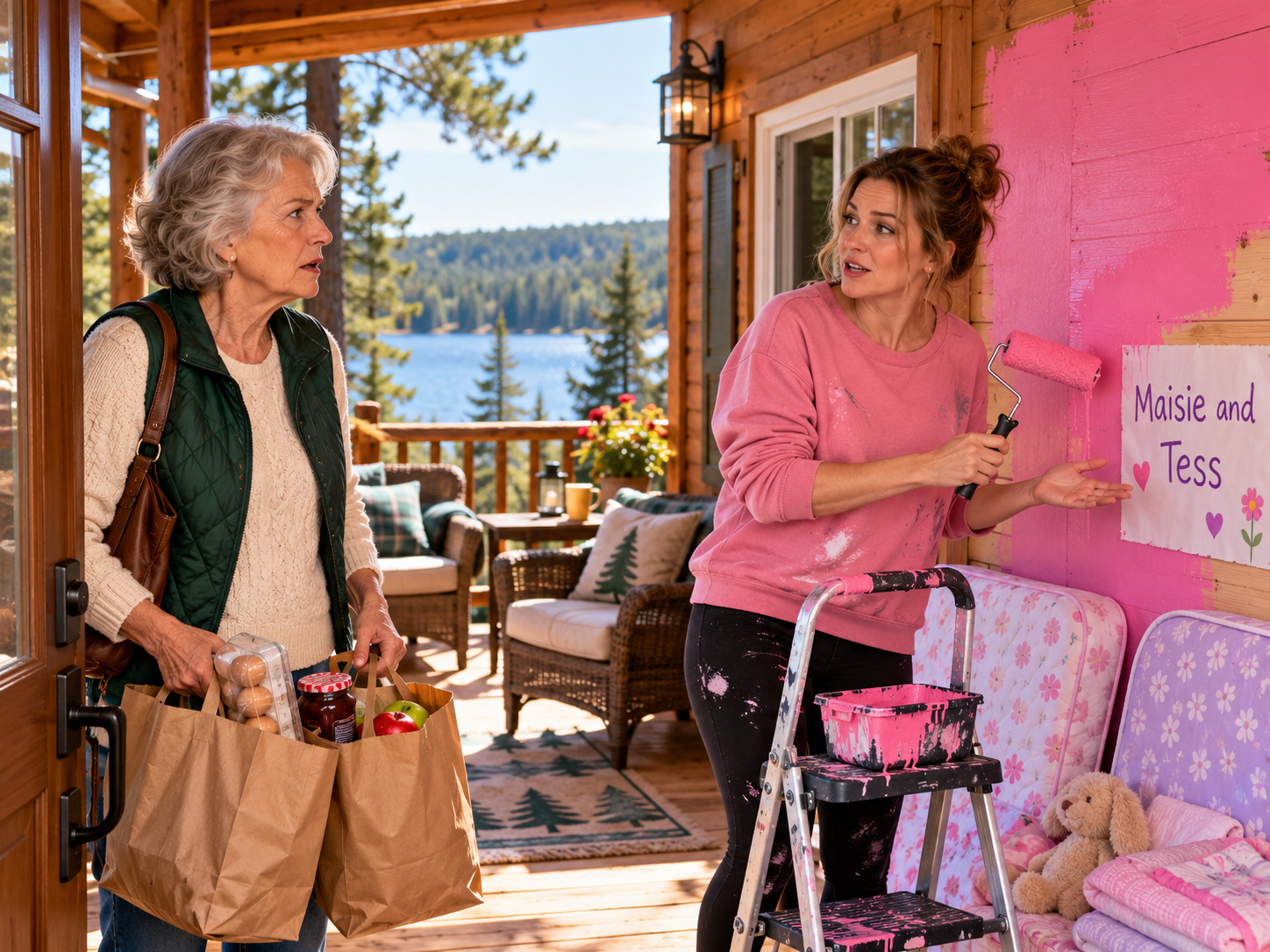
I wrote down every detail I could remember. I included the paint, the mattresses, the sign with the girls' names, the conversation about the loft, and Tanya's admission that Brian had photographed my key at Easter.
When I finished, I read the account aloud to make sure it was factual rather than emotional. Karen told me that was the right approach.
“Don't threaten them,” she said. “Don't try to negotiate while you're angry. Keep your communication clear, and don't let anyone make you feel that a family relationship replaces your legal rights.”
I thanked her, then sat in my kitchen with the phone in my hand.
I wanted to call Brian and ask what had happened to him. I wanted to know how he had convinced himself that his plans mattered more than my answer. But I also knew what the conversation would become. He would explain their financial pressure. He would say the girls needed stability. He would accuse me of choosing a building over my family.
And I would be tempted to explain myself until he decided my reasons were good enough.
I was finished asking him to approve my right to live my own life.
That evening, I received a message from Tanya.
Brian says you called the police on him. I can't believe you'd do that over a house. The girls are devastated. We only wanted a safe place to live.
I read it once, then again.
She did not mention the copied key, the paint, the locksmith, or the fact that I had refused to let them move in. The entire conflict had been reduced to my reaction, as if the first act that mattered was my decision to protect myself.
I typed a response, deleted it, and started over.
You and Brian were told that the cabin was not available for you to occupy. I did not authorize the entry, the painting, or the attempt to change my locks. I love Maisie and Tess, and I will continue to make room for them in my life. That does not give anyone permission to move into my home. Any future visit must be arranged with me in advance.
I sent it and placed the phone on the table.
A few minutes later, Brian called.
“You've made me sound like a criminal,” he said.
“I told the sheriff what happened.”
“You could have called me first.”
“I did. I asked what you were doing, and you told me you were changing my locks.”
“I was trying to solve a problem.”
“You were trying to move into my house after I told you not to.”
“We're in a terrible position, Mom.”
“I know you're struggling. I've helped you before, and I would discuss ways to help you again. But I won't give you the cabin.”
He fell silent. I could hear his breathing through the phone.
“Then what are we supposed to do?”
“You and Tanya need to decide what you can afford and what arrangements work for your family. I can help you look at options. I cannot become the solution you impose on me.”
“You make it sound so simple.”
“It isn't simple. It's still my decision.”
He hung up.
I did not sleep well that night. Every time I woke, I remembered the image of Brian standing behind the locksmith, arms folded, watching a stranger prepare to defeat the lock I had paid to install. I kept thinking about how calmly he had done it. There had been no shouting, no dramatic struggle. He had simply arrived with a plan and expected the world to make room.
The next morning, Karen called to say she had reviewed the documents. She recommended sending a formal written notice stating that neither Brian nor Tanya had permission to enter or occupy the cabin, and that any further attempt would be documented.
I agreed.
Before she sent it, I asked one question.
“Do you think I'm making too much of this?”
Karen was quiet for a moment.
“Dorothy, if a stranger had copied your key, painted your porch, and brought a locksmith to change your locks, would you wonder whether you were overreacting?”
“No.”
“Then don't make the family relationship a reason to ignore what happened.”
After we hung up, I returned to the camera app. I watched the recording once more, this time focusing on Brian's face when the locksmith asked whether he had written permission.
He had looked away.
It was a small movement, barely a second long, but it told me more than his explanations had. He knew he did not have permission. He had come anyway.
And if he was willing to bring a locksmith to my front door, I could no longer assume that a new lock would be enough to keep him out.
Click here to continue reading: PART 4: When the Final Recording Revealed What Brian Had Planned, I Had to Decide Whether Protecting My Home Meant Losing My Son
I Bought the Cabin for Peace, but My Daughter-in-Law Had Already Decided Which Parts of My Life She Could Take
Part 3 of 20

