
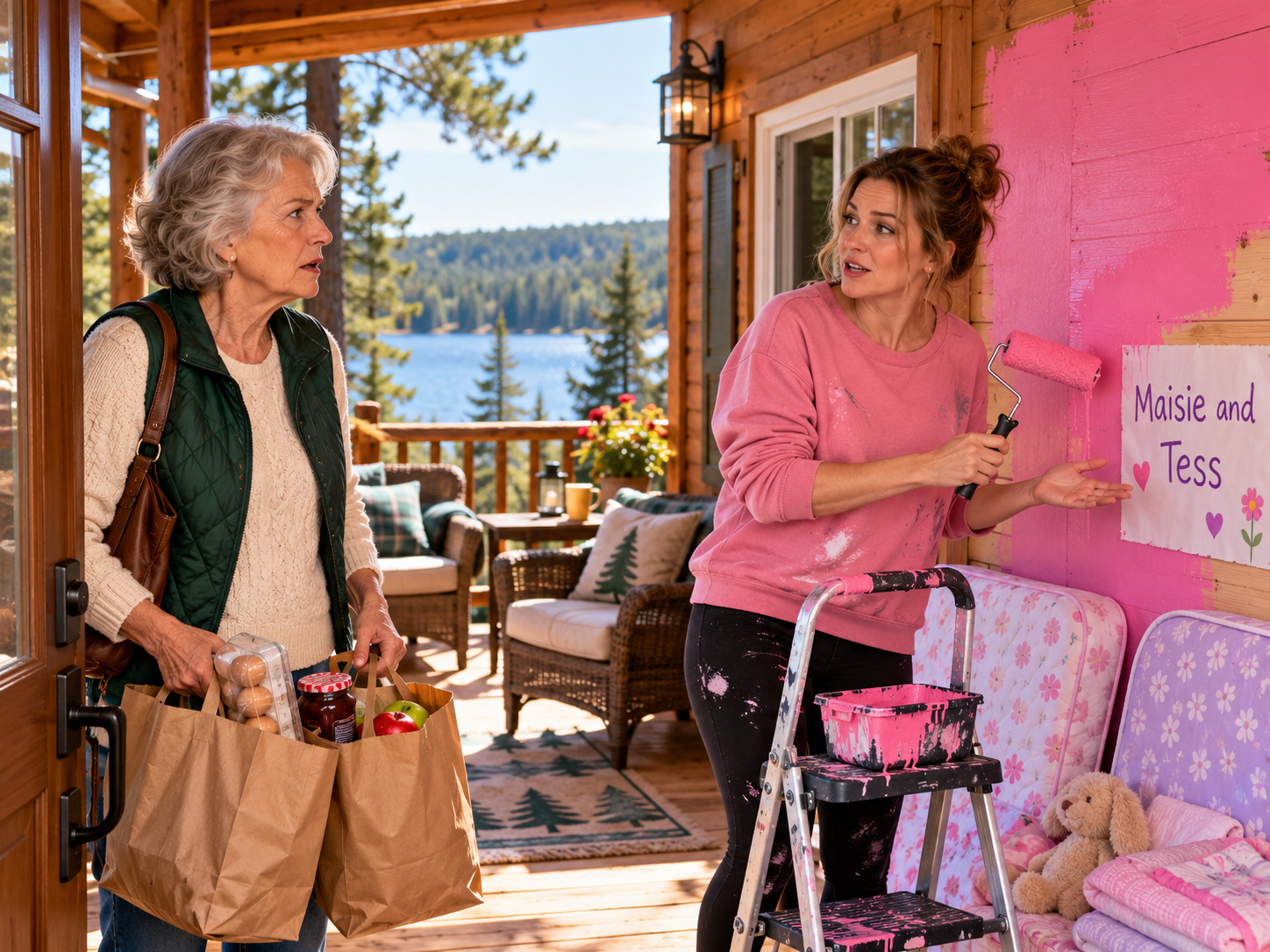
’s pink paint, though the carpenter had done his best to restore the wood. I had decided to leave the remaining marks alone. They reminded me that a beautiful place could be damaged without being lost, and that repair did not always mean making something look as if nothing had happened.
Tanya’s letter was two pages long. She did not ask for another chance, mention the girls, or explain how difficult things had been for her and Brian. Instead, she wrote about the afternoon she had arrived at the cabin with a can of pink paint, convinced that once the porch looked different, the rest of the arrangement would become easier to accept. She admitted that she had treated my refusal as a temporary obstacle rather than an answer.
I told myself we were trying to solve a family problem, she wrote. That made it easier to pretend what I was doing wasn't wrong. I knew you had said no. I knew the key wasn't mine to use. I did it anyway because I thought the practical details would matter more to you once the plan was already underway.
I read those lines twice. They were not pleasant to read, but they were honest in a way her first explanations had not been. She was no longer claiming that she had misunderstood me. She was acknowledging that she had understood and decided my answer could be overridden.
The next paragraph concerned the girls. Tanya wrote that she had told Maisie and Tess about the cabin before Brian had corrected the story, allowing them to imagine bedrooms, mornings by the lake, and a porch where they could paint little wooden signs. She had thought she was giving them something to look forward to. Instead, she had involved them in a decision that was never hers to make.
I'm sorry I made you the person who had to disappoint them, she wrote. You shouldn't have been put in that position.
That sentence hurt more than the others because it named something I had struggled to explain. I loved my granddaughters. I wanted them to have happy memories of the lake, and I would have gladly made room for their laughter on weekends when I chose to invite them. But loving them did not mean surrendering the home I had worked thirty-five years to afford. Their disappointment could not be allowed to become a weapon, even an unintentional one.
Tanya ended the letter by saying she understood why I had changed the locks and installed the cameras. She would not ask me to remove them, and she would not expect me to hand Brian a spare key simply because the family relationship had improved. She wanted to earn whatever trust might be possible, but she knew I had no obligation to promise it.
There was no request for forgiveness at the bottom of the page. Only her signature.
I folded the letter along its original creases and placed it in the wooden box with Walt’s letter. The two notes were different in every way, yet both belonged there. Walt’s had helped me understand that I could care for my family without giving away the right to direct my own life. Tanya’s reminded me that other people could begin to understand that lesson, too, even if they had once resisted it.
I did not call her. I did not send a message assuring her that everything was fine, because everything was not fine yet. But I also did not feel the familiar urge to punish her with silence. I could let the letter stand on its own, the way she had asked me to.
By noon, I had swept the porch, checked the weather stripping around the back door, and walked down to the water. A cool breeze moved across Birch Lake, disturbing the reflection of the trees. I watched a pair of ducks disappear around the reeds and felt the quiet settle over me without having to defend it.
For the first time in months, I could think about my family without immediately preparing for the next argument.
That evening, Brian sent a text asking whether I had received Tanya’s envelope. I answered that I had. He replied that she had wanted to apologize without making me responsible for reassuring her, and that he hoped I would take whatever time I needed.
I wrote back, I appreciate that. Please tell her I read it.
He sent a simple thank-you. There was no follow-up question, no suggestion that I should invite them back soon, and no attempt to turn the exchange into proof that the past had been settled. I put my phone away and returned to the book I had been reading.
It was a small interaction, almost too ordinary to remember. Yet I did remember it, because boundaries were not established only in dramatic confrontations. They were built in these quiet moments when someone could accept an answer without trying to improve it for their own benefit.
Over the next two weeks, life continued in the ordinary way. I drove to Rockford for groceries, called an old nursing colleague about a retirement luncheon, and spent a rainy afternoon reorganizing the cupboards in the cabin. The financial problems Brian and Tanya had been facing did not disappear. They still had bills, school expenses, and the furnace payments they were managing. But they were handling those things themselves, making decisions based on what they could afford instead of building plans around money or space they had no right to claim.
Brian occasionally sent me updates, but he no longer presented every difficulty as a problem I could solve. When he mentioned that the girls’ school was organizing a fall fundraiser, he told me they had decided to contribute a small amount and volunteer for an afternoon. He did not ask me to cover the difference between what they wanted to give and what their budget allowed.
I found myself smiling at that message. Not because I wanted credit for their progress, but because it meant the work of changing their habits was taking place when I was not watching.
On the third Sunday of November, Brian called to ask whether the girls could send me something they had made at school. He explained that the teacher had encouraged them to write about a place where they felt peaceful. Maisie had chosen the lake cabin, although she had never stayed overnight there. Tess had drawn the porch and the trees.
“They want to mail it,” he said. “I told them to ask you first, since it’s your home and they shouldn’t assume.”
“You can tell them I would love to receive it,” I said.
His pause was brief, but I heard the relief in it. “I’ll let them know.”
When the envelope arrived several days later, it contained two drawings and a note written in uneven pencil. Maisie had drawn the cabin with brown walls and a blue lake, adding a yellow sun above the roof. Tess had drawn the porch, the chairs, and a little table with four cups. She had included herself and her sister on the steps, but she had drawn me inside the porch doorway, holding a mug.
At the bottom, she had written, Grandma, thank you for letting us visit. We know we have to ask.
I pinned the pictures above the small desk in the loft. They were not promises, and they did not prove that everyone had changed forever. They were simply two children learning something important while the adults around them learned it again.
That night, I stood at the porch window and looked at the dark water. I thought about the cabin I had bought in secret, the money I had saved, and the years I had spent telling myself that retirement would begin when I finally reached a place where nobody needed anything from me.
I had been wrong about one thing. Peace did not require a life without other people. It required a life in which love did not automatically mean surrender.
I turned off the kitchen light and checked the door locks before bed. The cameras remained where the technician had installed them. I no longer checked their recordings compulsively, but I was grateful they were there. Security did not mean I expected everyone to betray me. It meant I had stopped treating trust as a substitute for sensible precautions.
When I woke the next morning, the cabin was quiet, the cedar porch was brown, and the lake was waiting beyond the glass.
For once, nothing needed to be decided before breakfast.
Click here to continue reading: PART 14: When Brian Asked Me to Help With a Family Decision, I Discovered Whether He Had Finally Learned the Difference Between Advice and Permission
I Bought the Cabin for Peace, but My Daughter-in-Law Had Already Decided Which Parts of My Life She Could Take
Part 13 of 20

