The following Monday, my mother called before sunrise.
I watched her name appear on the screen.
I did not answer.
A minute later, she called again.
Then came a text.
Please call me. This has gone too far.
I made coffee before responding.
Mom: What has gone too far?
Her reply came almost immediately.
Mom: The lawyer. The notices. The way you're treating us.
Me: You told twenty people I agreed to something I explicitly refused.
There was a long pause.
Mom: I thought you would come around.
I stared at that sentence.
Not I misunderstood.
Not I didn't hear you.
I thought you would come around.
That explained everything.
My no had never been treated as an answer.
It had been treated as the first stage of negotiation.
I called my attorney.
She read the messages.
“Save everything.”
“I am.”
“Don't argue with them.”
“I won't.”
“And don't let them pull you into defending every decision you've made since childhood.”
I smiled despite myself.
“That sounds specific.”
“Family property disputes are rarely about property alone.”
She was right.
The lake house was simply where the old argument had finally become visible.
My parents believed that because they were my parents, they were entitled to access.
Because they had raised me, they believed they were entitled to obedience.
Because I had once given them permission, they believed permission lasted indefinitely.
Because I had forgiven previous boundary violations, they believed forgiveness meant permanent access.
That was the part I needed to change.
I called Mrs. Harper at the lake house.
“Everything quiet?”
“Very.”
“Anyone come by?”
“Your mother drove past yesterday.”
I sat straighter.
“Did she stop?”
“No.”
“Are you sure?”
“She slowed down.”
“Did she enter?”
“No.”
Mrs. Harper paused.
“Claire?”
“Yes?”
“Your father called me.”
My stomach tightened.
“What did he say?”
“He asked whether I'd seen you.”
“What did you tell him?”
“That I had.”
“And?”
“That I wouldn't discuss your private business.”
I exhaled.
“Thank you.”
She laughed softly.
“I'm an old woman, not a fool.”
The next weekend, I drove to the lake house.
I needed to see it myself.
The road through the trees was damp from recent rain. The farther I went, the quieter everything became.
When the house came into view, something in my chest loosened.
The porch looked exactly as it should.
The lake was gray-blue beneath a cloudy sky.
The dock shifted gently against the water.
I parked and checked the locks.
Everything was secure.
Inside, the refrigerator hummed.
The rooms smelled faintly of cedar and the lemon cleaner I used before leaving.
I stood in the kitchen and remembered the night I bought the house.
I had been exhausted.
I had worked six years of double shifts.
I had lived with roommates who treated my groceries like community property.
I had eaten dinner standing at the sink because sitting down felt like losing time.
When I finally signed the closing documents, I cried in the parking lot.
Not because I owned a second home.
Because nobody could tell me I had not earned it.
I walked to the bedroom.
The bed was made.
The curtains were open.
Sunlight moved across the floor.
This was why I had bought the house.
Not for parties.
Not for status.
For quiet.
I opened the desk drawer and found the original closing documents.
The deed.
The mortgage.
The insurance papers.
Everything was still there.
I touched the deed.
My name looked strangely simple on the page.
Claire Bennett.
No family name beneath it.
No permission line.
No conditions.
Just ownership.
My phone rang.
Dad.
I answered this time.
“I’m at the lake house.”
“I know.”
I looked toward the window.
“How?”
“Your mother saw your car.”
I almost smiled.
“You were watching for me?”
“We're your parents.”
“That doesn't answer the question.”
He ignored it.
“Can we talk?”
“We're talking.”
“Not like this.”
“What do you want?”
“I want to explain.”
I sat at the kitchen table.
“Okay.”
He took a breath.
“Your mother thought you would eventually agree.”
“I know.”
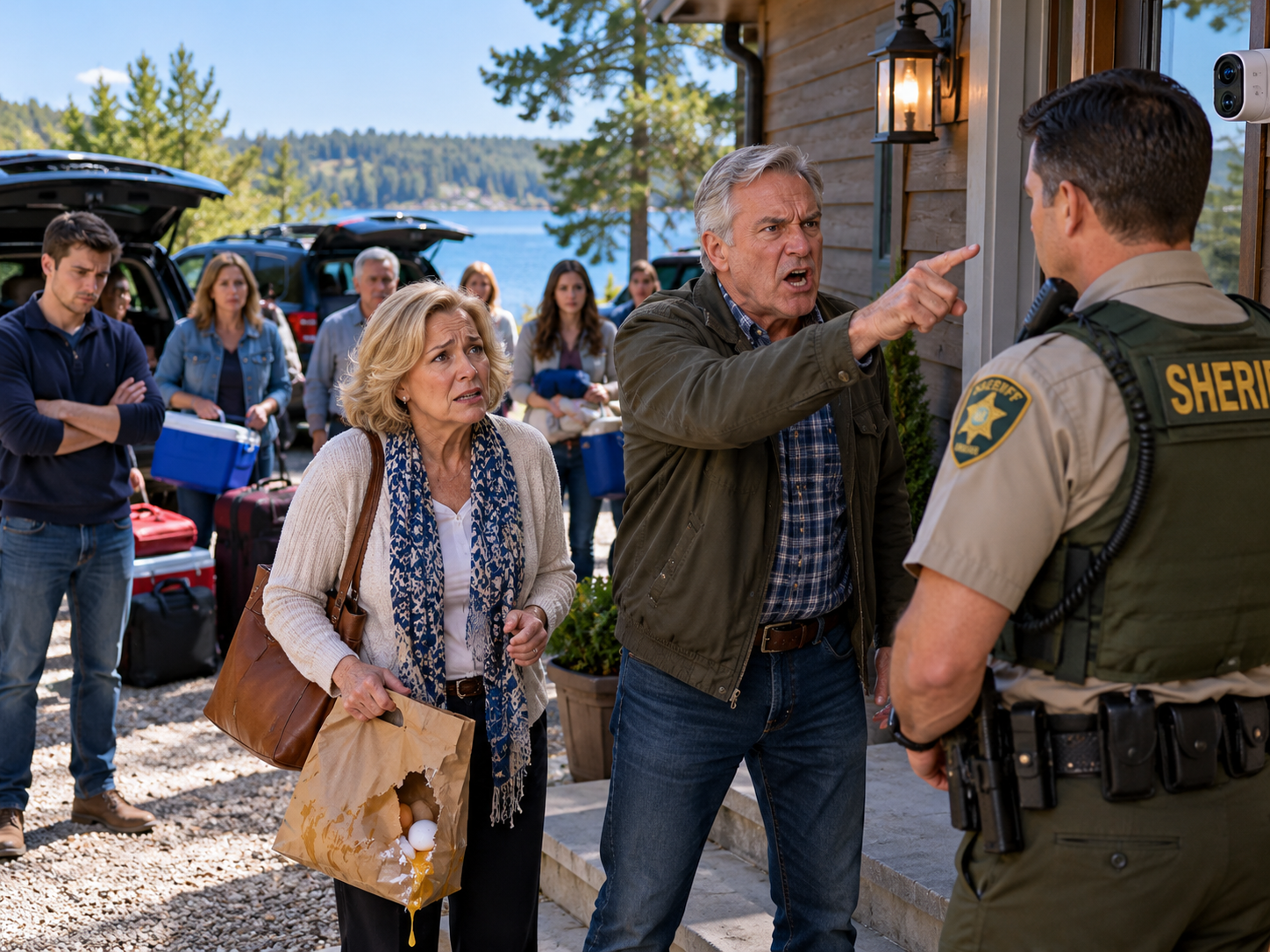
“She didn't expect the sheriff.”
“She shouldn't have brought twenty people after I said no.”
“I know.”
That surprised me.
I waited.
“I should have stopped it,” he said.
I looked at the lake.
“What?”
“I should have told your mother to cancel the weekend.”
“You knew I said no?”
“Yes.”
My stomach tightened.
“When?”
“Thursday night.”
“Before everyone arrived?”
“Yes.”
“Then why didn't you stop them?”
He was quiet.
Finally he said, “Because I thought you would give in.”
The honesty hurt more than the excuse.
“You knew.”
“Yes.”
“And you came anyway.”
“I did.”
“Why?”
“Because I didn't believe you would actually shut us out.”
I closed my eyes.
There it was.
The entire problem in one sentence.
He had not believed my boundary was real.
“I need you to understand something,” I said.
“What?”
“When I say no, I am not asking you to test me.”
“I understand.”
“No. I don't think you do.”
He was silent.
I continued.
“I love you. That doesn't give you ownership of me.”
His breathing became uneven.
“You're still my daughter.”
“I know.”
“And we're still your parents.”
“I know.”
“Then there should be room for family.”
“There is.”
“Where?”
“In my life.”
“And the house?”
“In my life too.”
He sighed.
“You're making everything conditional.”
“No. I'm making it consensual.”
He did not answer.
We stayed on the phone in silence.
Then he said, “Your mother thinks you've been selfish for years.”
“I know.”
“She says you think you're better than us.”
“I don't.”
“She says you've always been distant.”
I looked around the room.
“I learned distance because closeness kept becoming obligation.”
He said nothing.
I knew the sentence had landed.
After we ended the call, I sat alone for a long time.
I expected to feel victorious.
I didn't.
I felt sad.
Because my father had finally admitted the truth.
They had not misunderstood me.
They had underestimated me.
The distinction mattered.
That evening, Mom arrived.
I saw her vehicle on the security camera before she reached the porch.
She stopped at the bottom of the steps.
She did not try the door.
She looked toward the camera.
“Claire?”
I pressed the intercom.
“Yes.”
“Can I come in?”
I stared at the screen.
It was the first time she had asked.
I almost opened the door.
Then I remembered something.
Permission did not have to be automatic simply because someone finally requested it.
“Not tonight,” I said.
She nodded.
Her shoulders lowered.
“Okay.”
She walked back to her car.
I watched until she left.
For the first time, saying no did not feel like punishment.
It felt like a decision.
The next morning, I received an email from Mom.
There was no accusation.
No mention of money.
No complaint about the sheriff.
Just three sentences.
I didn't understand that your no was real. I do now. I'm sorry I taught you that it wasn't.
I read it several times.
Then I printed it.
Not because I wanted evidence.
Because I wanted to remember that sometimes people could change after a boundary became real.
I put the letter in the same folder as the deed.
Not together as equals.
But side by side.
One documented ownership.
The other acknowledged it.
Click here to continue reading: PART 4: By the Time the Lake House Became Quiet Again, I Had Learned That Protecting My Home Was Only the First Step Toward Taking Back My Life
Twenty People Arrived Expecting a Welcome, but My Locked Door and One Quiet Phone Call Forced My Parents to Face a Problem They Had Never Expected
Part 3 of 20